
Fokuse FKS-1001
4.9Editor score
Ten-needle multi-color production
Compact 14.2 by 9.5-inch area
Wi-Fi USB and LAN transfers
A commercial embroidery machine should do more than produce attractive stitches. It should handle repeated color changes, cap frames, oversized designs, varied fabrics, and long production days with repeatable placement. Needle count, working area, speed, controls, support, and included accessories all influence whether a machine suits a home studio or growing business.
This guide compares ten multi-needle commercial embroidery machines using the published product information for each model. The comparison covers embroidery area, needle configuration, claimed speeds, cap capability, touchscreen workflow, file transfer, software, accessories, and technical support, helping readers identify the machine that matches their production priorities.
Each review explains the most useful strengths and the trade-offs visible in the available specifications. The top selections represent the strongest options for different priorities, including overall versatility, large-area production, and entry-level value. Product availability, configurations, and prices can change, so readers should confirm current details before purchasing.
4.9Editor score

5.0Editor score

5.0Editor score
As an Amazon Associate we earn from qualifying purchases.
The table below places all ten machines side by side, emphasizing needle count, embroidery area, operating speed, and the principal production application. It provides a quick structural comparison before the detailed reviews evaluate workflow, support, accessories, and practical trade-offs.


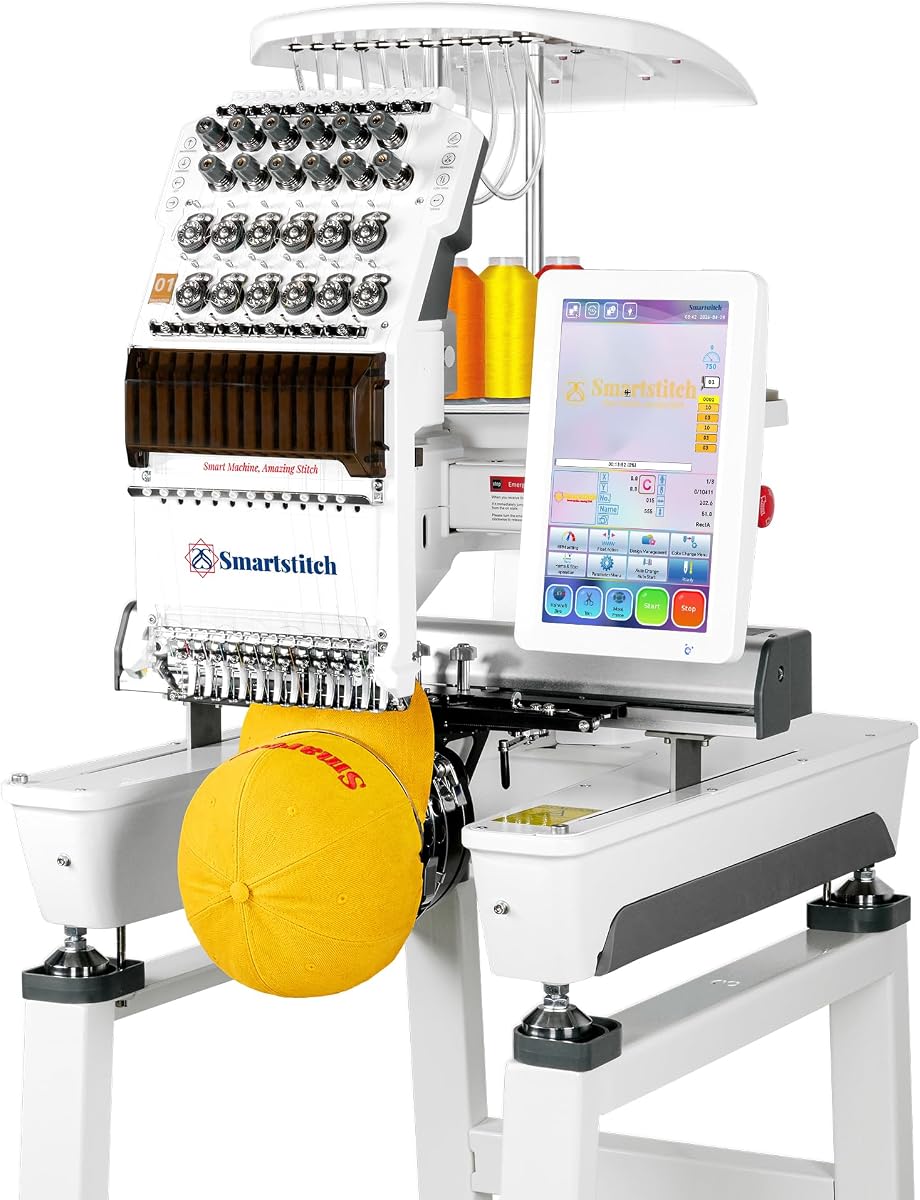


The Smartstitch S-1001 combines a ten-needle configuration with a 9.5-by-14.2-inch working area and a claimed maximum speed of 1,200 stitches per minute. Its 4.8 rating and broad list of automation features make it a practical option for apparel, hats, bags, and other commercial jobs without moving to a very large industrial installation.
We may earn a commission when you buy through this link, at no additional cost to you.
Automatic color changing and thread trimming reduce the manual interruptions that make a single-needle machine inefficient on multicolor logos. Thread-break detection, a self-lubricating system, laser positioning, and physical control buttons support dependable production and easier operation. USB and Wi-Fi transfers allow supported DST and DSB designs to move from a computer to the machine.
The main compromise is capacity rather than fundamentals. Ten needles can handle many practical designs, but a 15-needle machine can hold more colors without changing threads. The 9.5-by-14.2-inch field also requires more rehooping for large back prints and broad garment panels than the 20-by-14-inch or 24-by-16-inch alternatives in this list.
This is a strong recommendation for a new business that wants several needles, automatic production features, and training support in a relatively compact package. Buyers producing frequent multicolor apparel or smaller caps may prefer a 15-needle option, while operators whose layouts fit within 14.2 by 9.5 inches will find the S-1001 especially versatile.
Automatic thread trimming, color changing, and break detection are particularly valuable when identical orders are stitched in batches. These functions reduce idle handling while helping the operator focus on placement, thread tension, and garment preparation.
The listed package includes operation manuals, video training, online assistance, and local technical support. That combination can make the transition from home embroidery to a multi-needle workflow less intimidating, although setup and tension practice remain essential.
We may earn a commission when you buy through this link, at no additional cost to you.
BAI The Mirror is positioned as a production-oriented machine with 15 needles, a 20-by-14-inch embroidery area, and a 4.8 rating. Its published performance reaches 1,200 stitches per minute on flat work and 850 stitches per minute on caps, making it a strong candidate for shops balancing apparel, patches, uniforms, logos, and structured hats.
We may earn a commission when you buy through this link, at no additional cost to you.
The Institch OS5 touchscreen provides guided setup, design editing, hoop or frame selection, and output controls. Its 1-to-3-step guidance may particularly appeal to operators moving into commercial production. Fifteen needles reduce the frequency of thread changes, while the large field can accommodate jacket backs, hoodies, bags, and oversized logos with fewer rehooping operations.
Its size and production positioning are the main considerations. A 20-by-14-inch area demands more workspace than compact ten-needle alternatives, and buyers should account for table or stand requirements before installation. The product information emphasizes durable construction and brand-name components but provides fewer detailed memory specifications than some competing listings.
The Mirror is well suited to entrepreneurs, custom apparel sellers, and established shops that want a large working area with a guided operating system. It is less convincing for users whose orders consist almost entirely of small logos or who need the largest oversized-design capability in this group. For broad production versatility, however, its feature set is well balanced.
Fifteen needles allow operators to preload a broader palette than ten-needle models. This is useful for team logos, uniforms, layered graphics, and other jobs where frequent color changes would otherwise create avoidable production delays.
Published speeds of 1,200 SPM for flat work and 850 SPM for caps acknowledge the different demands of garments and structured headwear. The dedicated cap performance figure also gives buyers a clearer basis for comparison than a single headline speed.
We may earn a commission when you buy through this link, at no additional cost to you.
The Smartstitch S-1201 Plus sits between the ten-needle S-1001 and the larger 15-needle Smartstitch models. It offers a 12-by-16-inch area, a ten-inch touchscreen, 12 needles, and a stated maximum speed of 1,200 stitches per minute. The 4.8 rating reinforces its appeal as a capable general-purpose commercial machine.
We may earn a commission when you buy through this link, at no additional cost to you.
Its direct vertical guiding system is presented as a way to improve operating stability and reduce noise. Automatic thread trimming, automatic color changing, self-lubrication, thread-break detection, laser positioning, and physical buttons address several common production tasks. The Smart Control System V7 supports up to 100 million stitches of memory, a useful feature for operators who keep many repeat jobs.
The 12-needle count sits below the 15 available in many competing machines. That difference matters for logos using more than 12 colors without threading changes. Its 12-by-16-inch field is also smaller than the 20-by-14-inch, 20-by-16-inch, and 24-by-16-inch alternatives, although it offers more room than the compact S-1001.
This model is a compelling middle ground for a small commercial shop that wants a larger screen and more working area than a ten-needle compact machine. It is best suited to multicolor apparel, caps, bags, and medium-sized panels, while buyers needing maximum color capacity or unusually large back designs should step up to a 15-needle configuration.
The ten-inch display provides more room for file selection, layout work, and machine control than a seven-inch screen. That extra visible area can reduce navigation effort, especially for operators who are still learning color sequencing and hoop settings.
The direct vertical guiding system is highlighted for stability and lower noise. While published specifications cannot guarantee stitch quality on every fabric, the design indicates attention to smooth movement and repeatable production.
We may earn a commission when you buy through this link, at no additional cost to you.
The Poolin EOX combines a 5.0 rating with a 15-needle configuration and a 20-by-14-inch embroidery area. Published speeds reach 1,200 stitches per minute on flat work and 850 stitches per minute on caps, while the 270-degree cap system supports front, side, and back placement as well as 3D puff designs.
We may earn a commission when you buy through this link, at no additional cost to you.
Its nine-inch touchscreen runs the InStitch OS4 interface, and supported DST and DSB files can be transferred wirelessly or by USB. Automatic color changes, thread trimming, and laser positioning reduce repetitive work. The listed InStitch software ecosystem also includes digitizing, cloud project storage, pattern browsing, and Doodle Digitizing tools for converting artwork into stitch-ready files.
The 270-degree cap system is a major attraction for hat businesses, but the machine’s size and capabilities also demand adequate workspace and operator training. The listing states that the EOX arrives with a dedicated stand and embroidery supplies, reducing the need to source basic setup items separately. Buyers should still verify stand dimensions, local electrical requirements, and service arrangements before purchase.
This is our leading general recommendation because it combines multi-needle efficiency, a genuinely large field, advanced cap support, flexible transfers, and a strong digital workflow. It suits growing shops that produce caps, hoodies, jackets, workwear, bags, towels, and other varied orders. For buyers whose workload is primarily small garments, the additional capacity may be more than necessary.
The 270-degree system extends beyond a simple front-cap setup to support side and back embroidery. That versatility can help hat businesses accept more complex orders without changing to a separate production process for each placement.
Wireless transfer, USB connectivity, cloud project handling, and built-in digitizing tools connect artwork preparation with machine production. These features can shorten the path from a customer file to an organized, stitch-ready job.
We may earn a commission when you buy through this link, at no additional cost to you.
The Poolin EOM offers 15 needles within a 14.2-by-9.5-inch working area. It targets single-needle owners, home studios, and small businesses seeking multi-color production without the footprint of a larger industrial system. Its 4.6 rating reflects a capable product that balances needle capacity with a more manageable embroidery field.
We may earn a commission when you buy through this link, at no additional cost to you.
Automatic color changing, thread trimming, and thread-break detection keep multi-color work moving, while flat speeds reach 1,200 stitches per minute. The wide-angle cap system supports front, side, and back positions at speeds up to 850 stitches per minute. A nine-inch InStitch OS4 touchscreen, Wi-Fi, and USB transfers support files in supported DST and DSB formats.
The main limitation is rehooping. A 14.2-by-9.5-inch field is suitable for everyday logos, polos, uniforms, hoodies, bags, towels, and patches, but it cannot handle the broadest panels without additional positioning steps. Its bundled ecosystem is unusually complete, including InStitch digitizing, cloud storage, artwork conversion, and an integrated material-use cost-estimation tool.
The EOM is a strong fit for small shops that produce lots of multicolored orders but do not routinely embroider large back panels or oversized logos. Its 15-needle capacity and included accessories make it a credible bridge from single-needle equipment to serious commercial production.
The EOM prioritizes color capacity over the largest possible field. That makes it useful for compact production rooms where efficient thread management matters more than completing oversized designs in a single hoop.
The integrated cost-estimation tool can help operators estimate material use and price custom orders. Digitizing, cloud storage, and file conversion expand the system beyond needle placement into everyday business administration.
We may earn a commission when you buy through this link, at no additional cost to you.
The Smartstitch S-1501 combines 15 needles, a 14-by-20-inch area, a 12-inch touchscreen, and a maximum claimed speed of 1,200 stitches per minute. Its 4.7 rating and long list of automatic features position it as a traditional, broad-production option for apparel, flat work, and caps.
We may earn a commission when you buy through this link, at no additional cost to you.
The 270-degree wide-angle cap system supports structured cap placement, while automatic color changes and laser positioning improve repeatability. Supported DST and DSB files can be sent through USB or Wi-Fi, and the machine accepts denim, canvas, leather, vinyl, caps, shoes, bags, and other industrial-compatible materials.
Its dimensions and broad capability make space planning important. The field is well suited to larger garment sections, but not as expansive as the S-1501 Plus Beast. Buyers should also verify the precise Wi-Fi arrangement for their location and model configuration. As with the other Smartstitch machines, retaining the pallet and packaging for the initial period helps support a future return.
This model is a sensible choice for a new or expanding business seeking a traditional 15-needle configuration, a large display, and a generous working area without moving to the most specialized oversized machine. It works particularly well for mixed-order shops handling apparel, bags, shoes, and hats.
The combination supports multicolor designs and larger panels without moving to an oversized format. That balance is useful for shops that want one machine for several product categories rather than specializing exclusively in caps or small logos.
The 12-inch screen gives operators a generous view of design selection and machine settings. It is particularly valuable when switching among garment hoops, cap frames, and designs with multiple colors.
We may earn a commission when you buy through this link, at no additional cost to you.
The Smartstitch S-1501 Plus Beast stands apart with a 24-by-16-inch embroidery area, 15 needles, a 12-inch touchscreen, and a 5.0 rating. It is designed for buyers who need to complete unusually large designs in fewer positions and want one commercial machine to cover apparel, caps, quilting, appliqué, home textiles, and decorative work.
We may earn a commission when you buy through this link, at no additional cost to you.
The product information highlights an upgraded cap driver made with reinforced nylon and carbon fiber, a raised needle plate, a rotating trimming system without a picker, direct vertical guidance, and a 270-degree cap rotation. These details indicate a focus on cap stability, smooth operation, and reduced noise. Automatic color changes, self-lubrication, thread-break detection, laser positioning, and Smart Control System V6 round out the production features.
Its extraordinary working area is the main draw and the main logistical challenge. Users need adequate room for the head, frame movement, operator access, and garment handling. The extensive application list also makes the machine more complex than a general-purpose unit, so training and process planning remain important even when using supported DST or DSB files.
This is the premium choice for specialty shops, quilters, custom home-textile businesses, and apparel operators producing large back panels. For small logos and compact garment orders, much of its capability would go unused. Those who can use the 24-by-16-inch field and value fewer rehooping steps will gain the most from this configuration.
The 24-by-16-inch field allows wide jacket backs, tablecloths, bed sheets, rugs, picture embroidery, and oversized logos to be handled with fewer rehoops. That can improve consistency when positioning must be repeated across several pieces.
Reinforced nylon and carbon fiber in the cap driver, a raised needle plate, and vertical guidance collectively suggest attention to stability and smooth cap rotation. These features make the machine especially relevant to headwear specialists.
We may earn a commission when you buy through this link, at no additional cost to you.
The Poolin PEM150101 pairs 15 needles with a 20-by-14-inch embroidery area, a 10-inch touchscreen, and the InStitch OS5 system. Its 4.6 rating and industrial-style construction target operators who want a stable, multi-product machine for hats, sleeves, pockets, backpacks, finished garments, and larger apparel pieces.
We may earn a commission when you buy through this link, at no additional cost to you.
A heavy-duty cast aluminum frame and reinforced steel structure underpin the listed maximum speed of 1,200 stitches per minute. The machine supports stitching from 1-millimeter details through 9-millimeter satin stitches, while the 270-degree cap system focuses on smoother structured-cap rotation and visibility. Automatic color changes and thread trimming appear in the broader Poolin multi-needle feature set, although they are not emphasized as prominently in this listing.
Wi-Fi and USB transfers work with supported DST and DSB files through Institch Cloud software. Eleven hoops are included, which provides useful coverage for hats, shirts, patches, shoes, and garments. The substantial frame may be difficult to relocate after installation, so buyers should confirm floor area, ceiling clearance, and workbench compatibility before ordering.
The PEM150101 is well suited to a shop that handles many product types and values mechanical stability. Its 20-by-14-inch field supports substantial designs, while 15 needles reduce thread changes. The availability of a free live video demo and engineer support adds confidence for buyers who want to observe operation before committing to a production machine.
The cast aluminum frame and reinforced steel structure are intended to control vibration during high-speed operation. That emphasis is especially relevant when moving between delicate lettering, dense fills, and bold satin stitches.
Eleven included hoops cover several common production categories. A broad starter selection can reduce the need to purchase frames immediately, while the 20-by-14-inch maximum field supports larger jacket and hoodie designs.
We may earn a commission when you buy through this link, at no additional cost to you.
BAI The Vision is engineered around sustained commercial output, with 15 needles, a 20-by-16-inch embroidery area, and a claimed maximum speed of 1,200 stitches per minute. Its 4.6 rating reflects a production machine aimed at owners who value stable stitching, mechanical durability, and business-management tools over a minimal purchase.
We may earn a commission when you buy through this link, at no additional cost to you.
The welded frame is designed to minimize vibration, while German belts and Swedish bearings are highlighted for smooth motion, reduced noise, and lower wear. The machine reaches up to 950 stitches per minute on structured caps. That separate cap figure distinguishes it from listings that provide only a general maximum speed and makes its headwear capability easier to assess.
Institch OS5, a ten-inch touchscreen, and up to 100 million stitches or 1,000 designs of memory support large production libraries. The software platform includes Wi-Fi transfer, cloud file management, cost calculations for labor, rent, materials, and presets, plus Doodle digitizing software. These capabilities are valuable for owners who need to quote work and manage recurring jobs efficiently.
The Vision is suited to established or growth-focused operations that will use the large field, advanced costing tools, and high-volume workflows. It is also the most expensive model in this comparison, so the investment should be matched to meaningful order volume. Operators should take advantage of the stated training and technical support before beginning unattended production.
Welded construction, premium belts and bearings, and simple oil-point maintenance indicate an emphasis on serviceability. For a business machine, stable long-term performance can be more valuable than adding another marginal software convenience.
Cost tools that account for labor, rent, materials, and presets can make job pricing more consistent. Cloud storage and centralized file management also help operators organize recurring logos, uniforms, and customer artwork.
We may earn a commission when you buy through this link, at no additional cost to you.
The Fokuse FKS-1001 is a budget-oriented commercial embroidery machine with 10 needles, a 14.2-by-9.5-inch embroidery area, and a claimed maximum speed of 1,200 stitches per minute. Its 4.9 rating is the highest among the ten-needle options in the group, making it a compelling entry point for buyers building toward production.
We may earn a commission when you buy through this link, at no additional cost to you.
Automatic color changes, thread trimming, broken-thread alarms, laser positioning, LED lighting, and anti-collision protection provide a useful operating foundation. Supported DST and DSB files can be transferred through USB, Wi-Fi, or LAN. Built-in 29-font monogram templates and graffiti-style options make the machine approachable for personalized gifts, simple logos, and home projects.
Its compact working area means more rehooping for wide back prints, jackets, and large totes. The seven-inch touchscreen is also smaller than the displays offered by most 15-needle rivals. The starter kit includes a stand, toolbox, bobbin winder, four garment hoops, cap rings, a cap driver, and a frame holder, providing essential setup items in one package.
This machine is best for new operators, home-based businesses, and small studios that want to move beyond single-needle embroidery without committing to the largest footprint. Users who eventually need more colors, a larger screen, or wider designs can plan an upgrade, but for compact multicolor work the FKS-1001 delivers an attractive set of core features.
Built-in lettering templates reduce the need to digitize every simple personalized design from the beginning. The machine can therefore be used for learning, samples, gifts, and straightforward commercial jobs while the operator develops broader skills.
USB, Wi-Fi, and LAN compatibility provide several ways to move supported design files. That flexibility can simplify integration with different computers and production routines, although current network compatibility should be verified before installation.
We may earn a commission when you buy through this link, at no additional cost to you.
Choosing a commercial embroidery machine means balancing production volume, color count, design dimensions, cap requirements, operator experience, and available workspace. The most useful purchase is not necessarily the machine with the longest specification list; it is the one whose strengths align with the products and files your business actually produces.
The usable embroidery area determines the maximum width and height of a design that can be completed in one setup. A 14.2-by-9.5-inch field works well for typical chest logos, smaller garment sections, caps, patches, and bags, but larger jacket backs or hoodie panels may require repositioning. The 20-by-14-inch and 20-by-16-inch machines offer more freedom for oversized logos, while the Smartstitch S-1501 Plus Beast provides the largest field at 24 by 16 inches.
Choose an area that fits most of your typical orders without making the machine unnecessarily difficult to operate. More space is useful, but it also increases physical requirements and can make garment handling more demanding.
Needle count controls how many thread colors can be loaded at once. A 10-needle machine can handle many common multicolor logos while reducing manual rethreading compared with a single-needle unit. A 12-needle configuration adds some flexibility, while 15 needles are better for team apparel, uniforms, layered graphics, and other designs with extensive palettes.
For most growing shops, 15 needles offer the most flexible production standard in this group. Ten needles can still be efficient when customer artwork consistently uses fewer colors, so match the configuration to real design requirements rather than the highest available number.
Flat embroidery and structured caps present different mechanical demands. Flat-work speed is useful for garments, towels, patches, bags, and other supported products. Cap performance depends on frame movement, visibility, tension, penetration, and stability, making a separately stated cap speed more informative than a single maximum figure.
The Poolin EOX, BAI The Mirror, and Poolin PEM150101 support 270-degree cap systems, while the Smartstitch S-1501 Plus Beast adds an upgraded cap driver. If caps represent a major share of expected work, prioritize demonstrated cap capability and access to appropriate cap frames.
A maximum speed of 1,200 stitches per minute appears across the field, but the headline number is not the entire performance story. Stable high-speed stitching, even tension, accurate needle positioning, automatic trimming, and effective thread-break detection determine how efficiently orders actually move through the machine.
Compare the published flat and cap speeds where available, then consider the automation around them. A slightly lower headline speed can still produce excellent throughput when setup, color changes, and file handling are well supported.
Seven-inch screens are adequate for basic machine control, while 9-, 10-, and 12-inch displays provide more room for editing, hoop selection, and job review. Institch OS4, Institch OS5, Smart Control System V6, Smart Control System V7, and the Fokuse interface differ in features and learning curve.
Look for clear color sequencing, supported DST and DSB import, direct file transfer, cloud organization, and accessible design editing. New operators may benefit more from guided setup than from a large display, while experienced users may value broader file and project management.
Automatic thread trimming, automatic color changing, thread-break detection, and laser positioning reduce manual work and help maintain consistent placement. These features are particularly important for repeat logos, uniform runs, and small batches where every item should be embroidered in the same location.
Prioritize automation when the business measures production by completed orders rather than by individual sample quality. A well-used trimming and positioning system can save considerable operator time over a full production day.
A commercial machine may arrive with a stand, hoops, cap frames, stabilizers, threads, bobbins, tools, and other setup essentials. The Poolin EOM has one of the most explicitly described accessory bundles, while the Smartstitch models include starter packs with threads and stabilizers, and the Fokuse FKS-1001 includes a stand and basic production components.
Verify what is included rather than assuming every cap station, hoop, stabilizer type, or installation accessory comes in the box. Also plan for workspace, table capacity, electrical requirements, and the physical movement required to position the machine.
Commercial machines have more complex threading, tension adjustment, cap loading, file preparation, and troubleshooting requirements than basic home models. Smartstitch lists manuals, video training, online engineers, and local support; BAI emphasizes training and technical assistance; Poolin offers U.S.-based support and live video demonstrations; Fokuse includes quick-start materials and one-on-one online support.
Choose a seller with support that matches your location and preferred communication method. A live demonstration, structured onboarding, and access to experienced operators can be more valuable than a small collection of extra accessories.
Begin with a clean, stable work area and review the machine’s manual, included training materials, and local support resources before threading or loading a customer order. Install the stand or table as specified, confirm that the machine is level, and inspect the rails, needle bar, thread paths, bobbin area, cap accessories, and frame components. Prepare and digitize the artwork in a supported DST or DSB format, then check stitch settings, hoop choice, garment dimensions, stabilizer, and thread requirements before starting.
For the first run, use a simple design on a prepared sample rather than beginning with a dense multicolor production file. Check needle condition, bobbin tension, upper-thread tension, presser-foot clearance, color sequence, and design placement. Confirm that the fabric is supported correctly and that the hoop, cap frame, or attachment does not contact the machine’s moving components. Once the placement and stitch quality look consistent, reproduce the same setup across a small batch before increasing the order quantity.
Daily care should include clearing thread fragments, checking needles and thread paths, inspecting the bobbin area, and confirming that the rail and drive components are free of debris. Follow the manufacturer’s lubrication, cleaning, and replacement schedules rather than applying oil or solvents beyond the documented instructions. Keep the wooden pallet, accessory boxes, brackets, and fixing hardware intact after unpacking for a reasonable period so the machine can be returned or safely relocated. Back up important design files and preserve embroidery settings for repeat orders.
Ten needles are enough for many multicolor logos and personalized orders, while 15 needles reduce thread changes for complex artwork, uniforms, and layered designs. The correct choice depends on how many colors appear in your typical files. Consider the maximum number of colors in a single design before choosing a needle count.
A larger area lets you finish broader designs with fewer rehoops and can expand the range of garments you decorate. It also requires more space and may make larger materials more difficult to handle. Choose the smallest field that comfortably covers your normal orders rather than assuming the largest option is always the most efficient.
Flat speed describes performance on supported garments and flat goods, while cap speed applies to embroidery on structured headwear. Structured caps require different frame movement, tension, and machine stability. Comparing separate cap and flat figures gives a clearer picture than relying on one maximum stitches-per-minute number.
All ten models offer multiple needle positions and automatic color-changing features, allowing supported designs to move between loaded colors with less manual intervention. Designs requiring more colors than the available needles will still need thread changes. Proper digitizing and color planning remain important even with automatic functions.
Several models use the Institch ecosystem, including OS4, OS5, digitizing tools, cloud storage, and cost-estimation features. Smartstitch machines use Smart Control System V6 or V7, while the Fokuse FKS-1001 includes letter templates and supports common embroidery formats. Exact software entitlements and computer compatibility should be confirmed for the selected model.
Useful support may include manuals, video training, one-on-one online assistance, engineer troubleshooting, live demonstrations, and local service. The listed brands vary in how support is delivered, so buyers should identify their preferred contact method and confirm coverage in their area. Training is especially valuable during setup, threading, tension adjustment, and the first production runs.
Coverage varies by model. The Poolin EOM explicitly lists a cap station, cap hoops, stabilizers, bobbins, threads, and other accessories, while other machines include starter packs with threads and stabilizers. The Fokuse FKS-1001 lists cap rings, a cap driver, hoops, and a stand. Confirm all included parts and identify additional material requirements before ordering.
Prepare a stable table or suitable floor area, check power and room dimensions, and plan how the machine will enter the workspace. Keep the pallet, inner boxes, brackets, and fixing hardware because they may be needed for transport or return. After unpacking, inventory every accessory and follow the manual’s assembly, leveling, threading, and test-stitch procedures.
The Fokuse FKS-1001 is the strongest budget-oriented choice, combining 10 needles, a 4.9 rating, automatic production features, flexible transfers, and a useful starter bundle in a compact format. The Poolin EOX is the editor’s choice for its balanced combination of 15 needles, a 20-by-14-inch field, advanced 270-degree cap support, wireless workflow, and extensive business software. The Smartstitch S-1501 Plus Beast leads the premium group with the largest embroidery area in the list.
For most growing commercial shops, prioritize the products and designs you already produce. Needle count should match your typical color range, embroidery area should match your most common garment panels, and cap capability should reflect the share of headwear in your order mix. Also budget time for training, digitizing, operator practice, maintenance, and the physical space required by the machine.
Specifications and configurations can change, and current pricing should be checked on each product page before buying. Review the included accessories, support terms, file compatibility, workspace dimensions, and return requirements carefully. The right commercial embroidery machine is the one that supports your production workflow reliably and can be operated with confidence every day.