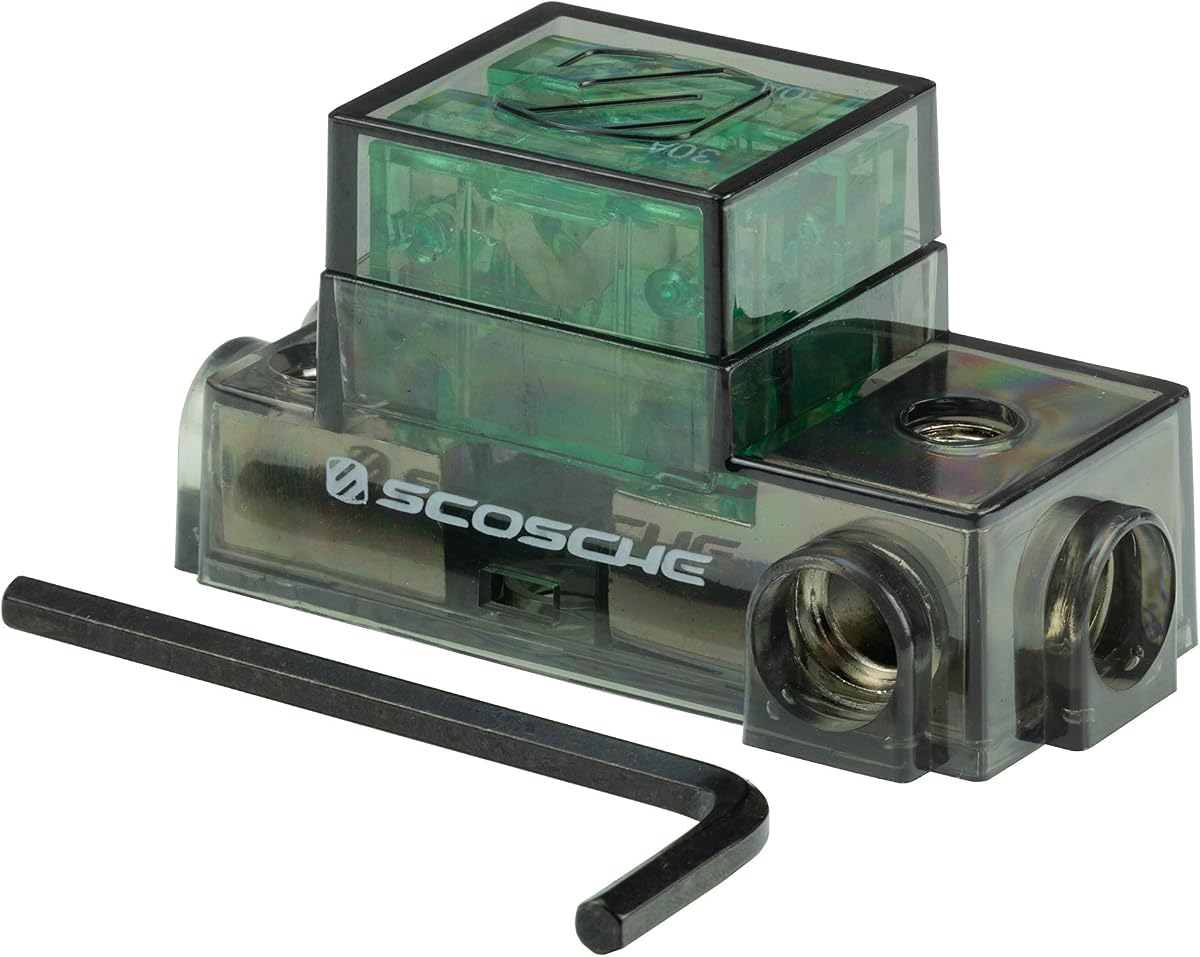
SCOSCHE PDM482A Maxi Fuse Distribution Block
4.6Editor score
One four-gauge input
Dual eight-gauge outputs
Two 30-amp MAXI fuses
Corrosion-resistant finish
Explore the best fuse block for car audio options, comparing capacity, branch count, fuse type, installation ease, and construction quality for safer installs.
A fuse block for car audio organizes high-current power and ground connections while placing appropriately rated fuses close to the equipment they protect. A good model offers secure wire termination, convenient branch access, dependable contact surfaces, and enough capacity for amplifiers, subwoofers, and supporting electrical systems.
The products in this guide were compared by examining their stated fuse ratings, input and output wire accommodations, number of distribution branches, grounding options, housing materials, installation features, and intended applications. The list includes compact single-holder designs, multi-branch distribution blocks, and dual-amplifier grounding and power solutions.
Each review explains the product's strongest attributes, practical limitations, and likely installation fit. Ratings and specifications reflect the supplied listing information, while details can vary between sellers and revisions. Availability and current prices may change, so confirm the latest listing before buying.
4.6Editor score

4.8Editor score

4.7Editor score
The table below compares all ten blocks by their distribution architecture, wire capacity, fuse provision, and construction. These differences determine whether a product is better suited to a simple stereo, a multi-amplifier build, a marine installation, or a high-current auxiliary system.


The Joinfworld 4-Way Mini-ANL Block is a multi-function distribution hub designed to organize both positive and ground wiring in a car-audio installation. Its 4.6 rating reflects a generally favorable buyer response, while its standout feature is the ability to combine power distribution, circuit protection, and grounding in one compact unit. Each pole supports two inputs and four outputs, giving installers meaningful routing flexibility.
We may earn a commission when you buy through this link, at no additional cost to you.
The block accepts 0, 2, or 4 gauge wire at the input and 4, 6, or 8 gauge wire at the outputs. Six mini-ANL fuses are included—two rated at 30 amps, two at 60 amps, and two at 80 amps—so the installer can match branch protection to the demands of different amplifiers and accessories. A red LED indicator illuminates when a fuse blows, making a fault easier to identify without checking every circuit immediately.
Its main tradeoff is complexity. A basic inline holder would be quicker to install and occupy less space, whereas this four-way design requires more branch planning. The indicator system also depends on the included or compatible fuse technology. Buyers should verify that the enclosure, mounting location, and wire-entry directions suit their vehicle before installation.
This is an attractive choice for a growing stereo, multi-amplifier build, or mixed vehicle project where one central hub can handle both power and ground. It is especially useful when the installation needs several protected outputs without creating a collection of separate fuse holders. For installers seeking a broad, adaptable distribution block, it offers one of the strongest feature combinations in this guide.
Using the block for both positive and ground connections can reduce loose terminal clutter and keep the installation easier to inspect. The installer still needs to preserve electrical separation, prevent conductor damage, and mount the unit where terminals and cables remain protected.
The red LED indicators provide a quick visual clue when a protected branch has opened. This is especially helpful in a crowded vehicle cabin, trunk, or marine compartment where tracing every separate fuse would otherwise be inconvenient.
We may earn a commission when you buy through this link, at no additional cost to you.
This three-pack of 300-amp ANL fuse holders is aimed at installers who want separate protected feeds rather than a single consolidated distribution panel. The 4.7 rating indicates strong buyer satisfaction, and the substantial current capacity makes the set relevant to high-output amplifiers, inverters, and other demanding auxiliary circuits.
We may earn a commission when you buy through this link, at no additional cost to you.
Each holder supports 0, 2, or 4 gauge wiring and uses solid-brass construction for stable conductivity. The useful swing-out fuse design means a replacement can be accessed without removing the main fastener. Flame-retardant ABS bases and an insulating layer help protect surrounding components, while the three-unit format allows protected runs to be positioned where each is most accessible.
The tradeoff is that this is a collection of single-position holders rather than a branched distribution block. It does not consolidate multiple output wires at a common terminal or provide a dedicated ground distribution point. Each holder also needs sufficient space, secure mounting, and suitable cable bend radius, so the set may feel less tidy than one multiway block.
The set is best for a car-audio build with several independent high-current feeds, particularly when routing space favors individual protection points. It also gives installers the option to locate each fuse near the branch it protects. For those needs, the package provides an adaptable and straightforward high-current solution.
The swing-out fuse arrangement simplifies routine inspection and replacement because the fuse can be accessed without fully removing the mounting hardware. Clean, secure connections remain essential, so the terminals should still be checked for proper seating.
Three individual holders can be placed near separate circuits, which can be helpful in large vehicles, boats, trailers, and multi-zone installations. This flexibility comes at the cost of a less centralized organization than a single four-way block.
We may earn a commission when you buy through this link, at no additional cost to you.
The RECOIL ZDFGK Fuse Distribution Combo Blocks stand out as a purpose-built solution for dual-amplifier car-audio systems. With a 4.8 rating, they lead the guide's customer feedback, and their combination of a fused power side with a two-way ground block closely matches a common need: organizing two amplifiers without creating a complicated harness.
We may earn a commission when you buy through this link, at no additional cost to you.
The power block accepts one 0, 2, or 4 gauge input and provides two 4 or 8 gauge outputs. The ground side is similarly designed for two amplifier branches, allowing power and return paths to be arranged in one coordinated package. Zinc die-cast construction supports efficient power transfer, while the marine-grade satin chrome finish is intended to resist corrosion in demanding environments.
High-temperature polycarbonate bases and covers provide insulation and physical protection. One limitation is that the block is optimized around a two-amplifier layout; installations with many more branches may need a different architecture. The listed package also does not emphasize included individual branch fuses, so fuse selection and placement may require separate planning or compatible accessory purchases.
This is the most straightforward recommendation for a dual-amplifier build that needs coordinated positive and ground distribution. It is particularly appealing for installers who value metal construction, corrosion-conscious finishing, and a compact purpose-built arrangement. For a single stereo or a very large multi-amp system, one of the four-way Mini-ANL blocks may offer more branch flexibility.
The matched power and ground layouts make it easier to plan two amplifier feeds consistently. Proper polarity, equal cable gauge decisions, and clean terminations remain the installer's responsibility even when the hardware is designed for convenience.
The zinc die-cast body and marine-grade finish are meaningful advantages in humid, exposed, or marine installations. The protective polycarbonate components also help limit accidental contact with conductive surfaces.
We may earn a commission when you buy through this link, at no additional cost to you.
The RECOIL MFH12 is a premium two-way Mini-ANL distribution block built around heavy-duty power transfer and individual branch protection. Its 4.7 rating reflects strong satisfaction, while the inclusion of 60-, 80-, and 100-amp fuses gives installers several starting options for a demanding car-audio or marine electrical system.
We may earn a commission when you buy through this link, at no additional cost to you.
The block takes one 0, 2, or 4 gauge input and offers two 4 or 8 gauge outputs. Its forged and machined brass construction is designed to maximize power transfer, and the marine-grade satin chrome finish adds corrosion resistance. A high-temperature polycarbonate base and cover provide insulation and shield the internal hardware.
Two output branches limit flexibility compared with a four-way block, and the unit does not serve as a combined ground distribution point. Those limitations are reasonable for a focused high-current setup, but less convenient when several amplifiers, sound processors, or accessory circuits need separate protection. The included fuse ratings still need to be chosen against the actual wire and load requirements.
This is an excellent selection for a powerful two-amplifier installation where robust contacts, substantial fuse ratings, and corrosion-conscious finishing matter. It is less appropriate for a basic head-unit system or a project requiring many protected branches. For the right layout, its premium construction and fuse selection provide a convincing balance of protection and focused performance.
The six included fuses cover 60-, 80-, and 100-amp positions, allowing the installer to begin with ratings suited to many substantial audio loads. Protection should still be selected from the specifications of each amplifier, accessory, and cable rather than by appearance alone.
Forged and machined brass is the centerpiece of this block, supporting stable electrical contact in high-current applications. A clean, properly torqued installation helps maintain that advantage and reduces the likelihood of heat buildup at loose terminals.
We may earn a commission when you buy through this link, at no additional cost to you.
The Bolipoeq Four-Way Mini-ANL Block combines a four-way power-and-ground layout with six included fuses and visible failure indicators. Its 4.8 rating places it among the most favorably reviewed products here, and its broad range of vehicle, marine, camper, trailer, RV, UTV, and solar-panel applications makes it a versatile wiring component.
We may earn a commission when you buy through this link, at no additional cost to you.
Each pole accommodates two inputs and four outputs. Input wire can be 0, 2, or 4 gauge, while branch wiring can be 4, 6, or 8 gauge. Each positive-side branch accepts a Mini-ANL fuse, and the package includes two 30-amp, two 60-amp, and two spare 80-amp fuses. Corrosion-resistant plastic, a clear shell, and copper terminals form the core construction.
A red indicator illuminates when a protected fuse blows, allowing quick visual troubleshooting. The indicator behavior depends on the appropriate fuse design, so installers should confirm compatibility if they plan to replace included fuses. The enclosure is also less materially premium than the forged brass and zinc die-cast alternatives, although its transparency makes internal inspection easy.
The box also includes twelve screws and two wrenches, which can reduce the need for extra tools during setup. This block is best for installers who prioritize branch flexibility, visible fault status, and useful included accessories. It is a particularly strong choice for multi-zone car-audio wiring where a single central organization point is desirable.
The red LED system makes it easier to identify a blown branch fuse without immediately dismantling the wiring. It shortens diagnosis after a sudden loss of an amplifier, processor, or accessory circuit.
Six fuse options and included hardware provide a useful starting point. The installer should still verify cable sizing, terminal compatibility, and branch-load requirements before energizing the system.
We may earn a commission when you buy through this link, at no additional cost to you.
The RED WOLF Two-Way Mini ANL Holder is a compact distribution block designed for protected positive power feeds to automotive, marine, trolling-motor, stereo, video, inverter, or battery-charger circuits. Its 4.6 rating suggests dependable performance, and its most distinctive feature is the ability to approach the block from the left, right, or straight direction.
We may earn a commission when you buy through this link, at no additional cost to you.
The main input accepts 0 or 4 gauge wire, while the two output positions accept 4 or 8 gauge wire. A 60-amp Mini-ANL fuse protects the distributed circuit, with a transparent cover allowing the internal structure and fuse status to be seen. The housing uses zinc alloy and is described as resistant to corrosion and high temperatures.
The two-way format is simpler and smaller than a four-way block, which can help in confined installations. It is not a grounding hub, however, and the listed specification centers on a 60-amp fuse rating. Installers with branch demands beyond that rating should verify the current listing and hardware limits before selecting it.
This product is a good fit for a two-branch audio or marine auxiliary circuit where mounting direction is more important than maximum expansion. Its flexible entry orientation and see-through housing make setup and routine inspection convenient. For more elaborate systems, a four-way model offers greater branch capacity.
Allowing three approaches to the main connection makes it easier to route cables around structural members. This can reduce the need for awkward cable bends and helps installers maintain a cleaner wire path.
The transparent cover provides a quick view of the fuse and internal terminals. It does not eliminate the need for periodic checks, especially in installations exposed to vibration, moisture, or heavy heat.
We may earn a commission when you buy through this link, at no additional cost to you.
The SCOSCHE PDM482A is a straightforward MAXI fuse distribution block for systems that need one protected input feeding two outputs. Its 4.6 rating reflects solid customer feedback, and its clear one-input, two-output design makes it especially approachable for a stereo or compact multi-amplifier installation.
We may earn a commission when you buy through this link, at no additional cost to you.
The block accepts one 4-gauge input and provides two 8-gauge outputs. Two 30-amp MAXI fuses are included, so the installer can immediately establish separate branch protection in a common fuse format. A corrosion-resistant platinum finish and ABS cover help protect the unit in automotive environments, while the installation-focused design simplifies the layout.
Its limitations are its two-branch capacity and use of MAXI rather than ANL fuses. MAXI and ANL fuse holders are not interchangeable, so installers with existing ANL wiring or accessories should not assume a direct fit. The 8-gauge outputs and 30-amp included fuses may also require attention for very large amplifier feeds.
The product is a good value-oriented choice when the requirement is basic, organized two-way power distribution. It is less suitable for installers seeking multiple fused outputs, integrated grounding, or 100-amp-class branches. Its simple architecture and included protection make it a practical option for a clean, straightforward installation.
The single input and dual outputs are easy to understand and can simplify a stereo or small multi-amplifier layout. Its simplicity also makes it less adaptable once additional branches are required.
MAXI fuses are widely recognizable, and two are supplied with the block. Users should confirm that their amplifier recommendations and existing wiring arrangement are compatible with this fuse type.
We may earn a commission when you buy through this link, at no additional cost to you.
The Four-Way MIDI Distribution Block emphasizes all-copper construction and a combined power-and-ground architecture. Its 4.6 rating indicates favorable feedback, and it targets installers who want multiple protected branches in cars, trucks, UTVs, boats, amplifier systems, stereo systems, and solar-panel installations.
We may earn a commission when you buy through this link, at no additional cost to you.
The positive side accepts 0, 2, or 4 gauge input and 4, 6, or 8 gauge output wiring. Each pole supports two inputs and four outputs, while the positive-side branches accept Mini-ANL protection. Six fuses are included—two each at 30, 60, and 80 amps—and a red LED provides a visual indication of a blown fuse.
The copper material is intended to support good conductivity, and the transparent housing helps protect the contacts from dust and corrosion while keeping internal components visible. The input gauge range is slightly less broad than some competing four-way blocks that also mention two-gauge configurations, so installers should confirm the exact terminal acceptance before committing.
This is a capable option for a larger car-audio installation that needs flexible routing and several protected outputs. It may not be the first choice for a harsh marine environment, where products with explicitly marine-grade finishes offer a clearer advantage. For general vehicle and audio use, however, it provides a useful balance of capacity, diagnostics, and organization.
Using copper as the central conductive material supports efficient current transfer in a high-power wiring hub. Correct tightening, clean contact surfaces, and suitable wire preparation remain essential for realizing that benefit.
Four outputs per pole provide room for several protected circuits while keeping wiring centralized. This is useful when the system includes multiple amplifiers, processors, lighting accessories, or auxiliary power branches.
We may earn a commission when you buy through this link, at no additional cost to you.
The BOJACK Inline ANL Holder is a minimal solution for adding one protected high-current connection to a vehicle wiring plan. Its 4.7 rating reflects strong satisfaction among buyers who value simplicity, and the included 300-amp fuse makes it possible to complete a basic inline installation without sourcing a separate fuse.
We may earn a commission when you buy through this link, at no additional cost to you.
The holder supports 1/0 or 4 gauge wires at its input and output. Its connections do not require separate terminal blocks, reducing the number of parts in the circuit. The housing is made from insulating plastic that also makes the fuse status easy to see, while the included zinc-alloy ANL fuse is described as offering good conductivity, flame resistance, and heat resistance.
The major limitation is that it is a single inline holder rather than a distribution block. It cannot organize multiple output branches or serve as a ground junction, and its 300-amp fuse rating is very high for many ordinary stereo circuits. Correct fuse selection is therefore critical even when a high-rated fuse is included.
This holder is best for a single high-current run, such as one major amplifier feed or auxiliary power path, where a compact inline component is preferred. It can also serve as a dedicated high-current protection point within a larger harness. It is not the right tool for consolidating a multi-amplifier system, but it solves a narrow need cleanly.
Eliminating separate terminal blocks keeps the inline circuit straightforward. It can be especially convenient when the installer wants to protect one cable run without building a larger distribution panel.
The included 300-amp ANL fuse provides substantial current capacity, but it does not automatically make a circuit safe. Protection must remain appropriate for the wire, load, equipment, and system design.
We may earn a commission when you buy through this link, at no additional cost to you.
The DS18 Three-Way ANL Holder is built for systems that need one high-current supply divided among three separately protected outputs. Its 4.6 rating indicates positive customer feedback, while the one-input, three-output arrangement gives it a clear role in large multi-amp or multi-load installations.
We may earn a commission when you buy through this link, at no additional cost to you.
A single zero-gauge input feeds three four-gauge output branches, and the package includes three 150-amp ANL fuses. The stated durable finish and conductivity-oriented construction support dependable use, while the simple layout makes the electrical path easy to understand during installation and inspection.
The included fuse ratings are unusually substantial, so they should not be treated as default values for every installation. Each branch should be assessed against the amplifier or accessory's requirements and the ampacity of its output wire. The block also does not combine the positive and ground sides, so a separate ground distribution solution may be needed.
This holder is best for a three-amplifier or three-heavy-load setup where a single large feed and three protected branches create a clean layout. It is less suitable for a compact stereo or a system that needs smaller, more varied fuse ratings. With the correct protection and cable sizing, it offers a robust and uncomplicated distribution path.
Each output has its own 150-amp fuse position, allowing a fault on one branch to be isolated. The large main input also helps keep the supply side visually and electrically distinct from the branch connections.
Zero-gauge input and four-gauge outputs suit a high-current architecture, but load and wire requirements still need to be calculated carefully. High fuse ratings demand particularly sound connections and properly selected cable sizes.
We may earn a commission when you buy through this link, at no additional cost to you.
The right fuse block depends on the number of circuits, current requirements, wire sizes, mounting environment, and whether the installation needs a dedicated ground hub. Use the following factors to narrow the options before purchasing.
Begin by counting the independently protected circuits that need power. A single inline holder works for one high-current feed, a two-way block is appropriate for a basic stereo or two-amplifier layout, and a three- or four-way block supports more processors, amplifiers, and accessories. Each protected branch should correspond to a circuit that can be isolated when a fault occurs.
Choose a branch count that fits the build without creating unused fuse positions. More branches can improve organization, but they also require additional wire space, secure mounting, and correct protection planning.
ANL and Mini-ANL fuse holders are common in high-current audio systems, while MAXI fuse blocks are widely used in simpler automotive applications. The formats are not interchangeable, so confirm which fuse type your wiring plan requires. Also compare the holder's rated current with the largest fuse it can safely carry.
Use the included fuse ratings as options rather than automatic selections. Each fuse should match the load, wire size, equipment recommendations, and system design, with appropriately rated protection taking priority over convenience.
A block with 0- or 1/0-gauge input capability can accept the heavy supply cable commonly used by high-output amplifiers. Branch terminals should match the gauge required by each amplifier or accessory; many combinations use 4-, 6-, or 8-gauge wiring on the output side.
Compare the listed terminal ranges rather than assuming every similar-looking block accepts the same conductors. Larger is not automatically better, since oversized terminals may not suit smaller cables without suitable adapters or lugs.
Some blocks handle only positive power, while others combine positive and ground distribution in a multi-pole arrangement. A dedicated ground block can create shorter return paths for multiple amplifiers, but a positive-only fuse holder cannot replace that function. Choose the architecture that matches the harness being planned.
For dual-amplifier builds, a matched power-and-ground set can simplify layout. For separate protection points, individual inline holders may be more practical. Consider access, cable routing, and serviceability as well as the number of terminals.
Contact materials influence conductivity, heat tolerance, corrosion resistance, and long-term reliability. Options in this guide include all-copper components, forged and machined brass, zinc die-cast construction, zinc alloy, and plastic housings with conductive internal terminals. A transparent or marine-grade cover can also improve inspection and environmental resistance.
Prioritize secure contacts, insulation, and environmental suitability over appearance alone. A premium body is most valuable in a demanding installation, while a well-designed plastic block can be entirely appropriate for a protected vehicle cabin or ordinary trunk.
Boats, marine environments, trailers, and exposed vehicle compartments can accelerate corrosion and expose connections to moisture. Products described as marine-grade or corrosion-resistant offer a clearer fit for those locations. The enclosure should also resist heat and prevent accidental contact with conductive surfaces.
For a dry, protected cabin installation, a standard automotive block may be sufficient. In harsher conditions, select products with explicit corrosion-conscious finishes and consider additional sealing or enclosure measures appropriate to the location.
The block should fit where cables can enter without sharp bends and where the installer can reach terminals for inspection or replacement. Swing-out fuse designs, transparent covers, red failure indicators, and multiple input orientations all improve maintenance. Mounting hardware and basic tools included in the package can simplify setup.
Choose a location that protects the block from impact and excessive heat while keeping the fuse readable. A convenient installation should never come at the expense of cable strain, inaccessible terminals, or compromised grounding.
Individual fuse visibility, transparent covers, and red LED indicators can shorten the process of identifying an open circuit. These features are particularly useful in complex installations with multiple amplifiers or accessories. They are helpful diagnostics, but they do not replace checking the load, wiring, and connections after a fuse failure.
If replaceable fuses are used, confirm that the replacement supports any indicator function. Reliable fault identification is most valuable when paired with a logical branch layout and clearly labeled circuits.
Begin the installation by disconnecting the battery and planning the complete power path. Identify the main power source, every protected branch, the ground return, cable gauges, fuse ratings, and the physical location of the block. Route the main cable before attaching smaller branch wires so the conductors are not twisted or pinched during assembly.
Strip and terminate each wire cleanly, keeping individual conductor strands from becoming trapped under a terminal. Match the cable gauge and lug to the holder's stated capacity, then secure connections with the appropriate hardware. Use separate, correctly rated fuses for each branch, and ensure that positive and ground conductors are routed without creating short-circuit paths.
After wiring is complete, inspect every terminal and connection before reconnecting power. Test the system in stages, confirm that each protected circuit receives the intended output, and verify that any failure indicators correspond to the correct branch. Periodically check terminals for looseness, discoloration, corrosion, or heat, and replace a blown fuse only after identifying the underlying cause.
The right size depends on the number of protected circuits, the main supply cable, the amplifier loads, and the fuse ratings required by the equipment. A basic stereo may need only a two-way block, while a multi-amplifier system may benefit from three or four independently protected outputs. Choose terminal capacities and fuse ratings that match the planned wiring rather than selecting by the number of amplifiers alone.
No. ANL and MAXI fuse blocks use different physical fuse formats and should not be treated as direct substitutes. The SCOSCHE PDM482A uses MAXI fuses, while most of the Mini-ANL options in this guide use MIDI or mini-ANL fuses. Confirm the fuse format, dimensions, and current rating before connecting an installation.
A ground distribution side is useful when multiple amplifiers or high-current accessories need a shared, organized ground point. It can reduce clutter and provide a more direct return path than chaining separate ground wires. Positive-only inline holders remain useful for a single protected feed, but they do not replace a proper ground junction.
A fuse holder primarily protects one inline power path, while a distribution block divides an incoming supply among multiple protected outputs. A multi-pole model may also distribute ground. The BOJACK is a single inline holder, the SCOSCHE and RECOIL MFH12 provide two outputs, and the four-way models offer broader expansion.
The included ratings are usually intended as options, but any replacement must fit the holder's form factor and stay within its electrical and thermal limits. Never install a fuse rated above what the holder, wire, and protected equipment can safely handle. When changing a rating, also verify whether an LED indicator function will remain available.
The main input generally needs a heavier cable than the branch outputs. Products in this guide accept combinations such as 0, 1/0, 2, or 4 gauge at the input and 4, 6, or 8 gauge at the outputs. Use the correct terminal arrangement for each product and size every conductor for its actual load, length, and installation environment.
A blown fuse may indicate a short circuit, reversed polarity, an accidental ground connection, or a load that exceeds the selected protection. Disconnect the power and inspect the affected branch before replacing anything. If repeated failures continue after the wiring is confirmed correct, verify the fuse rating, amplifier requirements, and system load with a qualified automotive electrical specialist.
Choose a secure, accessible location away from excessive heat, moisture, moving parts, sharp edges, and direct impact. The enclosure should be protected and the cables should enter without strain. In a marine installation, prioritize corrosion-resistant products and ensure that all connections remain suitably sealed and supported.
The RECOIL ZDFGK Combo Blocks stand out for dual-amplifier installations because they coordinate power and ground distribution in a purpose-built metal construction. The RECOIL MFH12 offers a premium two-branch alternative with robust brass contacts and high-current Mini-ANL protection, while the SCOSCHE PDM482A delivers the simplest focused option for a basic two-output system.
For installations needing more expansion, the Joinfworld, Bolipoeq, and Four-Way MIDI blocks are more accommodating because they combine multiple power and ground positions with several included fuse ratings. The BOJACK and DS18 holders suit narrower high-current layouts, while the three-pack of ANL holders is useful when separate protection points are more important than centralized branching.
Before purchasing, verify the fuse format, branch count, terminal gauge range, included ratings, mounting space, and environmental needs. Then check current prices, availability, and the latest seller specifications, since listings and components can change. The safest result comes from matching the block to the entire wiring design rather than choosing on branch count alone.