
Runleader RL-HM011E
4.3Editor score
Three-in-one gauge design
Programmable maintenance alerts
IP65 dust and water protection
Our Digital Tachometer for Small Engine guide compares ten models for RPM accuracy, timing, waterproofing, easy installation, and maintenance tracking.
A digital tachometer for a small engine makes otherwise invisible operating information easier to understand. It can show live engine speed, accumulated run time, maximum RPM, and service reminders, helping owners tune idle, diagnose performance issues, and keep maintenance on schedule across mowers, chainsaws, generators, motorcycles, and marine equipment.
The ten products in this guide were compared using the supplied specifications, focusing on RPM range, timing capacity, sensing methods, engine compatibility, backlighting, water resistance, power requirements, installation, and programmable service features. The list covers handheld, mounted, clip-on, inductive, and pulse-signal designs rather than treating every digital tachometer as the same type of instrument.
Each review explains the product's strongest benefits, practical trade-offs, and ideal use case, while the comparison table highlights the differences quickly. Ratings reflect the supplied customer feedback, product details can change, and current prices should be checked on the linked listing before making a purchase.
4.3Editor score

5.0Editor score

4.7Editor score
This side-by-side comparison shows the sensing method, RPM coverage, timing functions, and environmental protection offered by each digital tachometer, making it easier to match a gauge to a particular small engine and installation environment.




This digital tachometer combines a 0–18,000 RPM display with a 0–9,999-hour timer, a programmable service interval, maximum RPM recall, and an adjustable RPM alarm. Its supplied rating of 4.7 places it among the strongest products in this guide, while its dual-color backlight and broad range of operating data make it particularly useful for owners who want more than a basic speed readout.
We may earn a commission when you buy through this link, at no additional cost to you.
The gauge supports a clip-on spark-plug-wire signal and wireless inductive sensing at an optimal distance of approximately three to five centimeters. A 0.5-second refresh rate gives the display a reasonably responsive feel, and the stated RPM accuracy is plus or minus 10 RPM. Its TOT, JOB, and SVC timers separate lifetime use, individual work sessions, and scheduled maintenance, giving the unit a clear role beyond casual monitoring.
The main complication is the number of settings. Users must understand the RPM mode, sensor position, and programmable alarm, while the service interval and factory reset process require familiarization. A replaceable internal battery powers the unit, but the manufacturer advises replacing it when the low-battery indication appears. These are manageable trade-offs for a feature-rich instrument, especially if the same gauge will monitor several pieces of equipment.
This is a strong choice for a mower, chainsaw, generator, motorcycle, snowmobile, or other gasoline-powered machine that benefits from a mounted display. The combination of timing, warning functions, and flexible sensing makes it the most complete all-around option here, while the 4.7 rating suggests broad user satisfaction.
Live RPM, maximum RPM recall, and a programmable alarm give the operator more warning than a plain hour meter. The red alarm backlight provides a clear visual cue when engine speed crosses the selected threshold.
Users can clamp the pickup to the spark-plug wire or use non-contact sensing near it. The included bracket also allows the display to be secured to a suitable tubular part of the equipment.
We may earn a commission when you buy through this link, at no additional cost to you.
This digital tachometer is designed for a broad collection of small gasoline engines, including one- through eight-cylinder machines running two- or four-stroke configurations. Its 4.5 rating reflects a favorable balance of features, and the ability to reach 36,000 RPM in its third mode gives it an advantage for high-revving powersports equipment.
We may earn a commission when you buy through this link, at no additional cost to you.
The standard mode covers 0–18,000 RPM, while mode 03 extends the range to 36,000 RPM. A green backlight can be set to always on, off, or automatic, which makes it possible to preserve battery power while still reading the gauge in a dark workshop. Total time, job time, service time, maximum RPM, clock, battery status, memory, and alarm functions round out the display.
Because the measurement range changes by mode, correct configuration is important. A reading that appears too high or too low can result from using the wrong mode rather than a faulty signal pickup. The pulse-gauge approach also depends on the clip receiving a usable ignition signal, although the stated installation process is straightforward. The automatic display shutdown when the engine stops is energy-conscious but means the gauge is not always showing stored information.
This model suits owners with several types of equipment, especially chainsaws, motorcycles, ATVs, outboards, lawn mowers, and generators. It is particularly compelling when one instrument must cover both moderate-RPM utility engines and higher-RPM machines.
Support for one to eight cylinders and both two-stroke and four-stroke gasoline engines makes this a practical shared tool for mixed equipment. It is also listed for croppers, dirt bikes, marine engines, and utility vehicles.
The selectable backlight can remain off by default and activate when needed. This is useful during intermittent work because the display also shuts down automatically after the engine stops.
We may earn a commission when you buy through this link, at no additional cost to you.
The Runleader RL-HM011E combines an hour meter, tachometer, and service timer in one housing. Its 4.3 rating reflects a solid general-purpose option, and the combination of a 0–20,000 RPM range with a 0–99,999-hour counter makes it useful for both active diagnostics and long-term maintenance tracking.
We may earn a commission when you buy through this link, at no additional cost to you.
The 0.1-hour service accuracy allows reasonably precise scheduling, and custom service intervals cause the display to flash when maintenance is due. Compatibility is listed for two-stroke one- and two-cylinder engines and four-stroke one-, two-, or four-cylinder engines. That covers many common lawn mowers, tractors, generators, ATVs, and outboard motors without requiring a specialized display.
The rugged housing carries an IP65 rating for dust protection and resistance to water jets, making it appropriate for dusty yards and light outdoor exposure. A replaceable CR2450 battery supports long-term use, while manual shutdown helps limit standby drain during seasonal storage. One limitation is that total hours can be reset, so it is not a permanently locked lifetime record. The supplied information also does not mention a backlight.
This is the best budget-oriented choice in the group for an owner who wants more than a simple RPM meter. The hour counter, service reminders, real-time RPM, and outdoor protection create a particularly useful package for maintaining mowers, tractors, and generators.
The service timer can be programmed to match the owner's maintenance schedule. A flashing display provides a clear prompt for oil changes, inspections, or other recurring work.
IP65 protection and a replaceable CR2450 battery suit equipment stored in sheds and garages. The one-click shutdown function reduces unnecessary standby consumption between work sessions.
We may earn a commission when you buy through this link, at no additional cost to you.
The Gexmil handheld unit is a portable option for checking engine RPM and accumulated operating time without permanently mounting a display. It supports up to eight cylinders in two-stroke and four-stroke gasoline engines, and its 4.3 rating makes it a credible choice for field-service work involving chainsaws, mowers, motorcycles, generators, and other small machinery.
We may earn a commission when you buy through this link, at no additional cost to you.
Its timing system records between one minute and 99,999 minutes with a stated accuracy of one percent. The display is powered by a built-in CR2450 battery and turns off automatically when the engine is not operating, then starts testing when engine activity is detected. This automatic behavior is useful for a portable diagnostic instrument that does not need to remain switched on.
The product supports several measurement arrangements. A metal clip can clamp the spark-plug-wire sheath, the electronic wire can be bundled around the sheath, or the handheld body can be held approximately three to five centimeters from the wire. That flexibility helps when space is tight, although inconsistent placement could affect signal quality. Timing in minutes rather than hours also differs from the format used by several competing gauges.
Choose this product when portability and a straightforward inductive pickup are the main priorities. It is especially useful for owners who want to check multiple machines intermittently without installing brackets or adding external power connections to each engine.
The handheld body can be used close to the ignition wire without a permanent installation. This makes the gauge convenient for quick checks on different machines.
The display wakes when the engine is running and shuts down when it stops. This behavior helps conserve the CR2450 battery during intermittent use.
We may earn a commission when you buy through this link, at no additional cost to you.
The Runleader RL-HM011F combines an hour meter, tachometer, and programmable service timer in a straightforward package. Its 4.3 rating makes it a dependable option for users who want to track engine use and receive maintenance prompts without navigating a particularly complex display. The total run time remains visible when the engine is off.
We may earn a commission when you buy through this link, at no additional cost to you.
Service timing can be programmed, and a flashing warning icon appears when the interval expires. The hour counter uses 0.1-hour accuracy, which is suitable for tracking oil-service and inspection intervals. The RPM section can be programmed for different engine firing patterns, allowing the same gauge to accommodate varying engine configurations.
Its internal CR2450 battery is replaceable, and the data is retained after a battery change or manual shutdown. The IP65 rating provides dustproofing and protection against water jets, valuable in outdoor work environments. Compared with the more elaborate units in this roundup, the product information emphasizes fewer functions, and there is no stated maximum RPM recall or detailed RPM accuracy figure.
This model is a sensible choice for lawn equipment, tractors, generators, and similar machinery where predictable service intervals matter more than advanced race-style features. The included instructions and straightforward service logic also make it approachable for first-time tachometer users.
The programmable service countdown supports scheduled maintenance based on engine hours. A flashing icon removes the need to estimate when the next service is due.
The IP65 enclosure is designed to resist dust and water jets. Retained data and a replaceable battery support long-term seasonal use.
We may earn a commission when you buy through this link, at no additional cost to you.
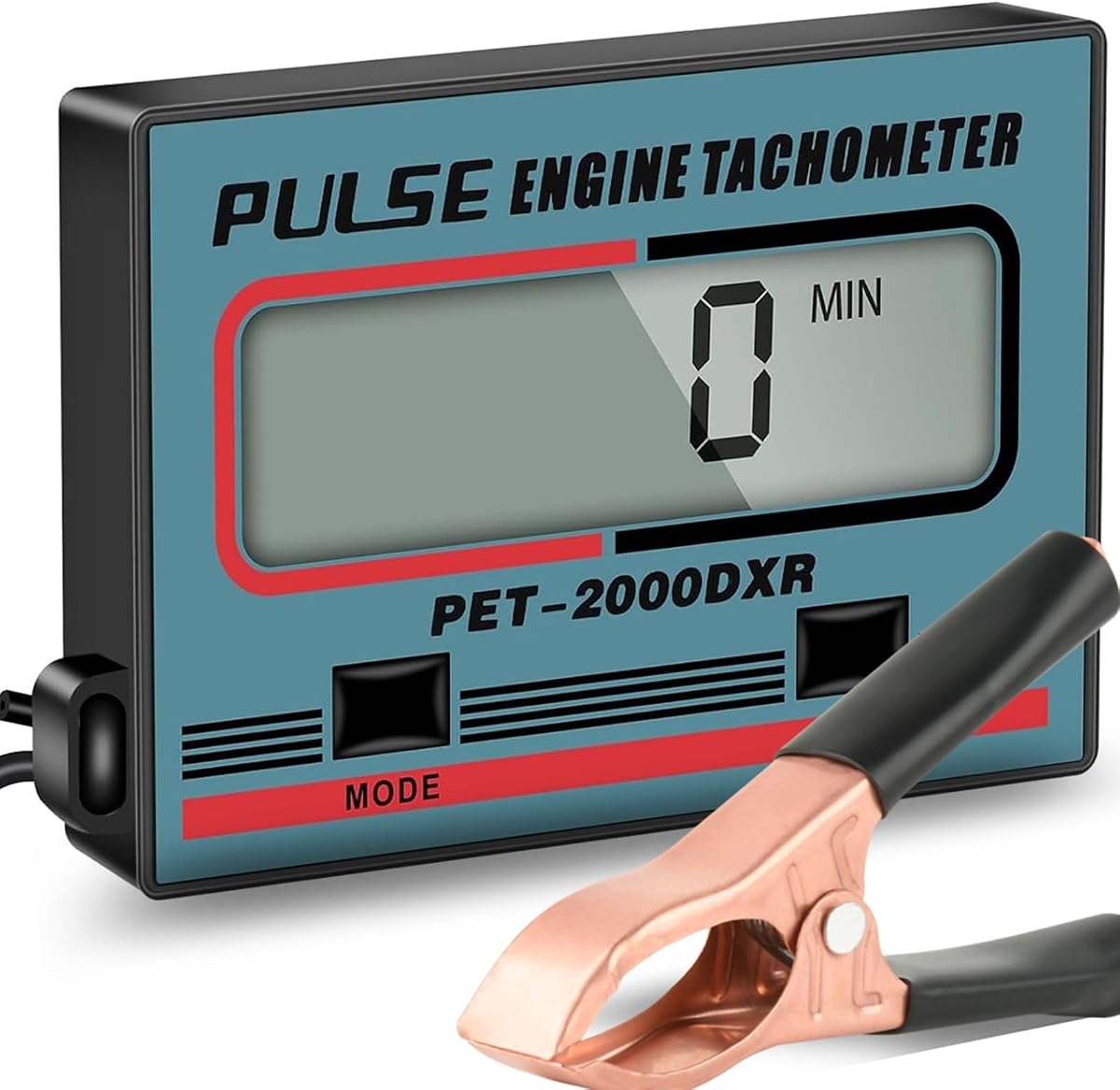
This compact digital tachometer supports 100–30,000 RPM with a stated accuracy of one percent and can be used with one- through eight-cylinder gasoline engines. Its 4.5 rating reflects a well-rounded feature set, while the two pickup options make it adaptable to different engine compartments and installation preferences.
We may earn a commission when you buy through this link, at no additional cost to you.
The four operating modes use a doubling relationship: mode 01 represents a one-times reading, mode 02 a two-times reading, and mode 03 a four-times reading. Mode 04 is reserved for reset functions. Importantly, these modes are not labels for two-stroke or four-stroke engines. The recommended method is to test the modes while the engine idles and select the one closest to the actual speed.
Users can obtain a signal through the included copper clip and signal-pickup wire, or through inductive sensing by mounting or holding the unit where it can detect vibration. The unit automatically turns its display off when the engine stops and resumes testing when the engine runs. The compact housing also supports timing up to 99,999 minutes, although that format may be less intuitive for some users.
This is a good choice for compact installations and owners who may switch between clip-on and non-contact sensing. Its main learning curve is mode selection, but the clear relationship between the modes and the test-at-idle procedure make the process manageable.
The clip and pickup wire provide a direct ignition-signal method, while the inductive approach can detect engine vibration. This allows the owner to choose the method that best fits the available space.
Modes 01, 02, and 03 apply one-times, two-times, and four-times scaling. Comparing each result at idle helps prevent a plausible but incorrect RPM display.
We may earn a commission when you buy through this link, at no additional cost to you.
This gauge offers a mounted display with RPM monitoring, hour tracking, maximum RPM recall, programmable alarms, and wireless sensing. It covers 0–18,000 RPM with a stated accuracy of plus or minus 10 RPM, refreshes every 0.5 seconds, and records up to 9,999 hours with 0.1-hour timing accuracy.
We may earn a commission when you buy through this link, at no additional cost to you.
The included bracket is designed to attach to a tubular object, while the sensing system can work without placing a clip on the spark-plug wire. For inductive sensing, the stated optimal distance is three to five centimeters. A clip remains available when a wired signal is preferred, so the product is not limited to one installation method.
TOT, JOB, and SVC modes separate total use, resettable job time, and service countdown. The SVC interval defaults to 50 hours and can be configured from zero to 500 hours. A green backlight supports low-light visibility, while the display turns red when the RPM alarm threshold is exceeded. The data remains stored after battery replacement.
The main drawback is that the optimal sensing position is relatively narrow, and the user must still select the proper RPM mode. Even so, this is a versatile option for owners who want a fixed dashboard-style display and the freedom to remove the clip from the ignition wire.
Wireless sensing can reduce the need to connect the clip directly to the ignition lead. The display still needs to sit within the stated three-to-five-centimeter sensing distance.
Total time, job time, and service time each serve a different tracking need. This separation makes it easier to monitor lifetime use, a specific task, and the next maintenance interval.
We may earn a commission when you buy through this link, at no additional cost to you.
This digital tachometer combines a 0–36,000 RPM range, plus-or-minus 10 RPM accuracy, a 0.5-second refresh rate, and timing up to 9,999.9 hours. Its supplied rating of 5.0 is the highest in the group, and the integrated 2.2-meter sensor wire gives it a distinct advantage for vibration-prone installations where detachable connections might work loose.
We may earn a commission when you buy through this link, at no additional cost to you.
The built-in wire is soldered directly to the board to reduce connection failures. It can be mounted using a clip on the spark-plug wire or positioned for non-contact inductive sensing at three to five centimeters. Four modes use one-times, two-times, and four-times multipliers, allowing the operator to match the gauge to two-stroke or four-stroke engines with one to eight cylinders.
Its IPX68 rating offers strong protection against rain, snow, and high-pressure washing. The TOT, JOB, and SVC timers track lifetime hours, resettable job time, and a programmable service interval that defaults to 50 hours. A green backlight improves visibility in low light, while a red display signals an RPM alarm. Maximum RPM recall adds context after a run.
This is the most complete choice in the guide for snowmobiles, motorcycles, mowers, generators, tractors, outboards, and similar equipment. The integrated cable is a meaningful feature, but it must be routed carefully to avoid snagging, pinching, or abrasion. With a 5.0 rating and broad protection, it earns the Editor's Choice distinction.
The permanently integrated sensor cable avoids the loose-fit problem associated with detachable pickup leads. Its 2.2-meter length provides room to place the display and route the wire around the engine.
An IPX68 rating provides a higher stated level of water protection than the IP65 and IP67 products in the comparison. That makes it well suited to exposed machinery, washing, rain, and snow.
We may earn a commission when you buy through this link, at no additional cost to you.
The BIBARAJM is a compact inductive tachometer designed to measure engine speed while sitting near the spark-plug wire. Its 4.3 rating reflects a generally positive user response, and the included clip makes the basic sensing process accessible for chainsaws, marine engines, ATVs, motorcycles, UTVs, and similar gasoline equipment.
We may earn a commission when you buy through this link, at no additional cost to you.
The stated RPM range runs from 100 to 30,000, making it suitable for both ordinary utility engines and higher-speed applications. Its hour meter reads to 10,000 hours and then resets to zero, while a system reset function is also available. Programmable service times can produce oil-change and other maintenance reminders through the service icon.
The gauge enters sleep mode when it is not in use and resumes operation when engine activity is detected. This is convenient for a compact unit without a permanent power connection. One drawback is that the hour counter's reset after reaching its limit means it is not a permanent lifetime record. The supplied product information calls it waterproof but does not state a specific IP rating, so buyers should not assume a certified level of protection.
This model is best for users who want simple inductive RPM monitoring, timing, and service prompts in a small package. It is a practical match for a collection of powersports machines or small engines used intermittently.
The included clip holds the tachometer near the spark-plug wire, creating a straightforward connection without external engine power. The unit also switches into sleep mode when it is not operating.
Programmable service times help owners remember oil changes and other recurring tasks. The hour counter's automatic rollover should still be considered when using it for long-term records.
We may earn a commission when you buy through this link, at no additional cost to you.
The Timorn gauge is distinctive for its ability to track the working time and service schedule of two different engines. Its 4.0 rating is the lowest among the listed products, but the dual-engine timers, programmable rev-limiter setting, and 0–25,000 RPM range make it a useful instrument for owners responsible for multiple machines.
We may earn a commission when you buy through this link, at no additional cost to you.
Total time is described as unresettable and accumulates the run time of all metered engines. Job time can be reset and used to record the working time of two engines separately. The service timer can also remember separate schedules for the two machines. This arrangement allows one gauge to provide a combined lifetime total and independent task tracking without confusing the records.
The contact sensor is installed by circling the wire around the spark-plug-wire sheath five times and securing it with a tie. RPM can refresh every 0.5 or one second, and the backlight duration is selectable. The battery is replaceable, previous data is restored afterward, and the stated IP67 rating provides dust and temporary-immersion protection.
This is a practical choice for operators who need to alternate between two engines. The installation process requires more deliberate wrapping than a simple clip attachment, and the relatively low rating suggests buyers should examine current customer feedback carefully. Its dual-engine records nevertheless offer functionality not found in most conventional hour meters.
The total counter combines engine use, while resettable job time can track two engines independently. Separate service memory helps maintain an accurate reminder for each machine.
The IP67 rating supports use in dusty and wet environments. Automatic sleep and selectable backlight duration help manage the replaceable battery.
We may earn a commission when you buy through this link, at no additional cost to you.
The most useful tachometer is one that matches the engine, sensing environment, and maintenance workflow rather than simply offering the largest display. The following factors help narrow the choices before installation or purchase.
Choose a range that covers normal operation and peaks without sacrificing useful resolution.
Confirm stroke type, cylinder count, ignition pattern, and supported RPM range.
Compare signal reliability, setup time, and available mounting space.
Choose the timer structure that matches how you record engine use and service.
Match the protection rating to outdoor exposure and washing conditions.
Look for readable illumination and a distinct overspeed warning.
Prioritize replaceable power, sleep behavior, and retained records.
Before installation, identify the engine's stroke type, cylinder count, normal idle speed, expected peak RPM, and the ignition-wire location. Program the appropriate firing pattern or multiplier mode, then connect or position the sensor as directed. For a clip pickup, attach it firmly to the spark-plug-wire sheath without opening or altering the ignition wire. For contact wrapping, follow the specified number of turns and secure the wire so it cannot slide or rub against hot components.
Start the engine and let it reach a stable idle. Compare the displayed RPM with the engine's expected idle and test the available modes if the reading appears scaled. Once the correct mode is selected, set the service interval, total or job timers, RPM alarm, and backlight preference. Give the display time to refresh, and confirm that the value changes smoothly when the throttle changes. Save the configuration where possible so it can be restored after a battery change.
During normal use, inspect the sensor connection and cable routing periodically. Keep the display away from extreme heat, sharp edges, moving components, and pressure-washer jets unless its protection rating permits direct exposure. Remove or disable the gauge before major service work, and replace the battery when the low-battery indicator appears. Before long storage, use the manual shutdown or sleep function, remove the equipment from wet conditions, and confirm that stored totals and service settings remain intact.
It displays live engine speed so an owner can check idle quality, monitor acceleration, identify rough running, and see when RPM approaches an unsafe level. Many models also accumulate run hours, recall maximum RPM, and issue service reminders. These functions make the gauge useful for both immediate diagnosis and long-term maintenance.
Yes, provided the engine's stroke configuration, cylinder count, ignition system, and RPM range are supported by the selected mode and sensor. The gauges in this guide commonly support two-stroke and four-stroke gasoline engines, sometimes with up to eight cylinders. Because multiplier modes may look alike, compare several mode readings at a known idle before relying on the result.
Inductive sensing avoids attaching a clip directly to the ignition wire, but it requires the display to remain within the stated sensing distance, commonly three to five centimeters. A clip-on model takes only a moment to position but creates a physical connection that can loosen under vibration. The best choice depends on available space, vibration levels, and how often the gauge will be moved.
The products described here generally use a replaceable internal battery and do not require an external engine power connection. The pickup senses the ignition signal or engine vibration, while the internal battery powers the LCD and settings. Battery life depends on backlight use, refresh behavior, and how long the unit remains active.
The gauge may be in a multiplier mode, or the selected mode may not match the engine's firing pattern. Several products use mode 01, 02, and 03 as one-times, two-times, and four-times readings rather than stroke labels. Test the available modes at idle and select the one closest to the engine's known speed.
These ratings indicate different levels of protection against solids and water. IP65 is described as dustproof and resistant to water jets, IP67 adds temporary-immersion protection, and IPX68 represents a higher stated waterproof level. They help when a gauge is exposed to rain, dust, splashing, or cleaning, but the rating does not make cable routing or physical impacts unimportant.
Several products in this guide specify that stored data is retained after battery replacement. That includes totals, job time, service timing, and maximum RPM on models that provide memory. Before changing a battery, consult the manual or listing because retention behavior is product-specific, and confirm that the new battery is installed with the correct polarity.
It can reveal symptoms such as unstable idle, inconsistent RPM, sudden drops, or unexpectedly high engine speed, but it does not diagnose the underlying cause by itself. Use the reading alongside sound, smoke, vibration, spark behavior, fuel delivery, and mechanical inspection. A tachometer is most useful for comparing normal operation with a problematic condition and monitoring repairs.
The Built-In Sensor Digital Tachometer is the strongest all-around choice, combining a 5.0 supplied rating, broad RPM and timing ranges, an integrated cable, four modes, and IPX68 protection. The Runleader RL-HM011E stands out as the best budget pick for owners who need an hour meter, tachometer, service timer, and rugged housing without an extensive feature set.
The Digital Tachometer and Hour Gauge earns the best premium distinction for its programmable RPM alarm, dual-color backlight, flexible sensing, and separate total, job, and service timers. For portable work, prioritize a handheld or compact inductive model; for a permanently mounted display, consider bracket stability, cable routing, and low-light visibility. In every case, confirm engine compatibility and test the selected mode before relying on the readings.
A digital tachometer adds the most value when it becomes part of a routine: check idle, review run time, and act on service prompts rather than treating it as a novelty. Compare the listed specifications with your equipment, read current customer feedback, and check the latest listing details and current prices before purchasing.