
5 Pieces Hearing Aid Cleaning Tools
4.7Editor score
Compact five-piece configuration
Includes brushes and wax loops
Plastic and nylon construction
Discover the best hearing aid cleaning tools for daily care, comparing wipes, brushes, thread cleaners, wax guards, and complete kits for safer upkeep.
Hearing aid cleaning tools range from simple brushes and wax loops to thread cleaners, pre-moistened wipes, and organized maintenance kits. The right choice depends on your device type, the areas that need attention, and how often you want to clean. Gentle materials and a compact design matter most for dependable everyday care.
We compared all ten options by examining their stated materials, cleaning methods, portability, included accessories, device compatibility, and customer ratings. The guide covers manual brush kits, alcohol-free wipes, fine cleaning strands, and replaceable wax guards, helping you identify the most practical format for your routine.
Each entry highlights a different approach, from compact daily-care sets to bulk supplies and comprehensive tool kits. The top picks represent strong options for budgets, versatility, and premium maintenance. Product details, ratings, availability, and offers can change, so confirm the current listing before purchasing.
4.7Editor score

4.6Editor score
4.6Editor score
The comparison below organizes ten cleaning solutions by format, core components, maintenance focus, and portability, making it easier to match a tool to your hearing aid and daily care routine.


This eight-piece kit earns the Editor's Choice position because it combines several brush styles, a magnetic handling feature, and a portable case in one broadly useful package. Its 4.6 customer rating reflects a well-received balance of versatility and convenience. Rather than forcing one tool to handle every cleaning task, it gives users different shapes for wax, dust, narrow openings, and more delicate components.
We may earn a commission when you buy through this link, at no additional cost to you.
The seven cleaning brushes form the core of the set and are intended for hearing aids, earbuds, ear molds, earplugs, sound tubes, and battery compartments. Their soft nylon construction is designed to lift accumulated material without scratching the device. The magnetic brush head can assist with removing and inserting a hearing aid battery, and the product information also describes using it for volume adjustments and routine maintenance.
The main limitation is that this is a manual brush system rather than a wet-cleaning or deep-cleaning package. It does not include wipes, a spray, or a cloth, so users who want to remove oils and fingerprints will need a separate solution. The case offers less impact protection than a hard shell, and the many small pieces must be secured carefully during travel to prevent them from being misplaced.
This is an excellent choice for households that maintain more than one hearing device or want a dedicated set for each user. The different brushes accommodate routine surface care without introducing liquid into sensitive areas. It is also a practical pick for people who prefer a reusable toolkit over disposable consumables. For those needs, the range of shapes and included magnetic tool make it one of the strongest all-around cleaning selections.
Using the appropriate brush shape makes routine care more manageable. Small openings can be approached with a narrow tip, while broader exterior surfaces and ear molds can be treated with a larger brush, reducing the temptation to force one tool into every space.
The included case keeps the separate implements together and makes the kit easier to carry. It is particularly useful for travelers or anyone who wants to clean a device away from a dedicated bathroom or work area.
We may earn a commission when you buy through this link, at no additional cost to you.
This cleaner uses fine nylon strands with sturdy probes at each end to move through narrow hearing aid tubes and vents. It holds a 4.5 rating and is built for users who need internal access rather than merely wiping the housing. The central soft brush is intended to collect wax and moisture while the strand travels from one end of the passage to the other.
We may earn a commission when you buy through this link, at no additional cost to you.
The thread-through design makes it suitable for thin-tube hearing aids, vent-air devices, IIC, ITC, and ITE models. The product information also lists earbuds, in-ear monitors, tympanometer tubes, and police radio earpieces among possible applications. Because each strand is ready to use and fitted with a probe, it avoids the preparation required by thread spools.
Its narrow profile is its greatest advantage and its main limitation. While the strand can enter passages that a brush cannot reach, it is not intended to clean broad exterior surfaces or fingerprints. The disposable format may also be less attractive to users seeking a fully reusable maintenance system, although it avoids reusing a strand after it has collected debris.
Choose this option when the priority is clearing thin tubes, receiver openings, or vents. It may be particularly useful as a travel supply because the strands require no assembly. Users with a broad mix of exterior and internal cleaning needs would benefit from pairing it with a brush set or wipes, but for focused internal maintenance it provides a clear, specialized solution.
A conventional brush works on surfaces, while a threaded strand can physically pass through a narrow channel. That distinction makes this option useful when a tube appears blocked or when debris has collected beyond the opening.
Pre-cut strands reduce setup and make the cleaning process predictable. Users can keep one nearby for periodic maintenance or include several in a portable hearing aid pouch.
We may earn a commission when you buy through this link, at no additional cost to you.
This 120-count wipe package is one of the most complete routine-care options in the guide. It combines individually packaged, alcohol-free towelettes with a cleaning brush, vent cleaner, and microfiber cloth. Its 4.6 rating and broad compatibility make it a strong choice for users who want both surface cleaning and dedicated tools in a single purchase.
We may earn a commission when you buy through this link, at no additional cost to you.
The wipes are designed for hearing aids, earmolds, earphones, headphones, and earbuds. The manufacturer states that the alcohol-free formula is suitable for rubber, plastic, silicone, and acrylic surfaces without harming those materials or the wearer's skin. Each towelette measures 3.5 by 3.5 inches, providing enough surface for wiping a device without taking up much room in a travel pouch.
The included microfiber cloth is useful for finishing exterior surfaces after a wet wipe, while the brush and vent cleaner address areas that a towelette cannot. The limitation is that wipes should not be pushed into receiver tubes or other openings. As with other disposable cleaning systems, repeated use creates waste, and the 120 individually wrapped pieces require some storage space.
This set is well suited to daily maintenance because it puts a wipe, cloth, brush, and vent tool within reach of the same routine. It is also a convenient choice for caregivers who manage a relative's devices, since each wipe remains sealed until needed. Users who prioritize gentle surface cleaning and a generous supply will find this package especially practical.
A wipe handles oils, dirt, and fingerprints while the cloth provides a dry finishing option. Adding a vent cleaner and brush means the package can support both exterior wiping and routine debris removal.
Each towelette is sealed separately, which helps keep unused wipes from drying out and reduces unnecessary exposure. The packaging also makes the supply straightforward to distribute between a home kit and a travel bag.
We may earn a commission when you buy through this link, at no additional cost to you.
This eight-piece cleaning kit is designed for more than basic surface brushing. It combines a steel pick, vent cleaner, screwdriver, three cleaning brushes, a vent brush tube tool, and a microfiber cloth in a compact case. The 4.6 rating reflects a versatile package that appeals to users who want fine control over different parts of a hearing device.
We may earn a commission when you buy through this link, at no additional cost to you.
Its strongest differentiator is the inclusion of a screwdriver and steel pick. Those implements can help with tiny screws and hard-to-reach wax, while the vent tools target narrow openings and the cloth handles broader exterior surfaces. The product information also notes that the tools can assist with battery insertion and hearing aid volume adjustments, making the set relevant to everyday ownership tasks.
The steel pick and screwdriver demand more care than soft nylon brushes. Users should work cautiously around delicate finishes and avoid forcing any tool into a component. The range of accessories also means some items may be unnecessary for a particular hearing aid model, especially users with a simpler design that lacks removable screws or external tubes.
This kit suits a maintenance-minded owner who wants one organized set rather than several separate products. It also works well as a practical gift for someone who already owns hearing aids or hearing amplifiers. Those who need only basic exterior care can choose a smaller brush set, but for varied maintenance requirements the case and broad tool selection make this option difficult to undersell.
The screwdriver and pick extend the kit beyond wax removal, giving users dedicated implements for small fasteners and stubborn deposits. These should be used only where the device manufacturer permits manual cleaning.
The compact case keeps the tools separated and organized. It also makes the kit easier to carry, which is useful for maintaining a hearing device while traveling or away from home.
We may earn a commission when you buy through this link, at no additional cost to you.
These MEDca wipes deliver a straightforward surface-cleaning solution for hearing aids, amplifiers, earbuds, glasses, headphones, screens, and other compatible electronics. They carry a 4.7 rating, the highest among the products featured here, and their pre-moistened, individually wrapped design supports quick use at home, work, or while traveling.
We may earn a commission when you buy through this link, at no additional cost to you.
The alcohol-free formula is intended to remove wax, dirt, and debris while remaining suitable for rubber, plastic, silicone, and acrylic surfaces. The wipes are described as quick-drying and designed to leave no sticky residue, making them useful when a device is handled frequently or placed into a charging case soon after cleaning.
This product focuses almost entirely on surface wiping. It does not include a brush, vent cleaner, microfiber cloth, or threaded strand, so it cannot replace tools designed to dislodge wax from narrow tubes. The wet-cleaning format also requires care around openings and should not be used where a hearing aid manufacturer advises against liquid.
This package is an appealing choice for users who prioritize fast, gentle cleaning of the outer housing and frequently handled accessories. The individual wrapping makes each wipe convenient to carry and preserves the others until needed. For a complete routine, it can be paired with a small brush set, while those wanting the simplest possible solution may find it sufficient on its own.
The pre-moistened, quick-drying format suits people who want a wipe rather than a spray and separate cloth. A device can be wiped, allowed to dry, and returned to normal use with fewer steps.
Because the wipes can also clean earbuds, glasses, headphones, and screens, they offer a broader application than hearing aid-only products. This makes them convenient for users who want one surface-cleaning product for several frequently handled items.
We may earn a commission when you buy through this link, at no additional cost to you.
NanoClean takes a focused approach with 20 pre-cut, ready-to-use strands stored in a pull-out box. The 4.5 rating reflects a practical cleaning method for small aids, narrow sound tubes, and earbuds. Rather than providing several unrelated implements, it concentrates on the threading and brushing technique that can reach inside confined spaces.
We may earn a commission when you buy through this link, at no additional cost to you.
Each strand measures ten inches and includes a soft nylon brush. The product information emphasizes that the non-metallic material will not damage the earpiece, while the long format allows it to move through internal tubes. This makes it a focused option for users who know that wax or residue has collected inside a narrow passage.
The product's simplicity also limits its versatility. It does not provide a way to wipe down the exterior, remove fingerprints, or clean a battery compartment, and the 20-strand pack may require regular replenishment for frequent maintenance. Users should not force a strand into a component that is not designed to be opened.
NanoClean is best for people who want a compact, dedicated solution for internal tube cleaning. The pull-out dispenser is convenient and keeps the unused strands together, while the lack of loose accessories means there are fewer small pieces to lose. Pairing it with a separate brush or wipe completes a broader cleaning setup.
The extended strand length is the defining feature, allowing it to pass through small sound tubes and away from the earpiece. That makes it especially useful for devices whose openings are difficult to reach with a short brush.
Each strand is already sized and ready to use. The pull-out box provides a simple way to dispense one strand at a time and keep the rest stored together.
We may earn a commission when you buy through this link, at no additional cost to you.
This five-piece set offers a compact manual cleaning solution with a 4.7 rating. It combines brushes and wax loops in a lightweight format intended for hearing aids and in-ear monitors. The set is especially convenient for users who want a small collection of focused tools without a large case or a supply of disposable wipes.
We may earn a commission when you buy through this link, at no additional cost to you.
The wax loops provide a different way to lift earwax and debris from the device, while the brushes cover broader surfaces and smaller areas. Constructed from plastic and nylon, the tools are described as durable and safe for routine maintenance. Each brush measures approximately 2.01 by 0.39 inches, allowing the entire set to fit in a pocket, purse, or travel bag.
The package does not include a microfiber cloth, wipes, vent tool, or screwdriver, so users who need wet cleaning or more detailed maintenance will need to add another product. Its five-piece configuration also provides less variety than the larger brush kits, although the core tools are well matched to the most common exterior cleaning tasks.
This is the Best Budget pick for a simple reason: it focuses on the small tools that many hearing aid owners use most often. It is easy to carry, requires no liquid, and handles both brushing and wax-loop tasks. The set is best for a user who wants a straightforward maintenance option and already has a separate method for deeper surface cleaning.
Brushes and wax loops address different kinds of buildup without introducing moisture. This makes the set useful for quick touch-ups after the device has been exposed to wax, dust, or everyday handling.
The slim dimensions make it easy to keep the tools with a hearing aid pouch. Portability is especially valuable for users who clean their device at different locations throughout the day.
We may earn a commission when you buy through this link, at no additional cost to you.
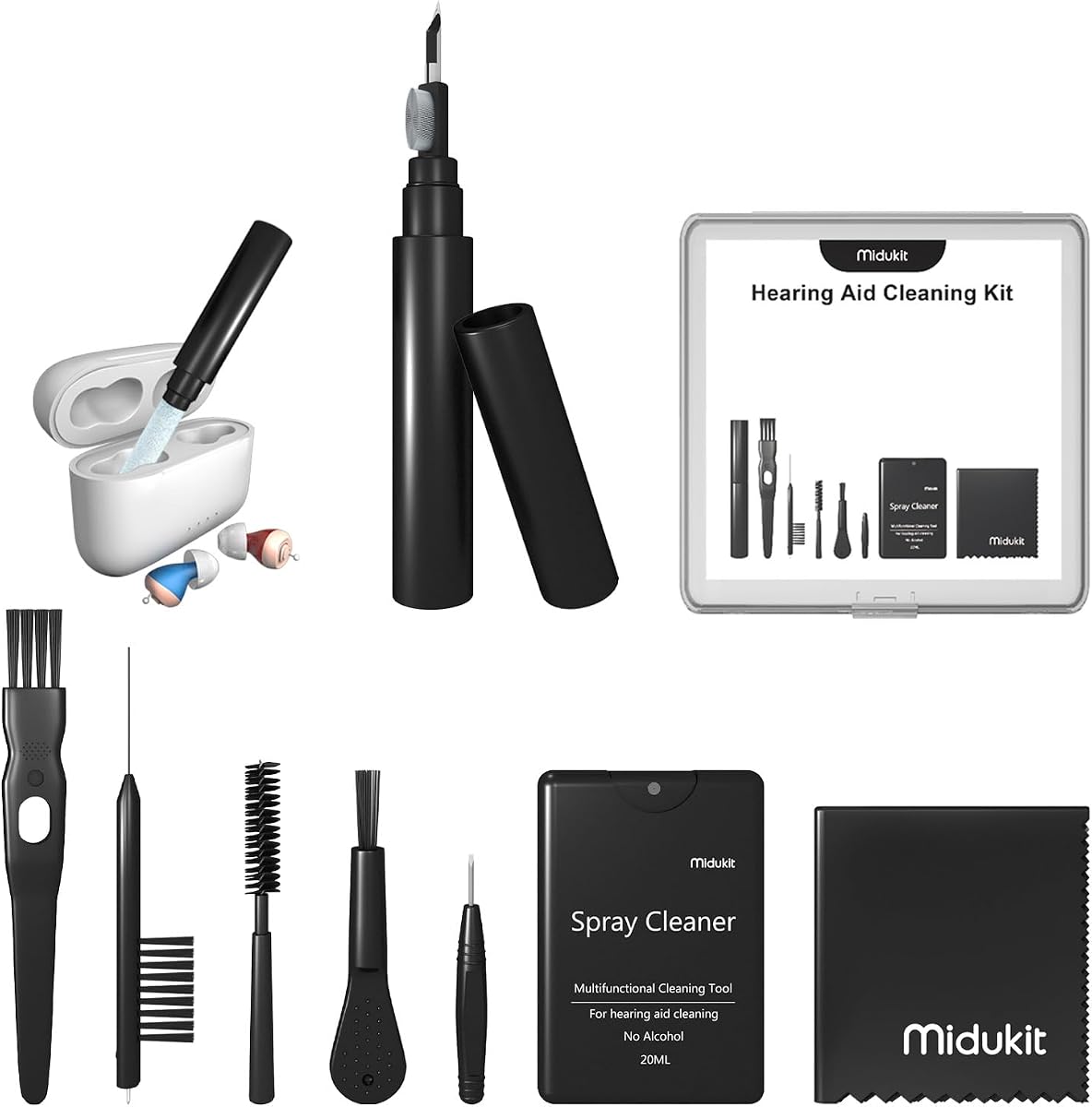
This premium kit is built around modern rechargeable hearing aids and combines a precision pen, brush, spray, and cloth in a lightweight case. Its 4.6 rating reflects a broad feature set, while the product information specifically calls out compatibility with rechargeable Bluetooth models, charging cases, Oticon, and Phonak devices.
We may earn a commission when you buy through this link, at no additional cost to you.
The precision pen provides focused access to narrow areas, while the brush handles loose debris and the cloth supports exterior finishing. The spray is intended for appropriate surfaces, and the soft nylon bristle head is designed to avoid scratching. A magnetic tip assists with battery handling, adding a practical feature for owners who regularly remove or replace batteries.
Compatibility should still be checked against the instructions supplied with a specific hearing aid. Users should avoid spraying liquid directly into receivers, vents, microphones, or charging contacts unless the manufacturer explicitly permits it. A premium all-in-one kit also contains more components than a user may need, so the case's organization becomes important to prevent small parts from being lost.
This is the Best Premium pick because it offers the most developed cleaning setup, combining targeted and broad cleaning methods in one organized package. It is a strong fit for owners of compatible rechargeable devices who want to clean microphones, sound tubes, battery areas, earbuds, and ear molds. For those users, the coordinated tool set offers a more complete routine than a basic brush or wipe supply.
Compatibility with modern rechargeable models and charging cases is a meaningful distinction for users whose devices have enclosed components. The included tools provide several ways to maintain both the hearing aid and its surrounding accessories.
The pen, brush, spray, and cloth form a coordinated toolkit for both precise and broad cleaning. Keeping them together in a case makes the full routine easier to carry out consistently.
We may earn a commission when you buy through this link, at no additional cost to you.
This package shifts the focus from removing existing debris to preventing it from reaching sensitive hearing aid components. It includes 32 gray wax guard filters arranged as four packs, along with an applicator and a complimentary brush. Its 4.5 rating makes it a practical option for owners who regularly experience wax accumulation.
We may earn a commission when you buy through this link, at no additional cost to you.
The replaceable filters are intended to keep earwax, dust, grease, and moisture from obstructing a hearing aid. The included applicator helps position each filter, making routine replacement more manageable than handling a tiny guard by hand. The product information lists compatibility with Phonak, Resound, Widex, Unitron, Jungle Care, and other well-known brands, though users should confirm the exact device and guard format.
Correct placement is essential. A filter that is not seated properly may not perform as intended, and a replacement interval should follow the hearing aid manufacturer's guidance. The listing also states that the wax guard should not be used by someone with a perforated eardrum or anyone using ointments, making professional medical guidance important in those situations.
This kit is most useful as a preventive companion to brushes and wipes. It does not clean the exterior or remove every trace of existing residue, but it can help protect a hearing aid from recurring contamination in a compatible model. Users should verify the filter shape and fit, use the applicator carefully, and replace filters at the interval recommended for their device.
A brush removes debris that is already present, while a wax guard helps block later contamination. Using both can support a more consistent maintenance routine for compatible hearing aids.
The dedicated applicator removes the need to handle each very small filter directly. It can make scheduled replacement easier and help users position the guard more consistently.
We may earn a commission when you buy through this link, at no additional cost to you.
This 100-count wipe package combines a 4.7 rating with broad stated compatibility across hearing aid types and major brands. It is designed as a simple surface-cleaning solution for removing dirt, sweat, oil, fingerprints, and dust. Individual wrapping and compact dimensions make the wipes easy to store in a hearing aid pouch, desk drawer, or travel bag.
We may earn a commission when you buy through this link, at no additional cost to you.
The alcohol-free formula is described as suitable for rubber, silicone, metal, plastic, nano-coating, and other device surfaces. The listing names Oticon, Widex, Phonak, Starkey, Resound, Unitron, Signia, Rexton, and Philips among compatible brands. Each folded wipe measures approximately 3.15 inches square, while the individual package is listed at 2.36 by 1.97 inches.
These wipes are meant for external surfaces, not passages through sound tubes or receiver openings. They do not include a brush, vent cleaner, or cloth, so users who also need to dislodge wax will need another tool. Users should still confirm that a specific device manufacturer permits wipe cleaning and avoid excess moisture around openings.
This product is well suited to quick, routine cleaning of hearing aids and other frequently handled electronics. Its broad compatibility claim and individual packaging make it a flexible choice for households with different devices. A small brush or wax guard system can complete the routine, but for exterior hygiene alone this wipe supply offers a convenient and well-rated solution.
The wipe's stated compatibility spans many major hearing aid brands and types. This makes it a practical option for caregivers or households maintaining more than one model without assembling a different wipe system for each.
Each wipe is wrapped separately, helping preserve moisture until use and allowing users to carry only what they need. The small package size also suits limited storage spaces.
We may earn a commission when you buy through this link, at no additional cost to you.
The best hearing aid cleaning solution matches the device, the type of buildup, and the user's comfort with manual care. Consider materials, included tools, portability, and manufacturer guidance before choosing a format.
Hearing aid cleaning is not one uniform task. Exterior housings, earmolds, receiver openings, sound tubes, vents, microphones, battery compartments, and charging cases may all collect different forms of debris. A brush or wipe is best for exposed surfaces, while a fine strand can reach a narrow tube. A wax loop can lift stubborn external residue, and a wax guard addresses recurring contamination at a filter point. Choosing by cleaning area prevents users from expecting a single implement to perform every task.
Look for a product whose stated applications match the areas your device actually exposes. A broader kit can be convenient, but a focused brush or strand may be easier to handle for one specific model. Confirm the device type before buying a specialized accessory.
Hearing aid surfaces can include plastic, silicone, rubber, acrylic, metal, and protective coatings. Soft nylon bristles are common because they can lift loose material without aggressively rubbing the finish. Non-metallic strands reduce the likelihood of scratching an earpiece during internal cleaning. Wipes should be alcohol-free and described as compatible with the relevant materials, while stronger tools such as steel picks require more restraint and should never be forced into a device.
Choose soft, purpose-designed components and avoid improvised sharp objects. The safest product is one whose materials and instructions align with the hearing aid manufacturer's cleaning guidance.
Reusable brush kits can support long-term daily care and are easy to keep in one organized case. Disposable wipes and pre-cut strands offer convenience because there is no preparation, cutting, or washing, but they create ongoing waste. A mixed approach often works well: reusable tools for brushing and detailed maintenance, with individually packaged wipes for convenient surface cleaning.
Consider how often you clean and how much storage you have. A compact reusable set may suit a home routine, while a supply of individually wrapped items is convenient for travel and shared caregiving.
Some products are intended for narrow-tube or vent-air hearing aids, while others emphasize rechargeable Bluetooth models or specific manufacturers. Accessories such as wax guards must match the physical shape and design of the device, and even a broadly compatible brush should be used with care around microphones and receivers. Always compare the product description with the model of hearing aid in your care.
Compatibility claims are helpful, but they do not replace the device manual. When the product description and manufacturer instructions conflict, follow the hearing aid manufacturer's guidance and avoid cleaning internal parts that are not meant to be opened.
A useful cleaning kit should fit naturally into the routine of its owner. Compact cases are helpful for travel, while individually wrapped wipes and pull-out dispensers keep supplies organized without taking up much room. A multi-piece case is valuable when tools have different jobs, but it should hold each piece securely. Very small brushes may be easy to carry yet easy to lose, so a case with individual slots can be an important feature.
Choose storage that you will actually use. If you clean the device only at home, a complete tabletop kit may be sufficient. If you travel often or split time between locations, prioritize a pocket-sized set or sealed individual wipes.
Wet cleaning can remove oils and fingerprints effectively, but hearing aids and charging contacts are sensitive to moisture. A pre-moistened wipe should be used on the exterior only unless the manufacturer explicitly allows liquid in a particular area. Sprays require particular care because overapplication can send moisture into openings. Quick-drying, alcohol-free wipes reduce residue and shorten the wait before handling or charging a device.
Follow the device manufacturer's instructions, use only the amount of moisture needed, and let the device dry fully. If a cleaning product does not clearly explain where it can be applied, treat it as an exterior care product until you verify otherwise.
A complete set may include a brush, vent cleaner, precision tool, cloth, spray, or carrying case. The best bundle is not necessarily the largest one; it is the collection that covers your device's actual maintenance needs. A soft brush and microfiber cloth may be sufficient for some owners, while others need a threaded strand or guarded applicator for narrow components. Organized cases also make it easier to perform each task correctly.
Avoid paying attention only to the number of pieces. Review the function of every included tool, confirm that the materials suit your device, and select the smallest organized set that fully meets your needs.
Begin by reading the hearing aid manufacturer's cleaning instructions and identifying removable parts. Turn the device off and, if appropriate, remove the battery or place the hearing aid in its manufacturer-approved charging or drying state. Use a dry brush to remove loose dust and debris from the exterior, working gently around microphones, receivers, switches, and buttons without pressing bristles into openings.
Match the tool to the area. Use a wax loop or brush on accessible earmolds and surfaces, and use a fine threaded strand only for passages the manufacturer permits you to clean. For a wipe, lightly pass the alcohol-free towelette over the exterior and avoid pushing moisture into vents or tubes. If using spray, apply it to a cloth rather than directly to the device, then allow the hearing aid to dry fully before charging or wearing it.
Inspect the cleaned device before returning it to service. Check that every removable part is correctly seated, that microphones and receivers are clear of loose debris, and that no tool fragment has entered the casing. Keep brushes, strands, and small parts in their case, replace filters according to device guidance, and discard wipes and used strands rather than attempting to clean and reuse them.
Start with the manufacturer's instructions, then use a soft, dry brush for loose debris and an alcohol-free wipe for exterior surfaces when permitted. Keep liquid out of receivers, microphones, vents, and charging contacts. If a component is removable, clean it separately and allow every part to dry fully before reassembly.
Many hearing aid cleaning tools are also suitable for earbuds, earmolds, in-ear monitors, and headphones because these products collect similar wax and dust. Check the materials and instructions to confirm compatibility. Avoid pushing a brush or strand into a headphone opening unless the manufacturer permits it.
Alcohol-free wipes are generally a gentler choice for devices with rubber, plastic, silicone, acrylic, or coated finishes. They can clean fingerprints, oils, and surface residue without the harshness associated with alcohol. Even an alcohol-free wipe should be kept away from openings unless the device manufacturer explicitly approves wet cleaning.
A light brush or exterior wipe after regular use can help prevent debris from building up. Tubed devices may need more frequent attention because wax can obstruct narrow passages. Follow the hearing aid manufacturer's cleaning schedule and replace disposable wipes, strands, and wax guards as directed.
They perform different functions. A brush removes accessible loose debris, while a wax guard is a replaceable filter intended to keep later wax, dust, grease, and moisture from reaching sensitive components. A complete routine may use both, but the guard must match the hearing aid's design and be fitted correctly.
Thread-style cleaners can lift wax and moisture from compatible tubes and vents as they pass through the passage. They are most appropriate for narrow openings that the manufacturer allows users to clean. They are not a substitute for professional drying and should not be forced into receivers or sealed microphone ports.
A magnetic tip can make it easier to handle a small hearing aid battery and may double as a useful storage feature. It should not be placed near a device's sensitive electronics unless the manufacturer permits it. Users who use rechargeable hearing aids may not need that function often.
Stop trying to force a brush, pick, or strand deeper into the device. A visible removable tube or earmold may be cleaned separately if the manual permits it, but sealed internal components should be left to the hearing aid professional. Continuing can push wax farther inside or damage a receiver.
The 8 Pieces Hearing Aid Cleaning Tools stands out as the most versatile Editor's Choice, while the 5 Pieces Hearing Aid Cleaning Tools is a compact Best Budget option. The Premium Hearing Aid Cleaning Kit is the strongest choice for compatible rechargeable hearing aids that need several cleaning methods in one coordinated case.
Prioritize the device type, the locations that collect debris, and the materials touching the hearing aid. A brush kit is ideal for routine manual care, individually wrapped wipes suit exterior hygiene, threaded strands reach narrow passages, and wax guards help prevent recurring contamination. The right choice is the one that supports safe, consistent maintenance without encouraging users to force tools into sensitive areas.
Before ordering, verify compatibility, read the hearing aid manufacturer's care instructions, and confirm the current listing details and availability. Product features, ratings, and offers can change, so checking the latest information helps ensure that the selected cleaning system still meets your device's needs.

