
ETMY K-2 PIN Throat Mic
3.9Editor score
Wide radio model support
Three earbud size pairs
Low-profile air tube
Discover the best Throat Mic for Gaming options by comparing radio compatibility, noise reduction, push-to-talk controls, comfort, connectivity, and overall
A throat microphone for gaming can give teams clearer voice communication in loud environments, but the term covers several very different devices. Traditional radio headsets use a neck-worn vibration sensor, while modern USB and wireless microphones capture conventional audio. Connecting the two categories responsibly means focusing on the actual game, radio, and platform involved.
We compared all ten products by examining their connection methods, compatibility claims, noise-control features, push-to-talk operation, wearing design, and practical applications. The list includes tactical two-pin and K-connector radio headsets, a 3.5mm gaming-capable option, a USB desktop microphone, and a compact wireless lavalier system so readers can distinguish the formats before buying.
The first three selections represent the most practical choices for gaming-related communication: a versatile radio headset, a modern K-connector option, and a direct 3.5mm alternative. Each review explains the product's strongest benefits, limitations, and ideal setup, while current ratings and prices can change at any time on the retailer's website.
3.9Editor score

4.1Editor score

3.2Editor score
This comparison highlights the major differences among throat-based radio headsets, a direct 3.5mm option, a USB gaming microphone, and a wireless lavalier microphone. Connector type, device support, noise reduction, and control style should determine the most suitable choice.




The Interface Z Tactical Throat Mic is a specialized two-way-radio earpiece with a 3.5 rating. Rather than picking up room sound through a conventional microphone, it uses a dual sensitive throat microphone transponder to carry speech from vibration along the neck. That design makes it most relevant to airsoft, security, and tactical-style game sessions that use compatible Element or Z Tactical push-to-talk equipment.
We may earn a commission when you buy through this link, at no additional cost to you.
Its most interesting feature is the dual-transducer arrangement, which is intended to improve pickup sensitivity compared with a single sensing element. The neckband combines ABS and nylon for a structure that can flex and sit close to the throat, while the transparent tube keeps the earpiece visually discreet. Mushroom earplugs are included, adding a more private listening option for users who do not prefer an open earbud.
The main limitation is the focused platform support. The listed interface is intended for Element and Z Tactical PTT connections, so it is not a universal solution for a standard gaming headset, smartphone, or every two-pin radio. Its 3.5 rating also suggests that some buyers may have found the fit, connector, or overall performance less convincing than the specialized feature set implies.
This is a strong recommendation for players whose communication setup already uses the stated radio platform and who want speech transmitted from throat vibrations in a loud environment. It is less suitable for console-only gaming or teams mixing several radio brands. Confirm the exact radio model, connector, and push-to-talk arrangement before purchasing rather than relying on the broad idea of tactical compatibility.
Throat vibration transmission is the product's defining benefit. Because it relies on the movement of the wearer's throat rather than open-air sound, it can help keep game callouts intelligible in places where engines, effects, wind, or crowd noise would overwhelm a conventional boom microphone.
The Element and Z Tactical PTT interface makes this a focused accessory for compatible radio-based teams. Players using a mixed-brand setup should verify connector geometry and control compatibility before treating any two-pin headset as interchangeable.
We may earn a commission when you buy through this link, at no additional cost to you.
The Retevis Adjustable Throat Mic has a 4.1 rating and offers the strongest balance of useful gaming communication features in this list. It is designed around a K-head two-pin connector and supports an extensive collection of Retevis models while also naming Pxton, Baofeng, and Kenwood radios. That makes it a practical choice for teams combining airsoft, hunting, security, or outdoor gaming with two-way-radio voice chat.
We may earn a commission when you buy through this link, at no additional cost to you.
The neck section can be adjusted to fit the wearer, and the throat contact area is designed to remain close enough to transmit speech while remaining comfortable for extended wear. A finger PTT switch allows a player to control transmission without reaching for a separate radio, and the transparent acoustic tube provides a more discreet path for private listening. These features make the headset particularly useful during movement-heavy gameplay.
Compatibility is broad, but not literally universal. The product is connected through a K-head two-pin arrangement, and buyers should match their radio and accessory port to the listed models rather than assuming every two-pin device uses the same plug. The finger switch also needs to be positioned carefully to avoid accidental presses, especially while running, cycling, or climbing.
Overall, this is the most convincing all-around throat mic for gaming because it combines a high rating, broad radio support, adjustable comfort, a discreet tube, and accessible push-to-talk operation. It is a particularly good match for players who communicate through compatible two-pin walkie-talkies. Buy it after confirming the exact radio model and preferred wearing position.
The named support list spans Retevis, Pxton, Baofeng, and Kenwood models, giving teams more freedom than a single-brand headset. Check the radio list carefully because connector shape and supported functions can differ even within the same broad connector family.
A flexible adjustable neck helps the sensing area remain positioned near the throat as the wearer moves. It is a more useful gaming consideration than appearance alone, since a stable, comfortable fit supports clearer transmission and makes long sessions less distracting.
We may earn a commission when you buy through this link, at no additional cost to you.
The Retevis Two-Pin Throat Mic carries a 3.9 rating and resembles the practical communication setup favored by airsoft and outdoor players. It uses vibration through the throat to reduce the influence of environmental noise, while an acoustic tube and soft mushroom earplug provide private, comfortable listening on either side.
We may earn a commission when you buy through this link, at no additional cost to you.
A major strength is its compatibility breadth. The listing names numerous Retevis models, Baofeng UV-5R and BF-series radios, Pxton, eSynic, Arcshell AR-5, and Kenwood two-way radios. The adjustable tightness of the neck section allows the sensor to sit close to the throat, and the sensitive finger PTT offers direct transmission control during fast-paced play.
The caveat is that the long compatibility list can create false confidence. A two-pin appearance does not guarantee a correct electrical and physical match, and the product's customer rating is below the leaders in this comparison. Players who need mission-critical communication should confirm the precise radio model, connector arrangement, and PTT function before use.
This headset is best for a player who has one of the many compatible two-pin radios and values a snug, adjustable throat sensor. It also suits users who prefer a soft mushroom earplug over an open earbud. For broad gaming communication rather than a single radio brand, it is a flexible option, although the Retevis Adjustable Throat Mic edges it out for a more polished overall package.
Adjustable neck tension is important for a throat mic because consistent contact can improve speech pickup. The product is designed to be tightened around the neck so the sensing section remains near the throat during movement.
The acoustic tube directs sound privately to the soft mushroom earplug and can be worn on the left or right. This is useful for players who need team communication without broadcasting the audio or wearing a large over-ear gaming headset.
We may earn a commission when you buy through this link, at no additional cost to you.
The ETMY M-Connector Throat Mic has a 3.7 rating and is built for Motorola two-pin radio systems. Its throat vibration technology transmits speech directly from the neck, while the air-conduction earpiece and noise-reducing design are intended to maintain clarity in construction sites, outdoor sports, and other noisy environments.
We may earn a commission when you buy through this link, at no additional cost to you.
The product is notably light, with a stated weight of 64.5 grams, making it appealing for extended wear. Its total cable length is 152 centimeters, divided into a 112-centimeter earphone cord and a 102-centimeter microphone wire. Flexible PU cable construction adds durability for active use, and the standard M-head connection is intended to provide a secure link to compatible radios.
Compatibility is the decisive limitation. The ET-ER401 model is specifically designed for Motorola two-pin systems and is explicitly not compatible with Baofeng radios. It also does not connect directly to a typical gaming controller, PC headset jack, or console without the appropriate radio and audio routing setup. Its game value therefore depends on an established Motorola-based communication network.
Choose this option if you already use a listed Motorola two-pin radio and want a light, discreet neck-worn throat mic. It is less appropriate for PC or console players without two-way radios and for anyone assuming it will work with Baofeng equipment. Matching the connector before ordering is essential.
The stated 64.5-gram weight reduces the impression of carrying a bulky headset. For airsoft and field-style gaming, that lighter profile can make a neck-worn communication device easier to tolerate during longer matches.
Separate earphone and microphone cables provide enough room to route the assembly beneath clothing or around a collar. Players should still secure the wires before sprinting or sliding, since a long cable is only useful when it remains properly positioned.
We may earn a commission when you buy through this link, at no additional cost to you.
The Caroo Tactical Throat Mic earns a 4.0 rating and is positioned for airsoft, security, and outdoor-sport simulation. It transmits voice through throat vibration rather than a conventional exposed microphone, and its lightweight neckband, acoustic tube, and transparent silicone earpieces create a low-profile communication setup suitable for active environments.
We may earn a commission when you buy through this link, at no additional cost to you.
The supplied compatibility information covers common Baofeng models such as the UV-5R, UV-5RA, BF-888S, UV-82 series, and several Kenwood and Retevis radios. A U94 tactical push-to-talk arrangement is included, giving the user a direct control intended for quick transmission. The product is also marketed for skiing, cycling, climbing, running, casinos, airports, paintball, and convention security.
The large number of supported radios is attractive, but it is also a reason to verify carefully. Different radio generations can use similarly sized two-pin ports with different pin layouts, and a U94 control unit may not be interchangeable with a simple inline PTT. Buyers should identify the exact accessory port on their radio and compare it with the connector supplied.
For a player attending tactical-style events where a compatible radio is already in use, the Caroo is a solid all-around option. It combines a good rating with a discreet wearing style and a high-noise use case that closely resembles outdoor and airsoft gaming. It is not a substitute for a universal PC or console microphone.
Throat transmission and a low-profile neckband suit situations where wind, crowds, or rapid movement could interfere with an ordinary boom mic. The vibration-based approach can improve intelligibility without requiring the player to speak directly toward a small capsule.
The U94 PTT provides a recognizable tactical interface for compatible radios. Its placement can support rapid communication, although players should test the control under gloves or during movement to ensure accidental activation is not a problem.
We may earn a commission when you buy through this link, at no additional cost to you.
The Retevis ETK007 has a 3.9 rating and focuses on a discreet, private listening experience. It includes two earplugs and two additional pairs in different sizes, making it one of the more accommodating options in the roundup for players who want a stable seal without committing to a single earbud size.
We may earn a commission when you buy through this link, at no additional cost to you.
Speech is carried through throat vibration, reducing interference from background and wind noise. The neck section adjusts to the wearer's throat, and the finger PTT allows convenient transmission control. Its K-head two-pin connection is compatible with numerous Retevis radios, which makes it a natural choice for a Retevis-centered game or event communication group.
Its limitation is that the product cannot be treated as universal. The listing specifically notes incompatibility with DEWALT walkie-talkies, and it lacks any direct 3.5mm, USB, or wireless connection for a normal gaming setup. The extra earplug sizes improve comfort, but users with very small or unusually shaped ear canals may still need to test fit carefully.
This is a good choice for discreet radio communication in a loud venue, especially for users who prefer sealed earplugs. It is less suitable for PC or console gaming without two-way radio equipment. Its multi-size earplug selection and adjustable throat contact make it a comfortable alternative within the K-connector category.
The inclusion of multiple earplug sizes improves the odds of finding a secure and comfortable fit. A proper seal can support private listening and reduce distractions, particularly in busy gaming venues or outdoor events.
The headset supports many K-head two-pin Retevis models but explicitly excludes DEWALT radios. Teams should standardize compatible equipment and check pin layouts before a match to avoid connection or transmission issues.
We may earn a commission when you buy through this link, at no additional cost to you.
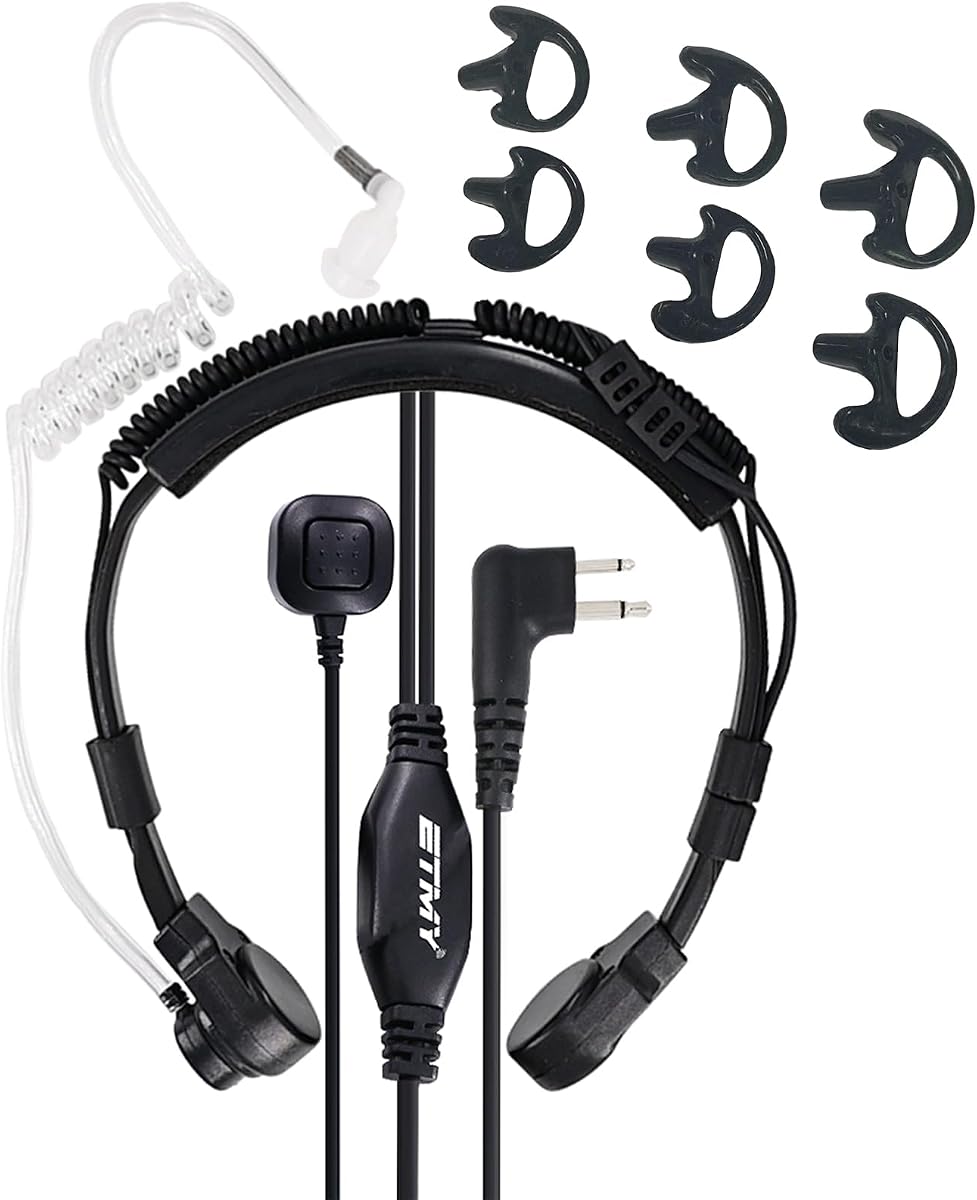
The ETMY K-2 PIN Throat Mic has a 3.9 rating and is aimed at players who need one headset to cover several popular radio brands. Its stated support includes Retevis, Pxton, Baofeng, and Kenwood models, with numerous examples across the UV-5R, UV-82, RT68, RT22, H777, TH-D7, TH-F6, and TK-208 families.
We may earn a commission when you buy through this link, at no additional cost to you.
The listing emphasizes throat vibration sensing as a way to reduce ambient interference during airsoft, motorcycle riding, construction work, hunting, and other noisy activities. It includes three pairs of small, medium, and large silicone earbuds to help prevent the air tube from falling out. A stated weight of 62 grams and a 150-centimeter cable complete a mobile-oriented design.
The 40-percent ambient-noise reduction claim in the product information lacks detailed test conditions, so it should be treated as a manufacturer claim rather than an independently established result. A single-ear air tube may also reduce the natural awareness provided by two open earbuds. Users should inspect connector fit, control behavior, and cable routing in real conditions.
This is the strongest budget pick for a mixed-brand gaming team that already uses K-connector radios. It combines broad model coverage, multiple eartip sizes, a light stated weight, and a design expressly aimed at high-noise use. It is less useful for PC-only players and for anyone whose radio uses an M-type or proprietary connector.
Supporting Retevis, Pxton, Baofeng, and Kenwood models makes standardization easier for groups that do not all own the same radio. Exact model verification remains essential because connector labels do not always describe every mechanical and electrical difference.
Three eartip sizes give users a better chance of securing the single-ear tube during movement. This is particularly helpful for airsoft, cycling, and motorcycle-related gaming, where a loose earbud can interrupt communication.
We may earn a commission when you buy through this link, at no additional cost to you.
The 3.5mm Throat Mic is the most directly connected gaming option in the roundup, with a 3.2 rating. It ends in a standard 3.5mm jack and is listed for cell phones, smartphones, laptops, computers, Android devices, iPhones, tablets, iPods, and game machines including the PlayStation 5.
We may earn a commission when you buy through this link, at no additional cost to you.
Its throat mic transmits speech through vibration rather than ambient pickup, and the transparent acoustic tube provides discreet listening. A finger PTT offers a way to control communication during gaming and other activities. The product information also describes professional applications including security, transportation, restaurants, warehouses, and other noisy workplaces, illustrating its broader tactical-radio roots.
The 3.2 rating is the lowest among the ten products, and the long list of named devices includes many older phone models rather than current gaming platforms. A 3.5mm jack does not automatically guarantee plug-and-play communication on every modern console or PC configuration. Users may need a suitable adapter, software routing, or a headset-supporting controller input.
Despite those caveats, this is the best product here for a gamer who wants a throat-based headset without operating a two-way radio. It is especially relevant when the gaming platform accepts a 3.5mm headset. Confirm the expected microphone and playback behavior with the selected device before committing, and consider the lower rating when deciding whether its convenience is sufficient.
A 3.5mm plug offers one of the simplest ways to connect a throat mic to a compatible phone, computer, controller, or console. The result is a practical alternative to a conventional boom headset for players who want their mouth unobstructed.
The transparent tube is intended to keep listening discreet. It can make communication less visually obvious at tournaments, social events, or shared gaming spaces where an open speaker would be inconvenient.
We may earn a commission when you buy through this link, at no additional cost to you.
The HyperX Quadcast 2 Frost has a 4.6 rating and represents a different gaming-audio approach. It is a USB desktop microphone intended for gaming, streaming, and podcasting, with onboard controls, LED lighting, and a removable shock mount. It does not use throat vibration, but it offers a familiar broadcast-style option for creators who want direct control over voice capture.
We may earn a commission when you buy through this link, at no additional cost to you.
Its main advantage is straightforward PC integration through USB and physical controls that can be reached during a broadcast. A removable shock mount helps isolate the microphone from vibration, while the desktop design keeps the microphone stable in a fixed position. This makes it more appropriate for a streaming desk than for mobile first-person shooter communication with a squad.
The principal drawback is category mismatch. A desk microphone cannot provide the same low-profile, hands-free, radio-network experience as a neck-worn throat mic. It also occupies a fixed position, which is a disadvantage for a player who moves around a room or uses a racing, flight, or motion-controlled setup. The supplied product data gives only the concise product identity, so detailed claims about polar patterns or software should be confirmed separately.
Choose the Quadcast 2 Frost if the priority is high-quality voice capture for PC streaming or recorded gaming commentary rather than throat-based radio communication. It is the strongest-rated conventional gaming microphone in this list, yet it serves a different workflow. For in-match squad communication through a radio, choose a compatible throat headset instead.
On-board controls are useful because a streamer can adjust audio without navigating software menus mid-session. They also make the microphone more approachable for players who want straightforward setup and monitoring.
The removable shock mount and desktop format suit a fixed streaming position. Players who need mobility, privacy, or communication with a separate two-way-radio network should not treat it as a direct substitute for a neck-worn throat mic.
We may earn a commission when you buy through this link, at no additional cost to you.
The DJI Mic Mini has the highest rating in the roundup at 4.7 and is designed for wireless recording, livestreaming, interviews, and content creation. The package includes two transmitters, one receiver, and a charging case. Each transmitter weighs 10 grams, making the system far more portable than a desktop microphone.
We may earn a commission when you buy through this link, at no additional cost to you.
Its audio specifications include 48-kilohertz sampling, a maximum 120 dB SPL, and a stated transmission range of up to 400 meters. The charging case supports up to 48 hours of battery life, while Basic and Strong noise-cancellation levels offer options for indoor and noisier situations. Automatic limiting is included to reduce the chance of clipping when input levels become excessive.
This is not a throat mic and therefore does not meet the core vibration-based communication needs of a player seeking a discreet radio headset. The product also requires the user to adopt its wireless transmitter and receiver workflow, and the listed direct-connection options concern DJI devices rather than gaming platforms. Its 4.7 rating reflects performance in its intended creator market rather than direct competition with the tactical headsets.
Consider the Mic Mini for hybrid-content creation, such as capturing commentary separately during a gaming event or producing mobile video around a match. It is an excellent wireless recording system within that use case. If the requirement is live squad communication through a two-way radio, choose one of the dedicated K-connector, M-connector, or 3.5mm throat products instead.
The ten-gram transmitters are small enough to wear discreetly and support a mobile creator workflow. That makes the system useful for interviews, livestreaming, and video recorded around live gaming events.
Two noise-cancellation levels allow the user to choose between Basic processing for quiet rooms and Strong processing for noisier settings. Automatic limiting adds another layer of protection against unexpectedly loud or close vocal input.
We may earn a commission when you buy through this link, at no additional cost to you.
The right throat mic for gaming depends first on how your team communicates. Radio connector standards, device audio routing, wearing preferences, and environmental noise matter more than the word gaming itself, so use the following factors to narrow the field before comparing ratings.
Start by identifying the exact device that must receive the microphone audio. Traditional throat headsets generally terminate in a radio-specific two-pin connector, such as K-head or M-type arrangements, while the 3.5mm model connects to compatible phones, computers, controllers, and other audio devices. The HyperX Quadcast 2 Frost uses USB for a fixed PC setup, while the DJI Mic Mini operates as a wireless transmitter and receiver system. Connector shape alone does not prove compatibility: pin layout, radio functions, and platform support must all align.
Radio compatibility should be checked model by model rather than by connector label. The products in this roundup mention Retevis, Pxton, Baofeng, Kenwood, Motorola, Element, and Z Tactical systems, but the coverage differs significantly. Some headsets support a K-head plug while excluding DEWALT radios, whereas the ETMY M-Connector model is specifically limited to Motorola two-pin systems and is not compatible with Baofeng radios. Look for the exact radio model in the listing and compare the plug, wiring, and PTT requirement before ordering.
A throat mic can reduce the effect of ambient noise because it detects speech vibration along the neck rather than relying entirely on a capsule exposed to the room. That makes it valuable for loud tournaments, crowded events, cycling games, and airsoft. However, claims such as a specified percentage reduction should not be treated as guaranteed because throat contact, speaking volume, wind, and room acoustics all affect results. Products with a close, adjustable sensor and a properly positioned earpiece generally offer a more useful combination for noisy play.
Push-to-talk can be more useful than an open microphone during team play because it limits background transmission and makes it clear who is speaking. Finger PTT designs let a player activate the radio without removing a hand from a controller, although the switch must be positioned carefully to avoid accidental presses. Dedicated radio PTT units may offer a more tactical feel, but they can add bulk. Confirm whether the control is integrated into the cable, supplied as a separate unit, and compatible with the radio's accessory port.
Gaming sessions can last long enough for neck comfort and cable management to matter. Adjustable neckbands, flexible sensing sections, and multiple eartip sizes help create a stable fit across different users. A tighter or more secure fit may stay in place during running and climbing, but it should not feel restrictive. Long cables can be routed under clothing to reduce tangles, yet players should also consider whether the tube or wires could snag on a desk, chair, steering wheel, or game controller.
A neck-worn throat mic is discreet, mobile, and designed for radio communication. A desktop USB microphone is easier to position for commentary and can be a better fit for a streamer who talks continuously while seated. A wireless lavalier system is also discreet but is optimized for recording and creator workflows rather than a radio network. The most useful product is the one whose form factor matches the actual activity: rapid in-match communication, stationary streaming commentary, or mobile content capture.
Construction details influence both durability and daily convenience. Flexible PU or nylon cables, lightweight neckbands, and removable or multi-sized earbuds can improve long-session comfort. Transparent tubes and silicone earpieces offer a lower-profile appearance, while extra earplug sizes can help achieve a secure seal. At the same time, more specialized hardware does not automatically mean better performance. Compare the included PTT, cable, connector, and eartips to ensure every component is actually usable with the intended device.
Customer ratings can offer a useful signal about fit, consistency, and connector reliability, but they remain subjective and change over time. A lower-rated product may still be ideal for a particular device, while a highly rated product may not support the radio in your team. Read the supplied specifications and compatibility notes first, then use ratings as supporting evidence. Because availability, product revisions, and current retailer pricing can change, confirm the listing immediately before purchasing.
Begin by confirming that the connector, radio, and PTT system are compatible. Connect the headset with the equipment powered off, tighten the neckband so the sensing area sits close to the throat without restricting breathing, and route the tube and cables away from sharp edges. For a 3.5mm product, check the device's audio input behavior and test both microphone and headphone output before entering a match.
Speak at a controlled volume and ask a teammate to confirm that the throat signal is clear. Adjust the neck position rather than simply increasing the radio volume if the transmission sounds weak. Place a finger PTT where it can be reached without blocking normal controller inputs, and test for accidental activation while standing, sitting, running, and looking through a typical gameplay view.
After each session, disconnect the headset gently and wipe the neck sensor and earbud surfaces with a lightly dampened soft cloth. Do not immerse the electronics or push moisture into the connector. Keep cables from forming tight knots, inspect the PTT and plug for strain, and store the device in a dry place. Replace damaged cables, loose earbuds, or degraded connectors before the next session.
Yes, but the connection must match the gaming setup. A 3.5mm throat mic can work with compatible phones, computers, controllers, and some consoles, while traditional two-pin headsets are designed for supported two-way radios. A USB desktop microphone and a wireless lavalier system are also useful for gaming commentary, although they are not throat-vibration communication devices. Test the audio routing before a match.
No, they should not be assumed to be interchangeable. Although both may be described as two-pin radio connectors, their plug shapes, wiring, and intended radio families can differ. The ETMY M-Connector model is specifically for Motorola two-pin systems and is not compatible with Baofeng radios. Check the exact model list and the accessory port on the radio before purchasing.
A throat mic detects vibration from the vocal cords and nearby throat tissues rather than relying primarily on sound arriving through the air. Nearby voices, music, wind, and game effects can therefore have less influence on the transmitted signal. Actual clarity still depends on correct placement, speaking volume, radio compatibility, and the quality of the receiving system.
A two-pin radio throat mic does not normally plug directly into a PC or console headset port. It may work if the radio is connected to the computer as a separate communication device and the appropriate audio software routes its input and output. The direct alternative in this roundup is the 3.5mm throat mic, but its exact device support should still be verified.
The ETMY K-2 PIN Throat Mic and the Retevis Adjustable Throat Mic are both compelling options because they support common radio brands, use vibration-based pickup, and include finger PTT controls. The ETMY model emphasizes multiple eartip sizes and a lightweight design, while the Retevis model offers broad named radio support and a 4.1 rating. Choose based on the exact radios your team uses.
The sensing section should sit close enough to the throat to capture speech clearly while remaining comfortable during extended wear. An adjustable neckband helps achieve this, but it should not be so tight that it restricts movement or breathing. Route the tube and cables away from the collar, then test the fit while speaking and moving in the posture used during gameplay.
It is highly useful when a team shares a radio channel because it makes the active speaker obvious and prevents ambient noise from interrupting every transmission. A finger PTT offers quick control during fast play, while a separate tactical PTT may feel more natural to some users. Position the control carefully and test that it does not activate when bumped.
They may be better for continuous commentary from a fixed position. The HyperX Quadcast 2 Frost provides a USB desktop format with onboard controls, while the DJI Mic Mini supports discreet wireless recording for mobile creator workflows. Neither transmits speech through throat vibration, so a throat mic remains preferable for private, low-profile live radio communication.
The Retevis Adjustable Throat Mic is the strongest overall choice for gaming because it combines a 4.1 rating with broad two-pin radio support, an adjustable neck, a discreet tube, and finger push-to-talk operation. The ETMY K-2 PIN Throat Mic is the best budget option for teams using Retevis, Pxton, Baofeng, or Kenwood radios, while the 3.5mm Throat Mic is the most direct choice for a compatible gaming device without a two-way radio.
The key decision is not simply which model has the highest rating. Players using a two-pin radio should identify its exact brand and model, then choose a matching connector. Direct gaming users should check whether their platform accepts 3.5mm audio, while streamers should decide between a throat headset, a fixed USB microphone, and a wireless creator system based on mobility and commentary style.
Before buying, compare the connector, PTT, fit, and intended environment against the supplied compatibility details. Customer ratings and current prices can change, so check the latest listing and availability at the time of purchase. With the right interface and a properly positioned throat sensor, a gaming communication setup can become clearer, more private, and better suited to noisy play.