
GIANDEL 4000W Pure Sine Wave Inverter
4.4Editor score
Less than 3% THD
ETL listed design
Hardwired heavy-load terminal
Discover the best 4000 Watt Power Inverter options, comparing pure sine wave output, surge capacity, ports, remotes, protection, and battery compatibility.
A 4000 watt power inverter turns battery power into household-style AC electricity, making it useful for RVs, trucks, boats, off-grid cabins, job sites, and emergency backup systems. A strong model combines usable continuous output, clean power, effective protection, and convenient controls.
We compared all ten models by waveform, continuous and surge capacity, outlet configuration, charging ports, remote monitoring, cooling, installation options, and compatibility with common 12V batteries. The list includes pure sine wave and modified sine wave units suited to different loads, budgets, and operating environments.
Each review identifies the standout features, practical limitations, and most likely use case. Ratings reflect the supplied customer feedback, while technical details come from the manufacturer information. Current prices and availability can change, so confirm the latest listing before purchasing.
Choosing among these inverters ultimately depends on the appliances you plan to run, the type of battery connected to the system, and how important clean AC output and remote monitoring are to your setup.
4.4Editor score

4.4Editor score

5.0Editor score
The comparison below highlights the major differences among these ten 4000 watt inverters, including waveform quality, continuous output, surge capability, outlet options, remote controls, and battery connections.




This 4000W pure sine wave inverter earns the Editor's Choice position because it combines clean 12V-to-110V conversion, 4000 watts of continuous output, an 8000-watt surge rating, and unusually flexible battery compatibility. Its 4.4 rating reflects broadly positive customer feedback, while the manufacturer information emphasizes stable power, comprehensive protection, and easy remote monitoring.
We may earn a commission when you buy through this link, at no additional cost to you.
The adjustable low-voltage shutdown is a particularly valuable feature. It can be configured from 9.5V to 11V, making the unit suitable for LiFePO4, AGM, gel, SLA, and deep-cycle batteries when the battery chemistry and charging setup are configured correctly. The 15-foot wired remote displays battery voltage, output voltage, load wattage, frequency, and warning indicators, reducing the need to open an enclosure or repeatedly inspect the main unit.
Four AC outlets, a USB port, and a Type-C charging port make it convenient for mixed loads. The included battery cables, remote controller, and user manual create a reasonably complete package, while the stated 12-month support period provides some reassurance after installation. The lack of a dedicated high-current hardwire terminal is a limitation for installers who want a permanent connection for heavy appliances or a professionally routed circuit.
This is the strongest all-around recommendation for RV travel, mobile living, emergency backup, and off-grid use. It suits people who want pure sine wave power without moving to a more specialized installation. Buyers planning to run several high-draw appliances at once should calculate their running and startup loads and ensure the battery and cable system can carry the required current.
Pure sine wave output is particularly helpful for sensitive electronics, audio equipment, medical devices, and appliances with motors or compressors. It also makes this inverter a more natural fit for users who do not want to experiment with the possible noise, heat, or reduced starting performance associated with modified sine wave power.
The wired LCD controller is useful when the inverter is mounted inside an RV cabinet, truck bed enclosure, backup-power room, or other concealed location. Seeing voltage, frequency, load, and fault information at a glance makes it easier to shut the unit down before a battery becomes deeply discharged.
We may earn a commission when you buy through this link, at no additional cost to you.
LANDERPOW's 4000 watt inverter combines pure sine wave output, a stated efficiency above 91%, 4000 watts of continuous capacity, and 8000 watts of surge capability. Its 4.4 rating places it firmly among the well-regarded products in this list. The strongest differentiator is the hardwired terminal, which gives installers an option beyond plugging appliances into the four AC receptacles.
We may earn a commission when you buy through this link, at no additional cost to you.
Output flexibility is broad. The four AC outlets can support ordinary household tools and appliances, while the hardwired terminal is intended for high-current loads or fixed wiring. A 5V/3.1A USB port and 30W PD port provide convenient charging for phones, tablets, and compatible USB-C devices, reducing the need to carry separate adapters when the inverter can safely charge them.
The two 1AWG, two-foot pure copper battery cables are specified to help carry current efficiently, and the manufacturer states that the full metal shell supports heat dissipation and durability. Protection covers undervoltage, overvoltage, overload, overheating, short circuits, and reverse connection. The three-year total coverage combines a one-year replacement period with two additional years of support, though the precise terms should be confirmed on the listing.
This inverter is a good fit for RV owners, mobile contractors, and home-backup users who want both convenient receptacles and a permanent connection option. Its 15-foot wired remote also helps with control and monitoring, although a wireless panel might be more convenient in some installations. As with any high-power unit, battery capacity, cable length, and ventilation should be planned before adding loads.
The hardwired AC terminal expands the inverter beyond a basic travel accessory. It can suit a fixed installation where a receptacle-only design would be inconvenient, although proper circuit sizing, grounding, fusing, and local electrical requirements remain the installer's responsibility.
USB-A and USB-C charging options are useful for phones and smaller electronics, while the LED remote provides battery-level, output, and error information. That combination reduces the number of separate accessories needed during travel or outages, provided the inverter is installed with adequate ventilation and current capacity.
We may earn a commission when you buy through this link, at no additional cost to you.
The Yinleader 4000 watt inverter is the value-oriented choice in this guide and carries a perfect 5.0 rating in the supplied product data. It provides 4000 watts of continuous output, 8000 watts of peak surge, and conversion efficiency above 90%. The dual-screen design gives users information both on the inverter and on a 16.5-foot wired remote.
We may earn a commission when you buy through this link, at no additional cost to you.
Three AC outlets support several smaller devices at once, and the included USB port handles basic charging. Compatibility with lead-acid, gel, and lithium battery systems broadens the possible applications, although users should confirm appropriate voltage settings and charging compatibility for the exact battery they use. The installation package includes the main unit, wired remote, manual, and connection cables.
Its intelligent cooling system responds to internal temperature and load, with the fan described as activating above 45 degrees Celsius or during high-power operation. Multiple protections cover overvoltage, undervoltage, overload, short circuit, overcurrent, overheating, and reverse polarity. The impact-resistant, heat-dissipating casing is designed for RV, off-grid solar, and emergency environments.
This model makes the most sense for straightforward use with resistive loads, standard electronics, lights, and selected power tools where modified sine wave output is acceptable. It is less attractive for sensitive medical devices, audio equipment, or other loads that benefit from cleaner AC. The strong rating, remote display, and clear protection package make it an appealing budget entry.
The second display is a meaningful convenience in an RV, truck, or cabin where the inverter may be mounted out of sight. Input and output voltage, frequency, and operating status can be checked from the remote, helping users identify changing battery conditions or fault states without moving the installation.
Cooling that responds to both temperature and load can reduce unnecessary fan noise during lighter use while supporting heat removal under demanding conditions. The enclosure's cooling design and protected electronics make it better suited to mobile and off-grid applications than a basic travel inverter.
We may earn a commission when you buy through this link, at no additional cost to you.
The Energizer 4000 watt car inverter stands out for formal safety recognition and straightforward vehicle-focused design. It is described as tested, validated, and approved by ETL under UL Standard 458, and the product information includes a two-year warranty. Its 4.4 customer rating indicates positive reception despite the move toward more feature-rich competitors.
We may earn a commission when you buy through this link, at no additional cost to you.
The inverter delivers 4000 watts of continuous modified sine wave power and 8000 watts of peak power. Two North American AC receptacles are rated at 15 amps each, and two USB ports provide 2.4 amps apiece. These connections cover common travel electronics, lights, media devices, and smaller appliances, while the included battery cables support direct connection to a vehicle battery.
The LCD display provides protection status, input voltage, output wattage, and battery level, which is important when a vehicle's alternator and battery are responsible for the load. Overload, overvoltage, undervoltage, high-temperature, and short-circuit protection are included. A hardwire kit gives users a path toward a more permanent connection.
Energizer is best for travelers seeking a reputable safety listing, uncomplicated outlets, and direct battery use. It is less suitable for sensitive electronics that require a pure sine wave, and the two-receptacle layout limits simultaneous use compared with four-outlet alternatives. Users should still size their battery system and fuse the cable run appropriately.
ETL approval under UL 458 provides a tangible compliance point that many listings do not offer. For mobile users who frequently connect different loads, documented safety testing and protection circuitry can be more persuasive than a long list of otherwise similar features.
Two AC outlets, two USB ports, battery cables, and a hardwire kit cover the common needs of a road trip. The LCD helps users track the vehicle battery and active output, though cable polarity and connection order should always be checked before switching the unit on.
We may earn a commission when you buy through this link, at no additional cost to you.
Sunivora's 4000 watt inverter differentiates itself with a remote control stated to operate from as far as 165 feet away. That range is useful in a large RV, workshop, garage, or installation where the main unit is inconvenient to reach. The product carries a 4.3 rating and provides 4000 watts of continuous modified sine wave power with an 8000-watt surge rating.
We may earn a commission when you buy through this link, at no additional cost to you.
Its LCD information is unusually detailed, covering input and output voltage, battery capacity, load capacity, output frequency, radiator status, converter temperature, and the cause of a protective shutdown. The aluminum shell incorporates integrated stamping, cooling fins, and intelligent fans. Two 0 AWG pure copper cables are included for battery connection, and the socket layout is designed to accept multiple large plugs.
Protection includes undervoltage, overvoltage, overload, overheating, short circuit, and reverse connection. The isolated PWM discharge design and low-interference technology are intended to improve compatibility with connected equipment. The package includes the inverter, two-foot cables, remote control without a battery, and instructions.
This is a good option for users who prioritize remote reach and detailed fault information over pure sine wave cleanliness. It can serve appliances, tools, lighting, refrigerators, and similar loads in vehicles or temporary power arrangements. The missing remote battery is a small inconvenience, and sensitive electronics may be better served by a pure sine wave model.
A 165-foot operating range is longer than the wired panels offered by many competitors and can keep an inverter accessible in a camper, truck enclosure, or workshop. Users should still confirm that the stated range is realistic within their particular installation and that walls or vehicle structures do not significantly interfere with the signal.
Showing the reason for protection can save time when troubleshooting an overloaded or overheated system. The LCD's battery, temperature, and radiator readings provide a clearer picture than a single status LED, making the Sunivora appealing for users who want system visibility.
We may earn a commission when you buy through this link, at no additional cost to you.
The GIANDEL 4000W pure sine wave inverter is the premium selection because it combines very clean output with professional safety compliance and a complete installation package. It provides 4000 watts of continuous power, 8000 watts of peak power, efficiency up to 91%, and total harmonic distortion below 3%. Its customer rating is 4.4.
We may earn a commission when you buy through this link, at no additional cost to you.
The product is described as complying with UL 458 and using an isolated input/output design with soft-start behavior. Four AC receptacles handle regular plug-in loads, while a hardwire block terminal supports a load of 1500 to 4000 watts. A single 2.4A USB port offers basic device charging, and an LED display provides operating feedback.
The aluminum alloy housing, intelligent cooling fan, and shock-proof pads are designed for physical protection and heat management. Seven protections cover high voltage, low voltage, overload, short circuit, overheating, and reverse polarity, with a fuse included in the protection design. The package includes three pairs of 4 AWG cables, a one-meter ground wire, and shock-proof pads.
GIANDEL is the strongest recommendation for users who prioritize waveform quality, established safety documentation, and a hardwired connection. It suits RVs, boats, trucks, solar systems, and outages where sensitive equipment benefits from stable AC. The lack of a remote is the clearest drawback, especially for installations where the inverter must be mounted in a concealed cabinet.
A stated total harmonic distortion below 3% is the defining technical advantage of this model. That specification supports smoother compatibility with sensitive electronics, audio equipment, medical devices, and variable-speed or compressor-based appliances that may behave poorly with a coarse waveform.
Three pairs of 4 AWG cables, a ground wire, and shock-proof pads make the package more installation-ready than a basic inverter-and-cable bundle. A hardwired terminal also provides a path for heavier fixed loads, although proper grounding and circuit protection are still necessary.
We may earn a commission when you buy through this link, at no additional cost to you.
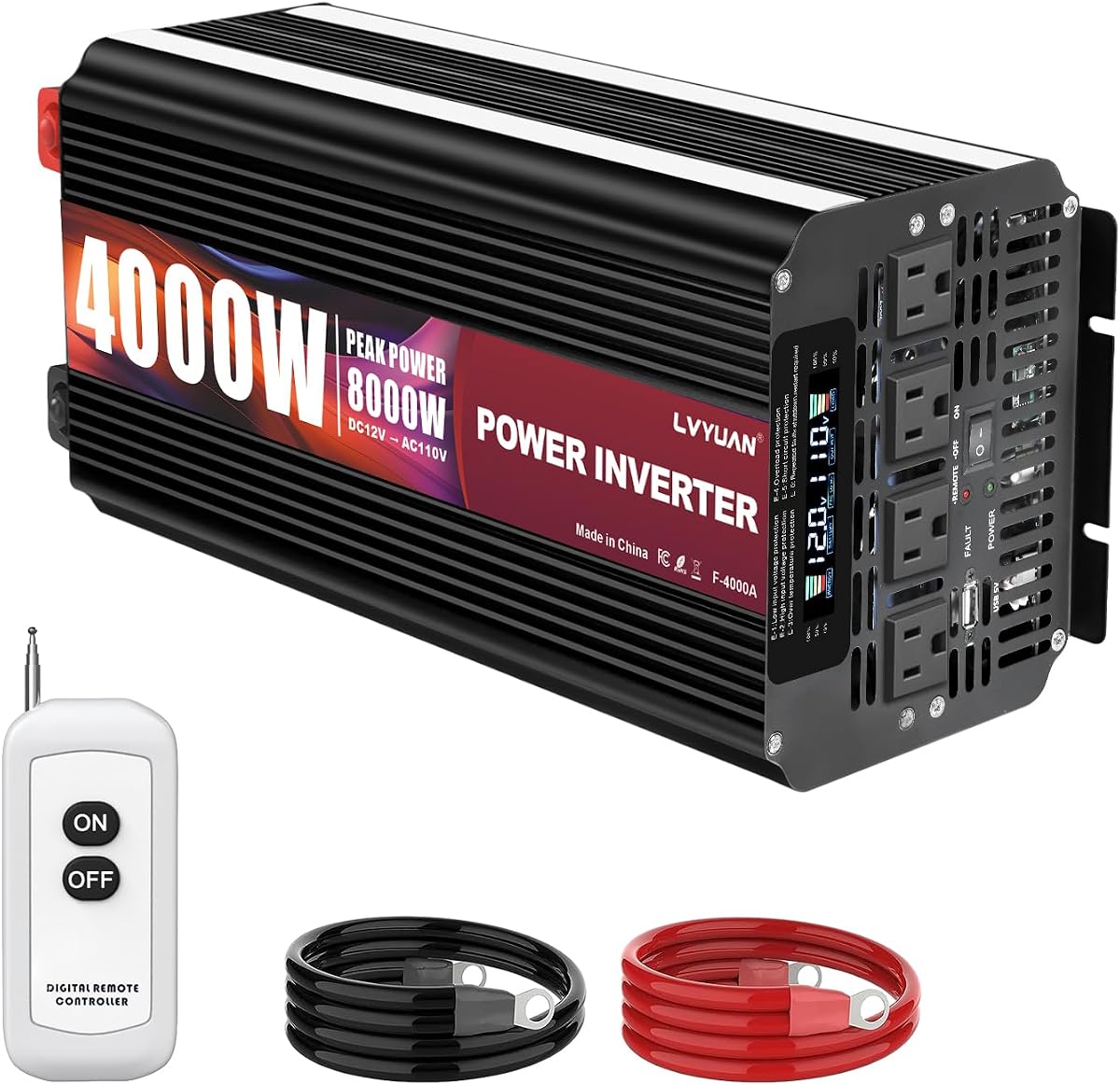
The LVYUAN 4000 watt inverter is a versatile mobile and off-grid model with a 4.5 rating, placing it among the highest-rated products here. It supplies 4000 watts of continuous modified sine wave output, 8000 watts of surge power, and converts 12V DC into 110V or 120V AC for vehicles, RVs, trucks, cabins, and solar-backed systems.
We may earn a commission when you buy through this link, at no additional cost to you.
Four AC receptacles and a hardwired terminal offer more connection flexibility than a basic two-outlet travel inverter. The LCD display shows voltage, battery level, load, and alerts. Its wireless remote is a notable convenience for installations inside RV cabinets, tool trucks, or solar equipment enclosures where a wired panel would be inconvenient.
The intelligent cooling fan is described as activating when the internal temperature exceeds 104 degrees Fahrenheit or the load exceeds 45%. Protection includes overvoltage, undervoltage, overload, short circuit, reverse polarity, and overheating. These controls make it easier to maintain a stable installation and identify the reason for a shutdown.
LVYUAN is a good fit for mobile users who want remote access and several outlets. Modified sine wave output is acceptable for many tools, household devices, and lights but may not be ideal for especially sensitive electronics. The hardwire terminal should be used only with appropriate wiring, grounding, and overcurrent protection.
The wireless panel simplifies remote switching and status checks in confined installations. It is especially attractive when the inverter sits behind cabinetry or inside a protected enclosure, where a wired remote would need to be routed through the installation.
Four receptacles support several everyday loads while the hardwire terminal adds a permanent option for heavier equipment. This makes the inverter more adaptable than a travel-focused model, though the user must verify that each load's surge demand and the installation's current path are within limits.
We may earn a commission when you buy through this link, at no additional cost to you.
This 4000W pure sine wave inverter offers one of the broadest remote-control packages in the group, supplying both a wireless controller and a wired LED panel. It produces 4000 watts of continuous 110V or 120V AC at 60Hz, with 8000 watts of peak capacity and conversion efficiency above 90%. Its supplied rating is 4.1.
We may earn a commission when you buy through this link, at no additional cost to you.
Four AC receptacles serve standard household appliances and electronics, while the remote panel includes a 5V/3.1A USB port and a 20W Type-C port. A dual LCD arrangement allows the operating state to be viewed from more than one location. The manufacturer includes both remotes, two battery cables, an instruction manual, and a 12-month warranty.
Protections cover overcurrent, short circuit, low load, overload, overheating, and overvoltage, with a cooling fan, LED indicator, and built-in fuse. The aluminum alloy housing is designed for durability and heat dissipation. The product data specifically advises making sure the inverter itself is turned off before starting it with either remote.
This model is appealing for RV and off-grid users who want clean power and flexible control. It can support game consoles, vacuums, cameras, ovens, coffee makers, refrigerators, and similar loads, but users should check startup demand carefully. Its lower customer rating and startup procedure deserve attention, so buyers should read recent feedback and follow the manual closely.
Having both wired and wireless remotes is useful when one person works near the inverter and another needs to check status from a distance. It also gives users the option to choose the more convenient panel without relying on a single control method.
Pure sine wave AC is beneficial for sensitive devices, while USB-A and USB-C outputs add convenient charging options. The remote's 20W Type-C specification is modest for modern high-power devices, so it is best treated as a supplementary charging feature rather than a replacement for a full wall adapter.
We may earn a commission when you buy through this link, at no additional cost to you.
The Homkeep 4000 watt inverter is built around clear status monitoring and a generous set of output connections. It supplies 4000 watts of continuous power, 8000 watts of peak power, and efficiency above 90%. The supplied rating is 4.1, and the product's high-definition LCD and remote make system visibility one of its strongest features.
We may earn a commission when you buy through this link, at no additional cost to you.
Four AC outlets support several appliances or tools at once. Two USB-A ports deliver 3.4 amps each, and a Type-C port adds another charging option. The remote can control the inverter from up to 120 feet and shows operating status, while the main LCD displays input voltage, output voltage, and protection indications.
Six protection systems cover undervoltage, overvoltage, overload, overheating, short circuit, and reverse connection. Two smart cooling fans support heat removal and are intended to help protect connected products. The aviation aluminum alloy shell is designed to withstand collisions and harsh environments, which is relevant for truck, RV, and outdoor use.
Homkeep is best for users who want readable monitoring, many output options, and moderate remote range. One detail worth considering is the stated no-load draw of 1±0.3A, which may be noticeable during long storage periods on a smaller battery. Modified sine wave output also makes it less suitable for highly sensitive equipment than a pure sine wave model.
A large LCD that presents input voltage, output voltage, and protection status gives users a more immediate view of system conditions. This is especially helpful when diagnosing a low-battery shutdown, overload, or reversed battery connection.
Two 3.4A USB ports and a Type-C port cover common charging needs for several small devices. Because the inverter's main purpose remains 110V or 120V AC output, these ports should be treated as convenient additions rather than evidence that the unit can sustain unlimited simultaneous charging.
We may earn a commission when you buy through this link, at no additional cost to you.
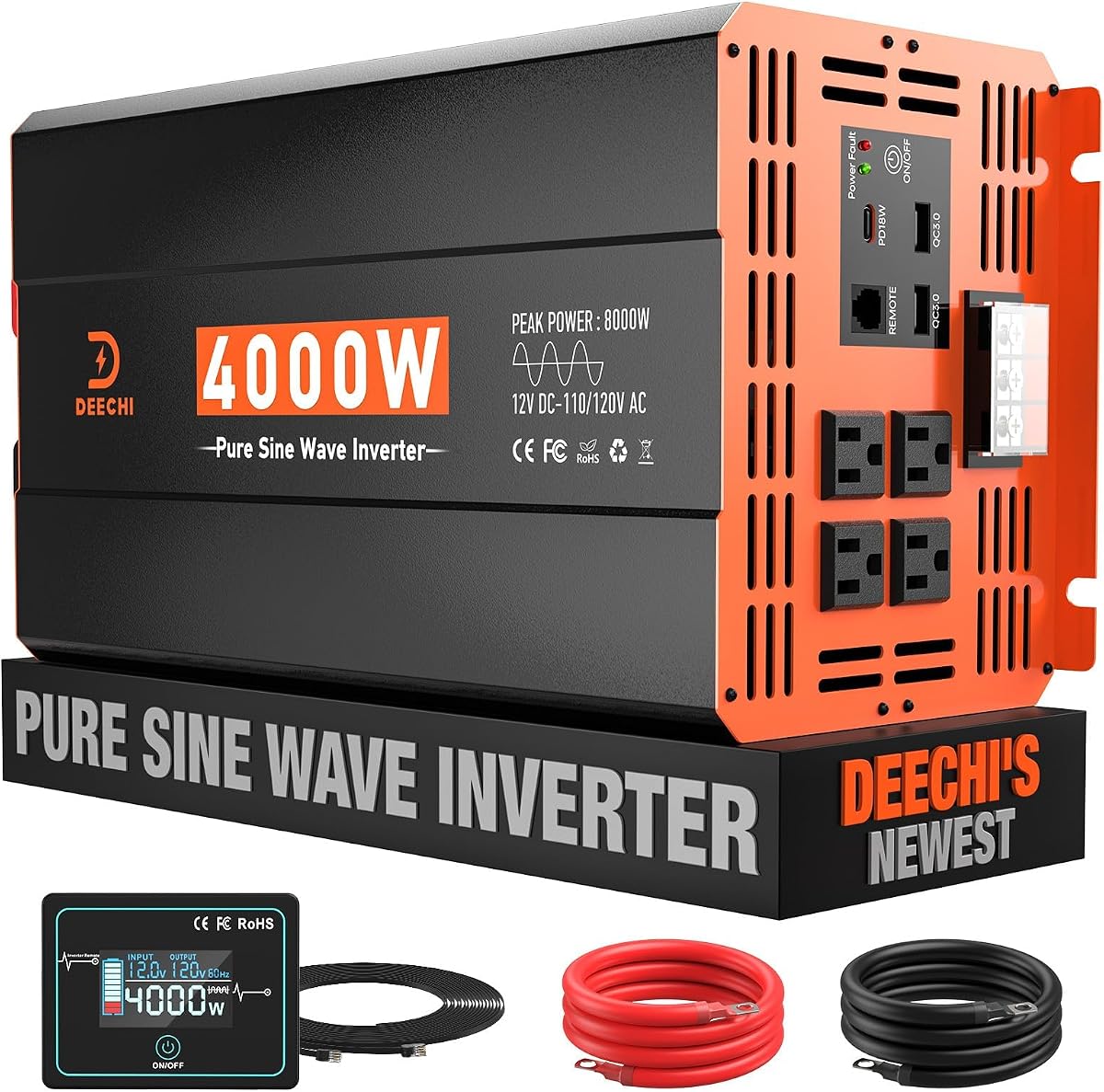
The DEECHI 4000W pure sine wave inverter rounds out the list as a durable option for RV, truck, home, solar, and general vehicle power. It delivers 4000 watts of continuous 110V or 120V AC and 8000 watts of peak power, with a supplied customer rating of 4.4. The manufacturer describes the output as comparable in quality to grid electricity.
We may earn a commission when you buy through this link, at no additional cost to you.
Four standard North American AC receptacles, two USB ports, one 18W Type-C port, and a hardwire kit provide flexible connections. The inverter is compatible with 12V and 12.8V batteries according to the product information, and it includes a pure copper flexible cable. These features make it appropriate for mixed loads ranging from electronics to household appliances.
The aircraft aluminum shell is designed to resist drops and collisions, while dual intelligent temperature-controlled fans are intended to reduce heat and keep operation quiet. A 16.5-foot wired color-display remote provides control and status information. That panel length is sufficient for many installations, although users needing shorter-distance wireless control may prefer a different model.
DEECHI is a strong option for users who want clean output without paying for an extensive accessory package. The hardwire kit and pure copper cable add installation value, while the remote helps manage the unit in an RV or vehicle. The lack of a stated surge-time specification and the modest Type-C rating are minor considerations when comparing it with more extensively specified competitors.
The aircraft aluminum housing and dual cooling fans target a demanding operating environment where vibration, bumps, and heat are common. These attributes make the inverter suitable for installation in vehicles, trailers, and mobile work setups when it is secured and ventilated correctly.
Pure sine wave output supports cleaner operation of sensitive equipment, while the hardwire kit creates an option beyond the four standard receptacles. This balance makes DEECHI practical for users who need both normal household connections and a more permanent installation path.
We may earn a commission when you buy through this link, at no additional cost to you.
A useful purchase decision depends on electrical quality, load behavior, battery system, controls, and installation demands. Comparing those factors before checkout is more important than focusing only on the headline 4000-watt rating.
Choose pure sine wave for broad compatibility; choose modified sine wave for basic loads. A cleaner waveform reduces uncertainty.
Compare both running and starting watts. Do not overload the inverter.
Match the inverter to battery chemistry and voltage. Verify cutoff settings before use.
Count outlets, hardwire options, and charging ports. Prioritize needed connections.
Choose wired or wireless control based on installation access. Detailed status helps troubleshooting.
Confirm all essential protections. Provide ventilation around the housing.
Use suitable cable gauges and secure connections. Ground and protect fixed installations properly.
Favor higher efficiency and demand-based cooling. Check size before installation.
Before connecting anything, identify the inverter's input voltage, confirm battery polarity, read the manual, and calculate the total running and starting demand of every planned load. Keep the inverter uncovered and position it in a dry, ventilated location. Connect the remote according to its instructions, and use appropriately rated cables and overcurrent protection for a permanent installation.
Start with the inverter switched off, attach the positive battery lead first, and then the negative lead. After checking the connection, turn on the inverter and verify the displayed input voltage, output voltage, frequency, and battery condition. Add one appliance at a time so any overload or connection problem can be isolated. If the unit shuts down, read the protection message rather than repeatedly restarting it.
For long-term care, keep the vents clear, inspect cable insulation and terminals, and periodically check the battery's state of charge. Shut down and disconnect the battery when the inverter will remain unused for an extended period. Do not exceed the rated continuous load, use the surge rating as a continuous-power allowance, or operate the unit in a sealed, hot, damp, or combustible environment.
A 4000 watt inverter usually has ample continuous capacity for one typical household refrigerator, but startup surge must be considered. Check the refrigerator's running and starting requirements, along with the battery's output current and the inverter's surge specification. Give the unit adequate ventilation and avoid adding several other high-draw appliances at the same time.
Pure sine wave output closely resembles grid electricity and generally works better with sensitive electronics, audio gear, medical devices, and some motor-driven appliances. Modified sine wave output is coarser and may cause noise, heat, or unreliable starting with certain loads. It can still be suitable for basic lights, heaters, and simple tools, but pure sine wave is the safer all-purpose choice.
Many microwave ovens fall within a 4000-watt inverter's continuous range, but the microwave's nameplate requirement should be checked. A microwave may also draw a surge when it starts, and the battery must be capable of supplying the resulting current. Avoid operating the microwave with other high-draw appliances on the same inverter.
Runtime depends on battery capacity, inverter efficiency, and the actual load. A rough estimate divides usable battery watt-hours by the load's wattage and then adjusts for conversion loss. Because many appliances cycle on and off, real runtime may be longer than a simple full-load calculation, while battery age and temperature also affect results.
It depends on the complete system. A power inverter converts stored DC into AC, while a solar charge controller regulates charging from solar panels. If the battery is charged directly by a properly matched solar charging system, a separate controller may not be needed, but incompatible charging equipment can damage the battery. Follow the battery and solar-system manufacturers' recommendations.
Yes, these products are designed for connection to a 12V vehicle battery, provided the inverter is switched off during connection and the correct polarity is used. A hardwire kit and suitable fuse are advisable for a permanent installation. Short, properly sized cables help maintain stable voltage when the load is high.
Common causes include an overloaded output, insufficient battery voltage, excessive input voltage, overheating, a short circuit, or reversed battery connection. Read the LCD's protection message if one is available, then disconnect the load and allow the inverter to cool. If the battery voltage is low, recharge it and verify that the low-voltage cutoff is appropriate for the battery type.
A hardwired terminal is useful for a fixed installation or a high-current load because it avoids relying entirely on a plug and receptacle. It does not automatically make the system safer or more powerful; proper grounding, fusing, disconnects, wire sizing, and local electrical rules are still essential. Plug-in outlets remain more convenient for temporary and mobile use.
The 4000W Pure Sine Wave Inverter with LCD Remote is the strongest all-around choice because it combines clean output, adjustable low-voltage protection, multiple outlets, charging ports, and a useful wired display. GIANDEL is the premium alternative for buyers who prioritize stated low distortion, UL 458 compliance, a hardwired terminal, and a complete installation package.
For value-focused users, the Yinleader model stands out with a 5.0 rating, dual LCD displays, broad battery compatibility, 4000 watts of continuous power, and 8000 watts of surge capacity. Buyers with sensitive electronics should prioritize a pure sine wave option, while those running mostly simple tools and household appliances may find modified sine wave models sufficient.
Before buying, verify the waveform, continuous and startup loads, battery type, cable length, protection features, and outlet configuration. Current prices, promotions, warranty terms, and availability can change, so review the latest product listing and manufacturer instructions before making a final purchase.