
1/4 Compression Fitting Brass Kit
4.6Editor score
Fifty-piece component assortment
Solid brass construction
Five common line applications
No welding or flaring
Suitable for 1/4-inch tubing
Compression fittings create secure, serviceable connections in copper tubing without soldering, flaring, or welding. The right fitting depends on tube diameter, connection type, operating pressure, fluid compatibility, local code requirements, and whether the joint must accommodate vibration, movement, or repeated maintenance.
We compared the 10 products in this guide by examining their stated materials, sizes, included components, pressure and temperature limits, compatible tubing, installation requirements, and intended uses. The list covers individual adapters and tees, broad component kits, and press-fit alternatives rather than treating every product as a direct substitute.
Each review explains what the product is best suited for, the practical advantages of its design, and any limitations visible in the supplied specifications. Ratings and product details reflect the current listings, while prices and availability can change, so readers should confirm fit, certification, and current cost before purchasing.
4.6Editor score
4.7Editor score
4.3Editor score
As an Amazon Associate we earn from qualifying purchases.
This side-by-side comparison highlights each product's connection format, material, size coverage, and stated pressure capability so buyers can quickly identify the right option for a copper-tube repair, branch connection, shutoff, or line assembly.



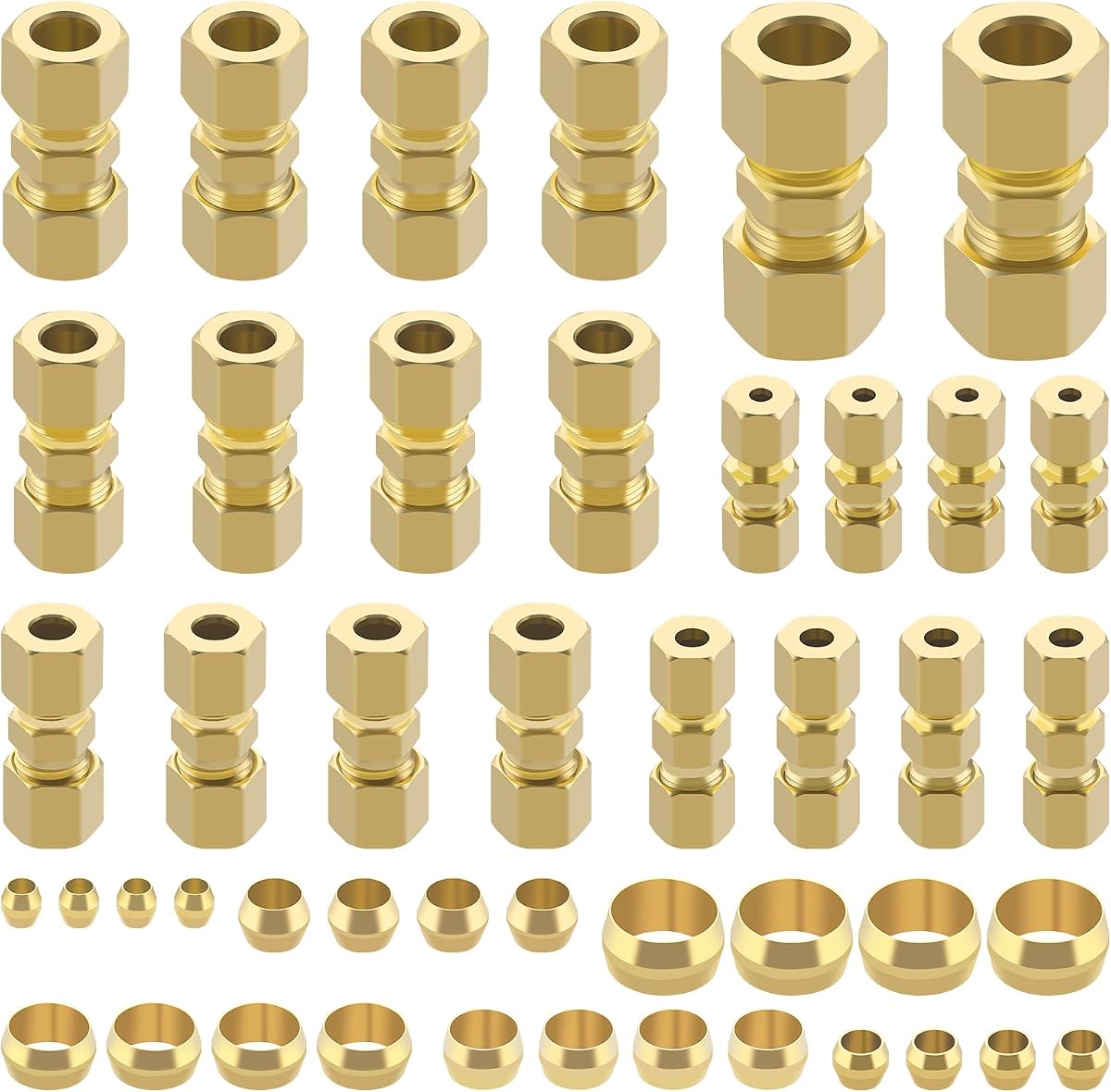
The 46pcs Brass Compression Tube Pipe Fittings Assortment Kit is a broad collection of straight compression couplings and sleeves for six tube sizes. Its 4.3 rating reflects a practical, specification-heavy option for installers who need several diameter options rather than one isolated connector. The listed 2,000 PSI maximum working pressure makes it one of the most capable compression products in this guide, although that figure should still be evaluated against the complete installed system.
We may earn a commission when you buy through this link, at no additional cost to you.
The kit is made from brass and includes 1/8-, 3/16-, 1/4-, 5/16-, 3/8-, and 1/2-inch components. It is intended for oil, gas, water, and other pipeline systems where the fluid and local requirements are compatible. Because the fittings use compression rather than soldered joints, installation, disassembly, and maintenance do not require welding or flaring tools. The broad size selection is especially useful for service work involving several smaller tube diameters.
Its main limitation is a significant regulatory one. The listing explicitly states that these copper tubing fittings contain lead and may not be installed for potable water use in the United States and its territories. That restriction means this is not the safest general-purpose choice for household drinking-water lines, even though the product description also lists water among possible pipeline applications. Buyers should treat the non-potable warning as a decisive limitation, not a minor disclaimer.
This assortment is best for compressed-air, fuel, oil, industrial, or other approved non-potable systems that use the included tube sizes. It may also appeal to experienced repair professionals who value the stated 2,000 PSI rating and the broad size range. For a drinking-water installation, choose a product explicitly approved for that use or a lead-free press system instead. Within those boundaries, it is a versatile and specification-rich kit.
Six included sizes let technicians cover common small-bore tubing without sourcing each diameter separately. This makes the assortment useful for maintenance inventories and mixed-line repairs.
The compression design can be disassembled for inspection or replacement without removing the surrounding line with a torch. That serviceability is valuable in equipment and utility applications.
We may earn a commission when you buy through this link, at no additional cost to you.
The ChillWaves Brass Compression Tube Fitting is a focused two-pack of 3/4-inch compression union connectors, giving it a clear advantage over broad assortments when the required size is already known. Its 4.4 rating is supported by straightforward construction, a stated 1,200 PSI maximum working pressure, and compatibility with oil, gas, water, and other non-corrosive pipeline systems.
We may earn a commission when you buy through this link, at no additional cost to you.
A union offers a practical reason to choose this model over a conventional coupling: the joint can be separated when equipment or a section of tubing needs servicing. The fitting includes a body, ferrule, and nut, with the nut drawing the ferrule inward so its sharp edge grips the tube and creates the seal. No welding, soldering, or flaring equipment is required for the stated installation method.
The 3/4-inch format is the main constraint. It is a purpose-specific purchase rather than a universal repair kit, and buyers should confirm whether they require 3/4-inch outside diameter or a specific threaded connection that differs from the product title. The listing also does not state lead-free or drinking-water certification, so it should not automatically be assumed suitable for potable-water work without additional verification.
This connector is a good choice for a known 3/4-inch copper line that must be joined through a serviceable union, particularly in non-corrosive industrial, fuel, gas, or approved water systems. It also offers a spare matching connector, which is helpful when future maintenance may require another union. Confirm tube diameter, thread orientation, system pressure, and local approval before installation.
Unlike a permanent soldered coupling, the union can be opened after the nut is loosened. That makes it useful where equipment may need to be removed without cutting the entire tube run.
The nut draws the ferrule radially onto the tube, producing a seal through controlled compression. The method avoids open flame and supports repeatable assembly when the compatible tubing and dimensions are used.
We may earn a commission when you buy through this link, at no additional cost to you.
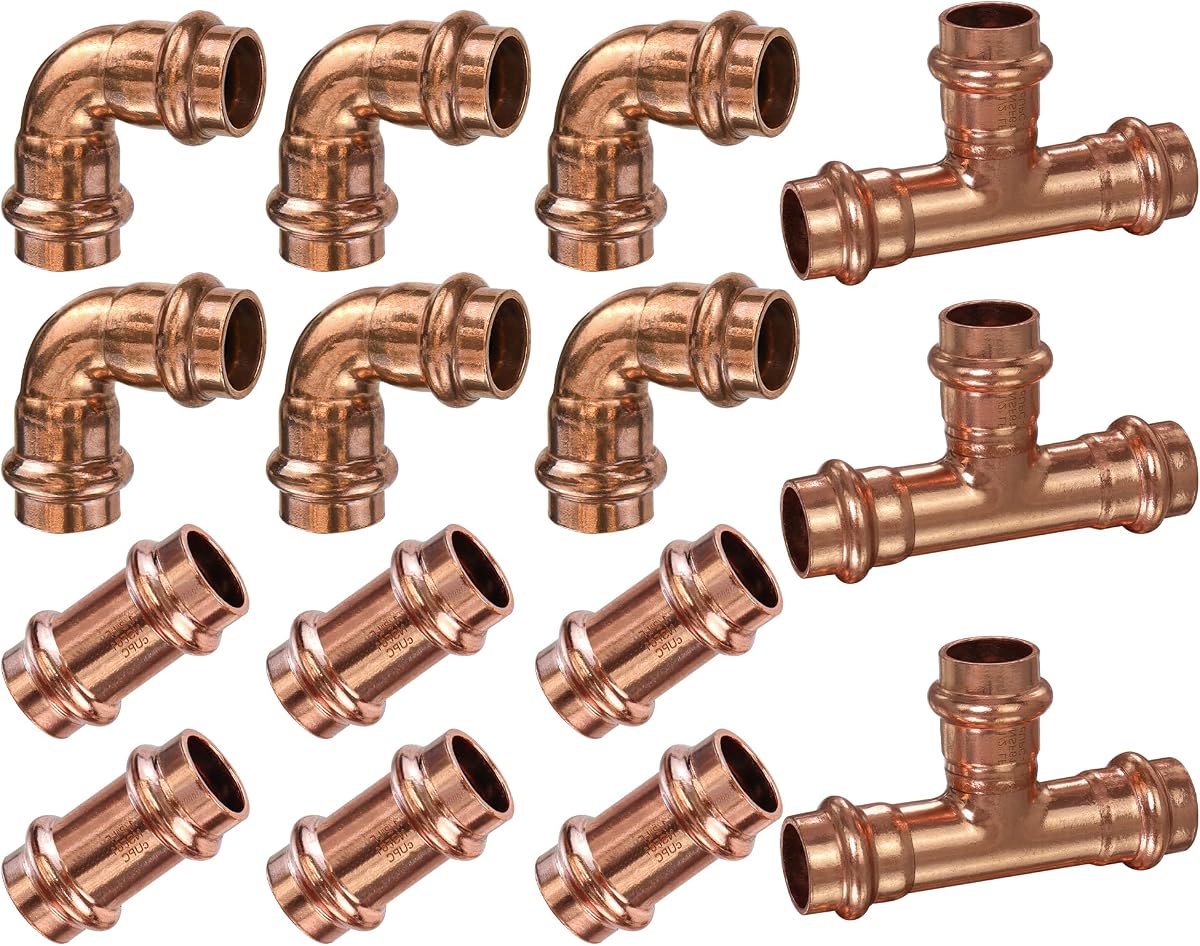
The Copper Press Fittings 1/2inch Kit combines six couplings, six 90-degree elbows, and three tees in one repair-focused set. Its 4.7 rating is among the highest in the group, and the listing provides a particularly useful combination of broad application support, stated CUPC and IAPMO certification, and a 300 PSI working-pressure claim.
We may earn a commission when you buy through this link, at no additional cost to you.
Made from zero-lead copper, the fittings are intended for hot and cold water, HVAC, compressed air, and hydronic heating. The press process eliminates solder, flux, cleanup, and open flame, which can make approved plumbing repairs faster and less disruptive. This kit is especially attractive for maintenance work involving shower valves, water heaters, hot-water tanks, and bath-tube connections.
Buyers must look closely at dimensions. Although the products are marketed as 1/2-inch press fittings, the actual outer diameter is listed as 5/8 inch, which is the dimension that determines the compatible tubing. A press tool is also required, and this system should not be confused with conventional nut-and-ferrule compression fittings even though both products appear in the same roundup.
This is the most broadly applicable plumbing-oriented pick for buyers seeking a certified press system. It is a strong option for contractors, property maintenance teams, and informed DIY users who own or can rent the correct press tool. Confirm the actual tube OD, tool compatibility, local approval, and application requirements before purchasing.
A hydraulic press tool creates the permanent joint without an open flame, solder, or flux. That can shorten repair time and reduce heat exposure around sensitive installation areas.
The stated CUPC and IAPMO certification, together with zero-lead copper construction, makes this kit more appropriate for drinking-water systems than products that carry an explicit lead restriction.
We may earn a commission when you buy through this link, at no additional cost to you.
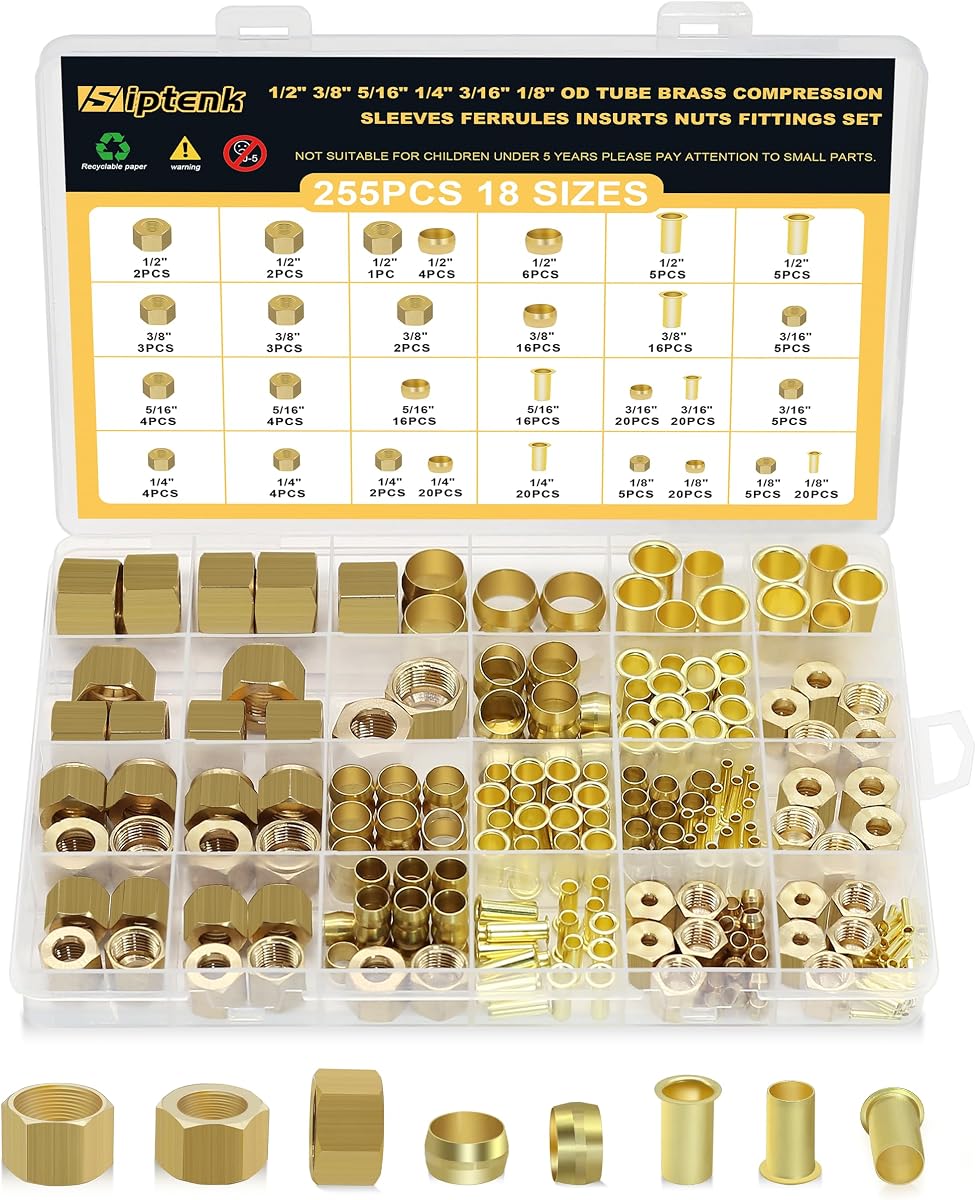
The Siptenk 255PCS Brass Compression Sleeves Ferrules Inserts Nuts Fittings is a component-level inventory rather than a box of complete, ready-to-connect fittings. Its 4.7 rating reflects the appeal of 255 pieces covering six grouped OD sizes, but buyers should understand that they will be selecting and combining sleeves, inserts, and nuts themselves.
We may earn a commission when you buy through this link, at no additional cost to you.
The kit includes grouped quantities for 1/2-, 3/8-, 5/16-, 1/4-, 3/16-, and 1/8-inch tube sizes. It can be used with aluminum, stainless steel, plastic, and copper tubing, and the listing identifies air, water, fuel, oil, and inert-gas lines among its possible uses. The included plastic container is a practical addition for keeping many small brass parts organized and away from moisture.
The main trade-off is complexity. A large assortment can be highly useful for a technician, but it may be excessive for a single household repair, and correctly matching every component to the intended tube size and connection style is essential. Loose inserts and sleeves also need to remain clean and undamaged. The listing's broad use language should not replace verification of local pressure, temperature, and fluid approvals.
This kit is best suited to repair professionals, workshop stock, or multi-line projects that need a generous supply of small components across several diameters. It is less attractive as a convenient one-job connector package because it does not present complete fittings in every configuration. For broad component availability and organized storage, it is a strong choice.
The grouped quantities make it easier to keep common small-bore parts on hand. That is helpful when a repair requires a replacement insert or ferrule without a complete fitting nearby.
The lightweight plastic case reduces the chance of mixing sizes or losing small components. It also gives stored brass parts a protected place between jobs.
We may earn a commission when you buy through this link, at no additional cost to you.
The Eastman 1/2 Inch Compression Heavy Duty Full Port Ball Valve is a purpose-built inline shutoff valve with 1/2-inch compression connections on both ends. Its 4.5 rating and long-standing plumbing-focused specification set distinguish it from the general assortments in this guide. It is intended to add an accessible isolation point between two pipe sections.
We may earn a commission when you buy through this link, at no additional cost to you.
The full-port design minimizes restriction by allowing a broad flow path through the ball. A vinyl-coated steel lever provides a straightforward grip for operating the valve, while solid brass construction and a Teflon seal support durability across the stated pressure and temperature conditions. The listing specifies 600 WOG working pressure and 125 PSIG steam working pressure.
This valve is more specialized than a standard coupling, adapter, or tee. Both ends require compatible 1/2-inch tubing, and care is needed to align the pipe without forcing it against the valve body. It also does not address applications needing a union, elbow, or multiple tube sizes. Its certifications and lead-free guidelines make it a more suitable candidate for potable-water work than kits with explicit lead warnings, subject to local acceptance.
This is the right selection when the project needs a compact quarter-turn shutoff between two copper lines. Plumbers and maintenance technicians will appreciate the full-port layout, accessible handle, and certification details. Homeowners can also use it for a well-defined repair if they have the correct tubing, tools, and applicable code knowledge.
A full-port ball opens a larger passage than a reduced-port valve. That helps preserve flow when the valve is used inline in a working water or utility line.
The stated UPC approval, CSA certification, and NSF and lead-free guideline compliance give this product stronger relevance for potable-water installations, provided local authorities accept the listing.
We may earn a commission when you buy through this link, at no additional cost to you.
The Compression Fittings, 1/4 Compression Fitting Brass Assortment Kit is a compact, focused option for small-bore work. Its 4.6 rating is strong, and the included inventory of 20 sleeve rings, 20 inserts, and 10 nuts gives buyers enough material to build several 1/4-inch compression connections or keep useful replacement parts nearby.
We may earn a commission when you buy through this link, at no additional cost to you.
Solid brass provides the ductility and durability described in the listing, while the mechanical assembly avoids welding, flaring, and deburring. The listed applications include air, fuel, water, oil, and inert-gas lines, making the kit relevant to workshop, utility, automotive-style, and small pneumatic or fluid-control projects. Its single-size focus also makes inventory easier to manage than a mixed assortment.
Buyers should not expect a box of complete push-to-connect couplings. The product contains the individual parts used in a conventional compression assembly, so correct matching remains necessary. The 1/4-inch designation refers to the tubing size, while the exact connection geometry still needs to be confirmed for a particular line. Potable-water suitability and specific pressure ratings are not stated in the supplied information.
This kit offers strong value for someone who regularly works with 1/4-inch tubing or wants an affordable bench-stock assortment for air, fuel, oil, water, or inert-gas lines. It is less suitable for a first-time buyer who wants a ready-made fitting and a broad diameter range. For repeat small-line maintenance, the focused inventory can be particularly convenient.
Keeping all parts in one 1/4-inch size simplifies matching and makes the kit easy to organize. It is a sensible stock option for shops that repeatedly service the same tubing diameter.
The stated assembly method does not require welding, flaring, or deburring. Correct sizing and clean components are still important for a dependable mechanical seal.
We may earn a commission when you buy through this link, at no additional cost to you.
The Brass Compression Tube Pipe Fitting Connector is a five-pack of straight adapters that transition 1/4-inch OD compression tubing to a 1/4-inch NPT male connection. Its 4.6 rating and clearly defined end formats make it a practical bridge between copper tubing and threaded equipment, controls, or pipe.
We may earn a commission when you buy through this link, at no additional cost to you.
The listing describes the adapter as suitable for aluminum, plastic, and copper straight compression tubing. Heavy-duty brass is specified for rust resistance, corrosion resistance, high-temperature ductility, and low magnetic permeability. Because the tube connection is mechanical, the transition can be made without soldering or flaring the copper, reducing the need for heat around the installation.
The important limitation is that the thread and tube dimensions must match the application. A 1/4-inch NPT male end does not automatically mean it will replace a fitting with a different thread standard or nominal size. The supplied details do not state a working-pressure or temperature rating, so those requirements should be verified before using the adapter in a demanding line.
This product is best for a straightforward copper-to-threaded transition, especially when a repair needs several identical adapters. It suits equipment installers, maintenance technicians, and experienced DIY users who understand NPT sizing. It is less appropriate for branch layouts or applications that require an elbow, union, or tee.
The adapter combines a compression tube connection with a threaded male end. This makes it useful when copper must connect to a component that accepts NPT threads.
Five identical adapters provide enough material for more than one isolated repair and leave a spare for future maintenance. The straightforward geometry also reduces configuration decisions.
We may earn a commission when you buy through this link, at no additional cost to you.
The 135PCS Brass Compression Fittings Kit is among the most configuration-rich conventional compression kits in the roundup. Its 4.4 rating reflects a useful mixture of union connectors, tees, 90-degree elbows, straight male connectors, bushings, sleeves, inserts, and nuts across 1/8-, 3/16-, 1/4-, 3/8-, and 1/2-inch sizes.
We may earn a commission when you buy through this link, at no additional cost to you.
One notable addition is the included 4-meter roll of Teflon tape and tube cutter, which makes the package more self-contained for basic assembly work. The brass components are described as corrosion resistant, durable, and suitable for oil, gas, water, and other pipeline systems. Copper, brass, aluminum, and plastic tubing are all listed as compatible, and the fittings do not require flaring or soldering.
Its stated maximum working pressure of 200 PSI is lower than the 2,000 PSI figure in the 46-piece kit and the 1,200 PSI figure for the ChillWaves union. It also notes that the fittings suit low- and medium-pressure work where excessive vibration or tube movement is not involved. Those points make the kit more appropriate for modest, stable installations than for high-pressure or movement-prone systems.
This assortment is a strong choice for a technician who wants many standard configurations in one purchase. It is less economical for someone needing a single adapter, but the included cutter and tape can make it convenient for setting up a new small-bore line. Verify the actual pressure, material, and potable-water requirements of the intended application before installation.
Straight connectors, tees, elbows, unions, and bushings cover many common routing needs. This variety reduces the need to search for a matching configuration during an unexpected repair.
A tube cutter and Teflon tape complement the fitting inventory. They help prepare tubing and threaded connections, although proper measurement, cleaning, and compatibility checks remain necessary.
We may earn a commission when you buy through this link, at no additional cost to you.
The 2 Pack Brass Compression Fitting Connector has the highest customer rating in the group at 4.9. It is a compact 3/8-inch OD compression-to-1/2-inch NPT male adapter made from heavy-duty brass, giving it a clear role in lines that need to transition from copper tubing to a larger threaded connection.
We may earn a commission when you buy through this link, at no additional cost to you.
The listing highlights the single-ferrule design, noting that it has fewer possible leak paths than a twin-ferrule fitting. The connector is suitable for copper, brass, aluminum, or plastic tubing and is identified for water, gasoline, oil, and vacuum lines. Its heavy-duty brass construction provides the stated corrosion resistance, high-temperature ductility, and low magnetic permeability.
There is an important quantity discrepancy. The product title says two-pack, while the package-information bullet says three pieces are included. Buyers should inspect the current package contents before ordering if the exact count matters. No working-pressure or temperature figures are supplied, so users must independently confirm those limits for their line rather than inferring them from the rating.
Despite that uncertainty, this is a compelling choice for a single, clearly defined transition because it has the highest listed rating and a simple, widely useful geometry. It suits repair technicians and installers working with 3/8-inch tubing and 1/2-inch NPT equipment. Confirm the current quantity, seal compatibility, and system requirements before use.
The single-ferrule arrangement uses fewer sealing interfaces than a twin-ferrule system. That can simplify the joint while still relying on controlled ferrule compression around the tube.
A 3/8-inch compression end to 1/2-inch NPT male end is a useful transition for attaching tubing to a larger threaded component. The dimensions should be checked carefully before assembly.
We may earn a commission when you buy through this link, at no additional cost to you.
The HIGHCRAFT D64-12-OM Compression Tee Pipe Fitting is designed to join three tubes at a branch point. Its 4.4 rating reflects a straightforward, reusable solution for instrumentation, hydraulic, and pneumatic lines where copper, aluminum, or plastic tubing needs to split into a third connection.
We may earn a commission when you buy through this link, at no additional cost to you.
All three ends use 1/2-inch OD compression connections, creating a uniform and easy-to-plan fitting. The brass body is described as durable, rust resistant, corrosion resistant, and vibration resistant. A stated temperature range of -65°F through 250°F is provided, with the listing noting that maximum pressure depends on operating temperature.
Because all branches use the same nominal size, the tee cannot reduce or expand the line. It is also intended for compression systems rather than press-connect or soldered copper systems, so it should not be selected merely because the tube diameter appears to match. The stated pressure behavior at elevated temperatures deserves attention even though the fitting's upper temperature figure looks impressive.
This tee is best for adding a branch to an existing 1/2-inch compression line in a compatible hydraulic, pneumatic, or instrumentation setup. It is a reusable alternative to a soldered tee and can be valuable where maintenance access matters. Confirm tubing compatibility, system pressure, temperature, and any local certification requirements before installation.
A tee provides a direct way to add a third line without joining tubes at odd angles or using improvised fittings. Its equal-size ends keep the layout straightforward.
The compression joint can be disassembled, and the listing specifically emphasizes vibration resistance. Those qualities suit serviceable equipment and instrument lines where a permanent soldered connection may be less convenient.
We may earn a commission when you buy through this link, at no additional cost to you.
A useful fitting begins with an accurate match between the connection method, tube dimensions, system conditions, and applicable approvals. The following factors help prevent the most common problems: incorrect sizing, incompatible sealing methods, unverified pressure limits, and fittings used outside their intended applications.
Compression fittings are selected by the actual outside diameter of the tubing rather than by a vague nominal pipe description. Copper tubing commonly appears in fractional sizes, and a product marketed as 1/2 inch may specify an actual OD of 5/8 inch. Measure the tube or consult its documentation before choosing a connector, especially when transitioning from press-fit to conventional compression hardware. A correct dimensional match is essential because the ferrule must grip the tube consistently to form a proper seal.
Bottom line: verify the physical tube OD, not just the label on the fitting package.
The products reviewed represent several distinct systems: conventional ferrule compression, copper press fittings, NPT threaded adapters, unions, tees, valves, and loose component assortments. A conventional compression fitting uses a nut and ferrule around a tube, while a press fitting is permanently deformed with a specialized tool. Neither should be forced into a connection designed for the other. Determine whether the mating component accepts tubing, NPT threads, a press connection, or a conventional compression end before making a purchase.
Bottom line: select the connection method required by both ends of the joint, not merely the preferred installation tool.
Brass offers strength, corrosion resistance, ductility, and broad compatibility, while pure copper press fittings provide a different construction and installation process. The metal used in the ferrule, body, and seal should be suitable for the fluid, temperature, and environment. Some kits list broad applications such as oil, gas, water, fuel, and inert gases without providing every certification detail. The first product in this guide explicitly warns that its lead-containing fittings are not allowed for potable-water installation in the United States and its territories.
Bottom line: verify the material, seal, fluid compatibility, and drinking-water approval for the exact application.
A fitting's maximum working pressure is an important limit, but it must be considered alongside tube wall thickness, system conditions, temperature, installation quality, and the weakest component in the assembly. Listed figures in this guide range from 200 PSI for one broad kit to 2,000 PSI for the 46-piece assortment, while several individual products omit pressure specifications. Elevated temperature can also reduce a fitting's allowable pressure, as reflected in the HIGHCRAFT listing's temperature-dependent pressure statement.
Bottom line: use the lowest applicable limit across the complete assembly and leave operating margin below the manufacturer's maximum.
Compression fittings create a strong mechanical seal, but they are not automatically suitable for every dynamic installation. One kit explicitly describes itself as intended for low- and medium-pressure work without excessive vibration or tube movement. A rigidly supported line is easier to seal than one that repeatedly flexes, pulls, or vibrates. High-temperature systems also need stable tubing and supports so the ferrule maintains consistent contact with the pipe. For demanding dynamic service, follow the fitting manufacturer's installation instructions and avoid improvised support arrangements.
Bottom line: stable tubing and proper support are essential, especially on vibrating or high-temperature lines.
A major advantage of mechanical compression connections is that they can often be removed without cutting the tubing or using a torch. Unions are especially useful where equipment needs frequent separation, while ordinary couplings, tees, and adapters can still be disassembled for replacement or inspection. Loose-component kits require more assembly effort and offer flexibility to build several configurations. Press fittings provide a different tradeoff because the connection is intended to be permanent after the correct press operation.
Bottom line: choose a union for frequent service, conventional compression for repairability, or press fittings for a permanent, fast installation.
For potable water, local code and certification are more important than a broad application description. The copper press kit states CUPC and IAPMO certification, the Eastman valve lists UPC approval, CSA certification, and NSF and lead-free guideline compliance, and the 46-piece kit contains an explicit lead warning. Other products in the roundup do not provide enough information in the supplied listing to make the same certification claim. Buyers should check the current manufacturer documentation, the mark on the product, and the local authority having jurisdiction.
Bottom line: a drinking-water application requires verified approval, not an assumption based on brass or copper construction.
A complete coupling, adapter, or tee solves one defined connection, while a component kit supplies sleeves, inserts, nuts, and other pieces for different configurations. Broad assortments are useful for maintenance teams, but they can be excessive for a single repair and require careful size matching. Kits that include a tube cutter or tape can be more convenient for setting up a new line. Before ordering, list the tube OD, connection type, number of branches, needed orientations, and whether future service or a replacement fitting is likely.
Bottom line: buy for the actual connection plan rather than choosing a larger kit by default.
Begin by shutting off and isolating the relevant line, then verify that the fitting's tube OD, connection format, material, pressure rating, and temperature range match the application. Remove the existing connection carefully, clean the copper tube, and check it for dents, ovality, deep scratches, or contamination. A damaged tube can prevent a ferrule from seating evenly, so replace or recut it rather than forcing the fitting onto compromised material.
For a conventional compression fitting, place the correct nut and ferrule or sleeve onto the tube in the specified order, push the tube fully into the fitting body, and tighten the nut with the appropriate tool. Follow the fitting maker's instructions and avoid excessive torque, which can strip threads or distort the tube. For press fittings, use a compatible press tool, jaw, and copper press sleeve selected for the fitting's diameter, and complete the press cycle specified by the manufacturer. Never substitute an ordinary wrench for the required press operation.
After assembly, inspect the joint for alignment, leakage, and abnormal movement, then restore flow gradually and check the connection again. Copper compression systems may be rechecked after a settling period, particularly on hot-water or high-pressure lines. Keep compression nuts accessible, avoid using the union or adapter as a lever, and support nearby tubing so weight and vibration do not load the ferrule. Replace damaged components rather than tightening a fitting that continues to leak.
Compression fittings can be used with copper tubing when the fitting is approved for the intended fluid and local code. Verify the actual tube OD, connection type, pressure and temperature limits, and drinking-water certification. The 46-piece kit in this guide is not allowed for potable-water use in the United States because it contains lead, while the certified copper press kit and Eastman valve have more relevant approval information.
Select the fitting by measuring the tube's actual outside diameter and matching it to the fitting's listed tube OD. Do not rely solely on a nominal size printed in a marketplace listing. For example, the press kit is marketed as 1/2 inch but states that the actual outer diameter is 5/8 inch, illustrating why physical measurement and product specifications both matter.
Conventional compression fittings use a nut and ferrule to secure the tube and generally do not require soldering, welding, or flaring. Copper press fittings also avoid solder, but they require a compatible press tool and the correct press sleeve. In either system, proper tube preparation, correct sizing, and manufacturer instructions remain essential.
A press fitting and a conventional compression fitting are different connection systems and should not be mechanically forced together. A transition is possible only when a correctly sized component is designed for both formats, such as a press-to-compression adapter specifically intended for that purpose. Check dimensions and manufacturer compatibility before combining fitting styles.
A coupling generally joins two tube ends to create a continuous run, while a union is designed to be opened without cutting the connected pipe. The ChillWaves product in this guide is a union, making it useful where a component must be removed for maintenance. Both use compression sealing principles, but the serviceability of a union is the key distinction.
Common causes include using the wrong tube size, a loose or improperly positioned nut, a damaged ferrule, a dented tube, mismatched thread sealant, or unsupported tubing that moves after installation. Do not simply apply more torque. Confirm the component order, inspect the tube and ferrule, and follow the fitting manufacturer's installation instructions before replacing the unit.
Not every brass fitting is automatically approved for potable-water service. Product composition and certification matter, and the 46-piece kit explicitly contains lead and carries a restriction against U.S. potable-water installation. For drinking-water lines, favor a product with explicit lead-free, NSF, UPC, CUPC, IAPMO, or equivalent approval that is accepted locally.
First, isolate the line and confirm that the tube is clean, round, and free from deep damage. Check that the ferrule and nut are the correct parts for that fitting and have not been distorted. Ensure the tube is fully seated, then tighten the nut to the manufacturer's specified level. If the joint still leaks, replace the fitting rather than overtightening it.
The 1/2-inch copper press kit is the strongest all-around choice for plumbing repairs, combining couplings, elbows, tees, zero-lead copper, stated certifications, and 300 PSI working pressure. The 1/4-inch brass component kit is a focused value option for small-bore work, while the 46-piece brass assortment offers the broadest size selection and a high stated pressure limit for approved non-potable systems.
Prioritize the connection method before anything else: conventional ferrule compression, press-connect, threaded NPT, union, tee, and valve products are not interchangeable. Then verify the actual tube OD, operating pressure, temperature, tubing support, local code, and fluid approval. For drinking-water work, a product with explicit relevant certification is more defensible than one that merely lists water as a possible application.
Prices, ratings, package contents, and product details can change over time, so shoppers should confirm the current listing before buying. Pay particular attention to dimensional accuracy, included components, lead restrictions, and pressure specifications, especially when using a kit for several different lines rather than one clearly defined repair.