
Brother QL-1100c Bundle
5.0Editor score
Fast 300 dpi label output
Wide-format 4 inch printing
Includes four genuine label rolls
QR code printers combine precise label placement with the ability to create scannable codes for inventory, shipping, storage, customer communication, and workplace organization. A capable model should produce clear symbols, support the required label size, connect reliably to your devices, and make recurring jobs faster and more consistent.
This guide compares ten thermal and inkjet options based on the supplied specifications, including printing technology, supported materials, connectivity, maximum label dimensions, application templates, portability, and specialized features. It covers compact Bluetooth label makers, desktop shipping printers, rugged construction models, handheld inkjet printers, and professional Brother equipment.
Each review explains where the printer fits best, what makes it useful, and where its limitations may matter. The top selections highlight the strongest options for general business use, professional shipping, and organized labeling, while noting that prices and availability can change over time.
5.0Editor score

4.5Editor score

4.4Editor score
As an Amazon Associate we earn from qualifying purchases.
The comparison below distinguishes each printer by its printing method, supported label format, connection options, and most practical use case, making it easier to identify the right model for a specific workflow.




The SUPVAN T50M Pro is a compact Bluetooth label maker designed for home organization, school supplies, office labeling, and small-business identifiers. It carries a 4.4 rating and stands out for a generous editing library, automatic label-size recognition, and compatibility with labels ranging from 3/4 inch to 2 inches wide.
We may earn a commission when you buy through this link, at no additional cost to you.
Its app can import images from a phone, tablet, or computer and offers more than 30 fonts, 50 frames, and 660 icons without requiring registration. That makes the printer particularly useful for turning QR codes, barcodes, logos, addresses, and product information into consistently sized labels for jars, folders, cables, jewelry, and other items.
The limitation is its focus. This is a label maker rather than a shipping-label printer, and it prints in black and white without ink or toner. Businesses needing full-size parcel labels or fixed-format media should choose a dedicated shipping model instead, while users who value attractive custom labels will find the creative resources more useful than professional industrial specifications.
This is a strong choice for home organizers, teachers, crafters, and small retailers who want one flexible device for QR codes, barcodes, and personalized product labels. It is also a sensible first printer for users who want phone-based editing without a registration process, provided their label widths fall within the supported range.
The supplied fonts, frames, icons, and image-import tools allow labels to look more deliberate than simple typed text. This is particularly useful for product branding, classroom materials, gift tags, and storage systems where visual recognition matters.
Automatic size recognition and a registration-free app reduce configuration friction. The printer is better suited to spontaneous labeling tasks than fixed, high-volume production runs.
We may earn a commission when you buy through this link, at no additional cost to you.
The REEKON P1L Tagger is a rugged, portable printer built for construction teams that need labels to connect physical materials with digital plans. It earns a 4.5 rating and distinguishes itself through one-click templates, automatic QR code generation, a battery-powered design, and mounting accessories for belts or carts.
We may earn a commission when you buy through this link, at no additional cost to you.
Through the BOLDR Pro app, users can connect tools, materials, and locations to digital information. The printer can generate QR codes that link to BOLDR Pro features, and the accompanying utilities allow customization for other applications. Its rubber case and mounting clip reflect a clear focus on use around active job sites.
Thermal printing keeps the device simple by eliminating ink and toner, while the included label options use adhesive designed to endure dust, moisture, temperature changes, and handling. The labels can also be removed with little residue, which is useful when temporary identification is needed. The trade-off is that the workflow depends on the connected app and is more specialized than a general office printer.
The P1L is most convincing for contractors, installers, facilities teams, and anyone who repeatedly labels materials in a mobile work environment. It is the top general recommendation in this guide because it combines purposeful industrial design with automatic QR code workflows, durable media, and a genuinely portable form factor.
The strongest feature is the relationship between real-world objects and digital records. QR labels can direct users toward plans or project utilities while reducing ambiguity at storage locations and workstations.
Battery power, USB-C charging, a protective rubber case, and a belt or cart clip keep the printer practical away from a desk. The thermal format also avoids carrying ink cartridges into a jobsite.
We may earn a commission when you buy through this link, at no additional cost to you.
This handheld inkjet printer is built for direct marking on plastic, metal, glass, wood, fabric, and cardboard. It has a 4.3 rating and stands apart from label-roll models through its 4.3-inch touchscreen, 42ml fast-drying ink cartridge, and ability to print batch codes, dates, QR codes, logos, and graphics directly onto surfaces.
We may earn a commission when you buy through this link, at no additional cost to you.
Templates can be created or edited on the touchscreen, while JPG, PNG, and BMP files can be imported through USB. The supplied description also notes preloaded industrial barcode formats, a 12.7mm print height, waterproof and fade-resistant ink, and support for 28 language interfaces, making it relevant to production, distribution, and product-identification workflows.
This versatility comes with added complexity. Unlike direct-thermal printers, the ink cartridge must be handled, and the device is not intended to feed conventional adhesive labels. Fast-drying ink improves handling efficiency, but the material preparation and print surface still require more attention than placing a pre-made label onto a package.
Choose this model when direct product or package marking is essential, especially for cases where labels cannot adhere. It is less suitable for a home user who only needs occasional QR stickers, but it may be ideal for warehouses, light manufacturing teams, and fulfillment operators who need flexible on-demand coding across several substrates.
Direct inkjet marking expands use cases to products and packages that cannot accept thermal labels. The 12.7mm print area supports useful identification details without turning the device into a large desktop printer.
The touchscreen lets operators create templates and import visual assets without a full computer workflow. Preloaded barcode formats and 28 language interfaces are useful for internationally distributed operations.
We may earn a commission when you buy through this link, at no additional cost to you.
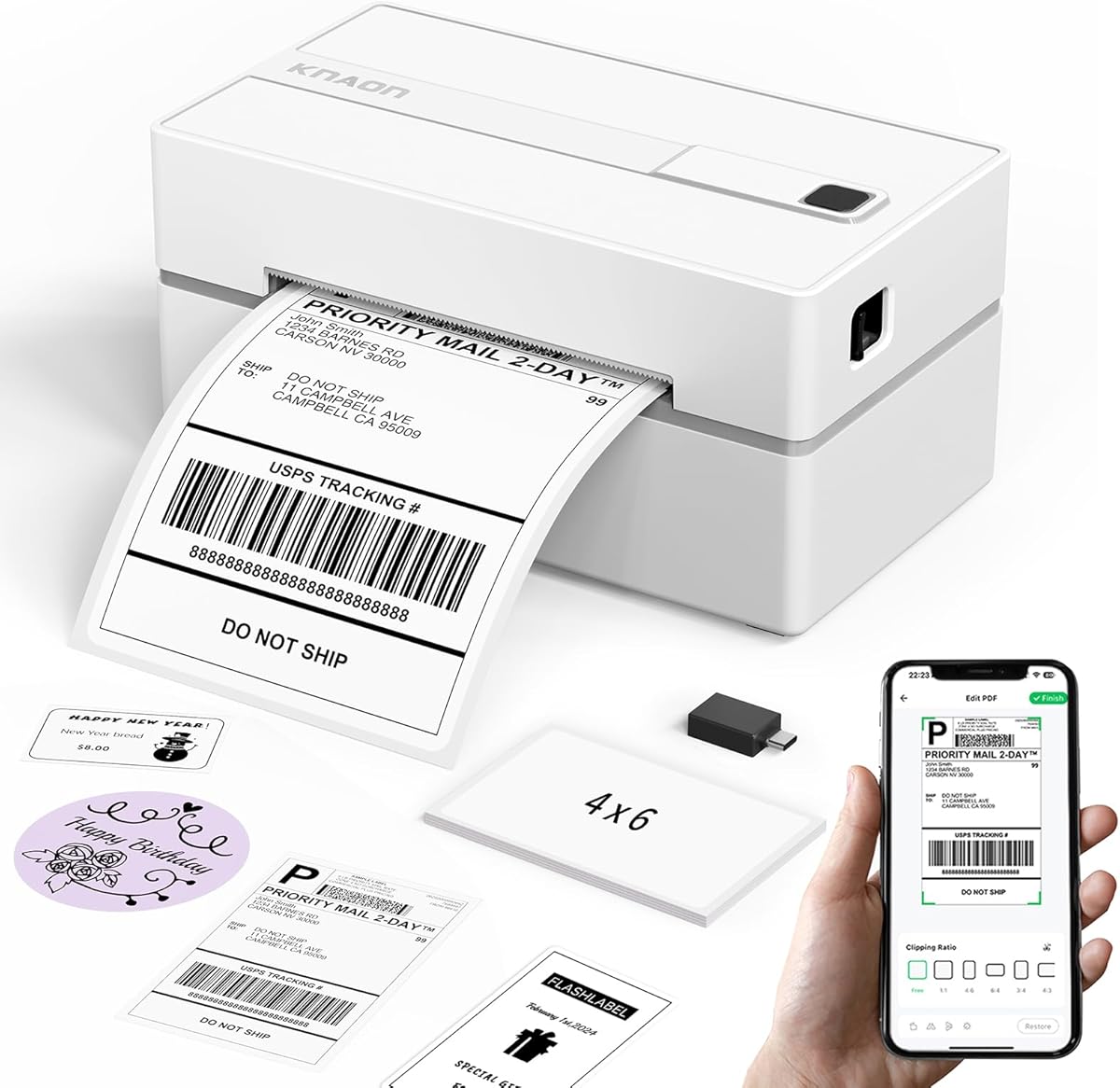
The KNAON Bluetooth Shipping Label Printer is aimed at small merchants who print shipping labels, address stickers, barcodes, and QR codes from phones or computers. It holds a 4.4 rating and offers a claimed print speed of up to 180mm per second across paper widths from 1.5 to 4.2 inches.
We may earn a commission when you buy through this link, at no additional cost to you.
Compatibility is a major strength. The FlashLabel Pro app supports mobile printing, while USB connectivity covers macOS, Windows, ChromeOS, and Linux. The supplied information also lists compatibility with Amazon, eBay, Shopify, USPS, UPS, Etsy, PayPal, Poshmark, DHL, and other major fulfillment platforms.
Setup requires attention to the connection method. Some mobile and desktop devices cannot connect directly through Bluetooth and must use FlashLabel Pro, while logistics labels generally need to be saved as PDF files and imported into that app. These are understandable workflow requirements, but they make the model less suitable for someone expecting universal plug-and-play operation.
The KNAON is a strong fit for online sellers and small businesses that need compact, fast shipping output without a large desktop setup. Choose it when frequent use of major shipping services is the priority and you are comfortable exporting orders as PDF files for the app-based workflow.
Support for major marketplaces, postal services, and carriers broadens the printer's practical value. Merchants can move between sales channels without changing their basic label workflow.
Its small footprint suits a packing bench, while the stated speed can keep pace with recurring order processing. The 1.5 to 4.2-inch paper range supports both small product labels and larger shipping formats.
We may earn a commission when you buy through this link, at no additional cost to you.
The CLABEL 221D is a two-inch thermal printer for price tags, clothing labels, file folders, jewelry stickers, bakery labels, and similar item identification. It has a 4.1 rating and stands out by accepting universal thermal paper without RFID chip restrictions or brand ID locks.
We may earn a commission when you buy through this link, at no additional cost to you.
Direct thermal printing at 203DPI produces barcodes, QR codes, and address stickers without ink or toner. The Clabel trade app includes templates for retail, office, and small business, along with saved layouts for batch printing, while USB supports high-volume back-office work and Bluetooth provides phone-based access at a counter.
Its scope is intentionally narrow. The manufacturer specifies that it is not designed for 4×6 shipping labels or receipts, and it is not intended for tablets or point-of-sale systems. The absence of a proprietary media lock offers long-term flexibility, but buyers must supply compatible thermal paper and remain within the supported width range.
This printer makes sense for stores, boutiques, craft businesses, and offices that tag individual products rather than ship parcels. It is especially attractive to buyers who want freedom to choose universal media. If a 4×6 shipping workflow is central to your needs, the KNAON or Brother models are better matches.
The ability to use ordinary thermal paper gives operators more sourcing options. That flexibility can simplify replenishment and reduce dependence on a single proprietary label supply.
Bluetooth serves phone-based counter work, while USB supports a fixed Windows computer for larger batches. The same printer can therefore cover both routine and more repetitive labeling tasks.
We may earn a commission when you buy through this link, at no additional cost to you.
The Phomemo M110 is a portable Bluetooth thermal label maker with a built-in display, offering a more self-contained way to create QR codes, barcodes, and text labels. It has a 4.3 rating and supports 20mm to 50mm label widths, making it suitable for clothing, prices, cables, jewelry, school materials, addresses, and folders.
We may earn a commission when you buy through this link, at no additional cost to you.
Its Print Master app includes numerous templates, custom template creation, text editing, and Excel batch printing. OCR can recognize text from images in approximately four seconds, a useful feature when a code or product name must be transferred quickly. Bluetooth 4.0 offers a stated range of up to 33 feet and a one-click connection process.
There are two important limitations. The printer is not designed for shipping labels and does not produce color output. In addition, some templates, icons, and fonts marked with a diamond in the app are reserved for paid members, although other assets remain free.
The M110 works well for portable organization, classroom labeling, and small retail tasks where a display helps confirm content before printing. It is less attractive for a professional parcel operation, but for users who want QR stickers, short text labels, and batch printing from a phone, it offers a capable and approachable feature set.
The built-in display helps users confirm text and layout at the point of labeling. It adds convenience when operating away from a computer and makes errors easier to catch before consuming a label.
Excel batch printing can accelerate repetitive tasks, while OCR turns photographed text into editable content. Together, they reduce manual retyping when organizing large collections.
We may earn a commission when you buy through this link, at no additional cost to you.
The NADAIIN N20 is a lightweight portable label maker for home, office, school, craft, and small-business use. It has a 4.4 rating, weighs 296g, and uses a rechargeable 2000mAh battery. Its 3/4-inch to 2-inch label support makes it relevant for QR stickers, names, barcodes, and product identification.
We may earn a commission when you buy through this link, at no additional cost to you.
The NADA Print app provides more than 30 fonts, 50 frames, and 660 icons, all stated to be free, along with image importing from a phone or tablet. Direct thermal technology at 203DPI supports square, round, transparent, and colored thermal labels without ink, toner, or cartridges.
The printer cannot create color output and is explicitly not intended for shipping labels. Its maximum printing size is 50 by 80mm, which remains appropriate for compact identification tasks but not full parcel documents. The included starter roll means users can begin labeling without sourcing media first.
The N20 is a strong value-oriented choice for people who want a dedicated QR code and organization printer without a large footprint. It is especially convenient for jars, bottles, food containers, handmade goods, bakery packaging, classroom materials, and small retail products, provided those tasks fit within its compact label size.
A light body and rechargeable battery make the N20 easy to move between a pantry, classroom, workshop, or retail counter. It is a practical personal labeling tool rather than a fixed production machine.
The app's fonts, frames, icons, and image import make it possible to build labels with visual identity. Users can create consistent product and storage identifiers without adding another design subscription.
We may earn a commission when you buy through this link, at no additional cost to you.
The Brother QL-1100c Bundle is a complete desktop solution for shipping, postage, barcode, and QR code labels. It carries a 5.0 rating and combines a wide-format direct thermal printer with four full rolls of genuine DK-1247 labels, adding up to 720 labels in the bundle.
We may earn a commission when you buy through this link, at no additional cost to you.
The printer supports labels up to 4 inches wide and prints at 300 dpi. According to the supplied specifications, it can produce up to 69 standard address labels per minute in black text, making it well suited to regular shipping volume. It uses convenient DK drop-in rolls and connects through USB.
The bundle is appealing because it addresses both equipment and consumables at once. Genuine Brother media can simplify print settings and material consistency, while the included power cable, USB cable, starter rolls, and four additional DK-1247 rolls create a ready-to-use package. Its main limitation is that the stated connectivity is USB rather than wireless.
This is a strong choice for a home shipping station, small fulfillment operation, or office that regularly produces 4-by-6-inch labels and wants a dependable desktop workflow. It is less compelling for a small, occasional label task because the bundle is considerably more substantial, but for steady volume it offers a clear balance of speed, resolution, and supplied media.
Four rolls of die-cut DK-1247 labels and 720 included labels reduce the need for immediate replenishment. The printer is designed for consistent parcel handling rather than occasional novelty labeling.
A stated output of 69 standard address labels per minute keeps a busy packing process moving. The 300dpi resolution also supports small text and detailed QR codes.
We may earn a commission when you buy through this link, at no additional cost to you.
The Brother PT-E720BT is an industrial label printer designed for technicians, installers, facilities teams, and other professional users who need consistent identification in demanding environments. It has a 4.2 rating and offers Bluetooth operation, database integration, app-based design tools, and support for laminated labels up to approximately one inch wide.
We may earn a commission when you buy through this link, at no additional cost to you.
The Pro Label Tool app supports professional industrial label designs, while existing databases can be used to print labels, barcodes, and QR codes quickly. Optional accessories allow the printer to attach to a belt, ladder, or rack, supporting hands-free work in confined spaces. A Li-ion battery adds mobile flexibility.
A micro-USB connection can charge the battery or connect the printer to a computer running P-touch Editor, which provides a more structured design environment. The trade-off is that the model is more specialized than a consumer label maker, and laminated output is limited to narrow widths. It is also not presented as a full-size shipping-label printer.
Choose the PT-E720BT when reliable industrial identification matters more than creative templates or parcel-label width. It is especially suitable for technicians who can use database records and need a printer that can remain attached to equipment while they work.
Directly using existing databases can reduce retyping and labeling errors. This is valuable when technicians must identify cables, assets, locations, or service points consistently.
Belt, ladder, and rack mounting keeps the printer close to the task. The result is a practical workflow for hands-busy environments where setting a desktop printer aside would interrupt work.
We may earn a commission when you buy through this link, at no additional cost to you.
The Brother QL-800 is a professional desktop printer built for high-volume shipping, business identification, and organized labeling. It has a 4.3 rating and stands out with a stated speed of up to 93 labels per minute at 300 dpi, along with black-and-red thermal printing and an integrated automatic cutter.
We may earn a commission when you buy through this link, at no additional cost to you.
Its Plug & Label technology allows printing from Microsoft Word, Excel, and Outlook without additional software installation. The printer supports Windows and Mac systems, genuine Brother DK pre-sized labels, and continuous-length tapes up to three feet long, expanding its use beyond standard address labels.
The included USB cable makes a wired desktop setup straightforward, although the absence of stated wireless connectivity limits flexibility compared with several mobile printers in this guide. Two-color output also requires suitable compatible media, and users considering custom label shapes or unusual stock should verify compatibility before purchasing.
The QL-800 is best for busy offices, shipping operations, retail environments, and teams that value speed above all else. Its automatic cutter, high throughput, and familiar Office integration make it a productive professional choice for organizations with a steady flow of labels.
The stated 93-label-per-minute rate is well suited to batch processing. It can reduce waiting at packing stations where shipping labels, badges, and organizational labels are produced in sequences.
Black-and-red thermal output adds visual emphasis without an inkjet-style cartridge system. It is useful for warnings, priorities, branding, or sections that need to stand out.
We may earn a commission when you buy through this link, at no additional cost to you.
The right QR code printer depends on the labels you need, where you will use them, how often you will print, and which device or business systems must feed the printer. Consider the following factors before choosing a model.
Direct thermal printers use heat to create a black image on specially treated labels, eliminating ink and toner cartridges. They are generally simple, portable, and efficient for QR codes, shipping labels, barcodes, price tags, and inventory identifiers. The trade-off is that most such models print only in black and white. Handheld inkjet printers are more appropriate when a code or graphic must be printed directly onto plastic, metal, glass, wood, cardboard, fabric, or another non-label surface.
In short, choose thermal for adhesive labels and inkjet for direct marking. Confirm the surface and consumable before buying.
Label width is one of the most important practical limits. Several compact models support approximately 20mm to 50mm widths, which suits jars, folders, cables, and retail tags but not standard shipping labels. The KNAON supports paper widths from 1.5 to 4.2 inches, while the Brother QL-1100c and QL-800 handle wide-format output and conventional 4-by-6-inch applications. Check both the media width and the maximum print area rather than looking only at the printer's physical size.
In short, match the printer to the exact label dimensions you already use. Wider and longer output requirements favor desktop shipping models.
Bluetooth is valuable for phone-based and counter workflows, while USB provides a stable path for computers and higher-volume office tasks. Some products support both, but their software paths can differ. The KNAON, for example, uses FlashLabel Pro for its mobile and some desktop workflows, and shipping platforms are generally accessed by saving a label as a PDF and importing it. The Brother QL-1100c and QL-800 focus on wired desktop printing, while the Brother PT-E720BT combines Bluetooth with micro-USB computer access.
In short, identify every device you expect to use. A printer with the right hardware can still be inconvenient if its app or computer workflow does not match your habits.
A high-volume shipping operation needs a printer that can keep pace with order processing, while occasional users should prioritize portability and simplicity. The Brother QL-800 claims up to 93 labels per minute, and the QL-1100c can produce up to 69 standard address labels per minute in black text. The KNAON states a speed of up to 180mm per second. These figures are most relevant when queues of labels are common; for a few pantry labels, speed rarely warrants extra complexity.
In short, match throughput to the busiest period, not the average day. Fast output helps most when labels are produced in continuous batches.
QR codes require enough resolution and contrast to remain scannable after printing. Thermal models in this list offer 203DPI or 300dpi output, while the handheld inkjet uses 12.7mm print height and high-resolution graphics. Black-and-white thermal labels generally provide strong contrast, but tiny codes can still be affected by label size, margins, surface condition, and contrast with the background. Test a representative code whenever a new material or layout is introduced.
In short, prioritize high resolution, clean contrast, and enough label space. Avoid shrinking a code simply to fit an undersized label.
Portability can mean carrying a printer around a home, using it at a retail counter, or attaching it to equipment in a demanding work environment. The SUPVAN, Phomemo, and NADAIIN models are compact Bluetooth devices. The REEKON P1L adds a rubber case, belt or cart clip, and battery power for construction work. The Brother PT-E720BT is designed for industrial use and offers hands-free mounting options. Its compatibility with laminated narrow labels adds another layer of environmental durability.
In short, choose the least complicated model that survives the intended setting. Portability helps mobile teams; rugged mounting and media help industrial teams.
Templates can shorten setup for common labels, while database connections can improve accuracy for technical and high-volume workflows. The Phomemo supports Excel batch printing and OCR, the REEKON uses prebuilt BOLDR Pro templates and automatic QR generation, and the Brother PT-E720BT can draw from existing databases. Brother's QL-800 also prints directly from common Microsoft Office applications. The most useful app is the one that reduces the amount of repetitive typing and formatting your team actually performs.
In short, prioritize data tools that match your records. Creative templates matter for retail labels; database integration matters more for technical operations.
Label supplies should be considered before choosing a printer. The CLABEL model uses universal thermal paper without a brand lock, which offers purchasing flexibility, while several Brother products depend on genuine DK or compatible media for their stated capabilities. The Brother QL-1100c bundle includes 720 DK-1247 labels, reducing immediate replenishment. Portable models generally include a starter roll, but their maximum sizes and supported media styles can differ. Always verify roll dimensions, adhesive type, surface compatibility, and printer requirements.
In short, check the ongoing supply as well as the hardware. A printer is only useful when the correct labels are consistently available.
Begin by charging a portable printer fully and installing the correct app or computer driver. For the Phomemo M110 and NADAIIN N20, follow the supplied pairing instructions and select the proper printer model in the app. For Brother desktop models, install the required utility, confirm the roll is loaded in the correct direction, and perform a test print before preparing a large batch.
Create the QR code in the design app or import an existing code, then check its size, contrast, margins, and wording before printing. Use black text on a light background, avoid unnecessary decoration around the code, and scan the result with the phone or scanner that will be used in practice. For shipping workflows, save the carrier label as a PDF and import it into the appropriate app rather than editing the original code.
Care for the device according to its technology. Thermal printers need no ink, but labels should be stored in a cool, dry place and the print head should be kept free from adhesive residue. Inkjet models require proper cartridge handling and a leak-proof, self-locking cartridge. Always use compatible media, keep charging contacts and rollers clean, and store the printer away from excessive heat, moisture, dust, and direct sunlight.
No, but a dedicated label printer usually produces more consistent results than a general-purpose inkjet. Most models in this guide generate QR codes through an app and print them as part of a larger label. A standard inkjet can also work, although a thermal label printer is often more convenient for organized stock, shipping labels, and high-volume repetitive tasks.
Some models can, but they are not all designed for that format. The KNAON and Brother QL-1100c support wider label formats, while the Brother QL-800 is built for professional shipping workflows. Compact models such as the SUPVAN T50M Pro, Phomemo M110, NADAIIN N20, and CLABEL 221D are better suited to smaller item, storage, or organization labels.
They can be, especially for retail counters, field work, and mobile teams. Business use requires checking app stability, multi-device behavior, template access, and whether the printer supports the required label stock. For a fixed packing station with high order volume, a wired desktop model may offer a more predictable workflow.
Thermal printing uses heat to produce black marks on thermal labels and does not require ink or toner. Inkjet printing sprays liquid ink and can mark surfaces directly, including materials that cannot accept adhesive labels. Thermal is usually simpler for labels, while inkjet provides broader material options but requires cartridge upkeep.
Use strong contrast, print at a sufficiently large size, and leave a clear margin around the code. Avoid placing the code over wrinkles, curved surfaces, or visually busy graphics unless the label has been tested. Scan the printed result with the same type of phone or reader that will use it, and revise the design if detection is inconsistent.
Support varies by model. Several portable units use Bluetooth with iOS or Android apps, while desktop models generally connect through USB. The KNAON supports multiple operating systems through its app and USB path, but some devices cannot connect directly by Bluetooth. The CLABEL is not intended for tablet or POS use, so check the product-specific compatibility notes before purchase.
Most of the label makers and shipping printers listed use direct thermal technology, so they do not need ink or toner. The handheld inkjet model is the exception and uses a 42ml fast-drying ink cartridge. Thermal printers still require compatible labels, and their print heads may eventually need cleaning as the workload increases.
A model with fast output, broad carrier compatibility, and support for standard shipping labels is generally the most practical. The KNAON is designed around major marketplaces and shipping platforms, while the Brother QL-1100c and QL-800 offer higher-volume desktop performance. The right choice depends on label volume, computer setup, and whether wireless operation is necessary.
The REEKON P1L Tagger is the strongest all-around recommendation for mobile and jobsite use, combining automatic QR generation, rugged construction, and convenient Bluetooth templates. The Brother QL-1100c Bundle stands out for professional shipping output and a substantial supply of genuine labels, while the NADAIIN N20 delivers a practical and affordable way to organize everyday items.
Before choosing, prioritize the exact label dimensions, printing volume, device compatibility, and operating environment. A compact Bluetooth label maker is ideal for jars, folders, products, and codes, while a wide-format desktop printer is better for frequent shipping. Direct inkjet marking deserves consideration when labels cannot adhere to the target material.
Finally, check the current price, included accessories, app requirements, and consumable availability before ordering. Printer technology and market conditions can change, but the fundamentals remain consistent: print a representative test, verify QR readability, and select a model that matches the labels and workflow you will actually use.
