
NIIMBOT M2 300 DPI Thermal Transfer Label Maker
4.4Editor score
300 DPI thermal transfer output
One to two inch media
Bluetooth and USB connectivity
Rechargeable 2000mAh battery
Our expert guide compares the 10 best label printers for laboratory use, covering durability, print quality, connectivity, media support, and labeling
Label printers for laboratories must combine readable output, dependable media handling, and practical identification features. Important considerations include narrow-text legibility, chemical and temperature resistance, barcode support, connection options, and whether the printer suits portable work, a bench, or a busy shared workspace.
The products in this guide were compared using the supplied specifications, ratings, intended applications, and feature descriptions. The list covers handheld, desktop, connected, and industrial models, including options for tubes, vials, bottles, slides, equipment, and general laboratory organization.
Each review highlights the features most relevant to laboratory labeling and explains where a model may be better suited to a specific workflow. Ratings and product details reflect the supplied listings, while current prices and availability can change, so readers should confirm the latest listing information before purchasing.
4.4Editor score

4.7Editor score

4.5Editor score
The comparison below places each laboratory label printer according to its physical format, print technology, media capabilities, and practical workflow features, making it easier to identify the right model for portable, desktop, or networked use.



The Brady M210-LAB is a portable thermal label printer with a 4.4 rating, and its feature set is especially well aligned with laboratory identification. It is designed to create fast labels for lab equipment and slides, tubes, beakers, and bottles, covering several common labeling needs without requiring a desktop-only workflow.
We may earn a commission when you buy through this link, at no additional cost to you.
Built-in label templates with mathematical symbols can save setup time when marking samples or laboratory materials. A backlit LCD graphics display helps users work in low-lit areas, while six text sizes provide useful control over information density. Compatibility with 90 easy-load cartridges made from 12 material types gives users considerable flexibility in media selection.
Its main limitation is that the listed output is single-color, which may restrict color-coded identification systems. It also belongs to a proprietary cartridge ecosystem, so users should verify that the appropriate consumable is available for their vial, tube, bottle, or equipment-label dimensions before committing to the printer.
The M210-LAB is a strong overall recommendation for researchers and laboratory staff who need portable, focused labeling for samples and glassware. It is especially attractive when operators must move between workstations or label materials in dimly lit areas, provided its supported media align with the lab's existing labeling plan.
The ability to label slides, tubes, beakers, bottles, and equipment makes this model more laboratory-focused than a general office label maker. That focus is valuable for teams that need consistent identifiers on several classes of research material.
The backlit graphics display and easy-load cartridge system support efficient label creation in busy or poorly lit workspaces. Six text sizes also help balance compact identifiers with larger equipment labels.
We may earn a commission when you buy through this link, at no additional cost to you.
The Brady M210 Portable Label Printer Kit earns a 4.7 rating, the highest among the ten products considered. It is a portable thermal printer designed for clear identification of wires, panels, circuit boards, and other industrial items, making it useful at the boundary between laboratory equipment and technical facilities.
We may earn a commission when you buy through this link, at no additional cost to you.
The full letter-and-number keypad allows labels to be entered without a computer, and the backlit graphics display supports operation in low-lit areas. Six text sizes from 6 to 40 points make it possible to produce compact technical identifiers or larger warnings, while multi-line output provides room for richer descriptions.
Media support is one of its strongest features. The printer uses more than 90 compatible cartridges spanning continuous tape and pre-sized labels in 12 material types. The trade-off is that this broad system is larger and more specialized than a compact phone-connected maker, and some cartridge options may not be needed by a particular laboratory.
Its drop-tested construction and molded rubber impact bumpers make it a reassuring choice for demanding workspaces. This is the strongest recommendation for users who value independent operation, broad consumable support, and a rugged portable format, especially when labels must be created away from a computer.
A physical keyboard containing letters, numbers, and a backlit display makes the M210 practical for carts, utility rooms, and other locations where immediate access to a desktop is limited. It also reduces the number of steps required for straightforward label jobs.
More than 90 compatible cartridges and 12 material types create options for many label dimensions and environments. Buyers should still check the exact cartridge and material required for their tubes, vessels, or equipment.
We may earn a commission when you buy through this link, at no additional cost to you.
The Brother PT-E510 is an industrial label printer with a 4.5 rating, and it brings high-resolution labeling to laboratory projects that need more than simple text tags. It supports laminated labels and heat-shrink tubes ranging from 3.5mm to 24mm, giving it useful flexibility for detailed equipment and sample identification.
We may earn a commission when you buy through this link, at no additional cost to you.
Application shortcuts for cable wrap, cable flag, patch panel, punch block, and faceplate labels speed up common industrial jobs. QR codes, linear barcodes, stored databases, and reusable templates add value for labs that integrate printed identifiers with asset-tracking or inventory systems.
Its dual auto-cutter can produce strips of half-cut labels for a peel-and-apply workflow. This is particularly useful when users need individual labels quickly, although it may be more machinery than a small laboratory requires. A USB-C connection and P-touch Editor support provide desktop-based design flexibility but make the printer less self-contained than keypad-operated models.
The PT-E510 is the premium pick for laboratories that value structured data, professional templates, and compatibility with both labels and heat-shrink tubing. It is best suited to organized technical operations where label content is created centrally and printed on a workstation.
Dedicated keys for common label formats reduce setup time and help standardize output. The stored database and template features are valuable for teams producing recurring equipment, cable, or asset identifiers.
Support for labels and heat-shrink tubes from 3.5mm to 24mm widens the range of laboratory jobs. The dual cutter streamlines both continuous and individually separated labels.
We may earn a commission when you buy through this link, at no additional cost to you.
The Brother P-Touch PT-D610BT is a connected label maker with a 4.5 rating and a strong focus on design flexibility. It supports Bluetooth and USB connections, allowing multiple users to create custom labels from computers or mobile devices, which fits shared and hybrid laboratory environments.
We may earn a commission when you buy through this link, at no additional cost to you.
Its design library includes 17 fonts, 17 styles, 160 frames, and 900 symbols for labels up to 1 inch wide. A 20-character, two-line full-color LCD provides a visual preview before printing, helping users catch layout issues. The built-in memory stores up to 90 frequently used labels for rapid reprints.
For laboratory use, the combination of barcodes, logos, templates, and mobile or computer editing is useful for equipment inventories and sample workflows. The one-inch maximum width, however, is narrower than several desktop models, and the product is aimed more at business-professional labeling than high-volume industrial production.
This model is well suited to administrators who maintain equipment records or shared inventory lists. It is also a good option for offices that want a recognizable label ecosystem, generous templates, and wireless design access without committing to a large industrial printer.
Fonts, frames, symbols, and 175 preloaded business templates make it easy to create polished identifiers. Users working from the supplied software can further customize labels for asset-management and inventory-tracking needs.
The color display helps users verify line breaks and content before printing. Internal storage for up to 90 labels also makes recurring identifiers faster to reproduce.
We may earn a commission when you buy through this link, at no additional cost to you.
The Brother QL-820NWB is a professional monochrome printer rated 4.3, aimed at labs that need a shared desktop labeling station. Bluetooth wireless technology, Ethernet, and wireless 802.11B/g/N interfaces give it more ways to integrate into an existing network than a simple USB-only printer.
We may earn a commission when you buy through this link, at no additional cost to you.
It can produce up to 110 standard address labels per minute with black text at 300 DPI, making it useful for frequent equipment, room, cabinet, or inventory labeling. Its monochrome LCD also permits standalone operation, although design and database workflows benefit from computer connectivity.
The printer supports black-and-red labels using DK 2251 media and handles label lengths up to three feet. That versatility is useful for signs and long equipment identifiers. Media compatibility, driver requirements, and network configuration should be checked before installation in a tightly controlled laboratory.
The QL-820NWB is a good centralized choice for facilities that print many standardized labels for multiple users. It is less attractive for mobile work and for small labs that only need occasional vial or tube identification.
Ethernet, wireless, and Bluetooth options allow the printer to fit different network arrangements. The included display keeps routine standalone tasks practical when a computer is not immediately available.
A listed maximum of 110 standard labels per minute at 300 DPI serves busy identification workflows. Long label support also extends the model beyond small container tags.
We may earn a commission when you buy through this link, at no additional cost to you.
The Makeid D50 is a two-inch desktop thermal transfer printer with a 4.2 rating. Its listed uses include laboratory labels, safety identification, asset tracking, component and equipment labeling, and several industrial applications, giving it broad relevance for mixed laboratory environments.
We may earn a commission when you buy through this link, at no additional cost to you.
Thermal transfer technology is designed to maintain label clarity for up to 10 years without fading, according to the supplied product information. Its 300 DPI resolution supports sharp text and narrow margins, which can be beneficial for small identifiers, while the two-inch head accommodates more content than a one-inch portable model.
An automatic cutter streamlines bulk production, and the integrated label-and-ribbon cartridge reportedly allows consumable changes in five seconds. Mobile app and PC software options support different editing environments. The 2600mAh battery and standby time of up to 90 days add flexibility, although the unit remains primarily desktop-oriented.
The D50 is a practical option for labs that need a larger two-inch format, fast consumable changes, and durable thermal transfer output. Its proprietary consumables and auto-template matching require buyers to confirm compatible media rather than assume generic rolls will work.
The integrated cartridge system is designed to reduce downtime when media or ribbon changes are frequent. This is useful for labs that run mixed identification jobs throughout the day.
The wider head can carry more information, while 300 DPI output helps preserve clarity. Small margins may also reduce material waste when carefully composed.
We may earn a commission when you buy through this link, at no additional cost to you.
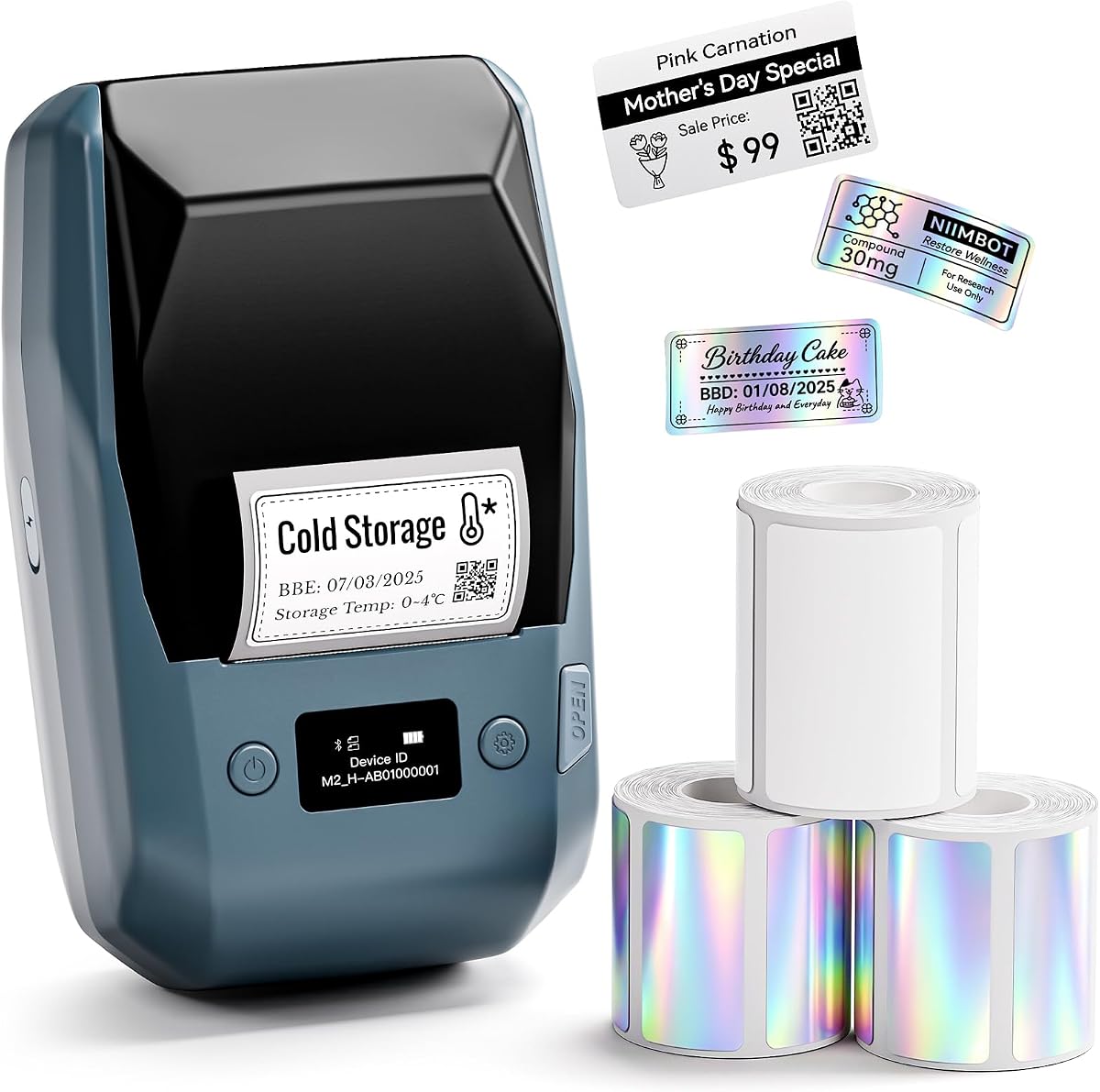
The NIIMBOT M2 combines 300 DPI thermal transfer printing with a portable form, earning a 4.4 rating. It produces sharp text, barcodes, QR codes, logos, and graphics, making it suitable for detailed identifiers on vials, centrifuge tubes, storage containers, and laboratory samples.
We may earn a commission when you buy through this link, at no additional cost to you.
Its stated label durability includes resistance to water, oil, scratches, and fading across a temperature range of -4°F to 248°F. The supplied information also states that labels can remain readable for 8 to 10 years, although actual life depends on the material, environment, and usage conditions.
Bluetooth connectivity supports up to ten paired devices at once, with three iOS and seven Android connections, while USB provides a path to more advanced PC editing. Labels from 1 to 2 inches wide are supported, along with several synthetic, PET, PVC, and transparent materials. The trade-off is that editing depends on a phone or computer rather than a built-in keypad.
This is the best budget-oriented recommendation for users who want detailed, durable output without a full-size industrial machine. The 2000mAh battery, Type-C charging, and ability to print up to 15 rolls on a charge also make it practical for mobile sample-labeling sessions.
The 300 DPI head supports small text and machine-readable codes, while thermal transfer construction is well suited to labels that must withstand handling. Media choice remains the main factor in real-world durability.
Supporting several paired phones can make shared labeling easier, and USB access provides a desktop option. The app and software workflow should be evaluated against the complexity of the labels a team needs to create.
We may earn a commission when you buy through this link, at no additional cost to you.
The BRADY M210 Handheld Label Maker has a 4.6 rating and is presented as a portable labeling solution. Its handheld format is relevant to laboratories where labels must be applied at a bench, in a storage area, or beside a sample rather than produced exclusively at a fixed workstation.
We may earn a commission when you buy through this link, at no additional cost to you.
The supplied listing provides only the product name and does not enumerate resolution, connectivity, media dimensions, or display features. As a result, buyers should not assume that this configuration provides every capability associated with other M210 listings in the roundup. The exact package contents and supported cartridge range require verification.
Its principal attraction is therefore the combination of a high supplied rating and a portable design. The tradeoff is a less complete public specification set, which makes cartridge availability, print resolution, and editing workflow especially important questions to ask before purchasing.
This model is best considered by buyers who already work with the M210 platform and understand its media system. It may serve as a convenient additional handheld unit, but a first-time buyer should compare the current listing details carefully with the fully specified M210 kit and laboratory model.
A handheld format can reduce the need to carry samples to a fixed printer. This is helpful for decentralized work, storage areas, and temporary laboratory stations.
Because the supplied listing is brief, buyers should confirm what is included and which media it accepts. Checking those details prevents assumptions based on similarly named models.
We may earn a commission when you buy through this link, at no additional cost to you.
The NIIMBOT M2 Tape Bundle is a 300 DPI thermal transfer label printer package that includes the machine and three rolls of laser silver label tape. Its 4.6 rating and included media make it appealing to buyers who want to begin labeling without immediately researching a separate consumable order.
We may earn a commission when you buy through this link, at no additional cost to you.
The labels are described as resistant to water, oil, scratches, and chemicals, and the bundle is specifically highlighted for peptide sample tubes and laboratory reagent vials. The printer supports label widths of 20 to 50mm, with a maximum effective printable width of 48mm and 300 DPI output for small text, barcodes, and QR codes.
Bluetooth supports up to ten paired mobile devices, while USB supports PC editing. Automatic label identification, automatic paper retraction, and a first-label saving function can reduce waste. The tradeoff is that the included silver tape may not match every laboratory color scheme, and advanced app functions are tied to the included six-month VIP membership.
This bundle is a strong starting point for biotech labs, sample repositories, and research groups that want immediate media availability. Buyers should check the dimensions and appearance of the three included rolls before planning a broad color-coding or container-labeling system.
Including consumables removes the initial setup barrier and lets users test a labeling workflow immediately. The silver material may also be especially useful where neutral, high-contrast identification is preferred.
Automatic recognition, paper retraction, and first-label saving are designed to improve media handling. These features are particularly helpful when a miscalibration would otherwise consume several labels.
We may earn a commission when you buy through this link, at no additional cost to you.
The Brother QL-800 is a high-speed professional thermal label printer with a 4.3 rating. It can produce up to 93 labels per minute at 300 DPI, giving it useful capacity for laboratories that repeatedly label boxes, shelves, files, samples, or equipment in a centralized station.
We may earn a commission when you buy through this link, at no additional cost to you.
Black-and-red printing can add visual emphasis without the complexity of a full color printer. The included USB cable and Plug & Label technology support printing from Microsoft Word, Excel, and Outlook, while compatibility with Windows and Mac systems broadens its usability across workstations.
The built-in cutter produces clean label edges, and the printer supports Brother Genuine DK pre-sized labels as well as continuous tapes up to three feet. These are desirable features for organized facilities, although a desktop unit is less convenient than a handheld model and the media system is model-specific.
The QL-800 is best for a lab with a steady volume of standardized labels and staff who want quick access to standard office applications. It is a practical choice for room, cabinet, archive, and equipment identification rather than highly mobile sample work.
The stated speed and direct Microsoft integration suit facilities that create labels from existing lists. This can make repeat labeling faster for staff without dedicated design software.
Two-color output can make priorities and categories easier to distinguish. It is especially useful where a single-color thermal printer would limit visual organization.
We may earn a commission when you buy through this link, at no additional cost to you.
Choosing a laboratory label printer means balancing sample compatibility, legibility, durability, workflow speed, and the level of design complexity the team needs. The most important starting point is the shape, size, material, and environmental demands of the labels you actually intend to use.
Begin with the dimensions of the objects being identified. Narrow tubes and cryogenic vials may require compact media, while bottles, beakers, equipment, shelves, and room signs may benefit from a wider format. Some models support only one-inch media, whereas the Makeid D50, NIIMBOT M2, and Brother PT-E510 accommodate broader ranges. Measure both the container surface and the usable print area, and check whether curved surfaces require a gap between printed bands.
Small identifiers often contain dates, sample codes, chemical names, or warning symbols that must remain readable. A 300 DPI head provides a strong starting point for dense text, barcodes, and QR codes, but resolution alone does not guarantee a successful scan. Barcode contrast, symbol size, print darkness, and label cleanliness all influence whether downstream equipment can read a code reliably.
Thermal transfer printers use a ribbon to create a more durable label than a typical direct-thermal label. That distinction matters for samples exposed to moisture, oils, abrasion, temperature variation, or chemicals. The NIIMBOT M2, NIIMBOT bundle, Makeid D50, and Brother industrial models use thermal transfer in their supplied descriptions. Media choice still determines final performance, so environmental claims should be matched to the exact stock.
Handheld printers suit operators who move between benches, sample collections, and storage areas. Desktop models provide a fixed output point and are often better for repeated batches. Networked printers can serve an entire facility through Ethernet or wireless connections. Choosing the wrong format may create workflow friction even when the underlying print quality is excellent, so consider where labels will be designed, where they will be printed, and who will need access.
Keypad-equipped printers can create basic labels without a computer, which is useful in isolated work areas. Bluetooth and mobile apps simplify quick editing from a phone, while USB and desktop software offer more complex layouts, databases, templates, and barcode workflows. The PT-D610BT, M2 models, Makeid D50, and PT-E510 provide connected options, but their software requirements differ. Evaluate the devices and software already used by your team.
A printer is only as useful as the labels, ribbons, and cartridges available for it. Brady models support proprietary cartridges, Brother printers rely on compatible Brother media, and the NIIMBOT and Makeid systems use their own consumable ecosystems. Check whether the required width, material, adhesive, and ribbon are sold reliably. For a new laboratory, buying a bundle that includes tape can be more convenient than selecting media independently.
Batch efficiency depends on more than print speed. An automatic cutter reduces manual trimming, while half-cut output can make individual labels easier to peel. Templates save time when the same design is repeated, and stored labels or databases speed up recurring identifiers. A visual preview can prevent errors and wasted media. Consider how many labels users print at once and how often layouts repeat.
Laboratory environments can include refrigeration, heat, moisture, oils, cleaning agents, and abrasion. Supplied durability claims range from long-lasting thermal transfer output to resistance across specified temperature ranges, but no label is universally suitable for every chemical and environment. Review the exact material, adhesive, ribbon, cleaning exposure, and storage conditions before relying on a longevity claim.
Install the correct ribbon, label stock, or cartridge according to the manufacturer's instructions, then run the printer's calibration or media-detection procedure. Before creating a full batch, print a test label and confirm the content, dimensions, alignment, text density, and barcode or QR code. For critical samples, scan the code with the intended reader rather than assuming that a clear printed symbol will be accepted by the receiving system.
Create a labeling standard that defines prefixes, dates, sample IDs, equipment categories, and the exact location of each identifier. Use templates or stored label designs for recurring formats to reduce manual entry errors. When working with portable printers, pair only the necessary device, keep the application updated, and charge the unit before an extended labeling session to avoid interruptions during sample processing.
Care for the printer by following its cleaning guidance, keeping the printhead and platen free of adhesive residue, and storing ribbon and media in a clean, dry area. Do not pull labels backward against the cutter unless the manual permits it, and avoid using unapproved solvents on the housing or printhead. Retire media that has become brittle, curled, contaminated, or difficult to feed, especially when readability is more important than conserving a partially used roll.
A compact thermal transfer printer is often a strong choice when small labels must remain readable and resist moisture or handling. The NIIMBOT M2 supports 1- to 2-inch media at 300 DPI, while the Brady M210-LAB is specifically described for tubes, bottles, slides, and beakers. Confirm the vial diameter, usable label length, adhesive type, and curvature before selecting media.
A 300 DPI printer is advisable when labels contain small text, dense codes, or limited space. It improves character and symbol clarity, which can make barcodes and QR codes easier to scan. For large, simple equipment labels, resolution may be less critical, but matching the printer to the intended content remains important.
Thermal transfer is generally more appropriate when labels face moisture, oils, abrasion, temperature changes, or long storage periods because the ribbon adds durability. Direct thermal can be convenient for short-lived labels, but exposure to heat or chemicals may reduce readability. The best choice depends on the exact environment and consumable.
A model with a broad media range and useful software can cover both tasks. The Brother PT-E510 supports media from 3.5mm to 24mm, including laminated labels and heat-shrink tubes, while the Makeid D50 uses a two-inch head. Larger signs may require a separate wide-format printer, so buyers should consider the full range of label dimensions rather than assuming one device covers every application.
Ethernet or wireless is useful when several staff need access from different computers. Bluetooth works well for portable and mobile workflows, while USB is a dependable choice for a fixed workstation. The Brother QL-820NWB supports Bluetooth, Ethernet, and wireless connectivity, while the PT-D610BT provides both Bluetooth and USB for more flexible deployment.
Not necessarily. Brady and Brother systems are designed around specific cartridges or DK media, while the NIIMBOT and Makeid products also use model-specific consumables. Even when a roll appears physically similar, its dimensions, sensor gaps, coating, ribbon, and adhesive may differ. Always check the manufacturer's supported media list before ordering.
Use enough label space around the code, preserve adequate contrast, and avoid placing the symbol across a curve or damaged surface. Print a test and scan it with the exact reader used by the laboratory's tracking system. High-resolution output, correct print density, clean printheads, and properly sized symbols are all more reliable than simply enlarging a code.
Choose handheld when users will move between sample locations, storage areas, and equipment. Choose desktop when labels are printed in batches or designed from office applications. A network printer is appropriate for shared facilities, while a portable Bluetooth model is more convenient for decentralized teams. Consider both the physical labeling location and the design workflow.
The Brady M210 Portable Label Printer Kit stands out for its standalone keypad, broad cartridge support, backlit display, and rugged construction, making it a versatile choice for technical labeling. The Brady M210-LAB is the more explicitly laboratory-focused alternative, while the Brother PT-E510 offers the most structured industrial workflow for teams relying on templates, codes, and specialized media.
Prioritize the labels you need before the features. Confirm media width, material, adhesive, print resolution, durability, cutting method, connectivity, and editing workflow against real laboratory tasks. The NIIMBOT M2 is compelling for portable, detailed thermal transfer output, the Makeid D50 suits two-inch desktop workflows, and the Brother QL models serve higher-volume or shared installations.
Ratings, listings, product configurations, and prices can change, so review the current product page and supported consumables before making a final decision. Checking the latest software requirements, dimensions, and environmental specifications will help ensure that the selected printer fits both today's samples and future laboratory workflows.