
Neideso N900Ultra
4.6Editor score
Five-channel 360-degree coverage
Dual rear cameras
AI driver monitoring
AI dash cams combine ordinary event recording with features such as driver monitoring, collision warnings, blind-spot alerts, smart parking detection, and mobile connectivity. The best model depends on your vehicle, routes, and recording priorities, especially when deciding between a conventional front-and-rear setup and a multi-camera 360-degree system.
This guide compares ten AI dash cams using resolution, lens coverage, sensor performance, low-light capabilities, parking features, positioning, storage, and driver-assistance functions. It includes options for daily drivers, professional drivers, rideshare operators, families, and owners who need comprehensive surround coverage.
Each review explains the model's strongest features, practical trade-offs, and ideal buyer. Ratings reflect the supplied customer feedback, while specifications and feature details come from the listed product information. Product prices and configurations can change, so confirm the current listing and included accessories before purchasing.
4.6Editor score

4.3Editor score

4.7Editor score
As an Amazon Associate we earn from qualifying purchases.
The comparison below highlights each model's coverage, imaging, AI functionality, connectivity, and parking approach. The 70mai A810S stands out for balanced daily-driver features, while the HUPEJOS and Neideso systems provide broader 360-degree monitoring and the Juscar model offers a more conventional dual-camera design.


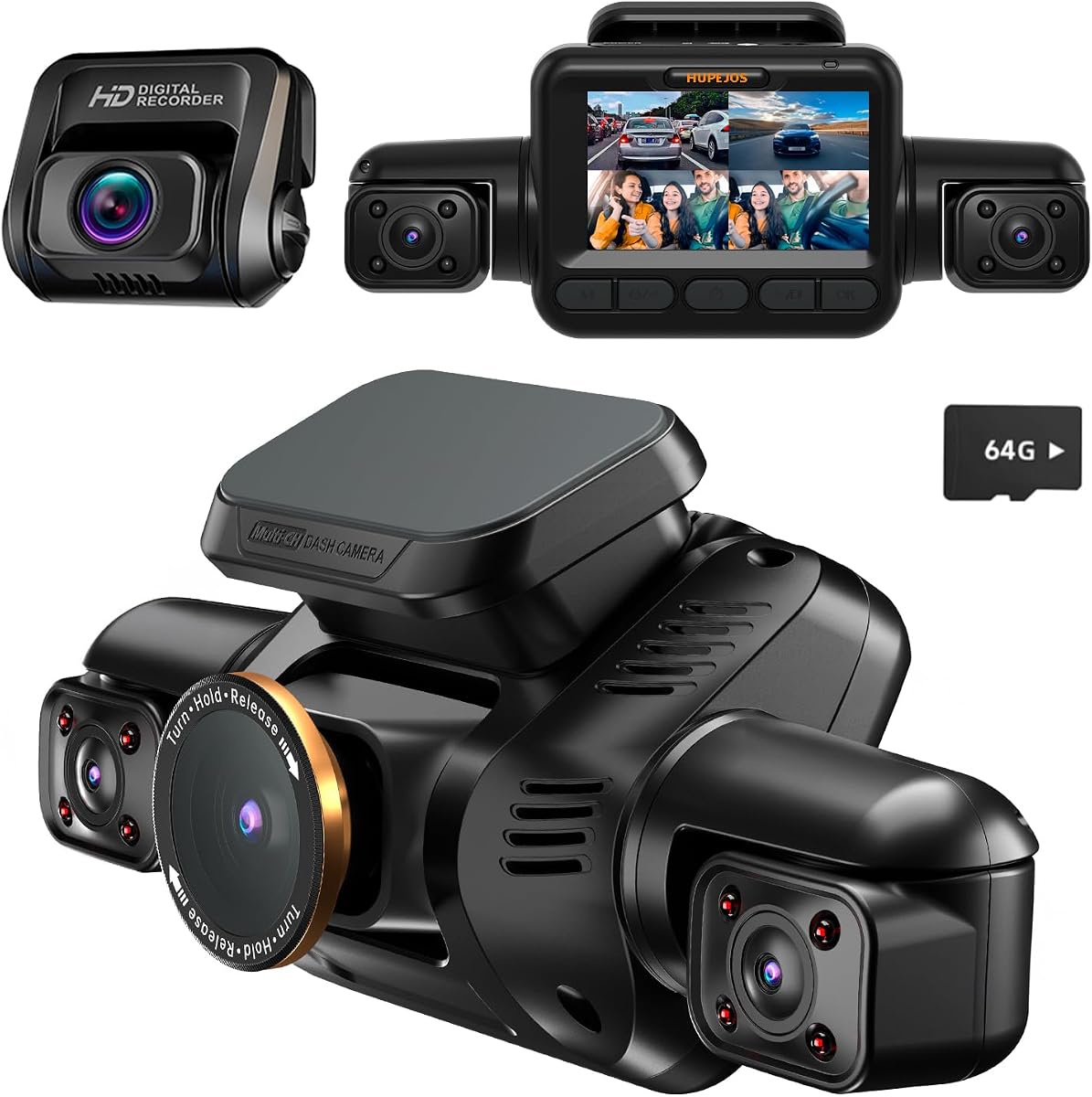


The HUPEJOS AI 360° View 4K Dash Cam is a four-channel system built for drivers who want evidence from the front, left, right, and rear at the same time. Its customer rating is 4.3, and its defining strength is the combination of simultaneous surround recording and an AI driver monitoring system. Each of the four 150-degree lenses is independently adjustable, giving owners more control over camera placement than a fixed 360-degree design.
We may earn a commission when you buy through this link, at no additional cost to you.
The imaging system supports two notable recording configurations: 4K at the front with dual-channel 1080p, or 3K at the front with triple-channel 1080p. That flexibility is valuable when storage, processing, or review speed matters. The CPL filter is intended to reduce glare, while eight IR lamps and six glass lenses support low-light recording. A status light makes it easier to determine whether recording is active when the screen is off.
The AI layer goes beyond ordinary motion alerts. Driver monitoring can identify distraction, yawning, driver absence, phone calls, and smoking after the vehicle reaches the configured speed threshold. The built-in 5GHz Wi-Fi supports phone viewing through the app, and GPS records location, speed, and route information. Loop recording runs in three-minute segments, while the G-sensor locks collision clips in an Event folder so routine overwriting does not erase them.
The main compromise is installation complexity. This is not a simple adhesive two-camera setup; it is closer to a small multi-camera surveillance system. Parking surveillance also requires a separately purchased hardwire kit. Even so, the broad coverage, driver monitoring, GPS, and user-friendly evidence locking make this a strong choice for rideshare drivers, delivery operators, commuters, and anyone who routinely struggles with blind spots.
Recording all four directions can be especially useful at complex intersections, parking lots, and narrow urban streets. It also creates a broader record of passenger activity for rideshare use, although owners must position each camera carefully to avoid glare or obstructed views.
The driver monitoring suite identifies several behaviors associated with unsafe driving. Because alerts activate at a configurable speed, drivers can tune the threshold to their normal routes rather than receiving constant prompts during slow traffic.
We may earn a commission when you buy through this link, at no additional cost to you.
The HUPEJOS V9 earns the highest customer rating in this group at 4.8, combining a 3-inch touchscreen with four-channel 360-degree recording. Its four adjustable 150-degree lenses cover the front, left, right, and rear, with 4K front resolution and three 1080p channels. The result is an unusually comprehensive package for a vehicle security and evidence system.
We may earn a commission when you buy through this link, at no additional cost to you.
Image quality is supported by a large F1.8 aperture, eight infrared LEDs, Wide Dynamic Range, intelligent IR balancing, and noise reduction. The AI driver monitoring system detects distraction, yawning, driver absence, phone calls, and smoking. Owners can adjust the speed threshold or disable the feature, which is sensible because hats, glasses, and other facial obstructions may reduce detection accuracy.
Connectivity and operation are major strengths. Listed Wi-Fi 6 capabilities support transfers up to 20MB/s, and the app allows previewing, downloading, saving, and sharing. Built-in GPS records routes, speed, coordinates, and altitude. On the device, the responsive touchscreen provides direct control over playback and settings, while English voice commands can start or stop recording, take photos, and lock important clips.
The V9 includes 128GB of storage and supports cards up to 512GB. Loop recording and G-sensor event protection keep routine storage management simple, while a privacy mode retains only the latest three clips. Parking surveillance requires a separately purchased hardwire kit, and a four-camera installation takes more planning than a standard front-and-rear unit. Overall, it is a feature-rich choice for drivers who value flexibility and broad coverage.
The 3-inch touchscreen makes menu navigation and footage review more direct than a button-only interface. Voice commands add a hands-free layer for common recording actions, although only the commands listed in the manual are supported.
Wi-Fi 6 is particularly useful for owners who regularly download clips to a phone. The stated transfer rate and built-in GPS also reduce the need to move the memory card between the vehicle and a computer.
We may earn a commission when you buy through this link, at no additional cost to you.
The 70mai A810S is the most conventionally balanced option in the roundup. It records true 4K UHD through a Sony STARVIS 2 IMX678 sensor, pairs that with a 1080p IMX662 rear camera, and adds a useful set of AI, parking, positioning, and driver-assistance features. Its 4.3 rating reflects a strong feature set without the extra installation demands of a multi-lens system.
We may earn a commission when you buy through this link, at no additional cost to you.
The 146-degree front and 130-degree rear views are broad enough to reduce blind spots, while MaiColor Vivid+ helps balance exposure and color. Night performance combines the two STARVIS 2 sensors with Lumi Vision black-light color technology, Night Owl Vision processing, and an F1.7 aperture. That combination makes the A810S a sensible option for unlit roads, parking structures, and nighttime commuting.
AI Motion Detection 2.0 identifies people and vehicles, and the G-sensor locks clips after a collision. With the optional UP05 hardwire kit, owners can add 4G LTE remote access, live viewing, vehicle location, and real-time motion or collision alerts. Built-in GPS supports five positioning systems, while Wi-Fi 6 handles mobile transfers. ADAS alerts cover lane departure, forward collision, and other driving situations, and voice control can take photos, lock videos, or activate Wi-Fi.
The rear camera records at 1080p rather than 4K, and remote 4G operation depends on an accessory. Those limitations keep it below the most elaborate 360-degree systems in coverage. Even so, the A810S covers the priorities most drivers actually need: sharp forward evidence, respectable rear coverage, strong night imaging, parking detection, route data, and easy phone access. It is our strongest general-purpose recommendation.
The native 4K front sensor is a meaningful advantage when plates, signs, and traffic participants need to remain identifiable. The rear camera is less demanding at 1080p, but the wide lens still provides useful evidence for following vehicles and parking incidents.
Adding the compatible 4G hardwire kit creates a more complete parked-car monitoring system. Live viewing and location tracking can be valuable on long trips, though the basic dash cam remains a local recorder without that accessory.
We may earn a commission when you buy through this link, at no additional cost to you.
The Juscar 2026 AI Drive Assist is a dual-camera model that delivers an unusually broad set of functions for a value-focused option. Its customer rating is 4.7, and the combination of a rotating 4K front camera, 1080p rear camera, 3-inch IPS touchscreen, GPS, and dual AI assistance sets it apart from entry-level dash cams.
We may earn a commission when you buy through this link, at no additional cost to you.
The upgraded 1.8 AI NPU supports front ADAS warnings for tailgating and pedestrians, while the rear blind-spot system watches for vehicles overtaking or changing lanes from behind. The 170-degree front lens and 140-degree rear lens offer broad scene coverage. Owners can rotate the protected front camera toward intersections, passenger windows, or other areas of interest, which makes the system more flexible than a fixed-lens design.
A distinctive waterproof rear camera can be installed under the rear bumper or inside the rear windshield and supports automatic reversing display. This makes the system particularly relevant to truck, RV, and SUV owners who need a wider rear view. Imaging is supported by STARVIS 2, HDR, a six-glass lens, and an F1.4 aperture. The touchscreen, 5.8GHz Wi-Fi 6, GPS, and free app simplify setup, review, and route tracking.
The rear camera is limited to 1080p, and 24-hour parking mode normally calls for a hardwire installation. It also provides only 32GB of included storage, though it supports larger cards up to 512GB. Despite those limitations, its 4.7 rating, flexible camera, large-vehicle-friendly rear design, and active safety alerts make it a compelling choice for new drivers and owners who want advanced features without moving to a complex four-camera system.
The rotating front module is useful when the primary concern is not just the road ahead. It can record toward a side intersection, passenger area, or other angle, giving owners more flexibility than a conventional fixed windshield mount.
The waterproof rear camera and optional automatic reversing display are practical for trucks, RVs, and SUVs. Under-bumper installation may offer a clearer rear perspective, but the final choice depends on the vehicle, weather exposure, and routing needs.
We may earn a commission when you buy through this link, at no additional cost to you.
The ROVE R2-4K DUAL is built around strong image capture, convenient management, and flexible storage. It has a 4.5 customer rating, a 3-inch IPS display, built-in GPS, dual-band Wi-Fi, and a free 128GB microSD card. It also supports cards up to 1TB, making it one of the more storage-ready options in the roundup.
We may earn a commission when you buy through this link, at no additional cost to you.
Its Sony STARVIS 2 IMX675 5MP sensor, wide F1.5 aperture, HDR, and the rear camera's F1.8 aperture support clear low-light footage. The product information states that the front camera records at 2.5K and upscales to 2160p for playback, so buyers should understand that this is not native 4K capture. Even so, the source resolution remains higher than standard 1080p, and the sensor is designed to retain useful plate and sign detail after dark.
Dual-band 5.8GHz and 2.4GHz Wi-Fi supports app-based viewing, downloads, settings, and over-the-air updates at speeds stated up to 20MB/s. GPS data is stamped on footage and can be reviewed with the free GPS Player on PC or Mac. The on-screen compass and live speed readout are useful, while voice guidance, emergency locking, motion detection, and loop recording round out the core functions.
Parking surveillance offers three styles: one-frame-per-second time lapse, motion detection, and collision detection. A hardwire kit is required, and an event is recorded as a one-minute clip and placed in a protected folder. The upscaled 4K distinction is the main caveat, but for owners who prioritize night performance, extensive storage support, and a well-equipped dual-camera package, the R2-4K DUAL remains a strong option.
The IMX675 sensor, F1.5 aperture, and HDR work together to preserve more usable information in darkness. These specifications make the R2 particularly compelling for night-shift drivers and areas with uneven street lighting.
A 128GB card is included, and support up to 1TB gives owners room for longer continuous recording. Loop recording still overwrites the oldest footage, so incident locking and regular file management remain important.
We may earn a commission when you buy through this link, at no additional cost to you.
The 70mai Omni X800 differentiates itself with 4K recording at 60fps, a rotating front camera, and optional 4G LTE remote monitoring. Its 4.3 rating pairs with a broad feature set designed for drivers who want smoother video of fast-moving traffic, intelligent parking alerts, and a front camera that can cover more than a fixed forward angle.
We may earn a commission when you buy through this link, at no additional cost to you.
The front camera records at 3840 by 2160 pixels and 60fps, while MaiColor Vivid+ improves color and region-of-interest processing targets license plate areas. Its 146-degree lens can rotate 340 degrees, creating up to 360-degree coverage. The rear camera adds 1080p coverage, and STARVIS 2 technology is presented as capturing 88% more light for better detail and reduced glare in difficult nighttime conditions.
AI Motion Detection 2.0 can distinguish likely relevant activity and follows moving objects with the rotating front camera. Collision handling is also thoughtful: up to 180 seconds before an event and 30 seconds after it can be locked into a protected file. ADAS provides forward-collision, lane-departure, and speed-limit reminders, while 15 or more voice commands control common functions without touching the screen.
With the separate UP05 hardwire kit, the system adds 4G live viewing, remote location, and time-lapse parking capture that compresses 24 hours into two minutes. That convenience comes with a storage cost, especially when recording 4K continuously. The optional accessory and high bitrate make this model better suited to owners who prioritize remote access and high-frame-rate evidence than to those seeking the simplest possible setup.
Recording at 60fps can make moving vehicles and road details appear smoother than a standard 30fps capture. The extra data also raises storage requirements, so a high-speed, appropriately rated card is advisable.
AI motion tracking is especially relevant when a vehicle is parked and the rotating camera needs to cover a broad area. The optional 4G kit adds remote viewing and time-lapse capture, while the AI is designed to filter irrelevant movement such as windblown leaves.
We may earn a commission when you buy through this link, at no additional cost to you.
The HUPEJOS V8 Max combines four-direction recording with the STARVIS 2 IMX675 sensor and an AI driver monitoring system. It holds a 4.2 customer rating and differentiates itself through its 3-inch touchscreen, physical control buttons, voice commands, and included CPL filter. It is a particularly relevant choice for owners who want more imaging quality in the forward view without abandoning complete surround recording.
We may earn a commission when you buy through this link, at no additional cost to you.
The front channel captures 4K UHD through a 150-degree lens, while the left, right, and rear channels record 1080p. HDR and WDR support balanced detail, and eight IR lights improve visibility in darkness. The result can document complex intersections, parking-lot activity, and passenger interactions while still preserving a higher-resolution forward view for traffic evidence.
Control options are unusually varied. Drivers can use the touchscreen, English voice commands, or dedicated physical buttons to start recording, take a photograph, lock footage, or manage the display. Fast 5GHz Wi-Fi connects to a phone for viewing, downloading, and sharing, and built-in GPS logs route and speed information. Three-minute loop recording is backed by a G-sensor that moves detected collisions into a protected Event folder.
Radar-based parking monitoring and time-lapse recording expand the system beyond active driving, but a hardwire kit must be purchased separately. Live remote viewing is not available, and phone access requires a Wi-Fi connection. These are sensible limitations for a local dash cam. Buyers who need 360-degree evidence, strong night capture, and several convenient control methods will find the V8 Max unusually well rounded.
The STARVIS 2 front sensor and 4K channel provide extra detail where most driving evidence is concentrated. Three 1080p side and rear channels add the broader context needed to understand how an incident unfolds.
A touchscreen is convenient while parked, voice commands support basic hands-free actions, and physical buttons provide dependable access to key functions. This range of interfaces can be especially useful for professional drivers who use the camera frequently.
We may earn a commission when you buy through this link, at no additional cost to you.
The Neideso N900Ultra is the most comprehensive recording system in the roundup, with a 4.6 rating and five simultaneous channels. Unlike standard front-and-rear or four-channel designs, it adds a second rear camera aimed into the cabin. That fifth perspective can document rear-seat passengers, cargo, or trunk activity while the other cameras continue monitoring the road.
We may earn a commission when you buy through this link, at no additional cost to you.
Users can select between five-channel mode, which records the front at 2.7K and four additional channels at 1080p, or four-channel mode, which uses a 4K front camera and three 1080p cameras. The STARVIS 2 sensor, HDR, F1.8 aperture, and eight IR lamps support detailed low-light capture. The outward rear camera excludes IR, while the cabin-facing rear camera includes four infrared lamps for interior monitoring.
The built-in AI driver monitoring system detects fatigue, yawning, distraction, and phone use. Alerts operate above a preset speed and can be disabled. For evidence management, three-minute loop recording is paired with G-sensor incident locking, built-in GPS, and 5GHz Wi-Fi transfers stated at up to 8MB/s. Voice commands start or stop recording, lock clips, and turn on Wi-Fi, while the included 128GB card supports up to 512GB.
Parking surveillance adds 360-degree motion detection within roughly three to four meters and low-frame-rate time-lapse capture. It requires a separately purchased hardwire kit. The five-camera installation also requires the most thought because every lens must have a useful, unobstructed position. Despite that complexity, the N900Ultra is the standout choice for rideshare drivers, families monitoring rear passengers, and professional operators who value the extra cabin perspective.
The fifth, inward-facing rear camera is the N900Ultra's most distinctive feature. It adds context to road events while helping rideshare operators or parents document activity behind the front seats, subject to applicable privacy rules.
Two imaging modes let owners balance resolution and field of view. Five-channel mode records every angle, while four-channel mode prioritizes a 4K front image and broader high-definition coverage around the vehicle.
We may earn a commission when you buy through this link, at no additional cost to you.
The Neideso N700Pro is a four-channel, 360-degree dash cam with a 4.2 customer rating. It uses four ultra-wide 150-degree lenses to cover the front, rear, and interior perspectives, while allowing either 4K plus two 1080p channels or 3K plus three 1080p channels. It also records audio, a useful addition for documenting conversations and surrounding sounds.
We may earn a commission when you buy through this link, at no additional cost to you.
Its AI driver fatigue monitor analyzes behavior for drowsiness, phone use, and inattention, delivering audible and visual alerts. This makes the system relevant to long-distance drivers and families monitoring newer drivers. The app can view and download recordings, built-in GPS tracks routes and speed, and 5GHz Wi-Fi supports phone connectivity. There is no cloud storage or remote monitoring, so the system is primarily designed for local recording and later review.
Night performance is supported by eight IR lamps, six glass lenses, and a CPL filter that reduces glare. A G-sensor detects sudden movement and stores protected incident footage in an Event folder, while three-minute loop recording manages storage. Voice commands cover taking photos, starting video, controlling audio, Wi-Fi, and the screen, with only menu-supported commands available.
The parking mode monitors movement within approximately three to four meters and can begin recording in about five seconds. A separate hardwire kit is required, and 64GB of storage is included. Compared with the N900Ultra, the N700Pro lacks the separate inward-facing rear camera and some premium options. In return, it offers a straightforward 360-degree configuration for drivers who want broad coverage, AI fatigue alerts, and glare-reduced imaging.
The driver monitoring system focuses on drowsiness, inattention, and phone-related behavior. It can provide a useful prompt during long journeys, while the adjustable activation settings help limit unnecessary alerts.
A CPL filter can improve color and reduce reflections from windshields and illuminated surfaces. The IR lamps add another layer of low-light visibility, making the system more versatile for nighttime evidence.
We may earn a commission when you buy through this link, at no additional cost to you.
The Type S T400 PLUS places the greatest emphasis on AI driver assistance. Its 4K front camera and optional 1080p rear camera are joined by blind-spot, front and rear collision, lane departure, stop-and-go, and pedestrian warnings. The customer rating is 3.4, the lowest among these ten products, so the guide places it at number ten while still recognizing the breadth of its safety functionality.
We may earn a commission when you buy through this link, at no additional cost to you.
The ADAS system monitors lane position, the vehicle ahead, surrounding blind spots, and pedestrians in the path. Rear collision warning addresses the less common scenario of a vehicle approaching quickly from behind, while the stop-and-go reminder prompts the driver when traffic ahead begins moving. These features make the T400 PLUS more than a passive recorder and position it as a driving-assistance device as well.
Incident management relies on a G-sensor that moves relevant video into a separate folder so loop recording cannot overwrite it. When hardwired, Park and Record mode awakens after an impact and captures a 20-second clip. The Type S Drive app provides Wi-Fi access on Android and iOS, allowing users to view and download videos without physically connecting the camera or memory card to a computer.
The optional rear camera reduces the value for buyers who require complete front-and-rear coverage out of the box. Hardwiring is also necessary for full parking surveillance. While the lower rating warrants more caution, the T400 PLUS appeals to drivers who prioritize lane, pedestrian, blind-spot, and collision warnings over surround recording or high-resolution rear video.
The T400 PLUS focuses its AI on warnings that can prompt immediate driver action. Lane departure, pedestrian detection, blind-spot activity, and front or rear collision risk cover several common hazards in traffic.
Built-in Wi-Fi connects the camera to the Type S Drive app on Android and iOS. This is convenient for checking an incident without removing the memory card, although the optional rear camera and hardwired parking mode should be considered before purchase.
We may earn a commission when you buy through this link, at no additional cost to you.
The right AI dash cam depends on whether your priority is forward evidence, complete surround awareness, driver monitoring, remote parking access, or a simpler two-camera installation. Review resolution, field of view, sensor quality, storage, connectivity, and hardwire requirements together rather than focusing on a single headline feature.
A conventional front-and-rear system is the easiest to install and generally places storage demands on a manageable number of cameras. A rotating front module adds flexibility for intersections and passenger-side views, while a four- or five-channel system is best when evidence from every direction is essential. The Neideso N900Ultra goes furthest with a dedicated cabin-facing camera, making it particularly interesting for rideshare and family monitoring.
A product labeled 4K may record natively or upscale a lower-resolution image for display and playback. The ROVE R2-4K DUAL is explicitly described as recording the front at 2.5K and upscaling it to 2160p. Native 4K, such as the 70mai A810S front camera, generally preserves more original detail before processing. Compare sensor resolution, aperture, HDR, and low-light processing rather than treating the 4K label as the only measure of image quality.
Low-light quality depends on the image sensor, aperture, infrared lighting, HDR or WDR processing, and exposure balancing. STARVIS 2 appears in the ROVE, 70mai, HUPEJOS V8 Max, and Neideso N900Ultra, while several other models use infrared lamps and larger apertures. Consider a dim parking garage or unlit road as a realistic test case rather than focusing only on daylight footage.
AI dash cams cover several distinct functions. Driver monitoring systems detect fatigue, yawning, distraction, phone use, and driver absence. ADAS and blind-spot systems warn about lane departures, forward collisions, pedestrians, tailgating, and vehicles approaching from behind. Smart parking detection differentiates people and vehicles from irrelevant movement. Choose based on the assistance you will actually use rather than assuming every AI label performs the same task.
Most comprehensive parking modes require a hardwire kit so the camera can draw power after the vehicle is switched off. Some kits and compatible cameras are sold separately, while others include only the necessary camera and cable. Radar motion detection, collision-only recording, and time-lapse modes consume power differently, and hardwiring may require professional installation depending on the vehicle's electrical system.
Resolution, frame rate, channel count, and parking time-lapses all influence storage consumption. Included capacities range from 32GB to 128GB, and supported maximums vary from 512GB to 1TB. High-resolution or multi-camera recording benefits from a reliable, suitably rated card. Loop recording also means that incident locking is essential if you want important footage to remain available.
Local Wi-Fi makes it possible to preview and download recordings through an app, while GPS adds speed, route, location, and sometimes compass information. Optional 4G LTE kits add live viewing, vehicle location, and real-time alerts when away from the car. Models without cloud or remote features can still work effectively as local recorders, but they cannot provide live access to a parked vehicle.
A front-and-rear system may need only two mounts and a few cable routes, while a four- or five-channel installation requires careful placement around the vehicle. Check whether a card, charger, mounting hardware, rear camera cable, trim tool, and hardwire kit are included. Read the installation instructions, inspect the vehicle's glass and trim before routing cables, and avoid blocking important driver sightlines.
Begin by reading the manual, charging the camera, and formatting the supplied or recommended memory card in the dash cam before inserting it. Mount the front camera high enough to avoid blocking the driver's view, clean the glass or mounting surface, and route power and rear-camera cables away from sharp edges, airbags, pedals, and moving parts. For multi-channel systems, adjust each lens while parked and verify the live view before driving.
Configure the resolution, recording mode, storage capacity, GPS, audio, AI alert thresholds, and privacy settings before relying on the camera. Driver monitoring should be enabled only when the camera has a clear view of the driver's face, and ADAS warning sensitivity should be tested in a familiar area. For parking surveillance, install the correct hardwire kit, confirm the vehicle's parking-mode behavior, and verify that the dash cam restarts or remains powered as intended.
Check footage periodically, keep the card clean, and avoid removing it while the camera is writing. Review locked incident files promptly and back up important clips to a phone or computer. Keep the lens and infrared area free of dust, condensation, fingerprints, and adhesive residue, and avoid exposing the camera to excessive heat or moisture. Update firmware when instructed, use only compatible storage, and rely on the app for software and firmware changes where supported.
Regular dash cams mainly record video and lock clips after sudden movement. AI dash cams add features such as driver-fatigue monitoring, lane and collision warnings, pedestrian detection, blind-spot alerts, and smarter parking detection. These systems can provide earlier warnings and more targeted event monitoring, but they still require correct installation and realistic settings.
A four-channel system is better when side impacts, parking-lot incidents, or activity around the entire vehicle are major concerns. A front-and-rear model is simpler, uses fewer cables, and may be easier to maintain. The right choice depends on your routes, vehicle, recording priorities, and willingness to manage a more involved installation.
No. They generally work best when the camera has an unobstructed view of the driver's face and lighting is adequate. Hats, glasses, shadows, and unusual seating positions may reduce accuracy, as noted in the HUPEJOS V9 information. The feature can usually be disabled or adjusted through the speed threshold and settings.
Many models support parking mode, but most require a compatible hardwire kit because they must continue drawing power after the vehicle is switched off. Available modes can include radar motion detection, collision-only recording, and time-lapse capture. Confirm that the hardwire kit and camera are compatible before installation.
No. Most systems in this roundup store footage locally on a microSD card and provide Wi-Fi access for previewing and downloading clips. Cloud storage and remote live viewing are separate features, and the 70mai A810S and Omni X800 require a compatible 4G hardwire kit for the listed remote functions.
Use a reliable card whose capacity and speed rating are supported by the manufacturer. Multi-channel 4K recording, 60fps video, and parking time-lapses consume more space than basic 1080p recording, so a larger card is often useful. The 70mai Omni X800 information specifically recommends a U3-or-higher high-speed card.
No. ADAS and blind-spot systems can identify certain risks and issue timely warnings, but they may not detect every hazard and can produce false alerts. Drivers must continue watching the road, controlling speed, checking mirrors, and following traffic laws regardless of the camera's assistance features.
Use the camera's lock, emergency, or incident function as soon as safely possible, and confirm that the file appears in the protected event folder. Download it to a phone or computer before removing or formatting the card. Continuous loop recording may overwrite ordinary clips, although G-sensor locking helps protect detected incidents.
The 70mai A810S is the most balanced choice for everyday driving, combining native 4K, strong night imaging, AI parking detection, ADAS, GPS, Wi-Fi 6, and optional 4G remote access. The Neideso N900Ultra is the premium option for buyers who need the most comprehensive coverage, including a dedicated cabin-facing camera, while the Juscar 2026 AI Drive Assist stands out as a value-focused dual-camera system with rotating front coverage and useful rear blind-spot warnings.
Before choosing, prioritize the type of evidence you need. Select a simple front-and-rear model for ordinary commuting, a rotating camera for added directional flexibility, or a four- or five-channel system for surround and cabin visibility. Also account for nighttime quality, driver monitoring, parking power, memory-card support, and whether remote access is worth the cost of compatible 4G hardware.
Ratings, included accessories, app behavior, and product configurations can change over time. Review the current listing, manual, compatibility notes, and accessory requirements before purchasing. Most importantly, install the camera correctly, format a suitable card, configure the AI thresholds, and verify the view so the system's capabilities translate into useful evidence in the moments that matter.