Rachio 3
4.5Editor score
Eight-zone sprinkler control
Local weather intelligence
Remote app scheduling
Explore 10 app controlled watering systems compared for scheduling, zone control, weather adaptation, indoor plant support, outdoor durability, connectivity
App controlled watering systems replace rigid timers with schedules, weather awareness, and remote control through a smartphone. The right model depends on whether you manage an established sprinkler system, one hose outlet, or a collection of indoor and outdoor plants. Good systems also offer dependable scheduling, clear notifications, and installation methods suited to your space.
We compared all ten products by examining their core capabilities, including app control, zone support, watering modes, weather intelligence, connectivity, outdoor construction, and included components. The list covers full sprinkler controllers, multi-outlet hose timers, and reservoir-based drip irrigation kits so readers can compare solutions for different yards and plant collections.
Each review explains who the system suits, what stands out, and where its requirements may not align with a particular home. The top picks demonstrate broad sprinkler control, flexible hose watering, and convenient indoor plant care. Product availability, features, and current prices can change, so confirm the latest specifications before purchasing.
4.5Editor score

4.5Editor score
4.8Editor score
The table below compares all ten systems by watering method, control scale, scheduling capabilities, and practical constraints. It highlights whether each model is designed for an existing sprinkler network, a hose connection, or reservoir-fed plant care, making the differences easier to assess before buying.


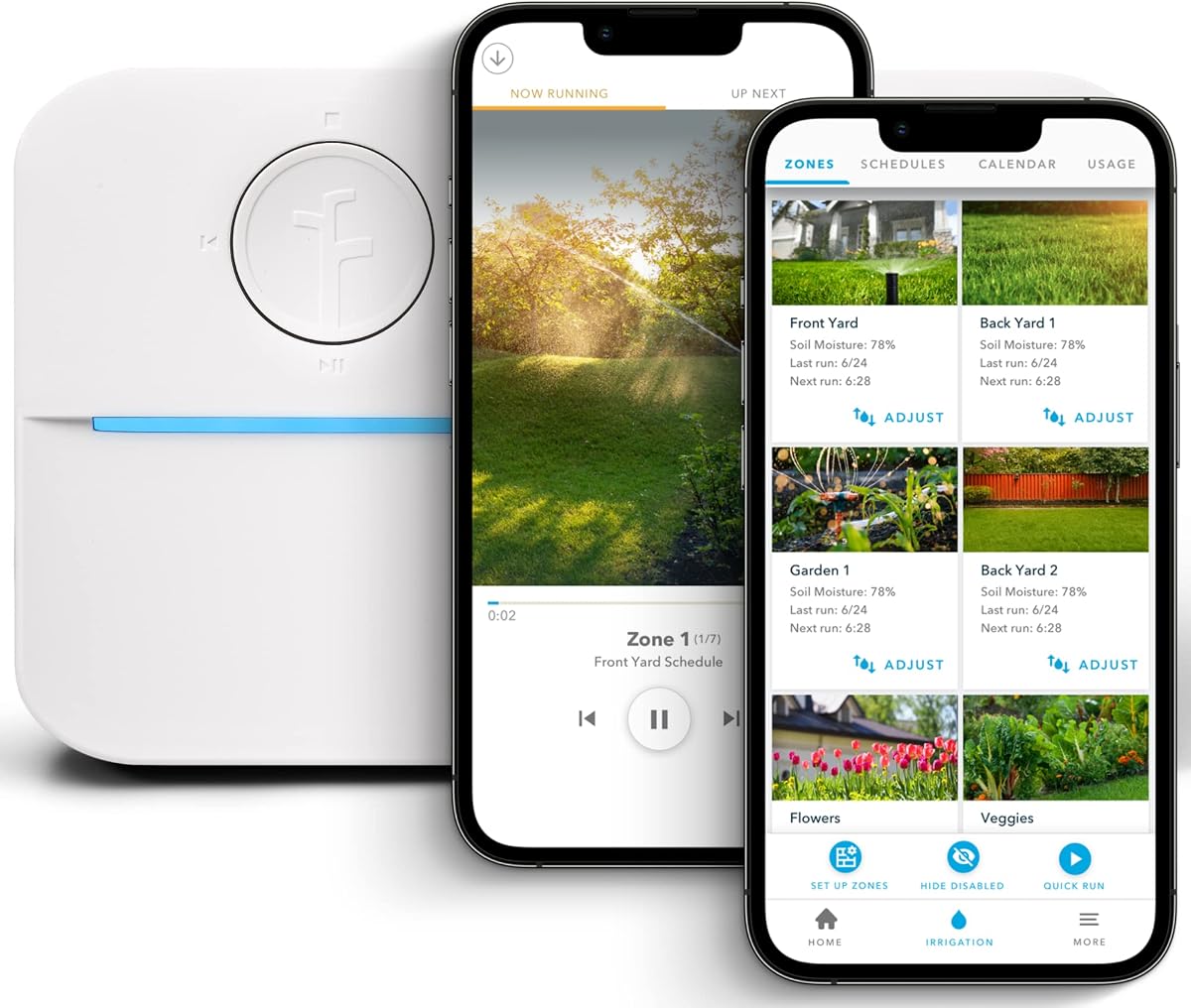
The Rachio 3 is a comprehensive smart controller for homes with an existing multi-zone sprinkler system. It carries a 4.5 rating and stands out for combining straightforward app-based scheduling with local weather intelligence. Instead of merely running a fixed timetable, it can modify watering behavior when rain, wind, freezing conditions, or other environmental factors make a cycle unnecessary. Its eight-zone capacity gives it substantial flexibility for lawns, flower beds, and drip irrigation.
We may earn a commission when you buy through this link, at no additional cost to you.
The Rachio app is central to the experience. Users can create their own schedules, allow Weather Intelligence to adjust automatically, run individual zones, review upcoming watering activity, and track estimated water use. Grow-in options are also included for a new lawn, while automatic skips help preserve scheduled cycles when conditions change. Compatibility with Alexa adds another layer of convenience for users who already manage compatible smart-home devices through a voice assistant.
The principal trade-off is that Rachio 3 is an indoor controller replacement rather than a hose timer or standalone plant-care pump. It requires a compatible sprinkler setup and some wiring knowledge, although the manufacturer states that installation can be completed in 30 minutes or less. It also appears to be aimed at more extensive irrigation demands than a single-garden timer, making it most relevant to homeowners with several independently controlled watering areas.
This is the strongest overall choice for a homeowner who wants sophisticated scheduling and automatic weather responses for an established landscape. It balances control, water conservation, and zone flexibility better than most alternatives. Buyers should verify terminal compatibility, transformer requirements, and their existing watering-zone configuration before ordering.
The controller uses local weather intelligence to skip or adjust watering when conditions make a scheduled cycle wasteful. This can reduce unnecessary irrigation without requiring the owner to remember checking the forecast and changing the app every time rain approaches.
Separate zone control allows lawns, planting beds, and drip lines to follow different schedules. Remote zone runs, estimated-usage tracking, and flexible grow-in programming make the system more versatile than a basic one-outlet timer.
We may earn a commission when you buy through this link, at no additional cost to you.
The Orbit B-hyve 57946 is a six-zone smart sprinkler controller designed for users who need more control than a simple hose timer but do not necessarily require the highest zone count. Its 4.5 rating reflects a favorable balance of scheduling tools, placement flexibility, and multi-zone irrigation support. The controller can be installed indoors or outdoors, making it suitable for garages, sheds, and exterior walls.
We may earn a commission when you buy through this link, at no additional cost to you.
Its app provides a practical way to build custom irrigation schedules, adjust watering programs, monitor individual zones, and manage the system remotely. The multi-zone architecture allows lawn sprinklers and drip systems to operate on different plans, which is valuable when trees, shrubs, and lawns have different water requirements. The protective weatherproof case adds installation flexibility without limiting access to app-based management.
This controller requires a compatible irrigation setup, so it is not a substitute for an above-ground timer or reservoir-based pump. The buyer must also be comfortable with the wiring and valve connections associated with a multi-zone controller. It includes a two-year limited warranty for private use, providing some reassurance, but buyers should still confirm local installation requirements and compatibility before purchasing.
The Orbit B-hyve 57946 is an excellent choice for medium-sized landscapes with several watering zones and a need for remote programming. It offers fewer zones than Rachio 3 but remains a flexible, straightforward option for coordinating conventional sprinklers and drip irrigation. It is especially attractive for users who want indoor or outdoor installation flexibility.
A weatherproof case allows installation in garages, sheds, or on outdoor walls, depending on the property and local setup. Buyers should select a location that remains accessible for maintenance while protecting the controller from the environment.
Coordinating sprinklers and drip lines independently helps prevent one planting area from receiving the same volume and timing as another. Remote program adjustment also reduces the need to return to the controller whenever a schedule changes.
We may earn a commission when you buy through this link, at no additional cost to you.
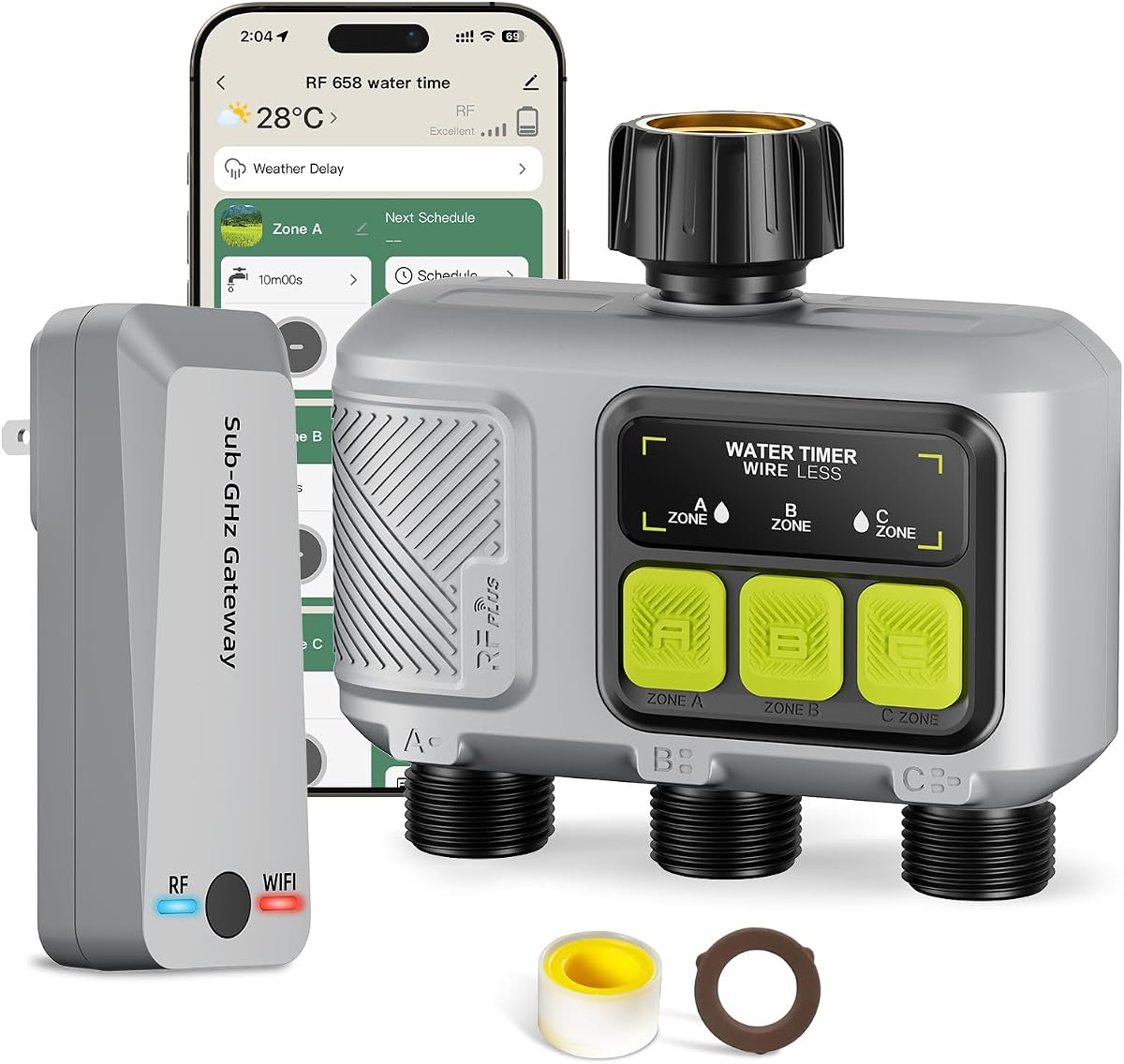
The WiFi Water Timer 3 Outlet is a strong budget-oriented choice for anyone who needs several hose-fed watering points without installing a wired sprinkler controller. It has the highest rating in this guide at 4.8 and supports three independent outlets. Each outlet can have its own start time, duration, and weekly frequency, allowing separate schedules for a lawn, flower bed, and drip line.
We may earn a commission when you buy through this link, at no additional cost to you.
A dedicated gateway is the key technical feature. It is advertised as maintaining a stable connection across as much as 984 feet and through several walls, which offers more placement flexibility than relying only on a standard WiFi timer. The Smart Life or Tuya app provides remote operation, while Alexa and Google Assistant support adds voice control. Timed, weekly-cycle, mist, rain-delay, and manual modes cover several common watering patterns.
The system is intended for outdoor hose use, but it does not replicate the zone-specific capabilities of a conventional sprinkler controller. It also requires a 2.4GHz WiFi network, and buyers should account for the power, outlet placement, and water connection required by the timer and gateway. The brass inlet, integrated filter, and IP55 housing are positive features for regular exterior use.
For users seeking the most flexible inexpensive setup, this product offers an unusually strong combination of outlet capacity, wireless reach, and watering modes. It is especially useful for gardens, young lawns, pots, and drip systems connected to ordinary hoses. It is less appropriate for a homeowner who needs to operate an existing underground multi-zone network.
Independent outlet programming lets multiple hose-connected areas run on different schedules without separate physical timers. This makes the system practical for renters, new gardens, and properties that have not yet been converted to underground sprinklers.
The included gateway is designed to carry the timer connection farther than an ordinary WiFi hose timer. That reach makes it easier to place the timer near a faucet while maintaining app access and reducing dependence on a strong WiFi signal at that exact location.
We may earn a commission when you buy through this link, at no additional cost to you.
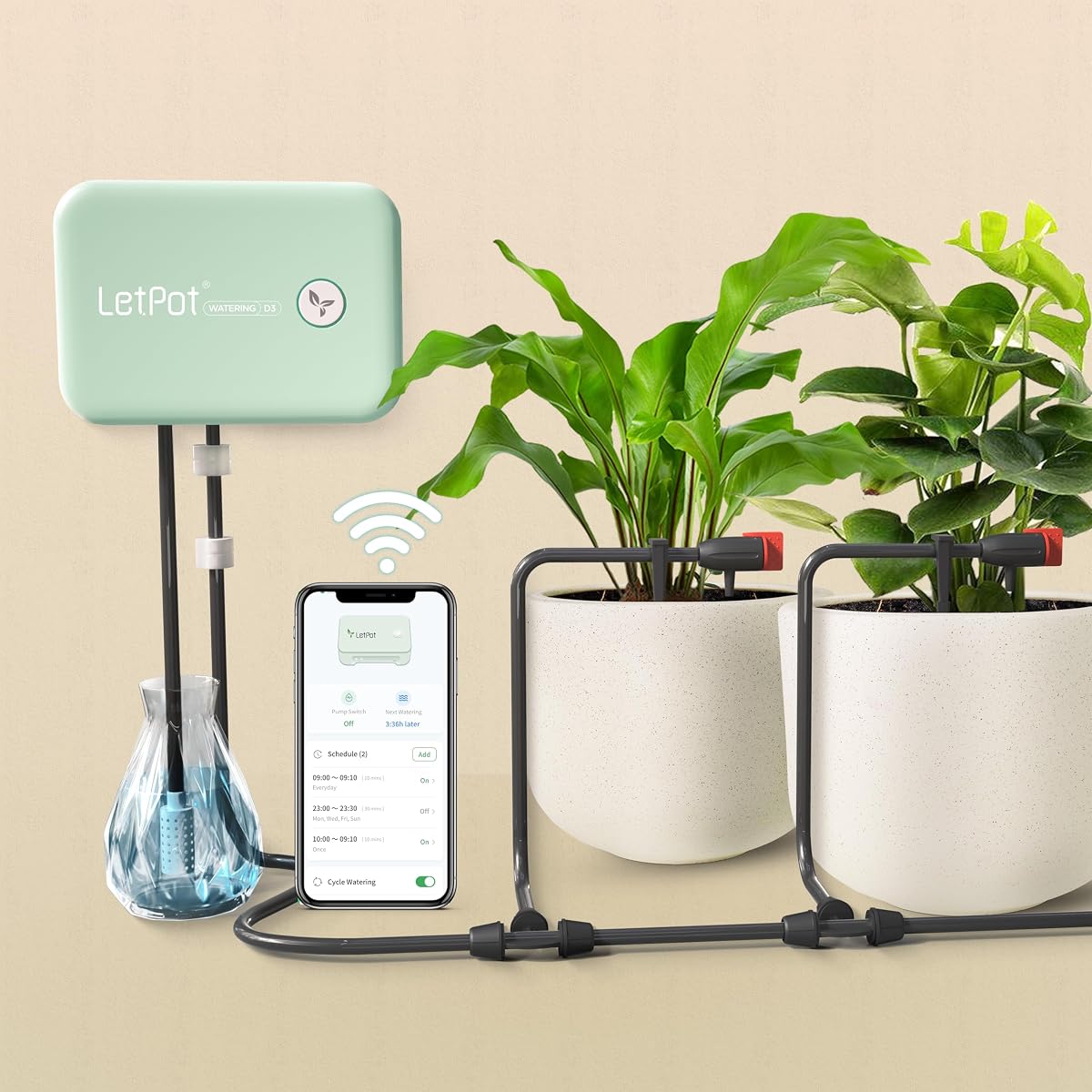
The LetPot Automatic Watering System is designed for people who want scheduled care for numerous pots rather than a lawn-wide sprinkler network. Its 4.2 rating reflects a capable system with a dedicated app, adjustable drip output, and support for up to 20 pots. The included components include a 10-meter pipe, ten adjustable drippers, connectors, brackets, a filter, and an adapter plug.
We may earn a commission when you buy through this link, at no additional cost to you.
Remote app control allows users to set frequencies, durations, and multiple watering tasks. The app can support up to five simultaneous tasks and includes low-water alerts, plant information, and a diary for recording care. Adjustable drippers and customizable plans allow intermittent or continuous watering, making the system usable for plants with substantially different moisture needs.
The upgraded chip is intended to improve connection stability, while the anti-backflow valve helps reduce siphon-related flow issues. A silent German-imported pump makes indoor use more practical, and the IP66-rated housing suits balconies and other outdoor locations. Buyers should still consider plumbing access, tubing routing, and the need to keep the water source supplied.
This is a good match for a balcony, indoor plant room, or collection of containers where hose timers are too limited and sprinkler controllers would be excessive. It is less relevant to an existing irrigated lawn. The included parts cover a useful plant count, and the app adds valuable visibility into water shortages and completed routines.
The app can notify the user when the connected water supply is running low. This is especially useful when the system operates while the home is unoccupied and a depleted reservoir could otherwise interrupt the schedule.
Individually adjustable emitters and selectable plans make it possible to serve plants with different watering needs. The choice between intermittent and continuous operation also helps align the system with different soil and root conditions.
We may earn a commission when you buy through this link, at no additional cost to you.
The VIVOSUN Automatic Drip Irrigation Kit is a smart plant-watering system aimed at growers who want direct-to-root irrigation and efficient flow control. It carries a 4.1 rating and includes 16 drip emitters, allowing it to water up to 16 plants. Its flexible tubing is compatible with soil, coco coir, perlite, and rockwool, giving it relevance across indoor and controlled growing environments.
We may earn a commission when you buy through this link, at no additional cost to you.
The included 15-watt pump can deliver up to 1,000 liters per hour and operates at a stated 30–40 dB. App control is provided through the Vivosun A10 GrowHub. Users can establish custom schedules, use Cycle Mode for recurring intervals, or employ Recipe Mode for precise daily timing and amounts. The distinction is important: cycle mode is straightforward, while recipe mode offers more exact control for growers with specific schedules.
Its main limitation is ecosystem dependence. App-based operation requires the compatible Vivosun A10 GrowHub rather than operating as a completely independent WiFi timer. Buyers with many small pots may also need to moderate flow because the pump and larger 4 mm drippers are capable of delivering substantial water. The anti-siphon connector and filter cotton help reduce backflow and debris-related clogging.
This kit is a good choice for existing Vivosun users, indoor growers, and users who want several plants to receive direct root watering automatically. It is less attractive for a broad outdoor yard because it is built around a compact plant irrigation network. Pairing it with the correct hub is the essential first step.
The ability to define exact daily timing and water amounts is more granular than a basic recurring timer. That makes the kit useful for growers who already understand the moisture and feeding requirements of their plants.
A 15-watt pump and 16 drip emitters give the system enough capacity for a substantial collection. The filter and anti-siphon connector support steadier operation, although users should still monitor emitters for buildup.
We may earn a commission when you buy through this link, at no additional cost to you.
The Orbit B-hyve XD 24639 is a four-port smart hose timer for properties that need several hose-connected watering points but do not require a wired in-ground controller. Its 3.9 rating is the lowest among these ten products, yet the system offers relevant features for targeted outdoor irrigation. The included Wi-Fi hub and app support remote access, while Bluetooth assists with programming.
We may earn a commission when you buy through this link, at no additional cost to you.
Smart Weathersense technology uses local weather data and drought conditions to adjust the watering schedule automatically. This focus on adaptive water management distinguishes it from a purely manual hose timer. The four-port design can coordinate multiple outlets, making it more practical than a single-outlet model for lawns, planting areas, and drip irrigation connected to standard hoses.
Its outdoor construction includes a weatherproof multi-valve unit and a battery-powered setup intended to support consistent operation. The trade-offs are that a separate hub adds another device to configure and power, and its rating suggests some inconsistency in overall customer satisfaction. Actual performance may also depend on signal placement, weather-service access, and the number of connected outlets.
The 24639 is most appropriate for users who want weather-responsive hose watering with several independent outlets. It may suit a new garden or a property transitioning from manual timers. Buyers should compare its hub requirements and four-port layout against simpler models, particularly if they only need to water one small zone.
Smart Weathersense can adjust watering in response to local conditions and drought. That automation is useful when a fixed schedule would otherwise continue watering during dry conditions or consume more water than the landscape requires.
Multiple valves allow separate hose runs to be programmed from one system. This provides a middle ground between a single hose timer and a full multi-zone underground sprinkler controller.
We may earn a commission when you buy through this link, at no additional cost to you.
The Orbit B-hyve XR 57985 is an eight-zone smart sprinkler controller that combines WiFi-enabled remote management with a flexible indoor or outdoor installation format. It has a 4.3 rating and is designed for properties whose landscaping includes several separately controlled irrigation areas. Its zone capacity makes it a credible option for larger lawns, beds, and drip systems.
We may earn a commission when you buy through this link, at no additional cost to you.
The app supports remote schedule changes, monitoring, and customized watering programs. Intelligent scheduling uses forecast-driven irrigation to adjust cycles, which can help conserve water and prevent unnecessary watering. This makes the timer more adaptive than a conventional mechanical controller, while remote access reduces the need to interact physically with the unit.
As a replacement for an existing sprinkler timer, it carries the same practical constraints as other multi-zone controllers. It requires compatible wiring, valve connections, and enough room for installation. The indoor and outdoor designation provides placement flexibility, but buyers must protect the unit appropriately and confirm that their existing system meets its requirements.
The XR 57985 is a good fit for a homeowner who needs substantial zone control and forecast-aware scheduling without moving to a premium full-featured controller. Compared with the Orbit 57946, it offers more zones, while the Rachio 3 emphasizes local weather intelligence and deeper usage tracking. The right choice depends on controller compatibility and the number of independent watering areas.
Eight zones let different sections of a yard follow distinct schedules. That granularity is valuable when irrigation needs vary significantly across turf, flower beds, and drip-fed planting areas.
Forecast-driven cycles allow the system to react to expected conditions rather than always following a fixed timetable. This can improve water efficiency while reducing the owner's need to cancel runs manually.
We may earn a commission when you buy through this link, at no additional cost to you.
The GoveeLife H5901 is a single-outlet smart hose timer that emphasizes network reach, weather responsiveness, and detailed app reporting. Its 4.1 rating reflects a useful feature set, including real-time adjustments based on rain, light, temperature, and humidity. Rather than relying on a static timetable, it can skip rainy periods and increase watering during hot, dry weather.
We may earn a commission when you buy through this link, at no additional cost to you.
The included gateway can connect as many as 64 devices and is advertised to maintain a connection up to 1,640 feet away. That makes the product particularly interesting for larger properties or arrangements where one timer controls a distant hose point. The app can display charts of watering time and volume, which helps users understand consumption instead of simply confirming that a cycle ran.
Construction details support outdoor reliability. Dual brass inlets, an IP67 waterproof housing, and a UV-stabilized shell are intended to resist leaks, cracking, rust, and sun-related deterioration. The timer supports continuous, intermittent, and custom watering modes along with up to ten schedules. It also works with Alexa and Google Assistant, although the gateway supports 2.4GHz rather than 5GHz WiFi.
The H5901 is well suited to a single garden area that needs more intelligent behavior than a basic mechanical timer. Its single outlet is a limitation for users wanting to operate several hose-connected zones from one unit, and the stated 7.25–116.03 PSI operating range means low-pressure supplies may drip rather than operate correctly. Verify the faucet, hose, pressure, and gateway compatibility before buying.
App charts track watering time and volume, giving users a clearer view of how much water the landscape receives. This information can support more informed schedule adjustments than a simple run-status display.
Brass inlets, UV-stabilized materials, and an IP67 housing address common outdoor timer weaknesses. These features are valuable for units installed near sprinklers and exposed to rain, splashes, and prolonged sunlight.
We may earn a commission when you buy through this link, at no additional cost to you.
The RAINPOINT Direct WiFi Waterer is a reservoir-based indoor drip system designed to keep a collection of plants on a schedule even when connectivity is imperfect. It has a 4.3 rating and supports up to 10 plants using a WiFi-enabled pump, 32.81 feet of tubing, ten adjustable emitters, and supporting fittings. The app is designed for straightforward setup through a direct 2.4GHz WiFi connection.
We may earn a commission when you buy through this link, at no additional cost to you.
Local storage is one of the most important features. Preset schedules continue running during an internet outage, and the built-in rechargeable battery maintains watering when power is interrupted. This makes the system more resilient for vacations or homes where network and electrical reliability are uncertain. A standard daily routine is available for beginners, while seasonal adjustments, profile and scene features, and multiple plans provide finer control.
The system also prioritizes protection against common indoor watering failures. Automatic shutoff prevents the pump from running dry, while a low-water indicator and push or email alerts notify users that the reservoir needs attention. Adjustable emitters accommodate different pot sizes, and an anti-siphon valve, filter, and blackout tube help reduce unwanted flow and debris-related issues. Family permissions allow multiple household members to monitor the system.
This product is a strong choice for indoor plants, especially when uninterrupted schedules matter more than lawn irrigation. It is not intended to replace an outdoor sprinkler controller, and the reservoir must be refilled before it empties. It also uses 2.4GHz WiFi only, so the home network must support that band.
The controller stores watering schedules independently of the internet connection. Even if the network is unavailable, established routines can continue, reducing the chance that a temporary outage stops plant care.
The rechargeable battery provides an additional layer of protection when household electricity is interrupted. Combined with automatic dry-run protection, it helps keep unattended watering both continuous and safer.
We may earn a commission when you buy through this link, at no additional cost to you.
The RAINPOINT WiFi Plant Waterer is a cordless indoor system intended to support houseplants through vacations and busy periods. It carries a 4.1 rating and can serve approximately 10 to 15 potted plants. The included pump, tubing, and drip stakes create a flexible arrangement, while a 2400mAh rechargeable battery is advertised to operate for up to 60 days on one charge.
We may earn a commission when you buy through this link, at no additional cost to you.
The smartphone app handles scheduling and monitoring and provides notifications while the owner is away. Because the system operates without a wall outlet or plumbing, it can be assembled around a suitable reservoir wherever the plants are located. Installation is advertised at about 15 minutes, which is helpful for users preparing a home before a trip.
Its anti-siphon technology is designed to stop water flow immediately when the pump turns off. This addresses a common concern with continuously dripping plant waterers, where residual flow can create leaks or contribute to overwatering. As with any reservoir system, the water container must be filled and positioned correctly, and the battery must be charged before the owner leaves.
This model is a practical choice for indoor plant enthusiasts who travel frequently or do not want a permanent plumbing-based installation. It offers less redundancy than the Direct WiFi Waterer and does not include the same local-memory and family-sharing emphasis. Its main advantages are cordless flexibility, long battery life, and straightforward setup.
Because no outlet or plumbing connection is required, the system can be arranged around indoor plants more freely. A suitable reservoir and the included tubing determine where the pump and drip stakes can be positioned.
The rechargeable battery is designed to keep the system operating for up to 60 days per charge. That makes the product convenient for vacations, although users should still monitor the reservoir and charge the unit before leaving.
We may earn a commission when you buy through this link, at no additional cost to you.
The right app controlled watering system depends on the number of watering areas, the type of landscape, available water pressure, network requirements, and how much automation you want. Use the following factors to narrow the field before comparing individual models.
Start by identifying how water reaches the plants. A full sprinkler controller is designed to replace an existing controller and operate underground valves, while a hose timer connects directly to an outdoor faucet. Reservoir-based drip kits are intended for pots or compact plant collections and usually draw from a container rather than a pressurized water line. Selecting the wrong architecture can make an otherwise capable product unsuitable for the property.
In short, match the controller to the physical irrigation system, not merely to the number of features in its app.
A zone represents an independently scheduled irrigation area, while an outlet controls a hose-connected output. Homes with lawns, beds, and drip lines may need six or eight sprinkler zones. Gardens using separate faucet connections may benefit from three or four hose outlets. A one-outlet timer works for a single simple watering point, and a plant kit should be matched to the number of pots and drip stakes it can support.
In short, count independently watered areas first, then choose a product with a little capacity above the number you expect to use.
Remote schedule editing is only the beginning of useful app control. Look for zone monitoring, manual starts, adjustable duration, separate programs, low-water warnings, watering history, and clear status notifications. Vacation modes, seasonal adjustments, and recipes can be helpful for plant collections, while users with an established sprinkler system will value the ability to run and inspect individual zones.
In short, favor an app that provides control and useful feedback rather than one limited to starting and stopping a single cycle.
Weather-aware systems can reduce unnecessary watering by using rain, forecast, temperature, humidity, wind, or freeze information. The sophistication and source of that intelligence vary. Some controllers use local intelligence, while others rely on internet data or forecast-driven adjustments. A smart schedule is not a substitute for checking the system, but it can make a fixed program more responsive to changing conditions.
In short, prioritize automatic skips and meaningful adjustments, especially if maintaining the schedule manually would be difficult.
Several products require 2.4GHz WiFi rather than dual-band or 5GHz networks. Others include a separate gateway that must be configured, updated, and placed to provide a stable path to the timer. Bluetooth programming may also be available even when remote management runs through WiFi. Check the home network, available outlet, and app ecosystem before ordering, because these requirements can affect installation and ongoing convenience.
In short, verify the required network band, hub behavior, app compatibility, and firmware requirements before purchase.
Hose timers and outdoor controllers are exposed to rain, ultraviolet sunlight, splashing, pressure, and temperature changes. Look for weather-resistant housings, brass inlets, integrated filters, and UV-stable materials. A stated waterproof rating indicates intended resistance but does not eliminate the need to install the unit according to its instructions. Pumps, valves, tubing connections, and power supplies each have separate environmental limits.
In short, match the hardware to the exposure it will face and inspect all hose and fitting connections for compatibility.
A controller can have excellent software and still underperform if the connected water supply is weak. Some products publish minimum and maximum operating pressures, while others require a particular threaded faucet size. Full sprinkler controllers also need compatible wiring, a suitable power source, and valves matched to the existing system. A hose timer should be checked for fitting size, and a plant kit should account for the size and number of containers.
In short, verify pressure, thread size, wiring, and water-source requirements before assuming the system will work with the current setup.
Automation reduces daily work but does not eliminate upkeep. Inspect filters, clean emitters, replace batteries, confirm that pumps are submerged when required, and keep reservoirs supplied. Low-water alerts, dry-run protection, and local schedule memory add valuable safeguards, particularly during travel. Users should also know how to disable or manually pause a system if a leak, valve failure, or unexpected rainfall occurs.
In short, select the level of monitoring and protection that matches how long the system will run without regular attention.
Begin by installing the system according to its instructions and confirming that the water source, fittings, wiring, and network are compatible. For a sprinkler controller, identify each valve and test the zones before creating detailed schedules. For a hose timer, check the thread, pressure, and gateway placement. For a reservoir-based plant kit, arrange the tubing, fill the container, and verify that every dripper is positioned correctly.
Next, connect the app and establish a realistic starting program. Use short test cycles to confirm flow, identify blocked emitters, and observe whether plants or lawn areas receive the intended amount. Create separate schedules for areas with different needs, then enable rain delays, weather adjustments, and notifications. Keep manual control available for troubleshooting rather than relying on automation without an initial test.
Ongoing care includes cleaning filters, inspecting outdoor fittings, replacing batteries on a consistent schedule, and checking the reservoir before extended absences. Review app history and adjust programs as seasons change. After severe weather, verify that valves, hoses, and controllers are still secure. If a leak or dry-run condition appears, shut off the water or power as appropriate and correct the issue before resuming schedules.
The primary schedule usually continues running after it has been configured, so the phone is not required for every watering cycle. However, a smartphone is needed to create or change schedules, run a zone manually, review history, or respond to alerts. Products with local storage and battery backup are especially useful when internet or power service is interrupted.
A smart sprinkler controller usually replaces an existing controller and operates multiple underground zones. A hose timer connects directly to a faucet and controls one or more hose outputs. Sprinkler controllers suit established irrigation networks, while hose timers are easier to add and work well with sprinklers, drip lines, or containers connected by hose.
They can, especially when weather data, rain delays, and soil-specific schedules are used correctly. Automation avoids watering during unnecessary cycles and helps different plants receive appropriate amounts rather than sharing one rigid program. The result depends on setup, weather-service access, and whether the owner regularly reviews the schedules and maintains the hardware.
Several of the listed products specifically support 2.4GHz WiFi only, while some may use a separate gateway with its own connection requirements. Check each product's compatibility notes and the router settings before installation. A device that cannot join the home network may still work through a separate hub, but only if that hub supports the required model and firmware.
The required reservoir size depends on the number of pots, emitter flow, watering frequency, and duration of time away from home. The system should be filled with enough water for the planned schedule plus a safety margin, and the water inlet must remain submerged as specified. Low-water alerts are helpful but do not replace checking the container before a trip.
Yes, if the controller has enough independently programmable zones and the existing valves are configured appropriately. Lawn sprinklers and drip lines generally benefit from different run times and frequencies, and separating them into their own zones makes those schedules easier to manage. Confirm the number of zones and compatibility with the home's wiring and valves.
First check the filter, hose connections, emitter positioning, and the pressure at the supply. Then verify that each valve or outlet corresponds to the correct app zone. A partially closed faucet, damaged hose, blocked fitting, or low water pressure can create apparent scheduling errors even when the program itself is correct.
They can be, particularly hose timers and other above-ground systems that do not require permanent wiring. The owner should confirm whether property rules allow attached devices, keep the setup easy to remove, and avoid changes to permanent irrigation controls without permission. Reservoir-based indoor kits are particularly convenient for temporary plant care.
The Rachio 3 is the most comprehensive option for an established eight-zone landscape, combining app scheduling with local weather intelligence. The Orbit B-hyve 57946 offers flexible six-zone control and convenient indoor or outdoor placement, while the three-outlet WiFi Water Timer provides the strongest budget value for hose-connected areas and distinguishes itself with a long-range gateway.
Prioritize compatibility before features. A sophisticated app cannot compensate for the wrong number of zones, insufficient pressure, incompatible fittings, or an unsuitable water architecture. The remaining options serve narrower but important needs, including indoor drip systems, Vivosun grow setups, weather-aware hose timers, reservoir systems with outage protection, and cordless vacation watering kits.
Before ordering, check the current specifications, app requirements, included components, and installation guidance. Features and product availability can change, as can current prices, so compare the latest listing and confirm that the system fits the property before making a final decision.