
TopTes PT-990 Rechargeable Gas Leak Detector
4.7Editor score
Real-time PPM display
Alarm data logging
Triple alert system
Rechargeable USB-C battery
A combustible gas leak detector helps locate potentially dangerous concentrations of methane, propane, butane, and other combustible gases around appliances, fuel lines, storage tanks, and confined spaces. The most useful model combines a responsive sensor, clear escalating alerts, an accessible probe, and simple startup calibration.
We compared the ten detectors by examining their stated detection ranges, supported gases, alarm systems, warm-up or calibration routines, probe flexibility, display capabilities, power options, and intended work environments. The list includes compact household units, rugged handheld instruments, and advanced models with data logging and live concentration readings.
Each pick highlights a different balance of portability, reach, information, and convenience. Ratings reflect the supplied customer feedback, while technical details come from the product information provided for this guide. Features and availability can change, and current prices should always be checked before purchasing.
4.7Editor score

4.6Editor score

4.6Editor score
As an Amazon Associate we earn from qualifying purchases.
The comparison covers detection range, probe flexibility, alert capabilities, display functions, and practical extras. Specifications are based on the supplied product information and should be checked against the manufacturer instructions before use.




The Klein Tools ET120 Gas Leak Detector combines a broad stated detection range with a flexible probe and escalating visual and audible warnings. Its 4.6 rating reflects generally favorable customer feedback, and its specification sheet positions it as a versatile instrument for detecting methane-based concentrations between approximately 50 and 10,000 ppm. It is a strong all-around choice for homeowners, HVAC workers, and service technicians who need a probe that can reach awkward spaces.
We may earn a commission when you buy through this link, at no additional cost to you.
The 18-inch gooseneck is one of the most useful physical features. It can extend around appliances, into narrow gaps, or toward pipes and storage equipment without requiring the operator to place the entire unit very close to the suspected source. The stated operating instruction recommends moving within one to five centimeters of a suspect area, and the flexible design makes that positioning more manageable. The probe also clips to the meter for compact storage.
Alert intensity is another major strength. Five red LEDs provide a visual warning, while the 85 dB audible signal becomes stronger as the detected concentration increases. This escalating response is easier to interpret than a detector that merely sounds once. High and low sensitivity settings also provide more control: the high mode covers 50 to 1,000 ppm, while the low mode covers 1,000 to 10,000 ppm according to the supplied information.
The trade-offs are mostly about information and documentation. The ET120 does not present a numeric concentration reading and has no stated data-logging function, so it is better suited to quickly locating a source than creating a formal record of changing readings. Automatic zero-point calibration at power-up helps simplify setup, but the user must still allow the unit to complete its flashing-light calibration sequence in clean air. Overall, it is the most balanced choice in this group for flexible access, useful controls, and unmistakable escalating alerts.
The 18-inch gooseneck extends the sensor into locations that are difficult to inspect with a fixed head. It can bend around cabinet edges, appliance edges, and narrow spaces while keeping the main housing accessible in the operator's hand.
The combination of five red LEDs and an 85 dB alarm makes the warning useful in kitchens, utility rooms, and active work areas. The changing signal also helps indicate when the sensor is moving closer to a stronger concentration.
We may earn a commission when you buy through this link, at no additional cost to you.
The TopTes PT520A is a portable natural gas detector designed for locating methane, propane, butane, natural gas, LPG, and other combustible gases. It carries a 4.6 rating and offers a broad stated methane-based range of 50 to 10,000 ppm. For homeowners, RV owners, and maintenance workers who want a dedicated gooseneck without a large display, it balances reach, response speed, and straightforward operation.
We may earn a commission when you buy through this link, at no additional cost to you.
Its 17-inch flexible probe is nearly as long as the ET120's and is intended for pipelines, storage tanks, gas fireplaces, basements, and other hard-to-reach areas. The supplied guidance recommends pointing the tip toward a suspected leak and moving within one to five centimeters. This distinction matters because the detector is designed for source location rather than general area monitoring, and a responsive probe makes close inspection more practical.
The stated response time is 0.5 seconds. As gas concentration increases, seven colored bars and a 75 dB alarm change, giving the operator both visual and audible feedback. A mute button is available when the audible signal is not useful, while the APO control lets the user enable or disable automatic power-off after ten minutes of inactivity. The included three AAA batteries, protective case, and user manual make the package convenient for storage and transport.
There are some limitations. Like many simpler sniffer-style units, the PT520A does not offer a numeric ppm display or a documented event log. The 30-second warm-up must occur in clean air before a search begins, which requires planning around appliance areas rather than powering it on immediately beside a suspected leak. For users who need quick location cues and flexible access without a screen, however, it is a capable and thoughtfully packaged choice.
The long probe can reach around appliances and into recessed areas while the operator maintains control of the detector. Its flexible construction is especially useful for RV cabinets, utility rooms, and locations with closely fitted equipment.
The stated 0.5-second response and increasing seven-bar display make it easier to distinguish a stronger reading from a trace response. A 75 dB alarm supplies an additional warning that can be heard in many household environments.
We may earn a commission when you buy through this link, at no additional cost to you.
The UEi Test Instruments CD100A Combustible Gas Leak Detector is a handheld instrument intended for residential, commercial, industrial, and HVAC work. Its 4.4 rating is supported by the stated ability to detect acetone, ammonia, butane, methane, natural gas, LPG, and jet fuel. For technicians who work around varied fuel systems, the broad listed gas coverage is a meaningful differentiator.
We may earn a commission when you buy through this link, at no additional cost to you.
The detector uses an 18-inch flexible gooseneck to reach confined and hard-to-access locations. A light at the end of the probe illuminates the inspection area, which is a particularly useful feature in basements, mechanical rooms, cabinets, and other poorly illuminated spaces. The operator is instructed to let the unit warm up for ten seconds in open air and then sweep the probe toward suspect areas.
When a leak is encountered, audio and visual cues provide feedback through an increasing tick rate. This method is simple and can help indicate when the probe is nearing a stronger source. The supplied information describes the CD100A as a faster and more effective alternative to the traditional soap method for assessing gas equipment, while also positioning it for professional inspection work.
The CD100A is less suitable for users who need recorded concentration values because no numerical screen or data logging is stated. Its benefit instead comes from robust access, broad gas coverage, and the illuminated tip. That makes it especially attractive for HVAC contractors, facilities personnel, and service technicians who regularly inspect equipment in dark or restricted spaces. It is a less information-heavy but highly practical locator.
The built-in probe light removes one common obstacle in dark cabinets, crawl spaces, and mechanical rooms. The operator can see the sensing tip and the immediate area while moving the detector.
The listed gas types extend beyond household natural gas to include ammonia, acetone, jet fuel, and LPG. That breadth suits technicians who may encounter different fuel or vapor sources across varied service calls.
We may earn a commission when you buy through this link, at no additional cost to you.
The TopTes PT199 is a compact natural gas leak detector with a 4.6 rating and a clear focus on quick household use. It detects natural gas, methane, propane, butane, LPG, and other combustible sources, making it relevant to owners of gas appliances, RV users, and do-it-yourself inspectors. Its compact body and included storage bag are especially convenient for keeping on hand.
We may earn a commission when you buy through this link, at no additional cost to you.
The stated detection range is 50 to 1,000 ppm based on methane, and the operating distance is one to five centimeters. These limits make it a source-finding tool rather than a broad area monitor. Visual and audio alarms are stated to trigger within 0.5 seconds, and the alarm intensifies as concentration rises. The LCD changes to red when gas levels are high, providing a distinct visual warning that can be noticed at a glance.
Startup is designed to be straightforward. The unit includes two AAA batteries, warms up for 30 seconds, and then becomes ready for detection. A low-battery indicator activates below 2.4 volts, while automatic shutdown occurs after five minutes without operation or detected gas. These features help prevent the detector from being left on unexpectedly or being used after the batteries have weakened too far.
The absence of a flexible gooseneck is the main limitation for reaching recessed areas. Users may need to position the entire unit close to a suspected point, which can be difficult around large appliances or built-in equipment. Its 1,000 ppm upper range is also lower than several alternatives. Even so, the PT199 offers the most immediately readable warning design in this group and is a practical choice for portable, close-range household inspections.
Turning the LCD red at high gas levels provides a prominent visual cue in addition to the escalating alarm. This can be useful in kitchens, basements, and spaces where hearing alone may not be sufficient.
The pocket-sized, non-slip housing is easy to keep nearby, and the included bag makes organization simple. Compact dimensions are useful for RV travel and quick checks between other tools.
We may earn a commission when you buy through this link, at no additional cost to you.
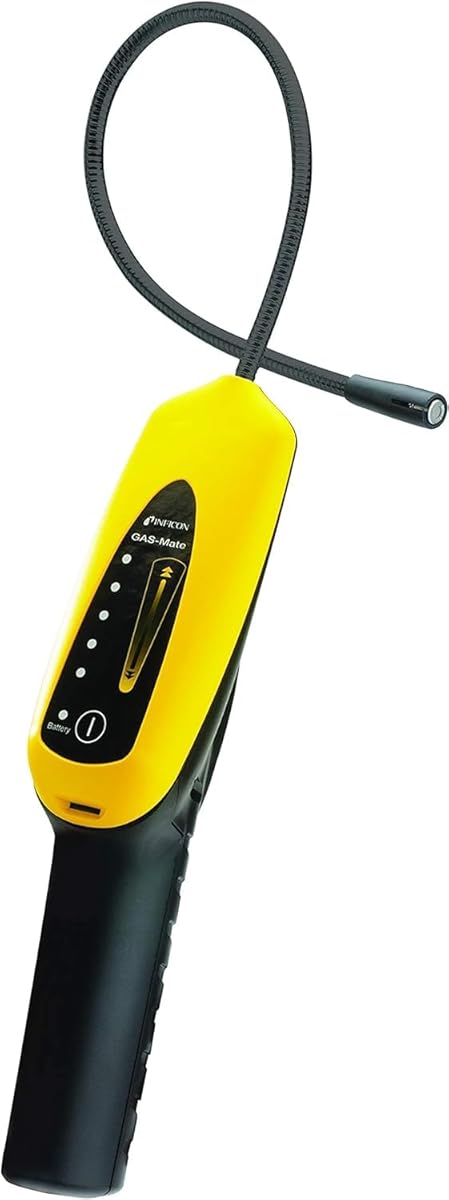
The Inficon 718-202-G1 Combustible Gas Detector is a focused instrument for professional test and gauge applications. It has a 4.5 rating and is listed as a combustible gas detector under the test instruments and gauges category. The supplied information identifies the country of manufacture as the United States and the manufacturer as Inficon, giving this model a more traditional industrial-instrument identity than many of the newer consumer units.
We may earn a commission when you buy through this link, at no additional cost to you.
What stands out in the available product data is the product's focused purpose. It is not presented as a multi-function environmental meter, an air-quality monitor, or a detector with a broad display ecosystem. Instead, it belongs to the category of instruments used to assess combustible gas. That specialization can be valuable for buyers who already understand their testing requirements and prefer a dedicated professional detector.
The package dimensions are listed as 15 inches long, 3.9 inches wide, and 8.4 inches high. Those dimensions suggest a reasonably compact piece of equipment compared with larger bench instruments, although the supplied data does not describe a specific probe length, alarm configuration, concentration display, or sensitivity range. It is therefore important to consult the current manufacturer documentation and the full listing before assuming compatibility with a particular application.
This model is a sensible option for professional users who prioritize an established instrument and combustible-gas focus. The trade-off is limited information in the supplied specification set, which makes direct feature comparisons difficult. A prospective buyer should verify sensor type, supported gases, warm-up time, display details, probe configuration, and calibration requirements before selecting it for a specialized inspection workflow.
The model is categorized specifically under test instruments and gauges rather than general household tools. That focus may appeal to technicians who want equipment intended explicitly for combustible gas assessment.
The supplied information does not list a numerical range, probe length, or alert system. Reviewing the current product documentation is essential when an application depends on those technical details.
We may earn a commission when you buy through this link, at no additional cost to you.
The Klein Tools ET190 Gas Leak Detector is a slim, lightweight combustible gas sniffer with the highest supplied rating in this comparison at 4.7. It is aimed at residential, commercial, and industrial users who need a portable instrument that can detect minor through major leaks. Its pocket clip and compact profile make it easy to carry during inspections or keep accessible in a tool bag.
We may earn a commission when you buy through this link, at no additional cost to you.
The stated methane-based detection range extends from 50 to 2,000 ppm. High and low sensitivity modes give operators a way to shift the focus while searching for a source, making it easier to narrow down a leak location. Bright LED indicators and escalating audible tones provide both visual and auditory warnings, which is useful in noisy, dim, or busy work environments where a single type of alert could be overlooked.
Automatic zeroing at startup is a notable convenience. After a 30-second startup sequence, the detector can establish its baseline without manual adjustment, helping it begin a search in a clean environment. This feature supports consistent operation and reduces the number of setup steps for a user who only needs to locate a combustible source.
The main limitation is that the ET190 does not have a stated numerical display, flexible gooseneck, or event logging function. It is therefore most useful for quick source location rather than detailed concentration analysis or logging. Its advantages are portability, simple controls, and fast automatic startup. For professionals who need something that fits in a pocket and responds clearly, it is one of the strongest options in the group.
The slim housing and sturdy pen clip let the detector remain available without occupying much tool-bag space. It is easy to carry from a truck, utility room, appliance area, or service site.
The 30-second automatic zeroing process simplifies preparation. Operators can complete the startup sequence in clean air and begin searching without making a manual baseline adjustment.
We may earn a commission when you buy through this link, at no additional cost to you.
The TopTes PT-990 is the most information-rich detector in this roundup, combining a 4.7 rating with live readings, trend graphics, data logging, and three types of alerts. It uses a Figaro sensor for combustible gases and is advertised for natural gas, propane, methane, industrial, and home applications. It is best suited to users who need more than a simple audible indication of a possible leak.
We may earn a commission when you buy through this link, at no additional cost to you.
The stated detection range begins at 0 ppm and extends to 10,000 ppm, equivalent to 0% to 20% LEL according to the supplied information. An active fan draws ambient air toward the sensor, and the manufacturer states that response can occur in as little as 0.5 seconds. The screen presents real-time ppm values alongside a dynamic trend line, helping the operator see whether concentration is rising as the probe moves.
Alarm management is unusually thorough. A 90 dB buzzer, visual indicator lights, and vibration alerts can each be enabled or disabled independently. The device also logs critical information such as the alarm time and ppm reading when an alarm is triggered. This turns a portable detector into a more useful tool for repeatable inspections, maintenance records, and investigations where the sequence of changing readings matters.
The PT-990 uses an 11-inch flexible probe, which is shorter than the 16-, 17-, and 18-inch probes offered by several competitors. Its rechargeable 4,000 mAh battery supports more than nine hours of use, while the USB-C port is protected by a dustproof cover. The TFT display, adjustable brightness, auto-sleep mode, and included storage case add to the premium experience. It is the best choice when readings, trends, and recorded events justify a more advanced instrument.
Live ppm readings and a dynamic trend graph reveal how the reading changes as the probe approaches or leaves a source. This is more informative than a unit that only changes tone or LED status.
Independent buzzer, light, and vibration settings let users adapt the detector to different jobsite conditions. Logging the alarm time and ppm value preserves useful context for maintenance and follow-up work.
We may earn a commission when you buy through this link, at no additional cost to you.
The Forensics Gas Leak Detector is designed for inspectors, technicians, and engineers who may need to evaluate more than household natural gas. It has a 4.4 rating and lists natural gas, methane, propane, butane, gasoline, diesel, alcohols, acetone, ethanol, IPA, toluene, LPG, and LNG among its applications. The breadth of listed substances gives it a strong technical and investigative positioning.
We may earn a commission when you buy through this link, at no additional cost to you.
Its sensor is made in Japan and calibrated for methane. The large color LCD is more informative than a simple LED-only interface, and the temperature display adds context that may help an inspector understand the operating environment. Rather than being limited to a single household gas, this model is presented as a multipurpose combustible vapor detector for professional assessment.
Durability is another distinguishing feature. The ABS housing is stated to pass a 10-foot drop test, which is reassuring for a portable instrument used in workshops, plant environments, or field inspections. A one-year limited warranty is also included, and the sensor is stated to have a seven-year service life, giving users a clearer maintenance horizon than many competing listings provide.
The available product information does not state the numerical detection range, probe configuration, exact alarm behavior, or battery details. Those omissions make it difficult to compare the detector precisely with units that publish those specifications. Nevertheless, for a professional who values a color screen, broad chemical coverage, temperature information, and rugged construction, the Forensics model offers a compelling technical package.
The listed applications include fuels, alcohols, solvents, and liquefied gases. That variety makes the detector more relevant to engineers and industrial inspectors than to a narrow household-only use case.
The color screen and temperature readout provide richer visual information, while the 10-foot drop-test claim supports use in active work environments. The stated warranty and sensor life support a longer-term ownership perspective.
We may earn a commission when you buy through this link, at no additional cost to you.
The RIDGID 36163 CD-100 is a handheld combustible gas diagnostic detector built for service work. Its 4.5 rating and stated list of supported gases—including methane, propane, butane, ethanol, ammonia, and hydrogen—make it relevant to installers, maintenance teams, and facility technicians. Its distinguishing feature is the Tri-Mode Detection system, which offers visual, audible, and vibration alerts.
We may earn a commission when you buy through this link, at no additional cost to you.
The 16-inch flexible probe reaches into confined and hard-to-access spaces where a fixed sensor head cannot easily be positioned. Adjustable sensitivity settings help operators locate leaks within seconds and choose an appropriate response level for different tasks. The detector is intended for gas line installations, repair assessment, and pinpointing combustible sources, giving it a focused diagnostic role.
Alert flexibility is particularly valuable in noisy environments. An audible signal can be missed when machinery or traffic is loud, while vibration can provide a discreet cue that the operator can feel. Visual feedback remains available for dark or confined areas. Together, the three modes make the CD-100 adaptable to warehouses, mechanical rooms, construction sites, and other working environments.
The ergonomic housing is described as comfortable for extended use while remaining suitable for heavy-duty work. A field-replaceable sensor can reduce service downtime and help keep a diagnostic tool in service longer. On the downside, no numerical display or data logging is stated, so it does not offer the measurement records of the PT-990. Its strength is instead a dependable combination of reach, alert choice, and serviceability.
Visual, audible, and vibration modes can each suit different surroundings. The operator can rely on tactile feedback in a noisy plant or use the visual and audible cues where appropriate.
A field-replaceable sensor can help limit downtime when maintenance is needed. The rugged, ergonomic design also supports regular use by installation and repair professionals.
We may earn a commission when you buy through this link, at no additional cost to you.
The TopTes PT177 is a pocket-sized gas leak detector with a 4.6 rating and a broad stated range of 50 to 10,000 ppm. It is designed to locate LPG, methane, ethane, propane, butane, natural gas, coal gas, and other combustible gas leaks. Its main appeal is simple, portable operation for households, RV owners, and do-it-yourself users who want a compact sniffer close at hand.
We may earn a commission when you buy through this link, at no additional cost to you.
The detector uses five red LEDs and a 75 dB alarm, both of which intensify as gas concentration increases. This creates a clear change in feedback while the user searches for the source. Startup requires a 30-second warm-up and automatic calibration in a clean, gas-free environment. Detection is stated to occur within 0.5 to three seconds once the unit is ready.
Its pocket clip makes it easy to carry in a shirt pocket, while the included drawstring storage bag helps protect it between uses. Two AAA batteries are supplied, and a low-voltage indicator flashes below 2.4 volts. The unit automatically turns off after five minutes without operation or gas detection, reducing the chance that it will remain active in a drawer or cabinet.
The PT177 does not have a flexible probe or numerical concentration display, so it is less suitable for recessed equipment and detailed diagnostic work than several alternatives. Even so, it combines a wide range, rapid escalation, and strong portability in a straightforward package. It is a practical basic detector for close-range checks around accessible household gas equipment and a useful addition to an RV maintenance kit.
The pocket clip and drawstring bag make the PT177 easy to keep accessible without taking up much room. It can move from the workbench to an RV cabinet or household appliance area with little effort.
Despite its compact form, the stated 50 to 10,000 ppm range covers many combustible gas levels. Escalating LEDs and sound make the result easier to interpret during a close-range search.
We may earn a commission when you buy through this link, at no additional cost to you.
The right detector depends on where you will inspect, which gases you expect, and how much information you need. Probe reach, response behavior, power, display, and alert design should be balanced against portability and required accuracy.
Start by confirming that the detector is suitable for the gas or gases present at your home, RV, workplace, or service location. Methane is common in natural gas, while propane and butane are especially relevant to portable appliances, recreational vehicles, and outdoor equipment. Some instruments also list ammonia, ethanol, acetone, jet fuel, LPG, LNG, and other vapors, which can be important for industrial or multi-fuel inspections. A broad headline claim does not guarantee equal sensitivity to every listed gas, so check the manufacturer documentation and calibration information before making a technical decision.
Detection range describes the concentration band in which the instrument is intended to identify combustible gas. Among the supplied models, stated methane-based limits range from 50 to 1,000 ppm on the PT199, 50 to 2,000 ppm on the ET190, 50 to 10,000 ppm on several others, and 0 to 10,000 ppm on the PT-990. A broader range can be useful when searching for both trace and stronger concentrations. Adjustable high and low sensitivity modes offer a more practical way to work across different levels, especially when the goal is to pinpoint the source quickly.
A flexible probe can reach behind appliances, into cabinets, around pipes, and into narrow service areas without forcing the entire detector into an awkward position. The longest stated probe in this group is 18 inches on the ET120 and CD100A, followed by 17 inches on the PT520A, 16 inches on the RIDGID CD-100, and 11 inches on the PT-990. Compact fixed-head units can still be useful, but they generally require the operator to bring the whole instrument very close to the suspected point. Consider the geometry of your typical inspection area before sacrificing bulk for portability.
Alerts should be noticeable in the environment where the detector is used. Escalating tones and LEDs are common among the more compact units, while the RIDGID CD-100 adds vibration and the PT-990 allows audible, visual, and vibration alerts to be configured independently. A numerical ppm display can make changing concentrations easier to compare, and the PT-990 goes further with a trend graph and event data. Decide whether a simple locator is enough or whether documentation and quantitative feedback are necessary for your workflow.
Every detector should be allowed to stabilize according to its instructions. Stated warm-up times range from 10 seconds for the CD100A to 30 seconds for the PT199 and PT177, while the ET190 uses a 30-second automatic zeroing sequence. Startup should occur in clean, gas-free air so the instrument can establish an appropriate baseline. A low-battery indicator, automatic shutdown, and easy calibration can all reduce setup errors, particularly for users who plan to carry the detector from one location to another.
Power requirements depend on how often and where the detector will be used. The PT199, PT177, and PT520A include AAA batteries, making them convenient for routine household checks. The PT-990 uses a 4,000 mAh rechargeable lithium battery, supports more than nine hours of use, and charges through a protected USB-C port. Rechargeability can reduce repeated battery replacement, while automatic sleep and power-off features help preserve charge. Consider storage temperature, charging access, and how the unit will be used in the field.
A detector that is difficult to carry may remain in a cabinet when a check is needed. The ET190 has a particularly slim pocket-clip design, while the PT177 also includes a clip and storage bag. The PT520A includes a protective case, and the PT-990 has a zippered storage case with a larger rechargeable design. Larger probes can also affect packing, so consider tool-bag space, grip comfort, non-slip surfaces, and whether the probe can be secured during storage.
Advanced models can provide a color display, temperature reading, trend graph, and recorded alarm events. These features support repeated inspections and technical reporting, although they add complexity and bulk. For field work, the Forensics model offers a color LCD and a stated 10-foot drop-test pass, while the RIDGID CD-100 emphasizes rugged construction and a field-replaceable sensor. Choose complexity only when it supports a genuine need; otherwise, a compact escalating-alert detector may be more practical for straightforward household leak searches.
Begin by reading the detector's manual, installing the specified batteries, and confirming that the sensor is within its stated service life. Operate the unit in a clean, gas-free area and allow the full warm-up or automatic calibration sequence to finish. A detector powered on beside an appliance or other suspected source may establish an unsuitable baseline, so move away before startup whenever possible.
Approach the suspected leak carefully. Follow the stated operating distance, which is commonly one to five centimeters, and move the probe or sensing head slowly through the area. Use the flexible probe to reach around obstacles, keep the unit stable, and watch both visual and audible alerts. A stronger or faster response generally indicates that the sensor is closer to a concentration worth investigating. If the detector alarms, do not attempt a risky repair until the source has been evaluated and the area made safe.
After the search, switch the detector off or allow its documented automatic shutdown to occur. Remove batteries for long-term storage if the manufacturer recommends it, protect the sensor from moisture and dust, and avoid dropping or sharply bending the probe. Keep replacement batteries, calibration information, and operating instructions available, and arrange sensor replacement or recalibration as required by the manufacturer.
A combustible gas leak detector helps locate concentrations of gases such as methane, propane, butane, and other combustible vapors. It is commonly used around gas appliances, fuel lines, RV systems, storage areas, and industrial equipment. A detector identifies a likely source for further action, but it does not replace professional assessment or repair procedures.
No. Each model has a stated set of gases and a calibration basis, commonly methane. Some units list broad ranges of fuels, alcohols, and industrial vapors, but that does not mean every gas is detected with identical performance. Users should verify the manual, supported gas list, and calibration details for their specific application.
Warm-up allows the sensor to stabilize and establish a clean-air baseline before measurements begin. The stated startup periods range from 10 to 30 seconds depending on the model. Starting the warm-up in clean air is important because gas present during calibration can affect the reference point and reduce the usefulness of the search.
A fixed-head detector must be moved with its sensing head already close to the target. A gooseneck model separates the sensor from the main housing, making it easier to reach behind appliances, around pipes, and into narrow spaces. The tradeoff is a bulkier tool and a longer probe that must be stored carefully.
It depends on the task. A simple locator with escalating tones and LEDs can be sufficient for a quick household check, while a ppm display, trend graph, and event log are more useful for professional inspections or repeated comparisons. Models without a display should not be expected to provide a numeric concentration value.
A portable detector is a diagnostic aid, not a complete safety certification. It can help narrow the search and identify likely problem areas, but a suspected leak still requires appropriate precautions, professional servicing, and confirmation that the system is safe. Avoid operating electrical switches or creating ignition sources near a suspected concentration.
Store the unit in a dry, protected location away from excessive heat, impact, and corrosive materials. Secure a flexible probe so it is not bent or damaged, and follow the manual's battery guidance. If the model uses a rechargeable battery, maintain it according to the manufacturer's charging and storage instructions.
Follow the manufacturer's service schedule and inspect the device before each use. The supplied information does not give a universal calibration interval, so check the manual, replacement guidance, and any stated sensor life. A unit that behaves inconsistently, fails to start, gives erratic readings, or has a damaged probe should not be relied upon.
The Klein Tools ET120 is the strongest overall choice because it combines a broad stated range, an 18-inch gooseneck, two sensitivity modes, automatic calibration, and escalating visual and audible alerts. The TopTes PT-990 takes the lead for advanced users who need live readings, trend graphs, event logging, independent alert modes, and rechargeable power, while the compact TopTes PT177 is the most straightforward portable option.
Prioritize the feature that matches your actual inspection environment. A long flexible probe and strong escalating alarm are valuable for tight household or service spaces, a ppm display and logs are more useful for professional assessment, and a rugged body with replaceable sensor may matter more for regular field work. Portable fixed-head models remain effective for accessible areas and quick checks.
Before buying, verify the latest specifications, operating instructions, supported gases, and included accessories. Customer ratings and product configurations can change, and current prices fluctuate, so compare the complete listing at the time of purchase. A detector is most useful when used correctly, maintained as directed, and treated as one part of a broader leak-safety plan.