
Zareba 17 Gauge Aluminum Wire
4.6Editor score
250-foot aluminum spool
38,000-psi tensile strength
Freely spinning installation reel
Electric fence wire for predator defense must do more than carry a charge. It must remain visible, resist weather and animal impact, transmit power over the intended distance, and create a boundary livestock and property owners can maintain with confidence. Polywire, aluminum, copper, and insulated cable each offer different advantages for temporary, portable, underground, and permanent installations.
This guide compares ten products according to conductor material, resistance, tensile or breaking strength, spool length, UV and corrosion resistance, visibility, installation requirements, and intended application. The list includes long polywire spools for rotational grazing, aluminum wire for conventional fence lines, high-conductivity options for demanding enclosures, and insulated cable for underground connections.
Each pick reveals how it fits a particular predator-control setup rather than treating every fence as the same application. The top selections provide the strongest balance of useful coverage, dependable construction, and practical handling. Product ratings and availability can change over time, and current prices should be checked before purchase.
4.6Editor score

4.6Editor score
4.7Editor score
As an Amazon Associate we earn from qualifying purchases.
The comparison below highlights each wire's conductor construction, length, mechanical strength, and outdoor durability so buyers can match the material to their fence layout, predator pressure, and charger requirements.



The ACLASTOOL Electric Fence Polywire is a 3,500-foot portable fence line built around six 304 stainless steel conductors and a woven polymer structure. Its 4.6 rating reflects a generally favorable buyer response, while the unusual combination of long coverage, manageable weight, and rust-resistant construction makes it the most versatile selection in this guide.
We may earn a commission when you buy through this link, at no additional cost to you.
The wire measures 1/8 inch in diameter and incorporates 15 thicker polymer strands around six conductive wires. This construction produces a stated 140-pound breaking strength, enough to discourage ordinary livestock pressure and repeated contact without behaving like rigid fence wire. Stainless steel also supports reliable current transfer over long distances and avoids the oxidation issue associated with ordinary aluminum.
The integrated reel, marked starting end, and flexible construction make this option convenient for rotational grazing, temporary paddocks, orchard protection, or other predator-sensitive areas that may need to be moved. The main trade-off is that polywire is not a universal replacement for every electric-fence component. It must be mounted on suitable insulators, kept away from vegetation and structures, and protected from physical damage.
This is the strongest all-around choice for buyers who need a large amount of portable wire. It suits farms, ranches, horse owners, goat keepers, and anyone establishing temporary boundaries where long runs and frequent reconfiguration are priorities. For fixed, highly exposed perimeter fencing, a more rigid wire may be easier to support, but for flexible predator deterrence this spool offers an excellent balance of coverage, strength, and handling.
Six stainless steel conductors give the polywire a practical advantage for long portable runs. The corrosion-resistant design helps retain performance when moisture, rain, and outdoor exposure are constant concerns.
The integrated reel and visible start marker reduce setup friction. A farmer can deploy, retrieve, splice, and reuse the line as grazing rotations or temporary predator barriers change.
We may earn a commission when you buy through this link, at no additional cost to you.
This 3,366-foot electric fence polywire is designed for temporary and portable enclosures, combining six stainless steel conductors with a 1/8-inch polymer body. The 4.6 rating indicates strong customer reception, and the nearly mile-long spool offers ample capacity for large rotational paddocks or multi-property predator control.
We may earn a commission when you buy through this link, at no additional cost to you.
Its low-resistance conductor construction is designed to carry current consistently through a long line, while UV-stabilized webbing protects the outer material from sunlight. The bright coloration makes the boundary easier for horses, cattle, goats, and other animals to recognize, reducing the chance of accidental collisions with a less visible fence.
Installation and maintenance are straightforward because the wire can be cut, spliced, rewound, and reused. It works with standard electric-fence reels and can support horse, dog, goat, and general livestock boundaries. As with other exposed polywire, however, it depends on appropriate insulators, good fence-line routing, and regular inspection for cuts, vegetation contact, or posts that have begun to lean.
Buyers who want a large amount of reusable portable wire will find this option practical and adaptable. It is particularly useful for temporary predator exclusion around paddocks, gardens, and orchards. It does not have the integrated reel highlighted by the first-ranked product, so users may need a separate reel for especially convenient deployment and storage.
The combination of generous length, low weight, and reusable construction makes the line practical for seasonal enclosures. It can be repositioned as livestock needs or grazing plans change without discarding a large amount of material.
A distinct color helps animals identify the fence before contact. This is especially useful in predator-defense layouts where the goal is to prevent animals from reaching the protected area in the first place.
We may earn a commission when you buy through this link, at no additional cost to you.
The Zareba 17 Gauge Aluminum Wire is a compact 250-foot spool intended for conventional electric-fence construction. It carries a 4.6 rating and offers a straightforward alternative to polywire when a permanent or semi-permanent line is needed for a smaller predator-control area.
We may earn a commission when you buy through this link, at no additional cost to you.
The product uses 17-gauge aluminum wire with a stated tensile strength of 38,000 psi and a 90-pound breaking load. Aluminum is described as conducting electricity four times better than steel, while the aluminized finish resists rust. That combination makes the line suitable for conventional fence posts, plastic insulators, and porcelain insulators.
A built-in spool spins freely during installation, which helps reduce tangles and makes the short length manageable. The limitation is coverage: 250 feet is appropriate for a gate line, small paddock, garden perimeter, or short section of a larger fence, but it is not ideal for a long portable boundary. Like other conventional wires, it must be kept under suitable tension and isolated from posts that are not fitted with insulators.
This wire is best for budget-conscious buyers who need a manageable spool for a focused enclosure rather than maximum distance. It provides simple installation, proven material characteristics, and compatibility with many common electric-fence systems. For larger projects, purchasing multiple spools can be less convenient than choosing one long polywire roll.
Because the wire works with plastic or porcelain insulators, it can fit many existing electric-fence systems. That makes it convenient for repairing an established line or adding a short predator-deterrent section.
The 250-foot spool is manageable for smaller jobs and straightforward to carry between paddocks. It is better suited to targeted barriers than to covering an entire large property.
We may earn a commission when you buy through this link, at no additional cost to you.
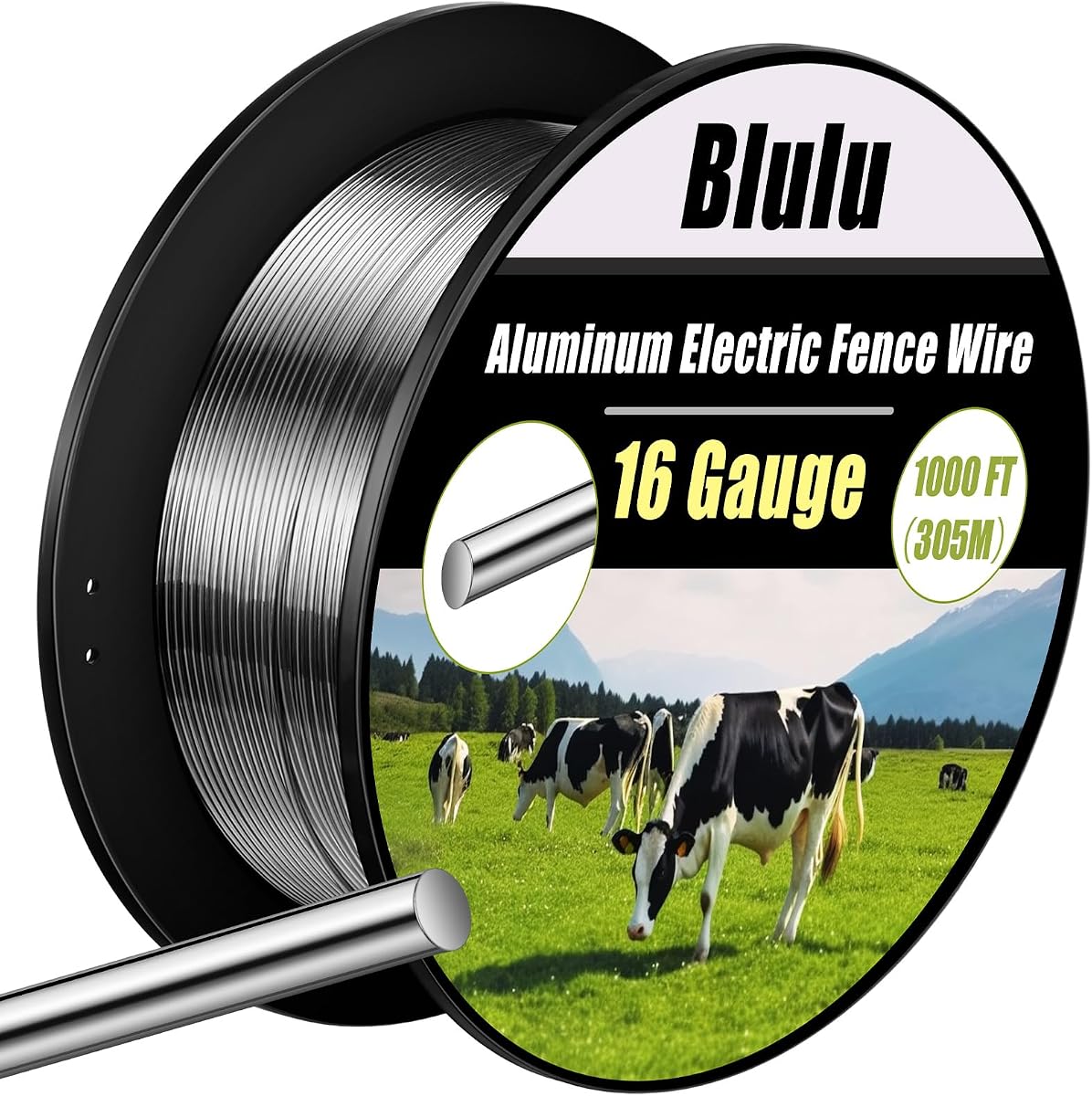
The Blulu 16 Gauge Aluminum Electric Fence Wire combines a 1,000-foot spool with an aluminum magnesium alloy designed for conductivity and mechanical strength. Its 5.0 rating is the highest among the listed products, making it an attractive option for buyers prioritizing customer feedback and a longer conventional-wire installation.
We may earn a commission when you buy through this link, at no additional cost to you.
The stated tensile strength of 260 MPa indicates a robust wire intended to withstand demanding conditions. Its low-resistance construction is designed to move current efficiently through the fence, and the alloy composition is described as resistant to rain, snow, corrosion, and long-term degradation. That durability can be valuable around predator corridors where uninterrupted performance matters.
The wire pulls, cuts, and installs from a reel, and it is compatible with most electric-fence systems using plastic or ceramic insulators. Unlike flexible polywire, however, it is better suited to a stable, tensioned fence line than to rapidly movable temporary boundaries. The product rating should not be interpreted as the result of a controlled laboratory test; it reflects aggregated buyer feedback provided for this roundup.
This Blulu wire is a strong recommendation for permanent or semi-permanent agricultural fencing, livestock control, and broader perimeter protection. Choose it when structural strength, conductivity, and a 1,000-foot length matter more than the rapid deployment and compact storage offered by polywire.
The stated 260-MPa tensile strength supports use where animals may lean against, rub, or repeatedly contact the boundary. A rigid line can also retain its geometry better than lightweight polywire.
Low-resistance construction helps maintain an effective deterrent over the spool's full length. Correct insulators and sound charger connections remain necessary for dependable results.
We may earn a commission when you buy through this link, at no additional cost to you.
The HOKENITY Electric Fence Polywire uses nine 304 stainless steel conductors, 30 reinforced polymer lines, and a 1/8-inch diameter construction. Its 4.5 rating remains favorable, while the high conductor count and 180-pound breaking strength distinguish it from basic six-strand polywire.
We may earn a commission when you buy through this link, at no additional cost to you.
The product is designed for long-distance conductivity and corrosion resistance. UV-resistant additives and new polymer materials support outdoor longevity, while the black-and-yellow color makes the boundary more noticeable to livestock and wildlife. That visibility can reduce collisions and help animals learn where the invisible electric boundary is located.
The wire is easy to cut, install, splice, and maintain, making it useful for rotational grazing and temporary enclosures. It applies to horses, cattle, sheep, pigs, dogs, poultry, and wildlife exclusion around crops and orchards. As a flexible polywire, it remains dependent on suitable insulators, a correctly positioned fence line, and regular checks for physical damage.
HOKENITY is a good fit for buyers who want more mechanical strength and better visual conspicuity than standard polywire without moving to a rigid metal line. Its 1,650-foot length provides a useful middle ground between a compact spool and the very long rolls offered by the two highest-ranked choices.
Nine stainless steel conductors and 30 polymer lines create a sturdy profile. The stated 180-pound break strength provides a reassuring margin for temporary fences holding larger livestock.
The contrasting black-and-yellow strands are easier for animals and property owners to notice. Better awareness can support safer containment and reduce accidental fence contact.
We may earn a commission when you buy through this link, at no additional cost to you.
The Zareba Insulated Cable is a specialized 50-foot run of 12½-gauge galvanized wire protected by a double-insulated, UV-resistant sleeve. Its 4.6 rating reflects a favorable response, and its 20,000-volt rating makes it particularly appropriate for transferring power beneath gates or between separated fence sections.
We may earn a commission when you buy through this link, at no additional cost to you.
Unlike exposed polywire or aluminum, this cable is designed to reduce voltage loss where the connection would otherwise contact soil, vegetation, or another grounded object. The insulated construction also allows an underground route from a controller to a remote fence line without running exposed fencing wire across the ground.
This is not a general-purpose substitute for the boundary wire itself. Its 50-foot length and protected construction are intended for electrical connections, especially beneath permanent gates. The outer sleeve helps the cable withstand outdoor conditions, but buried sections still require correct routing, secure connections, and appropriate charger output.
Choose this cable when the critical weakness in an electric-fence installation is an underground or gate-crossing connection. It is a useful companion to a longer polywire or aluminum boundary line, helping preserve current flow where an ordinary exposed wire would be difficult to route.
Insulated underground runs solve a common electric-fence problem: maintaining voltage across a gateway without leaving a hazardous exposed conductor. The cable is designed specifically for these buried connections.
Double insulation limits unintended leakage to soil and surrounding objects. This supports more predictable delivery of the charger's output along the connected fence line.
We may earn a commission when you buy through this link, at no additional cost to you.
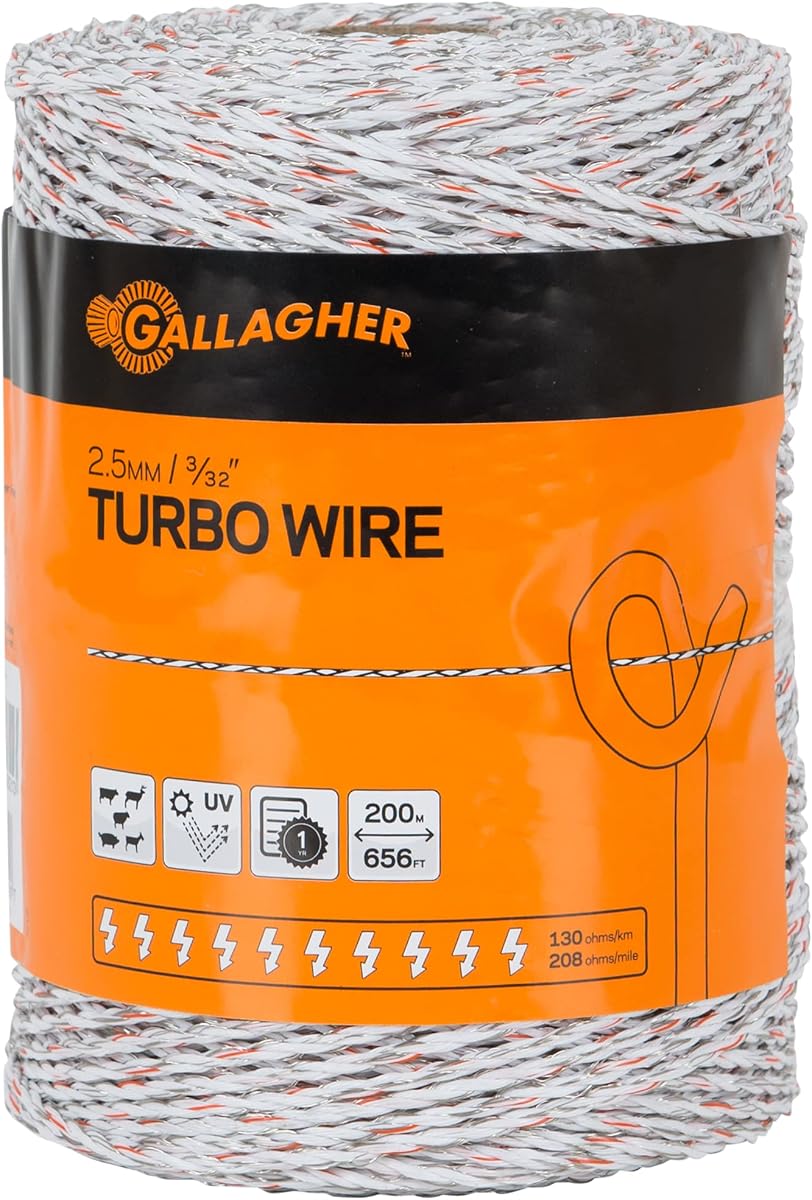
The Gallagher Turbo Polywire is the premium choice for buyers who prioritize electrical performance in a demanding portable-fence system. Its 4.7 rating is the highest among the polywire options, and its nine interwoven mixed-metal strands provide the product's defining advantage: conductivity stated to be 40 times greater than standard polywire.
We may earn a commission when you buy through this link, at no additional cost to you.
Combining stainless steel and copper supports strong current transfer over long runs, including applications beyond a quarter mile when paired with appropriate power equipment. The 656-foot roll is shorter than many competing polywire spools, but its construction targets exceptional power and reliability where voltage loss would otherwise undermine predator deterrence.
The wire is rust and UV resistant, suitable for windy conditions, and reusable. It fits Gallagher and other standard polywire reels without special tools, allowing owners to deploy and retrieve it conveniently. The trade-off is that its premium construction does not maximize physical coverage per roll, so buyers with extensive temporary perimeter needs may need multiple rolls.
This wire is best for serious rotational grazing, large portable enclosures, and high-pressure predator situations where reliable power matters more than the absolute maximum spool length. It also suits owners who already understand electric-fence voltage, insulation, grounding, and charger compatibility and want a specialized wire engineered for exceptional conductivity.
Copper and stainless steel are interwoven to move current efficiently through the line. This makes the wire especially attractive where maintaining the charger's signal over distance is the priority.
The line fits standard polywire reel systems, including reels from other brands. Owners can preserve the convenience of temporary fencing without needing specialized winding equipment.
We may earn a commission when you buy through this link, at no additional cost to you.
The BESTEEL Electric Fence Polywire provides 1,650 feet of 1/8-inch polywire with six interwoven stainless steel conductors and 30 nylon reinforcing strands. Its 4.6 rating supports a strong value assessment for buyers who need a versatile temporary line without stepping up to a specialized mixed-metal design.
We may earn a commission when you buy through this link, at no additional cost to you.
The manufacturer specifies a resistance of 6,000 ohms per kilometer, or 9,656 ohms per mile, emphasizing efficient current transfer across the spool. Stainless steel resists rust, while the polymer webbing is designed to resist aging and repeated outdoor use. The result is a flexible wire suitable for farms, gardens, orchards, and temporary livestock or wildlife boundaries.
Setup is uncomplicated because the wire can be cut, spliced, rewound, and repaired in the field. It works with electric-fence reels and common insulators, although the reel and insulators are not included. Its main limitation is physical strength: it is a practical polywire rather than a heavy-duty cable, so sharp contact, climbing animals, or poor routing can cause damage.
BESTEEL is a sensible choice for horse, goat, cattle, calf, and general wildlife-control applications where flexibility and portability are more important than extreme tensile strength. It also provides a manageable spool size that can be used across several sections without taking up the storage space of an extra-long roll.
The six stainless steel conductors are engineered to reduce resistance, helping the fence deliver a consistent signal over a substantial run. This is a useful balance between electrical efficiency and manageable spool size.
The wire can be spliced and repaired without complex tools. That serviceability is valuable when temporary fencing is exposed to weather, wildlife, or active livestock.
We may earn a commission when you buy through this link, at no additional cost to you.
The Tinned Copper Electric Fence Wire is built around four 0.4-millimeter tinned copper strands woven with PVC-coated high-density fiberglass. Its 4.1 rating is the lowest among the ten products, but the stated construction—900-pound breaking strength and conductivity claimed at 40 times standard stainless steel polyrope—positions it as a specialized high-performance option.
We may earn a commission when you buy through this link, at no additional cost to you.
The 1/4-inch diameter gives the wire a substantial profile and distinguishes it from ordinary thin polywire. Its maximum resistance is listed at 50 milliohms per meter, supporting stable electrical flow along the full 1,000-foot length. The PVC-coated fiberglass exterior adds flexibility, abrasion resistance, UV protection, and corrosion resistance.
Installation remains practical: the rope can be quickly deployed, spliced, or repaired, and the product label includes instructions. Bright strands improve visibility for horses and other animals, which can help reduce accidental contacts. The higher rating and thick construction may not be necessary for a lightly pressured residential boundary, but they offer reassurance in demanding livestock and ranch environments.
This product is best for buyers who want a hybrid of polywire handling and exceptional mechanical capacity. It is suited to temporary pastures, equine containment, livestock control, and farm or ranch configurations where a stronger boundary is worth the extra diameter. The lower aggregate rating should be considered alongside the very specific performance claims and the user's particular fencing demands.
A stated 900-pound breaking strength separates this wire from common portable polywire. That margin is useful around larger animals or locations where fence contact is frequent.
Four tinned copper conductors support efficient current flow over the 1,000-foot length. The tinned surface retains the benefits of copper while gaining added environmental protection.
We may earn a commission when you buy through this link, at no additional cost to you.
The 16 Gauge Aluminum Fence Wire provides 1,640 feet of 1.6-millimeter aluminum wire on a single spool. Its 4.6 rating and familiar aluminum characteristics make it a solid option for large permanent or semi-permanent electric-fence lines that need more coverage than a short conventional spool provides.
We may earn a commission when you buy through this link, at no additional cost to you.
The wire is described as conducting electricity four times better than steel, with a tensile strength of 38,000 psi and a 90-pound breaking load. Its aluminized finish resists rust, helping the fence remain dependable through outdoor exposure and reducing the maintenance associated with corrosion.
Unlike lightweight polywire, this aluminum wire is intended to remain tensioned on a stable fence line. It suits owners with suitable posts and insulators who want a conventional wire that can be repaired, cut, and reused. The trade-off is portability: winding, transporting, and re-tensioning a 1,640-foot aluminum line is more involved than managing a flexible polywire reel.
Choose this option for a substantial livestock, pasture, or property perimeter where rigid wire and long coverage are priorities. It is less suitable for quickly movable barriers but can be an effective predator deterrent when installed with reliable insulators, adequate tension, and a correctly configured electric-fence system.
At 1,640 feet, the spool is well suited to large enclosures and conventional fence lines. It minimizes the need to join multiple smaller conventional-wire spools.
The stated tensile strength and rust-resistant finish provide a durable balance for fixed installations. Proper tensioning remains important so the wire does not sag into vegetation or lose effective contact height.
We may earn a commission when you buy through this link, at no additional cost to you.
A useful predator-defense fence depends on more than conductor material. Match the wire to the fence length, animal pressure, terrain, portability requirements, charger capability, and installation conditions before choosing a spool.
Start by measuring the complete boundary, including curves, gates, corners, and any detours around buildings or waterways. A long polywire spool may cover an entire rotational paddock without splicing, while conventional wire is often easier to organize in measured runs on permanent posts. Consider whether the fence will remain in one location or be rewound and redeployed as predator pressure and grazing patterns change.
Stainless steel, copper, mixed metals, and aluminum each balance conductivity differently. Stainless steel polywire resists corrosion, copper provides exceptional electrical transfer, mixed-metal constructions target demanding long runs, and aluminum offers strong conventional-fence performance. Low resistance is especially useful when a charger must push power through a lengthy perimeter or through vegetation where some current may be lost.
Predator fences may experience pushing, rubbing, climbing, or impact from livestock. A stated breaking strength provides a useful comparison, but flexibility also matters because a resilient polywire can absorb force more gracefully than rigid wire. Match the construction to the animals involved: lightweight temporary lines may be adequate for poultry and small pets, while cattle, horses, goats, and determined wildlife justify greater tensile strength.
Polywire is generally easier to deploy, rewind, splice, and transport, making it well suited to temporary paddocks and seasonal predator barriers. Aluminum wire is better suited to a stable, tensioned perimeter. If the fence must move frequently, prioritize a light spool, integrated reel, and flexible construction. If it will remain fixed, focus instead on sag resistance, post fit, and long-term corrosion protection.
Outdoor fence wire faces ultraviolet radiation, rain, snow, moisture, and variable temperature. UV-stabilized polymers help protect the nonconductive portions of polywire, while stainless steel or protected copper conductors resist rust. Aluminized aluminum is also designed for longevity. Look for products that specifically address outdoor exposure rather than assuming every fence material has equivalent UV and corrosion protection.
A visible boundary helps animals recognize the fence before touching it, which supports training and can reduce collisions. Bright or contrasting strands are particularly useful in permanent grazing areas and temporary pens. Visibility does not replace an effective charge, but it complements the deterrent by giving animals a clear physical and visual cue.
The wire must be electrically isolated from posts, trees, buildings, and the ground. Polywire generally requires proper fence insulators, while aluminum wire also needs compatible plastic or porcelain insulators and controlled tension. Check the intended charger, reel, post spacing, and gate connections before purchasing. Insulated underground cable is a separate component used to carry power beneath gates or connect separated fence sections.
Temporary fences are more likely to suffer cuts, abrasion, and accidental damage. A wire that is easy to cut, splice, and rewind can be serviced quickly in the field. Conventional wire is also repairable, but tension management may require more effort. Check whether the product supports straightforward splicing, whether the spool is easy to handle, and whether replacement is practical if a section becomes damaged.
Plan the route before paying out the wire. Identify every post, gate, corner, and crossing, and install suitable insulators where the line will contact supports. Keep the fence line clear of heavy vegetation, and maintain an even height appropriate for the animals being contained. Before energizing the system, check every connection and ensure that all energized components are properly isolated from grounded structures.
Pay out the wire gradually, keeping it untwisted and free of sharp bends. On a reel, wind the line evenly so it does not tangle or develop narrow kinks. Use proper splices when joining sections, and avoid relying on knots or improvised metal contacts that may corrode or disconnect. For an underground gate crossing, use insulated cable and follow the charger's installation guidance for the specific system.
Inspect the fence regularly, especially after storms, high winds, heavy wildlife activity, or changes in vegetation. Look for cuts, loose splices, sagging lines, damaged insulators, vegetation touching the wire, and exposed conductive parts. Clean the line where practical, correct grounding and connection problems, and remove or repair damaged sections promptly. Before reusing portable polywire, inspect it before winding and store the spool away from sharp edges.
There is no single winner for every installation. Stainless steel polywire is flexible, corrosion-resistant, and convenient for temporary boundaries, while aluminum wire is rigid, mechanically strong, and easy to use on permanent post lines. The best choice depends on terrain, animal pressure, fence length, portability, and the charger's capability. Consider measured resistance and installation needs rather than comparing materials in isolation.
Measure the entire intended boundary, including gates and detours, before selecting a spool. Divide that length by the product's stated coverage to estimate how many rolls are required, then add extra for splices, curves, and future expansion. A 1,000- to 3,500-foot spool can cover a substantial temporary area, while shorter conventional-wire spools are better suited to focused sections.
Polywire is broadly compatible with many electric-fence systems, but the charger should be appropriate for the fence type, total load, and required output. Check the charger's compatibility information, especially for very long lines or high-resistance vegetation. Proper insulators, adequate grounding, sound connections, and correct wire-to-charger leads are just as important as the charger's advertised output.
Long polywire spools offer the most convenient deployment because they are light, flexible, and easy to reel. Stainless steel or mixed-metal constructions can improve resistance and conductivity, while the Gallagher Turbo Polywire specifically targets high power over demanding runs. A very long perimeter may require multiple spools or reels, and the line should still be routed away from heavy vegetation.
Route the fence where plants will receive less growth, trim vegetation regularly, and avoid placing the line where branches or tall grass are likely to touch it continuously. Maintain consistent tension so the wire does not sag into growth. If a location cannot be kept clear, choose a more conductive wire and verify that the charger has sufficient output for that environmental condition.
Boundary wire forms the electrified line that animals encounter, while insulated cable carries power to or between fence sections. Insulated cable is especially useful beneath permanent gates or in underground connections where exposed wire would be inconvenient or vulnerable. The Zareba UGC50 is designed for these connection tasks and should not be treated as a substitute for a full exposed boundary line.
No. Thickness may increase mechanical strength and durability, but electrical performance also depends on conductor material, resistance, wire length, charger output, vegetation, grounding, and connections. A thicker wire can also be harder to reel and tension. Choose the construction that best fits the animals, line length, installation style, and maintenance level rather than assuming more diameter automatically solves every problem.
Inspect the fence regularly and after severe weather or visible animal activity. Check for cuts, loose splices, broken posts, sagging lines, damaged insulators, and vegetation touching the wire. Portable polywire deserves particular attention because it is more exposed to movement, abrasion, and wildlife. Correcting a small fault promptly is usually easier and less disruptive than allowing a sustained fault to undermine the entire boundary.
The ACLASTOOL Electric Fence Polywire is the most versatile overall selection because it combines a 3,500-foot spool, six stainless steel conductors, and a 140-pound breaking strength. The Zareba 17 Gauge Aluminum Wire is the budget-friendly option for smaller, fixed installations, while the Gallagher Turbo Polywire is the premium choice when exceptional conductivity and mixed-metal construction justify a specialized portable line.
Prioritize the factors that directly affect your installation: total boundary length, animal pressure, charger capability, ground vegetation, post design, portability, and maintenance. Polywire excels when flexibility and quick deployment matter, aluminum works well for tensioned conventional fences, copper-based constructions support demanding power requirements, and insulated cable solves gate or underground connection problems.
Ratings, product availability, and prices can change, so check current product listings before buying. Review the exact wire diameter, length, conductor construction, included accessories, and charger compatibility rather than relying only on a general product description. A carefully matched fence system will deliver more dependable predator deterrence than an impressive specification used outside its intended application.