
Labstandard Wireless Lavalier Microphone
4.2Editor score
Two wireless lavalier transmitters
Real-time audio auto synchronization
Works with Lightning and USB-C
Explore 10 of the best external smartphone microphones for video, interviews, livestreams, and podcasts, comparing compatibility, sound quality, range, and
An external smartphone microphone can transform phone recordings by capturing cleaner, more detailed sound than a built-in phone microphone. The right model depends on your recording style, device port, environment, and whether you need wired control, wireless freedom, or advanced processing.
We compared the ten products in this guide by examining their audio formats, connection methods, pickup patterns, noise controls, wireless range, battery life, included accessories, and smartphone compatibility. The list covers shotgun, lavalier, handheld, stereo, and compact wireless options.
Each pick highlights a different use case, from interviewing two people to recording solo vlogs or polished video with a phone. Ratings and specifications reflect the supplied product information, while current prices and availability can change at any time.
4.2Editor score

4.6Editor score

4.3Editor score
This side-by-side comparison highlights each microphone's form factor, connection, key recording capability, and power system, making it easier to match a microphone to your phone and production needs.


The RØDE Wireless Micro is a two-transmitter system designed to connect directly to USB-C phones and combines a strong 4.6 rating with a notably simple workflow. It is especially effective for creators who want clean, consistent wireless sound without navigating a complicated pairing process. The two included microphones make it a strong fit for interviews, podcasts, collaborative videos, and multi-speaker livestreams.
We may earn a commission when you buy through this link, at no additional cost to you.
Its most appealing feature is the immediate connection between the transmitters and the USB-C receiver. Once the receiver is docked, the microphones connect without requiring an app or manual pairing sequence. Intelligent GainAssist automatically manages levels, which is valuable when a speaker's volume changes during a conversation. The compact charging case, included windshields, and pocket-sized components make the entire system easy to carry between indoor and outdoor shoots.
The main limitation is compatibility. This version connects directly to iPhone 15 and later and to Android devices with USB-C, but it does not support Lightning-equipped iPhones. That restriction makes model verification essential for buyers with older Apple hardware. The system also centers on a dedicated receiver rather than offering the multi-pattern flexibility of a stereo microphone, so it is less suitable when the goal is to record an entire musical performance or ambient soundscape.
This is the strongest general recommendation for smartphone creators who value quick setup, automatic level management, and two-person recording. It is particularly convincing for interviews and conversational videos where the ability to move freely and maintain consistent levels matters more than elaborate capture patterns. For anyone using a Lightning iPhone, however, choose the corresponding Lightning version or select a universal alternative from this guide.
The pre-paired design removes one of the most common sources of frustration in mobile audio. Connect the supplied receiver to the phone, dock the transmitters, and begin recording without a separate pairing routine.
Intelligent GainAssist responds as the sound level changes, making it useful for interviews in which speakers move closer to or farther from the microphone. The charging case adds up to 21 hours of combined use for extended shooting days.
We may earn a commission when you buy through this link, at no additional cost to you.
The Movo VXR10 is a wired directional shotgun microphone with a 4.3 rating and a broad device-support claim that includes phones, cameras, laptops, and other compatible recording equipment. Its most useful strength is focused sound pickup: rather than gathering sound equally from every direction, it emphasizes the subject in front while reducing distracting side noise. That makes it practical for vlogs, interviews, podcasts, and mobile video.
We may earn a commission when you buy through this link, at no additional cost to you.
The included equipment makes the VXR10 approachable. A fuzzy windscreen helps reduce outdoor wind noise, while the built-in or included shock mount helps limit bumps and handling vibration. A carrying case, camera cable, original and Rycote shock mounts, and a smartphone cable are also included. The aluminum construction and battery-free, plug-in-power operation make it dependable without asking creators to manage another rechargeable component.
Compatibility deserves careful attention. The microphone requires a 3.5mm microphone input and plug-in power, so newer Lightning or USB-C phones may need the appropriate adapter. Some cameras, including specified Canon Rebel T6, T7, and certain Canon VIXIA camcorders, do not support external microphones. The wired design also means the subject must remain within cable reach, and correct TRS or TRRS cabling matters for the intended device.
Choose the VXR10 when focused, reliable wired sound is more important than wireless movement. It offers a comparatively complete accessory package and a straightforward connection for compatible equipment. It is less appropriate for users who need a current USB-C-only connection without adapters or expect to record two separately moving speakers at once.
The shotgun pattern concentrates attention on sound directly in front of the microphone. This can reduce interference from side conversations, street activity, and other environmental distractions during a focused recording.
Windscreens, shock-mount options, cables, and a carrying case are included, reducing the need to purchase basic support equipment separately. The integrated shock mount also helps preserve cleaner audio during handheld operation.
We may earn a commission when you buy through this link, at no additional cost to you.
The Movo X1-Mini earns a 4.4 rating by combining a compact supercardioid design with both analog and digital connection options. It is positioned as a camera microphone that can also serve phones, tablets, laptops, camcorders, and audio recorders. That versatility makes it useful for creators who move between a smartphone and a dedicated camera without wanting to carry multiple microphones.
We may earn a commission when you buy through this link, at no additional cost to you.
The microphone supports up to 24-bit resolution in digital mode, offering a useful upgrade over basic built-in phone capture when the phone can accept digital USB-C audio. Its aluminum body, battery-free construction, and integrated shock mount make it a practical wired option for travel, interviews, and location shooting. The supplied Rycote shock mount, foam and furry windscreens, camera and smartphone cables, digital USB-C cable, and hard-sided case provide a well-rounded kit.
As with any wired microphone, the right cable and port matter. A 3.5mm TRS cable is included for cameras, a TRRS cable covers compatible smartphones, and the digital USB-C output serves compatible computers and smartphones. The supercardioid pattern still demands careful placement, and its fixed cable means it works best at relatively short subject distances. It also does not provide independent control over two speakers, unlike a dual-transmitter wireless kit.
The X1-Mini is a strong choice for content creators who want one compact microphone to handle both phone and camera work. Its digital output and broad accessory package distinguish it from a basic 3.5mm microphone. Pick it when broad compatibility, compact construction, and a focused pickup pattern matter more than wireless movement.
The combination of 3.5mm analog and digital USB-C output broadens the X1-Mini's practical use. It can complement a camera setup while remaining available for smartphone recording when a different capture format is needed.
Digital mode supports up to 24-bit resolution, while the supercardioid pattern directs attention toward the subject. The result is a sensible combination for creators who want focused sound and flexible connectivity.
We may earn a commission when you buy through this link, at no additional cost to you.
The single-transmitter DJI Mic Mini is built for creators who want a nearly invisible wireless microphone for solo mobile video. Its transmitter weighs only 10 grams and receives a 4.4 rating. The package includes one transmitter with noise cancellation and a plug-and-play USB-C mobile receiver, covering the essential needs of a vlogger, livestreamer, or presenter recording one principal voice.
We may earn a commission when you buy through this link, at no additional cost to you.
Wireless freedom is a major advantage. The stated maximum transmission range is 400 meters, and 48kHz sampling with a maximum sound level of 120 dB supports detailed capture across a wide range of recording conditions. Two noise-cancellation settings let the user choose Basic processing in a quiet room or Strong processing in a noisy environment. Automatic limiting reduces the likelihood of clipping when the input becomes unexpectedly loud.
The supplied charging case is particularly useful because the product information lists up to 48 hours of battery life with the case. That runtime suits trips, interviews, and livestream sessions where charging interruptions would be inconvenient. A transmitter can also connect directly to several specified DJI devices through DJI OsmoAudio, bypassing the mobile receiver for an integrated workflow. The tradeoff is that this package has only one transmitter, making it less suitable for a two-person interview without another system.
This is an excellent recommendation for a solo creator who prioritizes a tiny wearable transmitter, dependable wireless operation, and strong environmental noise control. The mobile receiver makes phone setup straightforward, while the case handles the demands of a full production day. For conversations or interviews involving multiple speakers, the two-transmitter version is the more logical choice.
At 10 grams, the transmitter is easy to wear without dominating the frame. It is well suited to vlogging, presentations, and livestreaming where visual presentation matters as much as audio quality.
Basic noise cancellation suits controlled indoor spaces, while Strong mode can help in louder streets or busy venues. Automatic limiting adds another layer of protection against unexpectedly high input levels.
We may earn a commission when you buy through this link, at no additional cost to you.
The Labstandard Professional Wireless Lavalier is a dual-microphone kit aimed at accessible mobile recording, interviews, podcasts, vlogs, and livestreams. Its 4.2 rating reflects a straightforward package that includes two wireless lavalier transmitters and a receiver designed for both Lightning and Type-C devices. The inclusion of a rechargeable Lightning adapter makes it a notable option for users switching between newer and older Apple hardware.
We may earn a commission when you buy through this link, at no additional cost to you.
The system uses 2.4G transmission with a stated latency of 0.008 seconds, supported by real-time automatic synchronization intended to keep recorded sound aligned with the picture. A built-in noise-reduction chip helps reduce background interference, while multi-channel real-time mixing can synchronize spoken vocals with background music during phone recording. Directional pickup and a pronounced proximity effect emphasize the wearer's voice at close range.
Battery life is approximately six hours, which is shorter than several other wireless options in this guide and may require charging during a long production day. The manual should also be checked for device-specific functions and operating details. Despite those limitations, the inclusion of two microphones removes the need to buy a second transmitter for a two-person conversation, which is the kit's strongest value proposition.
Choose this system when you need a compact two-person wireless microphone and work across Lightning and USB-C devices. It is less compelling for extended all-day sessions than higher-capacity charging-case systems, but it delivers the essential elements at an accessible entry point. Users should confirm that their phone and recording application support the required external-audio workflow before a critical shoot.
The two-transmitter configuration is well suited to interviews and dialogue-heavy videos. Real-time synchronization is designed to help speech remain aligned with the recorded image.
The kit includes a rechargeable Lightning adapter and supports Type-C devices, making it useful for creators who cannot commit to one phone connector. The manual provides additional information about setup and functions.
We may earn a commission when you buy through this link, at no additional cost to you.
The two-transmitter DJI Mic Mini has the highest rating among the ten products, at 4.7, and packages two ten-gram wireless microphones with a mobile receiver. It is a particularly attractive option for interviews because it supports two separate speakers without making either participant carry a larger recorder. The receiver connects through USB-C, and the included package is described as plug-and-play for streamlined mobile setup.
We may earn a commission when you buy through this link, at no additional cost to you.
Both transmitters offer Basic and Strong noise-cancellation modes, allowing the operator to choose lighter processing in a quiet studio or stronger vocal isolation in a crowded environment. Automatic limiting helps prevent distortion when a speaker raises their voice or moves close to the microphone. The stated maximum transmission distance is 300 meters, and the system offers up to 11.5 hours of operating time, which is suitable for many interview, livestream, and content-creation sessions.
Compared with the single-transmitter Mic Mini, this version trades a longer stated transmission range and the included charging case for the ability to record two people. The two-transmitter setup also requires more careful battery management if the session runs beyond the stated operating window. As with the one-transmitter package, direct connection to selected DJI devices through OsmoAudio is available for creators already using that ecosystem.
This is the best pick for a mobile interview that requires two lightweight wireless transmitters, strong noise control, and quick phone connection. It is especially convincing when participants move naturally and need discreet wearable microphones. The 4.7 rating and specialized feature set make it one of the most compelling options in this guide.
Each transmitter weighs only 10 grams, allowing both participants to wear a lavalier without bulky equipment. The system is designed for dialogue, interviews, livestreams, and collaborative video.
Automatic limiting reduces clipping risk, while two selectable noise-cancellation levels provide flexibility across quiet and noisy environments. The mobile receiver simplifies direct recording on compatible USB-C devices.
We may earn a commission when you buy through this link, at no additional cost to you.
The Shure MV88 USB-C is the most creatively flexible microphone in this guide because it can operate in four different polar patterns. It connects directly to USB-C mobile devices and supports stereo, mono cardioid, mono bi-directional, and raw mid-side capture. That range makes it suitable not only for spoken content but also for music, ambient sound, live performance, and two-person conversations.
We may earn a commission when you buy through this link, at no additional cost to you.
Its 4.3 rating reflects a feature set aimed at creators who want more than a dedicated lavalier. Auto Level Mode adjusts gain in real time to keep the signal from becoming too quiet or too loud, while the real-time denoiser helps reduce unwanted background sound in dynamic locations. The stereo and mid-side patterns open the microphone to environmental recordings that a narrow cardioid lavalier would not capture as naturally.
The direct USB-C connection is convenient for modern phones but excludes Lightning-equipped iPhones and other older connector standards. Shure also notes that iPhone users should update the MV88 firmware to version 1.3.0.3 and provides a setup path through the Shure Brand Store, with additional guidance for devices running iOS 26.4. Users who need broad connector support should verify compatibility before buying rather than assuming every phone will work.
Choose the MV88 when recording flexibility matters and you want a single microphone to handle interviews, ambient scenes, music, and performance. It is a premium-oriented pick for creators who actively adjust capture settings and can use USB-C. For a conventional talking-head setup, a simpler lavalier may be easier, but no other product here offers this many polar-pattern choices.
Stereo captures a wider field, cardioid isolates a front-facing subject, bi-directional favors a two-sided conversation, and mid-side provides a flexible raw stereo source. These modes let the creator change techniques without changing hardware.
Auto Level Mode manages gain in real time, reducing the need to monitor and adjust levels manually. The integrated denoiser also helps protect dialogue from distracting environmental noise.
We may earn a commission when you buy through this link, at no additional cost to you.
The DJI Mic 3 combines a 4.6 rating with several features aimed at protecting important recordings. The package includes one transmitter, one mobile receiver, a magnetic transmitter charging cable, and related accessories. It is a strong fit for solo travel vlogs, street interviews, and mobile recording sessions where reliable backup audio is more important than carrying a large system.
We may earn a commission when you buy through this link, at no additional cost to you.
Dual-file 32-bit float internal recording is the standout feature. The transmitter can preserve a local copy of the audio, providing a safeguard if the wireless link becomes unreliable or the phone recording fails. Adaptive gain control balances whispering and shouting, while three voice tones and two noise-cancellation levels allow the sound character to be adjusted for different scenes. Dual-band anti-interference is designed to support stable transmission in crowded offices and live events.
The receiver also supports larger configurations, including four transmitters and four-channel output with synchronization to additional receivers. That scalability makes the system attractive for creators who may later expand beyond the single-transmitter package. The tradeoffs are that a solo buyer receives only one transmitter, and the advanced control set may be more than a simple vlogger needs. The supplied mobile receiver is also still tied to a particular connection standard, so device compatibility should be confirmed.
The DJI Mic 3 is best for creators who want a safety net around every take. Its internal recording, adaptive levels, and interference protection make it particularly suitable for street interviews and events where a dropout or unexpected volume spike could be costly. For basic speech capture, a simpler wireless system may be sufficient, but this model prioritizes reliability and control.
Dual-file 32-bit float internal recording preserves audio on the transmitter itself. That local copy can protect a take if a wireless interruption or phone failure occurs.
Adaptive gain handles changes between quiet and emphatic speech, while selectable voice tones and noise-cancellation levels let the operator tune the result for the environment.
We may earn a commission when you buy through this link, at no additional cost to you.
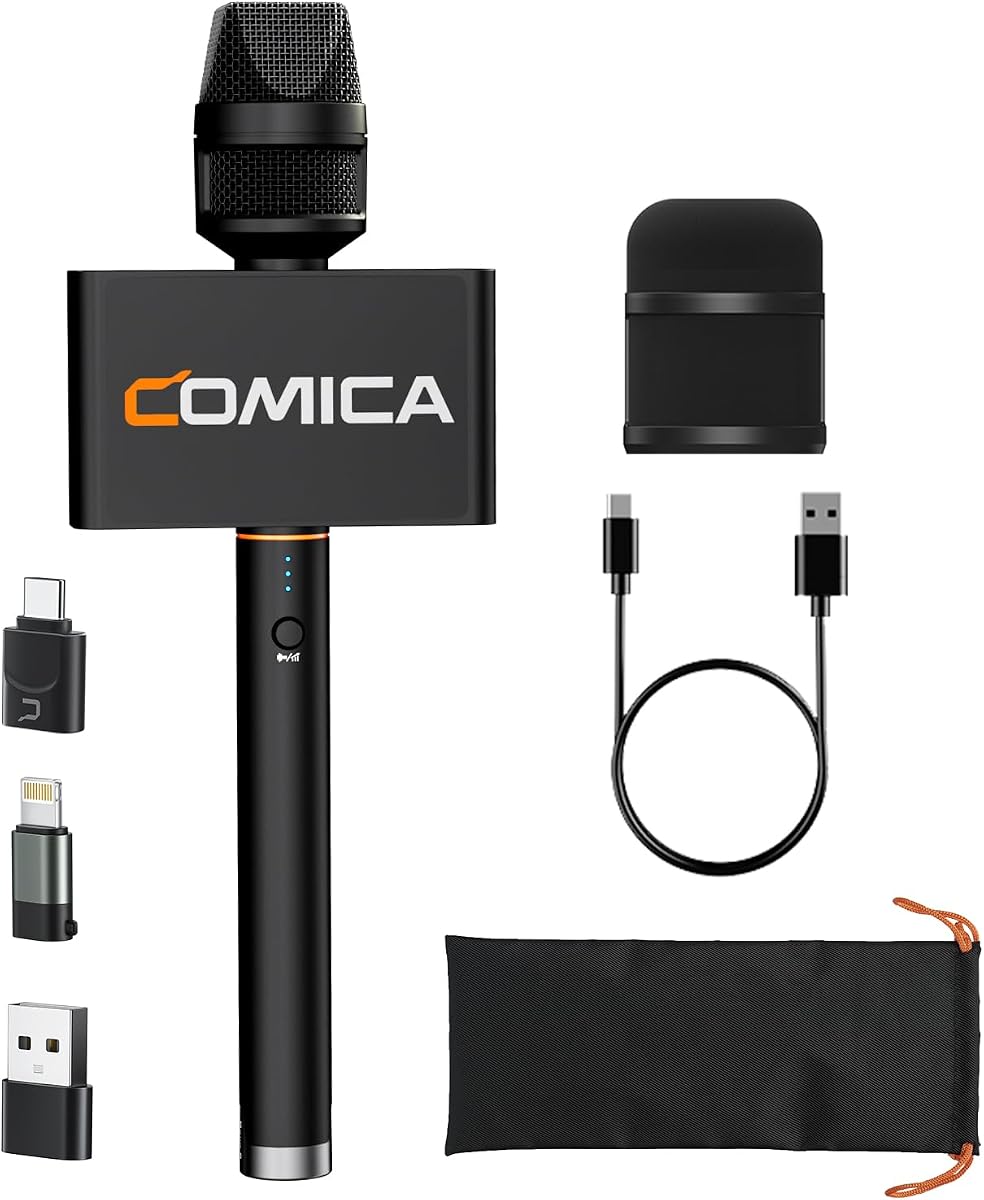
The COMICA Revo S takes a different approach from the clip-on products by combining a 14mm condenser capsule with a handheld wireless transmitter. It is intended for smartphone interviews, podcasting, reporting, and video production, and its 4.6 rating makes it a credible all-around choice. The supplied USB Type-C receiver makes connection to compatible phones, tablets, laptops, and computers straightforward.
We may earn a commission when you buy through this link, at no additional cost to you.
The cardioid pattern focuses on the front of the microphone, which is a natural match for handheld interviews and presenter-led content. Recording at 48kHz and 24-bit provides detailed digital output, while a one-key CalMix denoise function filters background noise. Three gain levels give the operator manual control over sensitivity when a subject is quiet, close, or speaking forcefully. Wireless digital output removes the need for a cable between the microphone and the phone.
The built-in 350mAh lithium battery is rated for up to 15 hours of use, making it suitable for long reporting sessions, livestreams, and event coverage. It is not a dual-person kit, and the receiver still imposes connector requirements. The supplied Type-C receiver supports the listed modern devices, but Lightning-port devices require a USB-C-to-Lightning adapter with OTG support, which is not included in the stated package.
Choose the Revo S when you want the presence and familiarity of a handheld microphone without a tethered phone connection. It works especially well for street interviews, voiceover, and presenter video where a visible handheld microphone is appropriate. If discreet wearability or simultaneous two-person capture is the priority, a lavalier system will fit the job better.
The 14mm cardioid condenser capsule and wireless digital output provide a clear, focused alternative to a phone's built-in microphone. Its handheld design also gives the subject something natural to hold during an interview.
One-key CalMix denoise reduces environmental noise, and three gain levels let the operator adapt the microphone to different speaking conditions. The stated 15-hour battery supports extended sessions.
We may earn a commission when you buy through this link, at no additional cost to you.
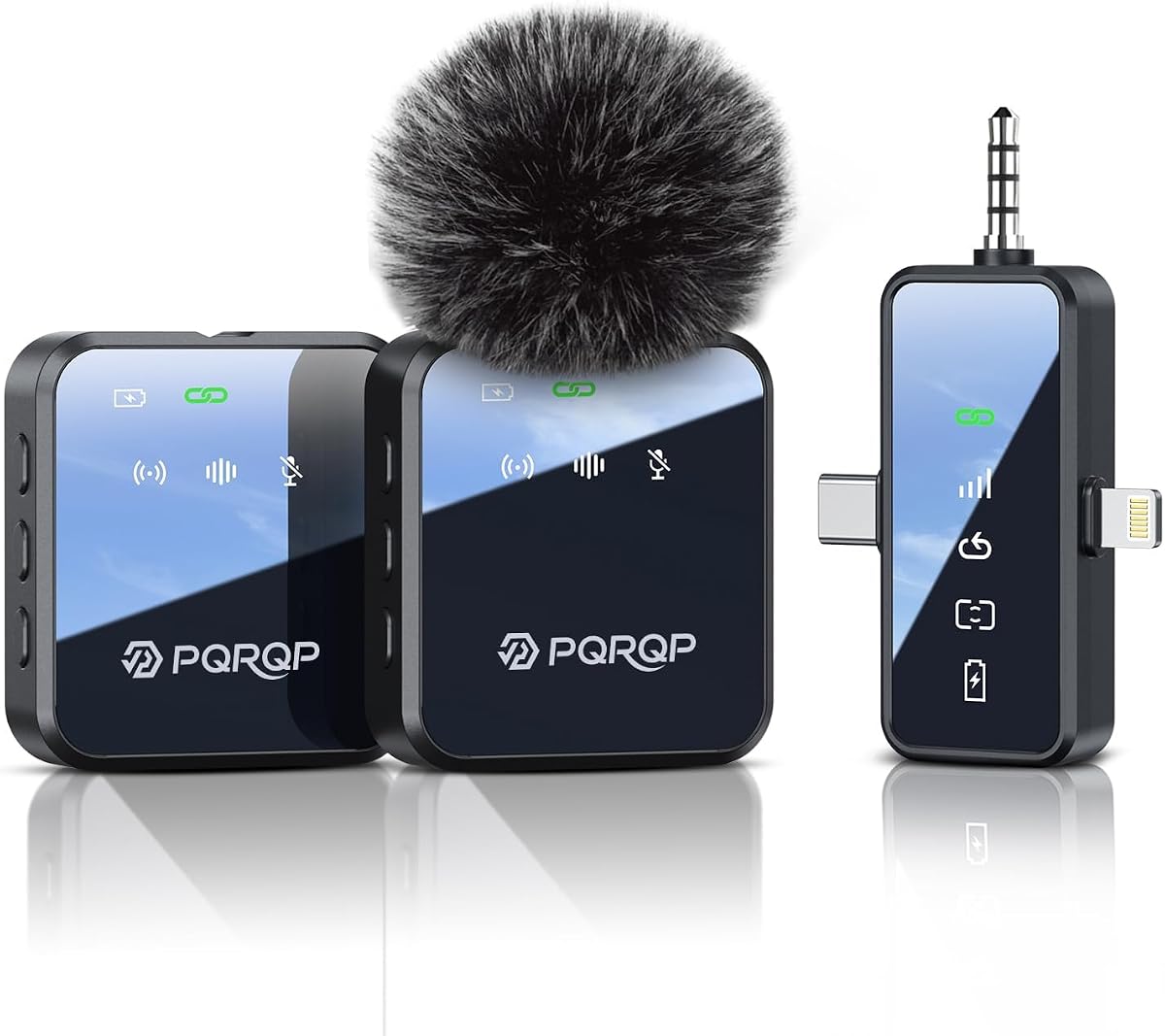
The PQRQP 3-in-1 Wireless Mini Microphone combines two compact transmitters with a versatile receiver and a 4.6 rating. Its receiver is designed for iPhones, Android devices, iPads, laptops, and cameras, making it one of the broadest compatibility claims in this guide. It suits YouTube, TikTok, podcast, livestream, interview, and performance recordings where a small wearable microphone is preferred.
We may earn a commission when you buy through this link, at no additional cost to you.
The system supports 48kHz, 24-bit recording with advanced noise cancellation and a windproof cotton cover. Its 2.4G transmission has a stated maximum range of 328 feet and is designed to maintain low latency for lip synchronization. Each microphone provides about ten hours of use, giving a combined maximum of 20 hours according to the supplied information. A one-touch mute control allows a private pause without disconnecting the system.
A built-in reverb function is unusual and useful for singing or narration, but it is not a conventional feature for documentary dialogue. The broad compatibility statement also deserves a careful check against the exact cable or adapter required by the user's device. As with any very small wireless system, stable placement and correct setup are important for achieving the intended result.
The PQRQP system is most appealing to creators who want two wireless microphones, generous stated range, extended battery life, and a single receiver that can serve several kinds of equipment. Choose it for value-oriented mobile production, particularly when camera and phone recording are both part of the workflow. Specialized functions such as reverb should be treated as optional rather than essential for clean spoken-word capture.
The versatile receiver is designed to work with iPhones, Android phones, iPads, laptops, and cameras. That flexibility reduces the need to maintain separate microphone systems for different parts of a production.
A stated 328-foot range supports freedom of movement, while combined battery life reaches 20 hours. One-touch mute provides a convenient way to pause capture without powering down the system.
We may earn a commission when you buy through this link, at no additional cost to you.
The best external smartphone microphone depends on your device, number of speakers, recording environment, and mobility needs. Start with connection compatibility, then compare pickup patterns, audio controls, wireless range, battery life, and included accessories.
Begin with the connector on the phone you actually use. Wired models may require a 3.5mm microphone input plus an appropriate TRS or TRRS cable, while newer phones often rely on a USB-C receiver. Lightning iPhones need compatible adapters or a dedicated Lightning version. Do not assume that every USB-C microphone works with every recording application, and check whether the device supports external audio input before making a purchase.
Choose the connection that matches your phone and avoids routine adapter changes. USB-C is convenient on recent iPhones and many Android devices, while a Lightning adapter adds another accessory to carry.
A single transmitter is normally sufficient for a solo vlog, course, livestream, or presentation, but an interview with two participants usually needs two independent microphones. Dual-transmitter packages also make it easier to let speakers move around without sharing a wired cable. If you regularly record conversations, prioritize a two-microphone system over an advanced single-mic feature set.
Match transmitter count to speaker count. One transmitter serves one isolated voice; two transmitters serve two speakers with separate level control.
Shotgun microphones emphasize sound from a specific direction and work well for video, interviews, and handheld narration. Lavalier microphones clip close to a speaker's chest and are ideal for discreet dialogue. Handheld microphones suit reporting and presenter-led recordings, while stereo or multi-pattern microphones can capture ambient sound and musical performances. Pick the form that matches the visual style and movement of your production.
Choose a lavalier for hidden dialogue, a shotgun for focused video sound, or a handheld for visible reporting. Multi-pattern models offer the widest creative range.
Wireless range determines how far a speaker can move from the receiver while maintaining a dependable connection. The listed systems range from 300 to 400 meters of maximum transmission, with another product claiming 328 feet. Maximum range is best understood as a laboratory figure rather than a guarantee in every setting, since walls, people, interference, and obstacles can affect performance. Low-latency operation matters when lip synchronization must remain convincing in the final edit.
Treat maximum range as an upper limit, not a daily-use promise. For ordinary phone video, focus more on stable short-range performance, clear status indicators, and low stated latency.
Wireless microphones need enough power to cover interviews, livestreams, and travel days without interruptions. Runtime figures in this guide range from about six hours to 15 hours, while charging-case configurations can extend total use considerably. A bundled case is especially useful because it can keep transmitters protected and topped up between sessions. Consider the length of your typical shoot rather than relying only on the most generous maximum.
Choose a battery system that comfortably covers your longest session. A charging case adds convenience, but it cannot compensate for poor planning when individual transmitters need frequent recharging.
A good microphone should preserve the voice without capturing every nearby sound. Noise reduction, denoising, automatic limiting, and gain assistance can help in unstable environments, although aggressive processing can also alter the natural character of speech. Automatic gain is convenient for interviews, while manual gain levels offer more control when the source is consistent. Look for a balance between background control and natural vocal detail.
Automatic tools are useful when levels vary, but avoid assuming they can replace careful placement. Keep the microphone near the speaker and monitor the recording whenever possible.
Resolution figures such as 24-bit and 48kHz can preserve more detail than basic phone capture, especially when the recording chain supports them. Wireless systems with internal or local recording provide an additional copy of the audio on the transmitter. This is valuable during street interviews, live events, and other situations where a wireless interruption could ruin a take. It is an extra safeguard rather than a substitute for a reliable phone connection.
Higher resolution is useful when supported by the full signal chain. Local backup recording adds valuable insurance for important recordings that cannot be repeated.
Foam and furry windscreens help reduce wind and plosive artifacts outdoors, while shock mounts protect against vibration and bumps. A carrying case keeps a compact system organized and protected during travel. Some products include several windscreens, mounts, and cables, reducing extra purchases; others provide only the essential connection hardware. Check the included items because their usefulness depends on whether you record indoors, outdoors, or in moving locations.
Favor a kit that includes the windscreen and protection your environment requires. A more complete bundle can be more useful than a headline range or resolution figure.
Before recording, charge every wireless transmitter and receiver, install the appropriate app if the manufacturer requires one, and confirm that the phone recognizes external audio input. Pair the system, select the correct input, and perform a short test recording. For wired models, use the specified TRS or TRRS cable and adapter, then set the phone's input to the external microphone. A quick test prevents a flawed setup from wasting a complete shoot.
Place the microphone close to the source and listen with headphones when possible. A lavalier should sit near the speaker's mouth without being hidden under clothing or rubbed by fabric. Position a shotgun microphone toward the subject, keeping it within the stated useful distance and away from reflective surfaces. For wireless rigs, maintain a clear line between transmitter and receiver, avoid blocking the antenna, and leave enough separation between the phone and transmitter to reduce handling noise.
Protect the equipment between sessions. Turn wireless units off when they are not in use, keep transmitters dry, clean foam and furry windscreens regularly, and store everything in the supplied case. Avoid leaving a microphone in excessive heat, direct sunlight, or a damp bag. Inspect cables and connectors for bent pins, and confirm that charging contacts remain clean. When a recording sounds wrong, check placement, gain, weather protection, and device compatibility before blaming the microphone.
No. Compatibility depends on the phone's connector, operating system, recording application, and the microphone's output format. USB-C products may not support Lightning iPhones, while 3.5mm microphones may require a specific TRS or TRRS cable and adapter. Some cameras also disable external microphone input. Always confirm both hardware and app support before recording an important session.
A wireless lavalier is usually better for mobile interviews because it provides two-person capture, discreet placement, and freedom of movement. A wired shotgun microphone can be preferable for solo video because it concentrates sound in a narrow direction and requires no batteries. The better choice depends on the number of speakers, available space, and whether a visible cable would interfere with the recording.
Yes, provided that the phone, receiver, and livestream application recognize the external microphone as the audio input. Wireless systems with a mobile receiver are particularly convenient for livestreams because they avoid a cable around the speaker. Test the setup before going live, monitor for unwanted feedback, and keep the microphone positioned consistently to avoid abrupt volume changes.
A cardioid microphone mainly captures sound from the front and rejects sound from the rear. A shotgun microphone is a more directional version of that concept, creating a narrow zone of emphasis useful for video and noisy locations. Neither pattern is completely blind to sound behind the microphone, so placement and environmental control still matter.
No. Noise cancellation reduces unwanted steady or electronic background noise, while a windscreen physically reduces airflow and wind noise around the microphone. Outdoor recordists should use an appropriate foam or furry windscreen even when noise cancellation is enabled. Together, these measures usually produce a cleaner and more natural result.
A lavalier is generally most effective near the speaker's mouth, clipped to the upper chest or collar area. Too much movement, clothing rubbing, or a loose cable can introduce noise. The product's directional characteristics can make close placement especially important because the voice becomes more prominent relative to the background.
Higher resolution can preserve additional detail, but it only helps when the entire signal path supports it. The microphone output must be accepted by the connected device, and the recording application must capture it properly. For many smartphone projects, stable levels, good placement, and effective noise control matter more than resolution alone.
Begin with a full charge, confirm a stable wireless connection, and keep the receiver and transmitter within a reasonable unobstructed distance. Use local backup recording when available, especially for important interviews. For wired microphones, inspect the cable and connector, and avoid sharp bends that can interrupt the signal.
The RØDE Wireless Micro is the best overall choice for its pre-paired USB-C workflow, automatic level control, and two-transmitter arrangement. The DJI Mic Mini Two-Transmitter package is a lightweight alternative for mobile interviews, while the Shure MV88 USB-C stands out for premium flexibility and four selectable polar patterns. Budget-conscious creators can also consider the Labstandard dual-lavalier kit.
Prioritize the connector and application support first, then choose based on how many people will speak and whether they need to move. Two-speaker interviews benefit from dual wireless systems, solo video can be handled by a compact shotgun microphone, and recordings of music or ambience may justify a multi-pattern microphone. Place the microphone well, control wind and background noise, and test the entire setup before recording.
Ratings, specifications, accessories, and compatibility can change as products are updated, and prices also fluctuate. Review the current listing, verify the exact phone connector, and confirm application support before making your final purchase.