
145A MIG Welder, 110V 3-in-1
4.4Editor score
Compact 7.5-pound design
Three-in-one process support
Synergic controls simplify setup
Extensive accessory kit included
This Mig Welder guide compares ten leading machines for output, processes, portability, features, and ideal projects, helping you choose with confidence in
A MIG welder combines a welding power source with controlled wire feeding, making it one of the most approachable tools for joining metal. The best model depends on your skill level, available power, material thickness, and whether you need only MIG or several welding processes in one machine.
We compared the ten products in this guide by examining their stated welding processes, output ratings, wire compatibility, voltage options, displays, safety systems, included accessories, portability, and intended applications. The list covers compact beginner machines, dual-voltage models, portable jobsite tools, and advanced multiprocess systems.
Each entry highlights the reason that machine belongs on the list while also calling attention to important limitations, such as separately sold TIG torches, gas requirements, or absent spool guns. Product configurations and availability can change, so verify the current listing and included components before buying.
4.4Editor score

4.5Editor score

4.4Editor score
The comparison below shows how each MIG welder differs in rated output, process flexibility, power options, controls, and portability. Read the specifications alongside the detailed reviews because features such as TIG capability, aluminum support, and included accessories often depend on optional accessories.




The BESTMIG 135A MIG Welder combines gasless flux-core MIG, Lift TIG, and Stick welding in a portable 110V package. Its stated true-current output of 135 amps and ability to handle material up to 1/8 inch thick make it a practical choice for home workshops, DIY projects, and a range of repair work. The 4.5 rating reflects generally favorable customer feedback, although actual results depend on technique, materials, and setup.
We may earn a commission when you buy through this link, at no additional cost to you.
The standout feature is the combination of accessibility and controls. Digital technology automatically adjusts parameters based on the selected settings, while the full-color LED display provides real-time visibility into welding parameters. Integrated wire feeding is designed to adjust voltage and feed speed to support stable operation and reduce spatter. Gasless flux-core wire from 0.030 to 0.040 inch can be used with stainless steel, carbon steel, and thicker projects.
The accessory package is unusually complete for this category. A ground clamp, electrode holder, MIG torch, auto-darkening helmet convertible to goggles, and leather gloves are included. The primary limitation is that Lift TIG is listed as a supported process, but a TIG torch is not included. It is also a single-voltage unit, so buyers should confirm that a suitable 110V circuit is available before purchasing.
This is our top overall pick because it balances useful output, approachable controls, essential accessories, and process versatility without presenting an unusually complicated control layout. It is especially attractive for a first welder or a homeowner who wants one compact machine for mild steel, stainless steel, fabrication, and general repairs. Buyers interested primarily in aluminum should choose a model with explicit spool-gun support.
The automatic parameter matching reduces the amount of setup knowledge required for common jobs. Users can still monitor the chosen values on the full-color display, making the machine approachable without hiding the controls an experienced welder may need to understand.
The included helmet, gloves, torch, ground clamp, and electrode holder reduce the number of separate items needed for a basic setup. Remember that the helmet is not a substitute for using every required safety precaution and that Lift TIG still requires a separate torch.
We may earn a commission when you buy through this link, at no additional cost to you.
The YESWELDER 160A is a dual-voltage, four-process machine designed for a broad range of automotive, construction, fabrication, and DIY assignments. It supports Flux Core MIG, Gas MIG, Stick, and Lift TIG, while its stated 160-amp output gives it more headroom than many compact beginner welders. The machine carries a 4.5 rating and is presented as a balanced choice for users who want flexibility without moving to a large multiprocess shop system.
We may earn a commission when you buy through this link, at no additional cost to you.
Its strongest argument is the choice between assisted and manual operation. Synergic control recommends voltage and wire-feed speed when the user selects a material thickness or changes amperage, which helps newcomers make sensible starting adjustments. Experienced operators can independently adjust wire speed and voltage. The digital display presents settings clearly, while dual 110V and 220V operation allows use with different household and workshop power supplies.
Consumable support is broad for its output class. The welder accepts 2-pound and 10-pound spools of 0.030-inch solid wire, 0.035-inch solid wire, and flux-core wire. In Stick mode, it works with most 6010, 6011, 6013, and 7018 electrodes. The important caveat is that Lift TIG requires the purchase of an additional torch. At 19.4 pounds, it is portable but noticeably heavier than machines in the 7.5- to 11.4-pound range.
This welder is a strong fit for a growing hobbyist, mobile contractor, or DIY user who wants to use gasless flux-core wire, shielded gas MIG, and Stick from one unit. It is less attractive for someone seeking an unusually light machine or a complete kit with TIG equipment and helmet. For those priorities, the BESTMIG 135A or compact 145A model may fit better.
Dual-voltage capability broadens where the machine can be used, while the integrated carrying handle and 19.4-pound weight remain manageable for many garage and jobsite assignments. Users should still confirm outlet configuration and adequate circuit capacity before operation.
Synergic settings give beginners recommended starting values, while manual mode preserves the independent control needed for more specialized work. This dual approach makes the machine adaptable as the operator's skills improve.
We may earn a commission when you buy through this link, at no additional cost to you.
The YESWELDER 165A provides a four-process configuration with a stated maximum output of 165 amps. It supports gasless Flux Core MIG, Gas MIG, Stick, and Lift TIG, making it suitable for users who want one power source to cover several common joining methods. Its 4.4 rating indicates a favorable but slightly less emphatic customer response than the highest-rated machines in this list.
We may earn a commission when you buy through this link, at no additional cost to you.
A detachable MIG torch is the product's most product-specific feature. Separating the torch from the power source makes installation, storage, and maintenance more convenient. In addition to the 165-amp capacity, the welder accepts 2-pound and 10-pound spools in 0.023, 0.030, and 0.035-inch diameters. Stick users can adjust Hot Start, Arc Force, VRD, and Anti-Stick behavior according to the job.
MIG operation includes both Synergic and Manual modes. The Synergic function matches recommended voltage when wire-feed speed changes, while Manual mode allows operators to set both values independently. A digital display improves visibility, and the machine weighs 18 pounds, making it relatively portable for a dual-voltage model with this feature set. Lift TIG still requires an additional torch, and the listed specifications do not include spool-gun aluminum capability.
This model is a compelling option for fabricators who value a detachable cable and torch, use larger wire spools, or want more output than a typical compact beginner machine. It is less suited to a buyer whose main goal is aluminum work or who wants all torch accessories included. Between the 160A and 165A YESWELDER models, detachable-torch convenience is the 165A's clearest distinction.
The separated torch can simplify storage and routine maintenance. It may also make it easier to replace or reposition the torch without moving the entire welder, which is useful in confined workspaces.
Adjustable Hot Start, Arc Force, VRD, and Anti-Stick controls give operators more influence over ignition and arc behavior. These features can be particularly useful when moving between different electrode types or positions.
We may earn a commission when you buy through this link, at no additional cost to you.
This 145A MIG Welder stands out for portability, weighing just 7.5 pounds while offering a stated output range of 30 to 145 amps. It combines MIG, Stick, and Lift TIG functions in a 110V machine intended for home DIY, repairs, outdoor metal work, and smaller workshop tasks. The 4.4 rating reflects a well-regarded balance of compact construction, accessible controls, and a broad included accessory set.
We may earn a commission when you buy through this link, at no additional cost to you.
Its Synergic control simplifies the first stages of learning. Users select 0.030- or 0.035-inch wire diameter or choose the amperage, and the machine adjusts voltage and wire speed. It also suggests metal thickness. A bright digital display shows real-time amperage and wire diameter, allowing the operator to monitor important values while wearing a welding mask. Carbon and stainless steel from 1 to 5mm are within the stated application range.
The package is unusually generous for a compact welder. It includes a 14AK MIG torch, ground clamp, electrode holder, five 2.5-inch welding rods, 0.9mm flux-core wire, contact tips, wrench, safety goggles, gloves, hammer, and manual. The main drawback is that the TIG torch is not included. Also, because the machine is designed for 110V, it does not offer the outlet flexibility of the dual-voltage models in this guide.
This is the best budget-oriented recommendation for anyone who values low weight and a nearly complete starter package. It is especially useful for repair work, outdoor projects, and users who need to carry the machine frequently. A TIG-focused hobbyist should budget for a compatible torch, while aluminum workers should select a model with explicit spool-gun support.
At 7.5 pounds, this is the lightest machine in the comparison and the easiest to move for one-handed transport. Its compact form suits garages, yards, and job sites where storage space is limited.
The included torch, wire, consumables, clamps, protective gear, and basic hand tools reduce initial setup time. The separate TIG torch remains the main exception and should be planned for if Lift TIG is important.
We may earn a commission when you buy through this link, at no additional cost to you.
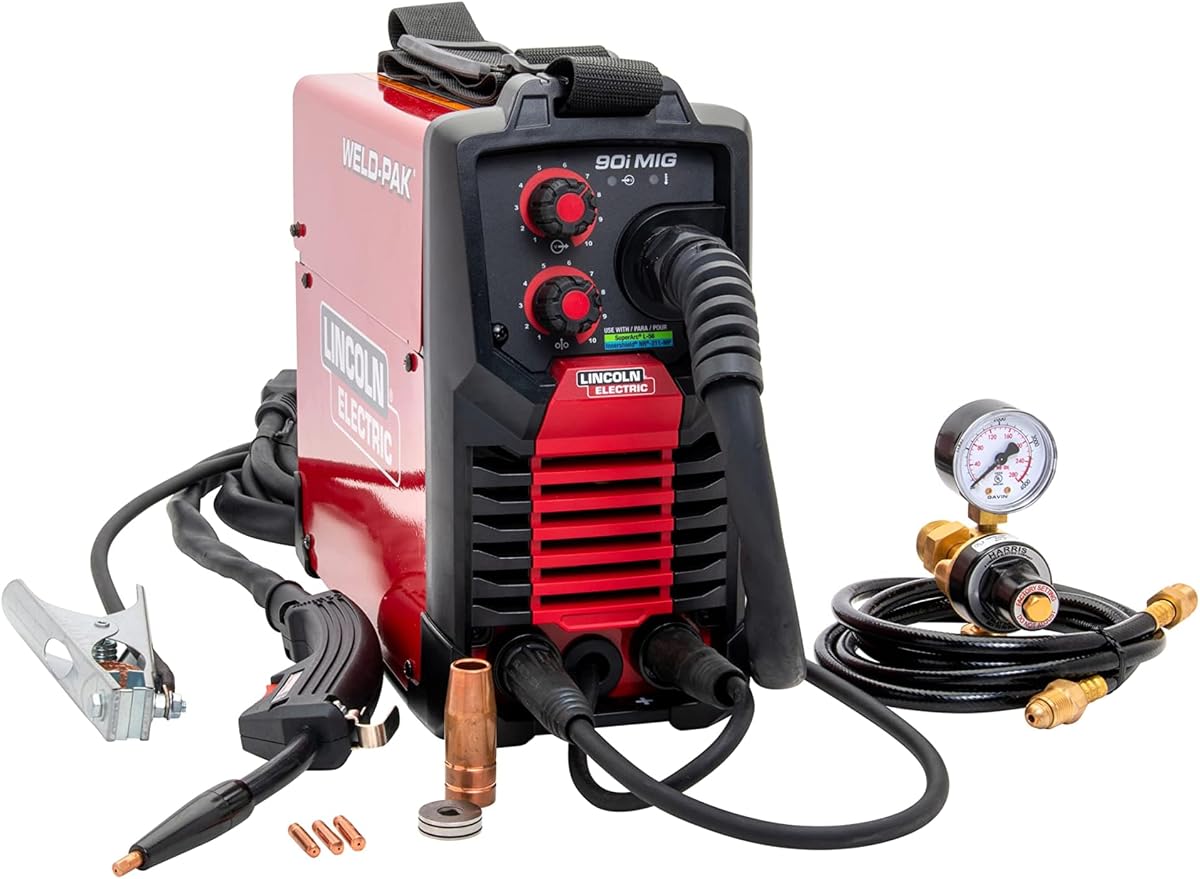
The Lincoln Electric 90i Weld-Pak is a focused 120V wire-feed welder for small jobs rather than a broad multiprocess machine. It handles flux-cored wire up to 1/4 inch and solid MIG wire up to 3/16 inch, making it suitable for hobbyists, DIY projects, home repairs, and maintenance work. Its 4.6 rating is the highest among the products included here.
We may earn a commission when you buy through this link, at no additional cost to you.
Ease of use is the defining characteristic. The operator controls wire speed and voltage with two knobs, while infinite voltage adjustment allows fine tuning of weld characteristics. The inverter power source is described as more efficient and capable of smoother weld behavior than traditional transformer-based designs. There are no complex digital menus or process-selection steps to work through.
Portability is handled well for a 15-pound machine. A shoulder strap makes it easier to move, and the included metal case protects the welder from elements and handling damage. The accessory list includes a welding gun, nozzle, contact tip, work cable, and clamp, covering the primary pieces needed for basic operation.
The limitation is intentional specialization. This machine does not provide Stick or TIG modes, and its 90-amp class is aimed at smaller welding tasks. Choose it when straightforward MIG operation, a protective case, and easy transport matter more than maximum output or multiple processes. For a broader home-shop toolkit, one of the 135A to 165A multipurpose machines would be more adaptable.
Two primary knobs keep the interface understandable, which is valuable for occasional users who may not remember detailed setup values. The operator can adjust wire speed and voltage while retaining fine control over weld characteristics.
The shoulder strap and protective metal case make the 90i a natural choice for mobile maintenance or small jobs away from a permanent bench. Its lighter process set also reduces the number of setup decisions compared with full multiprocess welders.
We may earn a commission when you buy through this link, at no additional cost to you.
The YESWELDER MCT-520 is the broadest all-in-one system in this guide, combining six working modes: Gas MIG, Flux Core MIG, plasma cutting, high-frequency TIG, MMA, and spool-gun aluminum welding. Its welding output reaches 200 amps, while plasma cutting covers 20 to 50 amps. The 4.2 rating is the lowest in the lineup, but the machine's process range is more extensive than that of any competing entry.
We may earn a commission when you buy through this link, at no additional cost to you.
Its shop-oriented design emphasizes practical control. The seven-inch LED display is described as 30 percent larger than a standard screen, and physical dials replace touchscreens so they can be adjusted while wearing heavy gloves. MIG inductance can be adjusted to manage spatter, TIG offers fine heat control, and MMA Arc Force can be tuned. TIG mode is also foot-pedal ready, although the pedal is a separate accessory.
Cutting performance is a major differentiator. The stated capability includes a clean 5/16-inch cut and a 5/8-inch maximum sever. A smart parameter-matching system adjusts wire-feed speed based on selected voltage, and step-by-step video tutorials support initial setup. Automatic protection against over-current, over-voltage, and overheating adds another layer of system safeguards.
This machine is best for a serious garage or small fabrication shop that wants welding and plasma cutting in one power source. It may be more than a beginner needs, and aluminum users still need to obtain a spool gun. TIG users who want hands-free amperage control also need the optional foot pedal. Even with those add-ons, the six-mode design offers exceptional versatility for the right buyer.
The large display and glove-friendly dials prioritize fast adjustment over touchscreen convenience. This is advantageous in a working fabrication environment where operators may have gloves on, limited space, or need to make changes quickly.
Integrated cutting can reduce the need for a separate cutter for suitable projects. It expands the machine's role from joining metal to preparing and separating it, making it attractive to maintenance teams and fabricators.
We may earn a commission when you buy through this link, at no additional cost to you.
The Millermatic 211 PRO represents the premium end of this comparison, combining 120V and 240V operation with advanced MIG automation. It supports mild steel, stainless steel, flux-cored wire, and aluminum when paired with a spool gun. Its 4.4 rating reflects strong customer satisfaction, and its software, monitoring, and program-memory features distinguish it from conventional entry-level welders.
We may earn a commission when you buy through this link, at no additional cost to you.
Auto-Set reduces setup time by selecting suitable starting parameters, while Smooth-Start is designed to limit spatter during arc initiation. BeadVision gives real-time bead monitoring, offering feedback that can help operators recognize changes in the weld. Program Memory saves frequently used settings, and a higher duty cycle supports longer work sessions. These features make the machine especially relevant to operators who repeat similar jobs.
Dual voltage is switched without tools using the MVP Plug, providing flexibility for a home shop, professional shop, or job site. The heavy-duty drive system uses an angled cast-aluminum drive and Quick Select drive roll, supports 0.024- to 0.035-inch wire, and automatically detects a spool gun for aluminum welding. A 15-foot MIG gun is included, although the spool gun itself is not listed as included.
This is the premium choice for fabricators, professional contractors, and serious hobbyists who value guided setup, reusable programs, real-time feedback, and aluminum potential. Buyers should account for the added expense and may need to purchase a spool gun. If those advanced features will not be used, a less advanced multiprocess welder can offer better value with a more straightforward control layout.
Auto-Set reduces repetitive configuration, Smooth-Start focuses on clean arc initiation, and BeadVision provides live bead feedback. Together, these features help users move more efficiently while retaining information about weld formation.
The machine handles mild steel, stainless steel, and flux-cored wire out of the available configuration, with aluminum available through spool-gun operation. That broader material support is one reason advanced fabricators may prefer this model.
We may earn a commission when you buy through this link, at no additional cost to you.
The TOOLIOM 5-in-1 combines MIG, Flux Core, plasma cutting, TIG, and Stick in a dual-voltage package. It supports up to 200 amps in TIG operation and includes 1 pound of flux-core wire and welding gloves. Its 4.5 rating places it among the stronger customer-rated products, while the combination of joining and cutting processes broadens its usefulness.
We may earn a commission when you buy through this link, at no additional cost to you.
MIG operation provides both Synergic and Manual modes. In Synergic mode, voltage automatically adjusts when the operator sets wire speed; Manual mode allows independent adjustments for experienced users. A Gas Check function helps verify gas flow before striking an arc. The machine is spool-gun compatible for aluminum, although the spool gun is sold separately. The digital panel displays current and other operating information in real time.
The plasma cutter produces 20 to 50 amps and is stated to make clean cuts up to 5/16 inch on 110V and 25/64 inch on 220V. Maximum sever capacity reaches 25/64 inch on 110V and 19/32 inch on 220V. It can cut stainless steel, alloy steel, mild steel, copper, and aluminum. Compressed air is required, and the foot pedal is another optional accessory.
This unit is a good fit for a well-equipped garage that wants both welding and cutting functions without purchasing two separate machines. It is less suitable for users who need a simple MIG-only setup or want every optional component included. Compared with the MCT-520, TOOLIOM offers one fewer working mode, but its gas-check feature, clear cutting specifications, and glove-friendly package make it a compelling alternative.
The Gas Check function allows gas flow to be checked before welding begins. This can help identify setup problems before they interrupt an arc or produce an inconsistent weld.
The cutting section covers common ferrous and nonferrous metals, including mild steel, stainless steel, alloy steel, copper, and aluminum. Buyers should ensure they have a suitable compressor and understand that plasma cutting adds another maintenance and safety consideration.
We may earn a commission when you buy through this link, at no additional cost to you.
The YESWELDER 140A is a dual-voltage, four-process welder with a stated output of 140 amps. It supports Gas MIG, gasless Flux Core MIG, Lift TIG, and Stick, making it appropriate for automotive repair, construction, fabrication, and home projects. Its 4.3 rating is solid, though not the highest among the models reviewed, and the machine provides a more conventional feature set than premium competitors.
We may earn a commission when you buy through this link, at no additional cost to you.
Synergic MIG automatically matches voltage to the selected wire-feed speed, which is listed as adjustable from 80 to 600 inches per minute. Operators can fine-tune voltage by -3 to +3 volts, and Manual MIG allows independent control of feed speed and voltage. A digital display monitors current during welding, giving users direct feedback while the helmet is down.
As a 110V and 220V machine, it can fit more varied workshop power arrangements than the compact single-voltage models. Its process selection is broad, but the Lift TIG torch is a separate purchase. The listing also notes that the adapter and ground clamp are stored inside the machine, so new owners should check the side compartment during unpacking.
This welder makes sense for a user who wants dual-voltage flexibility and four common processes without moving to a full plasma-cutting combo. It is especially useful for carbon steel and stainless steel tasks. Operators who need aluminum should choose a spool-gun-ready model, while those who prioritize the simplest controls can consider the Lincoln Electric 90i instead.
The broad 80- to 600-inches-per-minute range supports different wire diameters and project demands. Automatic voltage matching assists beginners, while the -3V to +3V trim range allows useful manual refinement.
Supporting both 110V and 220V lets users match the welder to different available circuits. This is especially helpful for mobile work or home shops that may not have a dedicated high-voltage outlet.
We may earn a commission when you buy through this link, at no additional cost to you.
The YESWELDER FLUX-135PRO combines a 135-amp, three-process welder with an LYG-L600A auto-darkening helmet. It supports Gasless Flux Core MIG, Stick, and Lift TIG, with the TIG torch sold separately. Its 4.5 rating and focus on mild-steel work make it a strong package for home projects, repairs, and users who want protective gear included from the start.
We may earn a commission when you buy through this link, at no additional cost to you.
The machine accepts 2-pound spools of 0.030- and 0.035-inch welding wire. Synergic control matches voltage to the selected wire-feed speed, with separate ranges for the two wire sizes and a -3V to +3V fine-tuning range. Hot Start and Arc Force can be adjusted for Stick welding. At 11.4 pounds, the machine is light enough to move between a garage, yard, and work area without requiring a cart.
The included helmet is a major selling point. Its blue-light-blocking outer lens is paired with true-color vision, a 3.64-by-1.67-inch viewing area, and 1/1/1/1 optical clarity. Two arc sensors react in 1/30,000 of a second, while adjustable sensitivity and delay accommodate changing conditions. It supports shade settings from 3.5 through 9 to 13 and includes Grind mode. The helmet is solar powered with a replaceable CR2450 battery.
This is a compelling choice for a beginner who wants a capable flux-core welder and a properly featured auto-darkening helmet in one package. The single-voltage design and separate TIG torch prevent it from replacing a full dual-voltage or multiprocess system. It is best suited to mild steel and projects where gasless flux-core wire provides a convenient way to begin.
Fast darkening, true-color visibility, broad shade selection, and automatic sensitivity make the LYG-L600A a useful companion for home and professional welding. The replaceable battery and solar charging support extended operation.
Gasless flux-core MIG avoids the need for shielding gas on compatible mild-steel jobs, while the integrated carry handle keeps the 11.4-pound machine manageable. It remains limited to 110V operation and does not include a TIG torch.
We may earn a commission when you buy through this link, at no additional cost to you.
Choosing a MIG welder means balancing output, process support, controls, power requirements, accessories, and the kinds of metal you expect to weld. The following factors help narrow the field before you compare individual listings.
A basic MIG welder may use shielding gas with solid wire or gasless flux-core wire, while multiprocess models add Stick, TIG, plasma cutting, or aluminum spool-gun capability. Choose based on work you expect to do now and may want to do later. Buying extra process support that you will never use adds complexity, whereas adding only the modes you need can make operation simpler. Always distinguish a listed process from the included accessories required to perform it.
The rated amperage indicates the power-source capacity, while material-thickness claims describe the intended range under suitable conditions. A machine around 135A can handle many light-gauge and mild-steel household projects, while 160A to 211A models offer more room for thicker material and sustained work. Look for both maximum output and duty-cycle information. A high maximum output alone does not guarantee that a machine can maintain that level continuously without overheating.
Single-voltage 110V or 120V machines are convenient for ordinary household circuits, while dual-voltage models can operate from high-voltage shop circuits as well. Verify the outlet configuration, required amperage, plug type, and extension-cord limitations before purchase. A 240V-capable welder can help reduce circuit strain during demanding work, but it may require a dedicated outlet and compatible connection.
Check which wire diameters and types the machine accepts, including solid wire, flux-core wire, and the spool sizes it can physically hold. A machine that accepts both 2-pound and 10-pound spools offers flexibility between portable projects and longer shop work. Wire diameter affects the range of suitable materials and amperage, so compatibility should be evaluated alongside the project types you have in mind.
Synergic modes automatically pair wire-feed speed with recommended voltage, reducing guesswork for beginners. Manual controls allow more precise independent adjustment as skills improve. Digital displays can show amperage, voltage, wire speed, and other settings without removing a helmet, while simple knobs may be preferable for occasional users. The best interface is not necessarily the most advanced; it is the one whose controls you understand and can adjust confidently.
Weight, carrying handles, straps, and case design determine how easily a welder can move between a garage, yard, and job site. A lightweight unit can be used for mobile repairs, while a larger multipurpose machine may be better suited to a fixed shop. Also inventory the accessories: a torch, work cable, ground clamp, electrode holder, wire, helmet, gloves, and basic tools can determine how quickly you can begin.
Look for automatic protection against over-current, over-voltage, overload, and overheating, as well as voltage stabilization. These systems help protect the machine and support consistent operation. A metal case is useful for storage and transport, while a digital display can improve awareness of operating conditions. For any welder, use appropriate protective equipment, ventilation, safe cable handling, and sound electrical practices regardless of the listed safeguards.
Aluminum usually requires a spool gun because standard MIG wire-feed systems are generally not suited to that application. Confirm that the machine is explicitly spool-gun ready, whether it auto-detects the gun, and whether the gun is included. Stainless steel and flux-core work have different consumable, polarity, and parameter considerations. Choosing the correct process and consumables for each metal matters more than treating a long feature list as proof of suitability.
Begin by reading the manual and identifying the power requirements, wire-loading direction, grounding connection, process settings, and safety requirements for the exact model. Work in a ventilated area, remove flammable materials, wear the appropriate helmet and protective clothing, and confirm that the work clamp makes secure electrical contact with the metal. Before striking an arc, verify that the torch, work lead, consumables, and wire are correctly installed and that the selected process matches the wire type.
For initial setup, choose the correct wire diameter and material, install the spool with proper tension, and check that it feeds smoothly. On a Synergic machine, use the recommended settings as a starting point and make small adjustments while observing bead shape, spatter, penetration, and wire-feed behavior. Manual mode requires more responsibility, so compare the selected voltage and feed speed with the material and wire diameter. Test on scrap metal before beginning a finished project.
After each session, turn off the power and disconnect it before handling the gun or changing consumables. Remove slag carefully, inspect the nozzle and contact tip, and replace worn parts before they create poor welds or unstable feeding. Clean the machine with a dry brush or compressed air as directed, keep ventilation openings clear, and store it in a dry location. Review the manual for periodic maintenance, and investigate unusual noise, erratic feeding, overheating indicators, or damaged cables before returning the machine to service.
MIG welding uses continuously fed wire and typically requires shielding gas to protect the weld pool from the atmosphere. Flux-core MIG uses flux inside the wire, allowing many gasless applications with self-shielding wire. Gasless flux-core is convenient for outdoor work and simpler setups, but it commonly creates more visible smoke and spatter than a properly tuned gas MIG process.
In many cases, yes. Several 135A machines include automatic voltage and wire-feed matching that reduces initial guesswork. Begin with mild steel, clean scrap pieces, and the settings supplied by the manufacturer. As your technique improves, move toward manual controls and thinner, more demanding materials where your skill has developed.
A 110V welder can handle many household and light-fabrication projects, but thicker material and longer sessions often benefit from 220V because the power source can deliver greater output with less circuit strain. The required wire diameter and machine duty cycle also matter. Verify the material-thickness rating before assuming more voltage is necessary or sufficient.
Aluminum generally requires a compatible spool gun and the correct aluminum wire. The MCT-520, TOOLIOM 5-in-1, and Millermatic 211 PRO are explicitly described as spool-gun compatible or ready, but the spool guns are not necessarily included. Smaller gasless machines should not be assumed to handle aluminum simply because TIG or Stick modes are listed.
Lift TIG starts the arc using the tungsten electrode in contact with the workpiece, then lifts the electrode as current rises. It offers finer heat control than many MIG processes and works well on thinner metals. Several machines in this guide list Lift TIG but require a separate TIG torch, so verify that accessory before planning around the process.
It can be worthwhile if you regularly cut metal as well as weld it, because a separate plasma cutter would otherwise be needed for suitable materials. The machine still requires compressed air and appropriate safety equipment. For occasional light repair work, a dedicated MIG welder may provide a simpler setup and use less space.
At minimum, confirm that the package includes the MIG torch, work cable and ground clamp, correct contact tip and nozzle, and appropriate wire. You will also need a properly rated welding helmet, gloves, safety clothing, and eye protection. A separate TIG torch or spool gun is necessary if you intend to use those modes, while a face shield is advisable for grinding and cutting.
Disconnect power, remove or secure loose wire, clean debris from the case and vents, and store the machine in a dry location away from excessive heat or corrosive materials. A protective case helps during transport, but it should not block ventilation while the welder is operating. Inspect cables and consumables periodically for damage or wear.
The BESTMIG 135A is the strongest all-around recommendation because it combines 135 amps, three processes, accessible automatic controls, a clear display, and useful included protective equipment. The compact 145A model is ideal when portability and a nearly complete starter package matter most, while the Millermatic 211 PRO is the premium selection for advanced automation, program memory, bead monitoring, and aluminum expansion.
Your priorities should match the type of work you expect. Choose a simple single-process model for focused small jobs, a dual-voltage unit for outlet flexibility, a multiprocess welder for broader fabrication, or a combo with plasma cutting when metal separation is part of your regular workload. Confirm material capacity, consumables, optional accessories, and shop electrical requirements before making a final decision.
Ratings and product configurations can change over time, so check the current listing, manufacturer instructions, included components, and availability of required accessories before purchasing. Comparing the machine against your materials, power access, and skill level will lead to a more useful purchase than choosing solely by output number or feature count.