
Portable Halogen Moisture Meter with 110g-10mg Precision
5.0Editor score
Rapid halogen heating system
110 gram sample capacity
Twenty saved test records
A Moisture Balance Analyzer 2 combines rapid halogen heating with continuous weight monitoring to determine moisture content without waiting for a conventional oven test. A useful model should balance weighing capacity, readability, drying controls, repeatability, and straightforward data handling across food, grain, plastic, chemical, and construction samples.
The ten instruments in this guide were compared using the published specifications and product information, including sample capacity, resolution, temperature range, operating modes, stored programs, interfaces, and included accessories. The list covers compact touchscreen units, higher-resolution laboratory systems, and models aimed at routine quality-control workflows.
Each review highlights the most important strengths, limitations, and likely buyer profile, while the comparison table makes the technical differences easier to scan. Specifications and product availability can change, and current marketplace prices fluctuate, so confirm the latest listing details before making a purchase.
5.0Editor score

4.7Editor score

As an Amazon Associate we earn from qualifying purchases.
This side-by-side comparison covers capacity, weighing resolution, maximum drying temperature, method flexibility, and data connectivity for all ten halogen moisture analyzers.


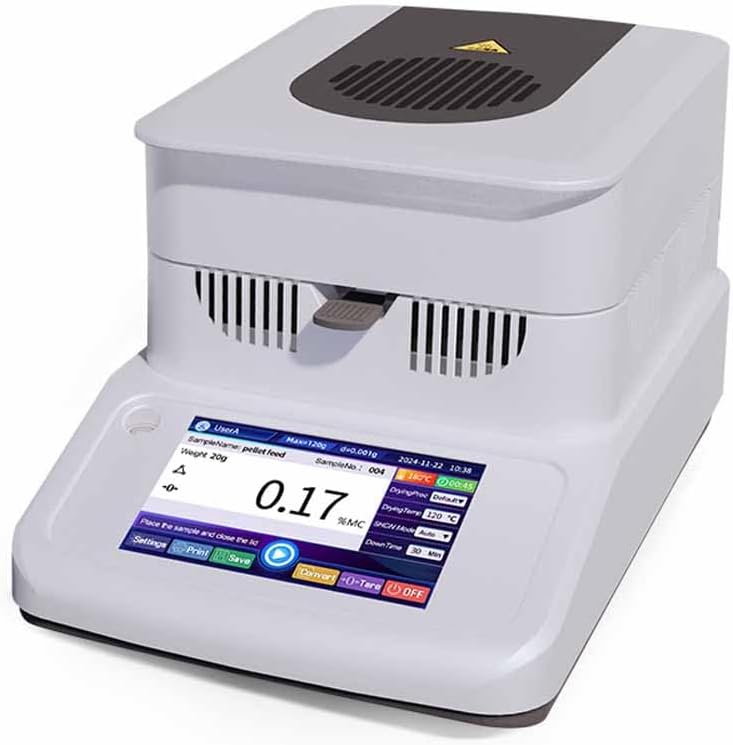


The Portable GS110 Halogen Meter is a 5.0-rated laboratory moisture balance that combines a halogen heating system with a 110 g sample capacity and 10 mg precision. It is designed to deliver results within minutes while supporting food, plants, grains, minerals, chemicals, soil, wood, paper, textiles, and building-material testing.
We may earn a commission when you buy through this link, at no additional cost to you.
Its main advantage is the combination of a 40–160°C adjustable range, one-degree temperature increments, and programmable drying durations from 1 to 99 minutes. The analyzer monitors weight loss as moisture evaporates and calculates the result automatically. Twenty aluminum pans, a 100 g calibration weight, a wind cover, a tray handle, and a triangle scale frame provide a useful starter package.
The 20-record history and printer interface make it more practical for repeated quality-control work than a basic display-only instrument. The lower resolution and smaller method library may not satisfy research workflows needing ultra-fine weighing or dozens of custom programs. The stated 160°C ceiling also limits it compared with units reaching 199–200°C.
This is a strong general recommendation for laboratories, agricultural testers, food businesses, and building-material specialists seeking straightforward halogen analysis without a large touchscreen. It offers a balanced feature set, a generous accessory package, and fast operation, making it the most accessible all-around choice in this guide.
The halogen lamp and real-time weighing processor shorten the feedback cycle compared with conventional oven-drying workflows. Selectable temperature and duration settings also make it practical to develop repeatable procedures for different sample types.
The stated compatibility spans food, agricultural materials, chemicals, paper, textiles, wood, and construction products. That breadth makes the GS110 suitable for mixed operations that need more than a dedicated grain tester.
We may earn a commission when you buy through this link, at no additional cost to you.
The U.S. Solid 110g Analyzer carries a 4.1 rating and combines 110 g capacity with 5 mg readability and 0.1% moisture resolution. Its 450 W halogen lamp offers a 40–199°C range, while standard, fast, and soft drying modes provide flexibility for delicate samples and denser materials.
We may earn a commission when you buy through this link, at no additional cost to you.
Fifteen preset method groups support repeated testing without repeatedly entering parameters. The digital display can present moisture percentage, dry weight, or dry-weight percentage, and manual calibration uses a 100 g weight. An RS-232 port transfers results to a computer or printer, and the package includes a 90 mm pan plus 50 sample dishes.
The 4.1 rating is lower than those of several newer touchscreen competitors, and the supplied information does not mention a color display, touchscreen, automatic calibration, or extensive record storage. Buyers who need live curves, user authentication, or a large method library may prefer a more advanced model. The listed 110V 60Hz supply should also be checked against local electrical requirements.
Despite those limitations, it is a sensible option for food, grain, plastic, textile, and chemical laboratories that value a broad temperature range, several drying profiles, and computer connectivity. The 50-dish package and 15 stored methods are particularly useful for teams that repeat standardized tests throughout the day.
Standard, fast, and soft modes give operators a practical starting point for samples with different heat sensitivities. The broad 199°C maximum also supports methods requiring more aggressive moisture removal than lower-temperature instruments.
Stored method groups help preserve consistent settings between runs, while RS-232 output supports direct transfer to a computer or printer. This is helpful when measurements must become part of a larger quality-control record.
We may earn a commission when you buy through this link, at no additional cost to you.
The FLB 110g Halogen Analyzer is a 4.7-rated model offering 0.001 g, or 0.01%, moisture readability in a 110 g capacity instrument. It is positioned for food, agriculture, chemical, pharmaceutical, laboratory, and production inspections where finer readings and flexible setup are useful.
We may earn a commission when you buy through this link, at no additional cost to you.
A five-inch sensitive touchscreen provides manual, automatic, and timed operating modes, along with the ability to switch between gentle and rapid drying. Thirty-four programmable memory groups allow frequently used settings to remain available, which is particularly useful for labs that test multiple materials or run repeated production checks.
The 40–180°C range is broad but does not reach the 199–200°C offered by some competitors. Data output is handled through RS-232 rather than the more flexible USB options found elsewhere, and the information mentions stored programs but not a larger historical-record database. The stated CE certification and pre-calibration process may also reassure buyers who require documented instrument checks.
This is the editor's choice for buyers who want a capable touchscreen analyzer without moving to the premium electromagnetic-force model. It is especially appropriate for laboratories balancing precision, program storage, multilingual operation, and report output. Its combination of resolution, interface quality, and 34 saved methods gives it unusually broad utility.
The color display provides a more approachable way to configure sample type, temperature, timing, and result presentation. Manual, automatic, and timed modes help align the instrument with different sample behaviors and laboratory preferences.
With 34 memory groups, operators can preserve tested procedures and avoid re-entering them for each batch. This reduces setup friction and supports more consistent comparisons between routine production samples.
We may earn a commission when you buy through this link, at no additional cost to you.
The U.S. Solid 0.005g Analyzer is a 4.4-rated laboratory balance with 110 g capacity, 0.005 g readability, and 0.05% moisture resolution. It combines a 250 W halogen heater with a five-inch color touchscreen, offering a straightforward middle ground between basic bench models and highly specialized systems.
We may earn a commission when you buy through this link, at no additional cost to you.
Operators can select standard, fast, or soft drying modes, along with automatic, manual, or timing end conditions. Up to 20 test methods can be stored, and a preheat function may help reduce delays before a run. Results can be shown as moisture percentage, dry weight, or dry-weight percentage, with manual calibration using a 100 g weight.
Its 160°C maximum is lower than the 199–200°C range of certain competitors, and the 250 W heater is also lower than the 450 W configuration listed for other U.S. Solid models. The 4.4 rating suggests generally positive customer sentiment, though it is not among the highest-rated products in the group. RS-232 and 50 included pans improve its laboratory practicality.
This analyzer is a good fit for food, grain, plastic, textile, and chemical testing where a color touchscreen, stored methods, and sub-milligram weight readability are needed without moving to a premium electromagnetic sensor. It is especially appealing to teams balancing good precision with a conventional lab-bench footprint.
The five-inch display makes method selection, result interpretation, and preheat control more visible than on a basic instrument. Touch controls can also reduce the number of physical steps required for routine jobs.
Twenty stored methods and three result formats support repeatable quality-control work. The included dishes and RS-232 connection also help the analyzer fit into an established laboratory documentation process.
We may earn a commission when you buy through this link, at no additional cost to you.
The 120g Halogen Analyzer 1mg offers a 120 g capacity, 0.01% moisture readability, and a 1 mg weighing option. It is designed for grain, wood, and food testing, with broader applications in agriculture, chemicals, medicine, and other production-monitoring environments.
We may earn a commission when you buy through this link, at no additional cost to you.
Its defining feature is the selection of four drying modes—standard, fast, slow, and soft—combined with automatic, timed, and manual ending modes. The touchscreen can store 100 sets of data and display sample temperature, elapsed time, moisture content, solid content, and dry weight. RS-232 connectivity allows reports to be sent to a printer.
No customer rating is supplied for this model, so there is no direct basis here for comparing user satisfaction. The stated repeatability error of 0.6% should also be considered when deciding whether the instrument meets a specific quality standard, because repeatability and readability are different performance measures. The available information does not state a maximum heating temperature.
Despite those caveats, the 120 g capacity and four drying profiles make this model attractive for grain and other sample types that may exceed the 110 g limits of competing instruments. It is a practical choice for users who value larger batches, extensive record storage, and multiple termination options, provided the published repeatability specification aligns with their requirements.
The addition of slow and soft modes gives operators more choices than the common three-mode configuration. This can help balance turnaround time with sample sensitivity when establishing a method.
Showing temperature, time, moisture, solid content, and dry weight together gives operators a fuller view of each run. The 100-record store also supports retrospective review and routine reporting.
We may earn a commission when you buy through this link, at no additional cost to you.
The 112g USB Halogen Analyzer combines a 112 g capacity with a large seven-inch HD color touchscreen and a halogen heating system. It supports granular, sheet-like, and non-volatile liquid samples, making it potentially useful across food, agricultural, and chemical workflows.
We may earn a commission when you buy through this link, at no additional cost to you.
Automatic and timed ending modes are joined by standard, fast, and soft drying modes. The analyzer can store 20 methods, and the listing mentions a one-touch preheat function plus two calibration modes. Connectivity is described as RS234, which appears to mean RS-232, and supports current or historical results being sent to printers or computers.
This model has no supplied customer rating, and the exact moisture readability is not stated in the available product information. Buyers should also confirm the interface designation directly with the seller because an unusual port label can create compatibility uncertainty. Its listed 40–162°C range is adequate for many materials but narrower than the premium 200°C model.
The large display and convenient preheat control make this model appealing for operators who value visibility and quick setup. It is best suited to labs that regularly test multiple material forms and want stored methods plus computer or printer output. Confirming the connection type, electrical requirements, and calibration details before ordering would be advisable.
The large color display can make live parameters and final results easier to read during routine testing. It is particularly useful for operators who share results with colleagues or need clearer menu navigation.
Automatic and timed endings, three drying modes, and 20 stored methods accommodate a broad mix of materials. The listed suitability for granular, sheet-like, and non-volatile liquid samples extends utility beyond grain testing.
We may earn a commission when you buy through this link, at no additional cost to you.
The 120g 0.002g Halogen Analyzer provides 120 g capacity, 0.002 g weight readability, and 0.01% moisture readability. Its five-inch full-color touchscreen, halogen heating system, and PT-100 temperature sensor target laboratory, industrial, and routine quality-control applications.
We may earn a commission when you buy through this link, at no additional cost to you.
The internal database stores up to 100 test records and supports saving, conversion, and RS-232 output. Standard, mild, fast, and slow drying programs operate across a 40–180°C range, while auto-stop, timed, and manual modes provide control over how each test ends. The listing also highlights chemically resistant stainless steel components for practical durability.
The package includes the analyzer, sample tray, tripod stand, tray bracket, windproof cover, calibration weight, power cord, stylus, and manual. No customer rating is supplied, so this recommendation rests on the stated feature set rather than user-review evidence. The 5-inch screen is smaller than the seven-inch display offered by some alternatives, and data transfer is limited to RS-232 in the listed specifications.
This is a compelling option for buyers seeking strong capacity, fine resolution, a large record database, and a complete setup at a practical entry point. It is well suited to labs that repeatedly test grain, food, chemicals, or industrial materials and want multiple drying profiles without a large number of manual data steps.
Keeping up to 100 tests in the internal database helps users review recent results without exporting every record immediately. Conversion functions can also adapt stored information for different reporting needs.
The included wind cover, tray system, calibration weight, stand, and support tools cover the basic setup needs. This reduces the need to source several separate accessories before routine operation can begin.
We may earn a commission when you buy through this link, at no additional cost to you.
The U.S. Solid 0.0001g Analyzer is the premium selection in this guide, offering 110 g capacity, 0.1 mg weight readability, and 0.001% moisture readability. Its electromagnetic force transducer and 450 W halogen lamp place it in a higher class for research, development, and detailed laboratory analysis.
We may earn a commission when you buy through this link, at no additional cost to you.
A seven-inch color touchscreen displays a live drying curve and results, while as many as 200 test methods can be stored. Standard, fast, soft, and step drying modes operate from 40–200°C, and automatic, manual, and timed endings are available. Results can be shown as moisture percentage, dry weight, or dry-weight percentage.
Automatic calibration with a 100 g weight, an automatic touch-operated door, and user authentication support controlled laboratory workflows. RS-232 output and 50 included pans assist documentation and sample handling. No customer rating is provided, however, and the instrument's specialized specifications and 110V 60Hz requirement may exceed the needs of a small operation.
Buyers who need the finest resolution in this list, broad temperature control, live process visualization, and extensive method storage should give this model serious consideration. It is less compelling for simple grain checks or users who only need a compact routine analyzer, but for advanced R&D workflows it offers the strongest specialized feature set.
The electromagnetic force transducer and 0.001% moisture readability support applications where small differences matter. This level of detail is most useful in method development and tightly controlled laboratory comparisons.
Watching the real-time drying curve can help operators understand how a sample loses mass over time. Two hundred stored methods and automatic calibration further support repeatable, auditable workflows.
We may earn a commission when you buy through this link, at no additional cost to you.
The Rapid Heating 110g Halogen Meter is a 5.0-rated alternative featuring 110 g capacity, 5 mg high precision, and an adjustable 40–160°C heating range. It is marketed for rapid moisture determination in food, plants, construction materials, and other laboratory or production samples.
We may earn a commission when you buy through this link, at no additional cost to you.
Users can set temperature in one-degree increments and choose drying durations from 1 to 99 minutes. The halogen lamp and fast weighing processor are designed to shorten turnaround compared with oven drying. Once a run is complete, the unit displays moisture content and can save or print the result through its printer interface.
Twenty sets of historical data, a 100 g calibration weight, 20 aluminum pans, a wind cover, and a tray handle create a well-equipped package. The 160°C ceiling is lower than several competitors, and a 20-record history is modest for a busy production laboratory. It also shares a closely related description and image with the rank-one GS110 listing, so shoppers should compare the final specifications and seller package carefully.
This model is recommended for labs and quality-control teams that value fast turnaround, simple controls, and a 5.0 customer rating. It is particularly relevant for food, plant, grain, soil, wood, paper, textile, and building-material testing where a 110 g capacity and adjustable heating program are sufficient.
The halogen system evaporates moisture while monitoring weight loss, allowing results to be calculated within a run rather than after a separate cooling and weighing step. This can improve daily sample throughput.
Fine temperature increments and a broad timer range provide useful control when adapting the method to different materials. The listed applications cover both organic samples and solid construction products.
We may earn a commission when you buy through this link, at no additional cost to you.
The 120g Halogen Analyzer 2mg provides a 120 g capacity, 0.01% moisture readability, and a 2 mg weighing configuration. It is targeted at grain, wood, and food applications, with additional uses in agriculture, chemicals, medicine, and production quality monitoring.
We may earn a commission when you buy through this link, at no additional cost to you.
The touchscreen instrument offers automatic, timed, and manual ending modes alongside standard, fast, slow, and soft drying profiles. It can store 100 data sets and display sample temperature, elapsed time, moisture, solid content, and dry weight. An RS-232 connection provides a route to printer output for laboratory reports.
The listed repeatability error is 0.6%, which should be compared with the tolerances of the intended test method. No customer rating is available, and the supplied information does not state the maximum drying temperature. Its feature set is otherwise broad, but buyers should verify those omissions before committing to a demanding specification.
This analyzer suits buyers who want more than the common 100 g capacity and need multiple drying profiles for varied materials. It is a sensible choice for grain, wood, and food quality work where the 100-record history and multi-parameter display support regular monitoring. Confirming the temperature range and validating a method on known samples are sensible precautions.
The 120 g platform offers extra room for grain, wood, and food specimens that might be constrained by smaller units. That capacity can also reduce the need to divide a representative sample into multiple runs.
Four profiles and three ending conditions provide meaningful flexibility across sample types. The ability to review temperature, time, moisture, solid content, and dry weight supports a more complete understanding of each test.
We may earn a commission when you buy through this link, at no additional cost to you.
The right moisture balance depends on sample characteristics, required precision, throughput, documentation needs, and operating environment. Compare the published specifications carefully because capacity, readability, repeatability, and temperature range describe different aspects of performance.
Capacity determines the maximum sample mass the instrument can handle in one run. Most models here support 110–120 g, which suits routine food, grain, plastic, textile, and chemical samples. Larger sample capacity is useful when a representative specimen is bulky, but it does not automatically make the instrument more accurate. Buyers should also consider the pan diameter and whether the sample will remain evenly distributed during heating.
Readability indicates the smallest displayed change the balance can resolve, while repeatability describes how closely repeated measurements agree. Specifications range from 10 mg moisture resolution in the GS110 to 0.001% in the electromagnetic-force model. These figures should not be treated as interchangeable with method accuracy, which also depends on sample preparation, temperature selection, and reference-method validation.
The maximum heating temperature affects which materials can be tested safely and how quickly water can be removed. The range across this list runs from 160°C on several models to 200°C on the premium analyzer. Standard, fast, soft, slow, mild, and step profiles offer different heating curves, while automatic, manual, and timed endings control when a test stops.
Halogen moisture analyzers are widely used for food, grain, agricultural products, chemicals, pharmaceuticals, plastics, textiles, paper, wood, and soil. Some models explicitly support granular, sheet-like, or non-volatile liquid samples. A stated use does not guarantee that every formulation will be safe under every program, particularly for heat-sensitive or volatile materials.
Routine laboratories may need stored records, printed reports, or direct computer transfer. Method storage and historical-record storage serve different purposes: methods save test settings, while records preserve individual results. RS-232 is common throughout the list, while one title references USB. Check the exact port, cable, software, and printer compatibility before ordering.
Compact displays may be adequate for occasional users, while touchscreen interfaces make menus, live values, and saved methods easier to navigate. Available screens range from five to seven inches, and the premium model adds a real-time drying curve. Consider whether the operator will wear gloves, share results with colleagues, or perform many tests in succession.
A calibration weight, sample dishes, pan handle, wind cover, and printer support can make setup and recordkeeping easier. Manual calibration is common, while the premium model adds automatic calibration. Confirm whether the calibration weight and required sample pans are included, and plan a cleaning routine that keeps the pan and draft shield free of residue.
Several models specify 110V 60Hz operation, which matters for laboratories outside that electrical environment. Also consider bench space, ventilation, sample throughput, noise, and whether results must connect to an existing quality-management system. The most precise instrument is not automatically the most efficient choice for a high-volume grain operation.
Place the analyzer on a stable, vibration-free bench with adequate clearance around the pan and heating chamber. Connect the unit to a compatible power source, level it according to the manual, and perform the specified calibration using the supplied weight. Before running a sample, select a validated temperature, drying profile, and ending mode for that material rather than relying on a generic program.
Prepare a representative, homogeneous sample and spread it evenly across a clean sample pan without exceeding the capacity. Close the draft shield or chamber, start the test, and observe the live mass change where supported. When the run finishes, record the displayed moisture, dry weight, or dry-weight percentage, save the result if needed, and export or print it through the appropriate connection.
After each run, allow the chamber and pan to cool as directed, then remove debris with a soft brush or approved method. Keep the pan, weighing surface, draft shield, and temperature sensor clean, and follow the manual for calibration checks and firmware or software updates. Do not use aggressive solvents on coatings or displays unless the manufacturer explicitly permits them.
A halogen moisture balance heats a sample while continuously measuring its weight. As moisture evaporates, the instrument calculates moisture content from the change in mass. This approach can provide results much faster than conventional oven drying, which usually requires a separate cooling and weighing step. The correct program still depends on the material being tested.
The listed 110–120 g figures describe maximum sample capacity, not moisture percentage. The acceptable moisture range depends on the sample, the instrument’s working parameters, and the chosen method. Operators should not load the pan to its limit automatically, because an even and representative sample distribution is more important for repeatable results.
The required resolution depends on the smallest difference your quality method must detect. Routine grain, food, and industrial checks may be satisfied by a 1–10 mg range, while advanced research may demand finer performance. Readability is not the same as accuracy or repeatability, so a method should still be validated against known samples or a reference procedure.
No. A 200°C maximum offers more headroom, but excessive heat can damage a sample, drive off volatile compounds, or alter the result. A model with a 160–180°C range may be more appropriate when the validated method uses lower temperatures. The correct choice depends on the material and its heat sensitivity.
The listed models are marketed for those applications and others including grain, plastics, textiles, paper, minerals, soil, and pharmaceuticals. Compatibility does not mean one universal setting should be used for every material. Each sample type needs an appropriate pan, temperature, ending mode, and often a separately validated method.
A stored method preserves settings such as temperature, drying profile, timing, and stop conditions for reuse. A stored record preserves the result of an individual test, including measured values and often associated method information. A lab with many standardized products may need both substantial method storage and detailed record history.
Yes, instruments should be checked according to the manufacturer’s schedule, after movement, and whenever results appear questionable. Many models use a 100 g calibration weight for manual checks, while the premium U.S. Solid model offers automatic calibration. Calibration should be followed by test runs with stable reference samples to confirm the complete process.
A larger screen is helpful when operators need to monitor live values, curves, menus, or multiple result fields during busy workflows. It is less important for occasional testing where a compact display and simple controls are sufficient. Consider readability, available bench space, glove use, and whether recorded reports will be transferred to a computer.
The Portable GS110 Halogen Meter is the most accessible overall recommendation, combining rapid testing, a 110 g capacity, useful temperature controls, data storage, and a broad accessory package. The FLB model stands out for its clearer touchscreen workflow, 34 saved methods, multilingual menus, and RS-232 output, while the U.S. Solid 0.0001g analyzer leads the group for advanced resolution, live curves, and premium laboratory controls.
For routine work, prioritize the capacity, temperature range, drying profiles, and accessories that match your actual samples rather than selecting solely on the largest display or finest number. Advanced users should validate repeatability and method accuracy, confirm the electrical supply, and check data-export compatibility before purchase. Larger touchscreen models are most useful for frequent operators, while stored methods and printer support may matter more in batch testing environments.
Marketplace prices and seller configurations can change, so check the current listing, included accessories, warranty information, and technical specifications at the time of purchase. The product names and capabilities in this guide reflect the supplied October 2026 data, while the live listing should remain the final source for availability and current terms.