
ASUS ROG Strix XG27ACDNG
4.5Editor score
360Hz QHD QD-OLED panel
0.03ms response time
OLED Care+ protection
A monitor for Valorant must place crisp characters, subtle enemy outlines, and fast-moving projectiles at the center of the experience. The right combination of high refresh rate, low response time, adaptive synchronization, accurate color, and a readable resolution can give competitive players a clearer view without distracting from the game.
This guide compares ten monitors using the specifications and features supplied for each model. We consider resolution, maximum refresh rate, pixel response, adaptive-sync support, panel technology, color coverage, HDR capabilities, connectivity, stand adjustment, and practical features that can influence long competitive sessions.
Each pick highlights a different route to a strong Valorant setup, from a rapid Fast IPS display to premium OLED panels with exceptional motion performance. The rankings reflect the supplied feature sets and ratings, while current availability, compatibility, and prices can change, so readers should verify those details before purchasing.
4.5Editor score

4.6Editor score

4.4Editor score
As an Amazon Associate we earn from qualifying purchases.
The comparison below makes it easy to scan the central differences among all ten recommendations, including panel type, resolution, refresh rate, response time, and sync support. These specifications indicate how each monitor is designed to handle the fast visual demands of Valorant.




The ASUS ROG XG27AQDMGR combines a 26.5-inch QHD OLED panel, 240Hz refresh rate, and 0.03ms gray-to-gray response time, making it a particularly well-rounded monitor for Valorant. Its supplied rating is 4.6, and the supplied specifications place it near the top of this list for competitive motion performance, color range, and responsive gaming features.
We may earn a commission when you buy through this link, at no additional cost to you.
Valorant rewards players who can identify small visual details quickly, so the combination of 2560 x 1440 resolution and 0.03ms response time is highly relevant. The 99% DCI-P3 gamut, true 10-bit color, and Delta E below 2 provide a strong foundation for colorful character abilities, environmental lighting, and clear enemy silhouettes. ROG Gaming A.I. features are also included to enhance the gaming experience.
This is a glossy OLED display, which brings excellent clarity but can reflect room lighting. ASUS addresses long-term OLED concerns with OLED Care Pro and a Neo Proximity Sensor that switches the screen to black when the user is away, helping reduce burn-in risk. Buyers should also consider the premium nature of the feature set, although the supplied information does not establish its value against every alternative.
This monitor is best for competitive Valorant players who want more visual detail than Full HD without moving to an extremely high refresh rate. It is especially attractive to gamers who value deep blacks, rich color, low response times, and thoughtful OLED protection in one package. For those priorities, it is the strongest all-around recommendation in this guide.
The QHD panel gives agents, weapon outlines, and map textures more room to breathe than a typical Full HD display. Its 240Hz refresh rate and 0.03ms response time support fast, fluid movement when players strafe, turn, or track projectiles.
True 10-bit color, 99% DCI-P3 coverage, and DisplayHDR 400 True Black compliance make the display well suited to varied game scenes. OLED Care Pro and the proximity sensor add practical safeguards for frequent use.
We may earn a commission when you buy through this link, at no additional cost to you.
The ASUS TUF Gaming VG249QML5A is a focused competitive monitor built around a 23.8-inch Full HD Fast IPS panel, 240Hz refresh rate, and 0.3ms minimum response time. Its 4.4 rating and strong sync support make it a practical choice for players who want the fundamentals of rapid esports gaming without paying for a premium OLED panel.
We may earn a commission when you buy through this link, at no additional cost to you.
For Valorant, the 240Hz refresh rate provides a meaningful upgrade over conventional gaming displays, while FreeSync Premium and G-SYNC compatibility help maintain a tear-free presentation when paired with a compatible graphics card. ASUS Extreme Low Motion Blur Sync works with variable refresh rate, and the 99% sRGB coverage is sufficient for a vivid competitive image.
The principal compromise is resolution. At 1920 x 1080, the monitor cannot show as much environmental detail as the QHD models in this guide, although the smaller screen can also make characters and HUD elements feel more prominent. Its 3-year warranty provides useful support, and the height-adjustable stand helps position the 23.8-inch panel comfortably.
This is the best-value pick for budget-conscious Valorant players, especially those prioritizing high refresh rate, low pixel response, and broad GPU compatibility over maximum pixel density. It is also a sensible target for anyone who already uses a 1080p gaming setup and wants a straightforward upgrade for fast-paced matches.
A 240Hz Fast IPS panel and 0.3ms minimum response prioritize quick updates and clear motion. ELMB Sync adds another layer of motion clarity when used with variable refresh rate.
G-SYNC compatibility, FreeSync Premium, mouse-controlled OSD access, and a height-adjustable stand cover the essentials. The 99% sRGB gamut delivers colorful imagery without claiming a wider professional color space.
We may earn a commission when you buy through this link, at no additional cost to you.
The ASUS ROG Strix XG27ACDNG raises the performance ceiling with a 26.5-inch QHD QD-OLED panel, 360Hz refresh rate, and 0.03ms response time. Its 4.5 rating reflects a premium specification set that is especially compelling for Valorant players who want maximum frame pacing and extremely responsive imagery.
We may earn a commission when you buy through this link, at no additional cost to you.
The combination of 2560 x 1440 resolution and 360Hz refresh rate offers detailed presentation and exceptional motion handling. G-SYNC Compatible technology supports tear-free play with reduced input lag and stutter, while 99% DCI-P3 coverage, true 10-bit color, and DisplayHDR 400 True Black compliance strengthen the visual experience. AI Gaming features add further optimization tools.
As with other QD-OLED displays, thoughtful care matters, but this model includes ASUS OLED Care+, a custom heatsink, and advanced airflow design to reduce burn-in risk. Its three-year warranty includes ARR and burn-in coverage according to the supplied information. The tradeoff is the premium specification level, which may be unnecessary if the PC cannot consistently drive the display at demanding settings.
This monitor is best for high-end competitive rigs and players who want maximum headroom for future hardware. It offers an exceptional balance of speed, resolution, color, and protection. Choose it when the fastest possible motion and premium QD-OLED image quality matter more than a more modest feature set.
The 360Hz panel can display exceptionally fluid motion when the connected PC and game settings can support it. Even when the game does not use the full refresh rate, the low 0.03ms response remains a useful indicator of the panel's rapid pixel transitions.
The QD-OLED panel combines 99% DCI-P3 coverage with true 10-bit color and Delta E below 2. ASUS pairs the display with a custom heatsink, advanced airflow, anti-flicker technology, and OLED Care+ for long-term use.
We may earn a commission when you buy through this link, at no additional cost to you.
The Samsung Odyssey G55C pairs a 32-inch QHD panel with a 1000R curve, 165Hz refresh rate, and 1ms MPRT response. It carries a 4.4 rating and stands apart in this list through its large, curved format, which can create a more encompassing view of the action in Valorant.
We may earn a commission when you buy through this link, at no additional cost to you.
QHD resolution gives players more visible map detail than Full HD, while the curved screen fills more of the peripheral field. AMD FreeSync keeps the display and graphics card refresh rates synchronized to reduce tearing. HDR10 support, deep dark blacks, bright whites, and Eye Saver Mode add useful features for both gameplay and extended viewing.
The obvious compromise is speed. Its 165Hz refresh rate is lower than the 240Hz to 400Hz rates offered by most alternatives here, making it more appropriate for players who prioritize immersion and screen size over the highest possible competitive refresh rate. Also, the advertised 1ms MPRT response is a motion measurement rather than the same type of native pixel-response figure used by several OLED and Fast IPS models.
The G55C is best for a player who wants a large, immersive Valorant display and appreciates curved screens. It can also make a compelling secondary or shared gaming monitor. Competitive players who consistently compete in fast online matches and demand the lowest possible motion delay should favor one of the higher-refresh alternatives.
The 1000R curve wraps the QHD image around the viewer, reducing the need to turn the head while tracking movement across the field. The 32-inch size makes the display particularly suitable for players who prefer broad peripheral visibility.
AMD FreeSync reduces image tearing, while Eye Saver Mode and reduced screen flicker are designed for longer sessions. HDR10 provides additional contrast and color depth for visually varied maps.
We may earn a commission when you buy through this link, at no additional cost to you.
The Samsung Odyssey OLED G6 G61SH is a 27-inch QHD QD-OLED monitor with a 240Hz refresh rate, 0.03ms response time, and a 4.7 supplied rating. That makes it one of the strongest all-around contenders here, particularly for players who want fast motion and accurate, richly colored imagery.
We may earn a commission when you buy through this link, at no additional cost to you.
Its Pantone Validated screen is specified to reproduce more than 2,100 colors and over 110 skin-tone shades, which can make character designs and map elements appear more faithfully differentiated. The 240Hz refresh rate and 0.03ms response time suit rapid movement, while AMD FreeSync Premium is included to reduce choppiness, screen lag, and tearing.
Samsung's OLED Safeguard technology uses thermal modulation to help prevent burn-in, and Glare Free Technology is designed to limit reflections from external light. These features make the display more practical for a room with variable lighting, although OLED users should still understand that static content can present long-term retention risks. The stand supports height adjustment, pivoting, tilting, and swiveling.
The G6 is best for a Valorant player who wants a balanced 27-inch format, QHD clarity, vivid color, and high-refresh responsiveness. It is a particularly strong choice for viewers who care about both competitive motion and visual presentation, without needing the absolute maximum refresh rate of the 360Hz and 400Hz models.
Pantone validation and support for more than 2,100 colors help separate similar shades within Valorant's character art and environments. HDR10 further improves highlight and shadow presentation.
Glare Free Technology helps preserve clarity in rooms with external light. The stand's height, pivot, tilt, and swivel adjustments make it easier to align a 27-inch OLED panel with the user's preferred viewing position.
We may earn a commission when you buy through this link, at no additional cost to you.
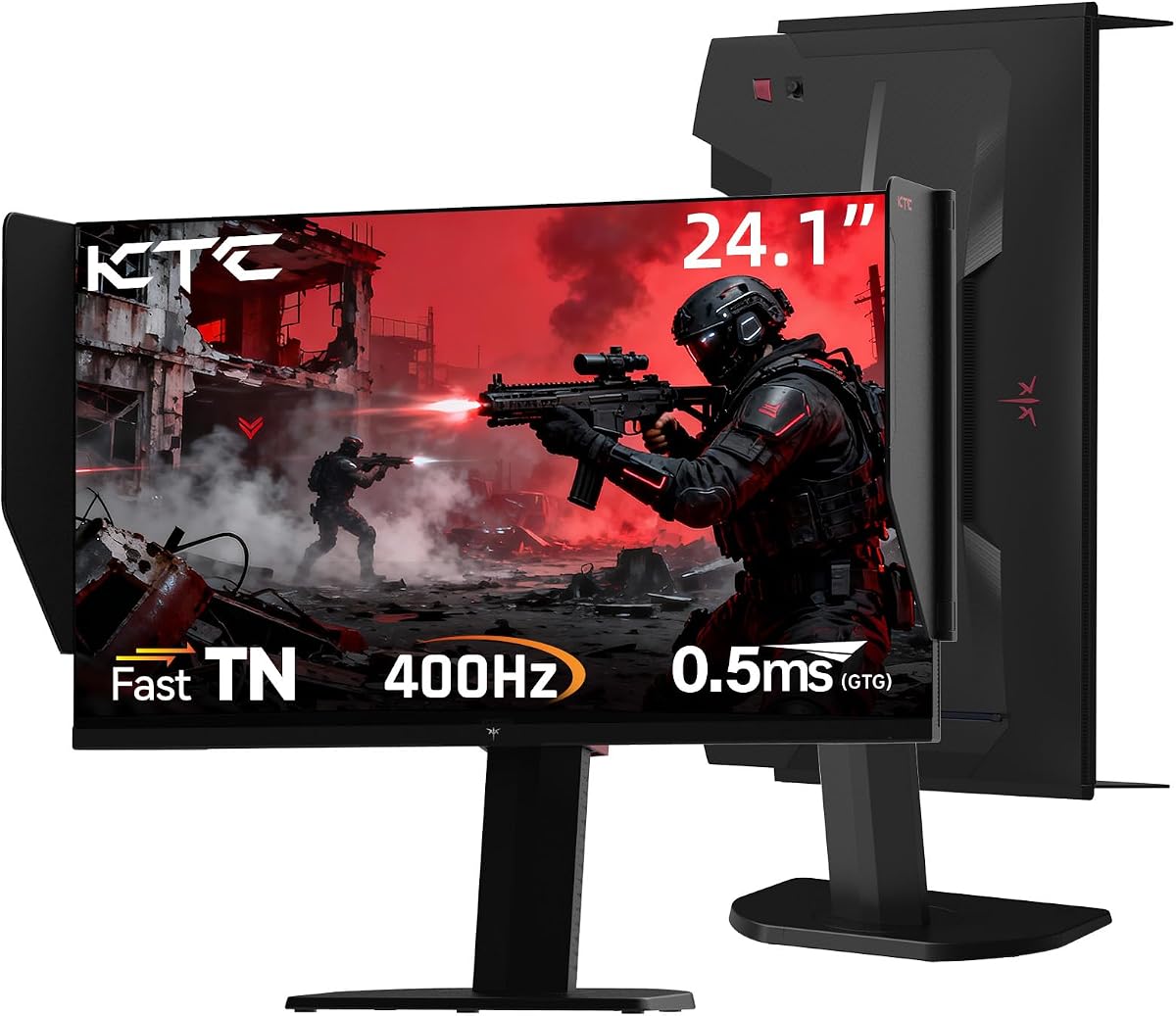
The KTC 25M1 stands out with an extraordinary 400Hz refresh rate on a 24.1-inch Fast TN panel, paired with a 0.5ms GTG response time. Its supplied rating is 4.3, and its feature set clearly targets competitive players who want the highest possible refresh rate and rapid motion handling.
We may earn a commission when you buy through this link, at no additional cost to you.
DisplayPort 1.4 supports the monitor's 400Hz mode, while HDMI 2.0 supports up to 240Hz, giving users options when connecting different systems. Adaptive sync, a 125% sRGB gamut, 1000:1 contrast, 8-bit color, and 350cd/m² brightness form a practical foundation for fast titles such as Valorant, CS2, and Overwatch.
The 24.1-inch Full HD format is the main trade-off. It cannot match the detail of the QHD OLED and IPS options, and the quoted color figures are less ambitious than the DCI-P3 and Pantone-focused displays elsewhere in the list. The included shielding hood is distinctive, though, with flocking on the inner bezel intended to absorb light and reduce frame reflections.
This monitor is best for competitively minded players with hardware capable of taking advantage of 400Hz, particularly those who accept Full HD in exchange for maximum refresh capability. Its extensive adjustment range, external gaming-mode controller, and VESA 100 x 100 compatibility also make it adaptable to different desks and mounting arrangements.
The 400Hz Fast TN panel is the defining feature of this monitor. A 0.5ms GTG response and adaptive sync reinforce its emphasis on rapid visual updates in demanding competitive games.
The shielding hood can reduce unwanted light around the screen, while the external controller provides quick access to gaming modes. Height, tilt, swivel, pivot, and VESA support make positioning straightforward.
We may earn a commission when you buy through this link, at no additional cost to you.
The LG UltraGear 27GX704A-B combines a glossy 27-inch QHD OLED panel, 240Hz refresh rate, and 0.03ms response time. Its 4.5 rating and extensive connectivity make it an attractive high-speed option for Valorant players who want a modern PC setup with room for multiple devices.
We may earn a commission when you buy through this link, at no additional cost to you.
The supplied brightness figures range from 275 nits to a peak of 1300 nits, while the 1.5M:1 contrast ratio and up to 98.5% DCI-P3 coverage support vivid scenes and deep blacks. NVIDIA G-SYNC Compatible and AMD FreeSync Premium Pro provide broad adaptive-sync options, and a three-pole headphone jack is included for convenient private audio.
Dual HDMI 2.1, DisplayPort 1.4, a USB 3.2 upstream connection, and two USB 3.2 downstream ports distinguish this model from many gaming monitors. The glossy finish may show reflections in a bright room, however. Automatic pixel-care cycles, brightness controls, and OLED protection settings are included through the On-Screen Control interface.
This monitor is best for a player who wants fast QHD OLED performance, broad synchronization support, and a comprehensive set of connections. It is also well suited to users who alternate between a gaming PC and console, provided their devices support the available connection modes. The feature set makes it a strong premium all-rounder.
Two HDMI 2.1 ports, DisplayPort 1.4, and USB connectivity simplify a multi-device desk. The upstream and downstream USB ports can support peripherals while the headphone jack provides a direct audio connection.
Up to 1300-nit peak brightness, a 1.5M:1 contrast ratio, and up to 98.5% DCI-P3 coverage give Valorant scenes bright highlights and detailed shadows. Adjustable height, tilt, swivel, and pivot improve the physical setup.
We may earn a commission when you buy through this link, at no additional cost to you.
The AOC Q27GAZD is a 27-inch QHD QD-OLED gaming monitor with a 240Hz refresh rate and 0.03ms GtG response time. Its 4.4 rating and competitive specifications position it as a focused option for Valorant players who value the motion characteristics of OLED without moving to an oversized display.
We may earn a commission when you buy through this link, at no additional cost to you.
Quantum Dot OLED technology is specified to cover 147.6% of sRGB and 110.2% of DCI-P3, providing a broad color range for saturated game visuals. HDR400 True Black certification improves contrast between highlights and shadows, while adaptive-sync compatibility helps reduce tearing and stuttering with compatible graphics hardware.
The 27-inch size is easier to accommodate than a 32-inch model, making this a practical choice for a dedicated gaming desk. Its supplied feature list focuses on the display rather than stand adjustment, rich ports, or built-in audio, so buyers who prioritize those conveniences should verify the physical configuration carefully. As with other OLED panels, sensible image settings and varied content are important for long-term use.
The Q27GAZD is best for a gamer who wants a compact, high-refresh QHD OLED display with rich color. It offers the core qualities competitive players seek—fast response, a high refresh rate, strong contrast, and adaptive sync—in a conventional 27-inch format.
A 0.03ms GtG response and 240Hz refresh rate create a strong foundation for tracking small, fast-moving targets. Adaptive sync helps maintain fluid presentation when the system and game frame rates fluctuate.
The QD-OLED panel's wide sRGB and DCI-P3 coverage benefits colorful agents and map environments. HDR400 True Black certification adds deeper contrast, while the 27-inch format remains convenient for many gaming spaces.
We may earn a commission when you buy through this link, at no additional cost to you.
The AOC Q27G41ZE delivers a 27-inch QHD IPS panel, an overclocked 260Hz refresh rate, and a supplied rating of 4.6. That combination makes it a particularly compelling competitive option for Valorant players who want more detail than Full HD without moving into premium OLED pricing.
We may earn a commission when you buy through this link, at no additional cost to you.
The 240Hz native mode and 260Hz overclocked mode can make the display more future-facing when the connected PC can drive the additional headroom. Its 0.3ms MPRT response supports fast motion clarity, while adaptive sync is listed for both AMD and NVIDIA GPUs. The supplied feature set also identifies NVIDIA G-SYNC support, giving competitive users more than one synchronization route.
Shadow Control and Game Mode presets are useful for tuning different game scenes, while a graphical OSD supports direct control. A 300-nit brightness level, 1000:1 contrast ratio, DisplayPort 1.4, dual HDMI 2.0 ports, and audio output cover everyday connectivity. The listed ergonomic adjustment is limited to tilt, so users wanting height, pivot, or swivel may need to check the supplied stand carefully.
This is the best value-oriented QHD pick for a competitive Valorant setup. It is suited to players who value refresh rate, resolution, and G-SYNC support more than OLED-level contrast or a wide port selection. It also provides a useful middle ground between the compact Full HD models and the more elaborate premium OLED displays.
The overclocked 260Hz mode provides additional headroom for high-frame-rate PCs, while the 240Hz mode serves as the standard high-speed configuration. A 0.3ms MPRT figure emphasizes the monitor's motion-focused design.
Shadow Control can improve visibility in darker scenes without forcing users to alter global brightness. Game Mode presets and a graphical OSD simplify common adjustments, and the frameless three-sided design gives the 27-inch panel a modern appearance.
We may earn a commission when you buy through this link, at no additional cost to you.
The ASUS TUF Gaming VG27AQM5A combines a 27-inch QHD Fast IPS panel with a 300Hz refresh rate, 0.3ms minimum response time, and a 4.4 rating. It is one of the strongest speed-focused IPS options here and offers a balanced feature set for competitive Valorant players.
We may earn a commission when you buy through this link, at no additional cost to you.
At 2560 x 1440, the monitor provides more visible detail than a Full HD panel while its 300Hz refresh rate is among the fastest listed here. ASUS Extreme Low Motion Blur Sync enables ELMB and variable refresh rate technologies to work together, and G-SYNC support is included for compatible NVIDIA systems. These features target clarity and fluid motion during quick turns and sustained firefights.
Shadow Boost brightens dark areas without overexposing bright regions, making it useful for revealing subtle environmental details. The 95% DCI-P3 gamut is suitable for vivid game imagery, and DisplayWidget Center allows settings changes through a mouse. Integrated speakers add basic audio convenience, while the three-year manufacturer warranty supports long-term ownership.
The VG27AQM5A is best for a player who wants a very high refresh rate, QHD detail, and an IPS panel without moving to OLED. It may be particularly useful for competitive users who value ELMB Sync, G-SYNC, and dark-scene visibility. Those seeking maximum contrast should still consider one of the OLED options, but this is a well-balanced competitive choice.
A 300Hz refresh rate and 0.3ms minimum response make this monitor particularly suitable for competitive games. ELMB Sync combines motion blur reduction with variable refresh rate for a clearer presentation.
Shadow Boost is designed to reveal detail in darker portions of Valorant maps without over-brightening the rest of the image. The 95% DCI-P3 coverage and QHD resolution support a colorful, detailed view.
We may earn a commission when you buy through this link, at no additional cost to you.
Choosing a Valorant monitor involves balancing competitive speed, readable detail, image quality, and the practical features of your desk setup. The most important specifications depend on the power of your PC, the size of your room, and whether you prioritize tournament-style clarity or an immersive presentation.
Refresh rate determines how many times the display updates each second, while frame pacing describes how consistently those frames are presented. A higher refresh rate can make camera movement and target tracking appear smoother, but its benefits are most visible when the PC and game can actually generate enough frames. The list includes 165Hz, 240Hz, 260Hz overclocked, 300Hz, 360Hz, and 400Hz options, creating choices for different system capabilities and competitive ambitions.
Prioritize a refresh rate your computer can sustain consistently. A lower frame rate on a very fast display will not create the smooth result the specification suggests, so hardware performance and in-game settings remain essential.
Fast pixel response helps characters, weapon indicators, and projectiles remain distinct as you turn or strafe. The monitors here provide figures ranging from 0.03ms on several OLED models to 0.3ms minimum response on Fast IPS displays and 0.5ms GTG on the KTC's Fast TN panel. These measurements are not always directly comparable because some use GtG, gray-to-gray, or MPRT methods, but lower advertised values generally point toward a motion-focused design.
Look for response specifications and related motion features together. ELMB Sync, OLED anti-flicker technology, and adaptive sync can complement a fast native response, while measurement terminology should be compared carefully.
Full HD monitors at 1920 x 1080 place a comparatively large image on a smaller screen and remain common in competitive gaming. QHD at 2560 x 1440 reveals more of Valorant's environment, making map details and distant character outlines easier to inspect. Several of the strongest high-refresh options in this guide are QHD, but they generally require a more capable PC to combine high resolution and high frame rates.
Choose QHD when visual detail matters and your hardware can maintain competitive frame rates. Choose Full HD when your priority is maximum refresh potential, lower system demands, or a more compact and often more accessible competitive setup.
Adaptive sync aligns the display refresh with the frame rate produced by the graphics card, reducing tearing and helping maintain smoothness when frame rates fluctuate. Options in this list include G-SYNC Compatible, G-SYNC, FreeSync, FreeSync Premium, and FreeSync Premium Pro. Compatibility depends on the graphics card, driver, game, and selected mode, so the monitor label alone does not guarantee identical results across every system.
Check your GPU and the monitor's supported synchronization range before purchasing. The AOC Q27G41ZE offers broad AMD and NVIDIA support, while several ASUS and Samsung models provide clear FreeSync or G-SYNC-oriented options.
OLED panels deliver deep blacks, strong contrast, quick pixel response, and vivid color, making them attractive for visually detailed competitive games. They also require more attention to static interface elements and long-term image retention than a conventional IPS or TN panel. ASUS models in this list include OLED Care, OLED Care Pro, OLED Care+, and related protection functions, while Samsung's G6 uses OLED Safeguard thermal modulation.
OLED is worth considering when picture quality matters alongside speed. Use the supplied protection features, avoid displaying static content unnecessarily, and follow the manufacturer's guidance for brightness and image care.
Valorant uses a stylized art direction that benefits from saturated colors, distinct team outlines, and controlled shadow detail. The gamut figures in this guide range from 99% sRGB on the ASUS TUF VG249QML5A to broad DCI-P3 coverage on several OLED and QHD models. DisplayHDR 400 True Black, HDR10, Delta E below 2, and Pantone validation add useful context, but certification and gamut coverage do not automatically guarantee a neutral image for every user.
Prioritize strong color coverage when visual presentation is a major concern. Players who mainly need competitive clarity can focus more on refresh rate, response, and adaptive sync.
Screen size changes both the amount of the game visible and the physical desk space required. A 23.8-inch or 24.1-inch model often feels compact and can make HUD elements easy to read, while a 27-inch QHD display offers a balanced combination of detail and footprint. The 32-inch Samsung Odyssey G55C expands the view further and adds a 1000R curve, potentially improving peripheral immersion but taking up more room.
Choose the size and shape that suit your desk, viewing distance, and preference. A large curved screen is not automatically better for competitive play, so consider comfort and consistency rather than physical size alone.
A dependable connection and a comfortable viewing position matter during long sessions. DisplayPort is the preferred choice for many high-refresh PC configurations, while HDMI 2.1 can be useful for compatible consoles. The LG UltraGear adds USB upstream and downstream ports and a headphone jack, and the AOC Q27G41ZE includes DisplayPort, dual HDMI, and audio output. Adjustable height, tilt, swivel, and pivot are more consistently documented on several ASUS, Samsung, LG, and KTC models.
Measure the available space and check the supplied stand details before ordering. If you use a monitor arm, verify VESA compatibility, and make sure the graphics card can drive the intended resolution and refresh rate through the selected port.
After installation, connect the computer through the port best suited to the graphics card and target resolution. For high-refresh PC use, DisplayPort is generally the most straightforward option, especially when the advertised maximum refresh rate is available only through that connection. Update the graphics driver, select the correct input source, and use the monitor's OSD or control software to confirm that the intended refresh rate is active.
Inside Valorant, set the display mode to match the physical screen rather than forcing an unsupported resolution. Players should also use an appropriate graphics preset, avoid unnecessary frame-rate caps, and test the available adaptive-sync range with the connected GPU. If motion looks inconsistent, verify that variable refresh rate is correctly configured before changing the game's in-game settings again.
For OLED models, use the available OLED care, automatic pixel-cycle, or thermal-modulation features and follow the manufacturer's brightness and image-care guidance. For IPS, TN, and Fast IPS models, keep the operating system and game color settings consistent to avoid an unexpectedly bright or washed-out image. Periodically cleaning the screen with a soft cloth and checking cable connections and stand adjustments also helps maintain a stable setup.
A 240Hz monitor can present more frames per second and generally appears smoother during rapid camera movement than a 165Hz model. The difference is most convincing when the PC consistently produces frame rates near the higher display limit. A 165Hz monitor can still deliver an excellent competitive experience, particularly when it offers good response times, adaptive sync, and a resolution that the system can drive confidently.
No. Fast IPS and TN panels can provide the high refresh rates, low response times, and adaptive synchronization needed for competitive Valorant. OLED models add deep blacks, strong contrast, wide color, and very fast pixel response, making them attractive for both competitive and visual quality, but they are not required for the game to feel responsive.
QHD provides more visible map and character detail than Full HD, which can make it easier to identify small environmental features. The trade-off is greater GPU demand. If your PC cannot maintain a smooth frame rate at 2560 x 1440, a capable Full HD monitor may produce a better competitive experience than a QHD panel running below the desired frame rate.
Enable the adaptive-sync mode supported by your monitor and graphics card if your frame rate varies. It can reduce tearing and improve smoothness, particularly near the display's refresh limit. You should update the graphics driver, use a supported frame-rate range, and disable any conflicting in-game frame cap that prevents the adaptive-sync feature from operating as intended.
A low response time helps moving objects remain distinct with less visible blur. Figures in this guide range from 0.03ms to 0.3ms minimum response, 0.5ms GTG, and 1ms MPRT, but these labels are not perfectly comparable. Treat them as part of the overall feature set and consider refresh rate, adaptive sync, and the panel technology alongside the response number.
Screen size does not alter the game's rules or mechanically improve aim, but it can affect how easily you locate targets and read HUD information. Smaller monitors often feel direct and focused, while 27-inch and 32-inch displays provide a larger visual field. Choose the size and curvature that fit your desk and remain comfortable during long sessions.
Use the OLED protection functions supplied with the monitor, such as OLED Care, OLED Care+, automatic pixel-care cycles, or Samsung's OLED Safeguard thermal modulation. Avoid leaving static images onscreen for extended periods, keep brightness within the manufacturer's guidance, and vary the content displayed during long breaks. No protection system makes OLED retention impossible, but proper use reduces avoidable risk.
A 400Hz monitor can offer the highest refresh ceiling in this guide and may benefit players with hardware capable of producing very high frame rates. However, the practical improvement depends on the computer, game settings, and the player's ability to perceive differences in motion. A well-matched 240Hz or 300Hz display can still deliver an excellent competitive experience.
The ASUS ROG XG27AQDMGR is the strongest overall recommendation because it combines QHD detail, a 240Hz refresh rate, 0.03ms response, wide color, and thoughtful OLED protection. The ASUS ROG Strix XG27ACDNG is the premium option for maximum speed, while the ASUS TUF VG249QML5A delivers the essentials of competitive play at Full HD with a 240Hz panel.
Prioritize the specification that most directly affects your experience: use a high refresh rate when the PC can drive it, favor low response times and adaptive sync for competitive clarity, and choose QHD when more environmental detail is worthwhile. OLED buyers should also account for image care, while players on smaller desks may prefer the more compact 24-inch options.
Before making a final purchase, verify current specifications, port configuration, graphics-card support, and availability directly with the retailer. Prices and promotions can change, so compare the current cost against the features that matter most rather than assuming the highest refresh rate or premium panel is automatically the right choice for every player.