
TP-Link TL-SG105
4.7Editor score
Five Gigabit Ethernet ports
Fanless metal construction
Plug-and-play operation
This expert guide compares the 10 best network switch for Xfinity options, covering port counts, speeds, PoE, management, and home network fit for 2026 buyers.
A network switch can give an Xfinity-connected home more wired capacity without requiring a complicated networking setup. The right model should fit the number of devices, available space, and the speeds used by computers, televisions, game consoles, access points, and storage equipment. Port count and link speed are only the starting points.
This guide compares ten switches based on the supplied specifications, including Gigabit and Multi-Gigabit performance, PoE capability, management features, physical design, energy efficiency, and installation requirements. The list covers straightforward unmanaged models, managed options, compact five-port units, and larger switches intended for demanding networks.
Each selection highlights the scenario in which that model makes the most sense, along with its important limitations. Ratings reflect the published product data rather than individual hands-on testing, and product availability, features, and pricing can change. Readers should confirm the current listing before making a final purchase.
4.7Editor score

4.7Editor score

4.8Editor score
This side-by-side comparison evaluates each switch by port capacity, link speed, PoE support, management level, physical design, and the type of Xfinity-connected home or small office it best serves.



The TP-Link TL-SG105 is a straightforward five-port Gigabit unmanaged switch with a 4.7 published rating. It is a strong general recommendation for an Xfinity home that needs a small number of reliable Ethernet connections without advanced configuration. Its combination of auto-negotiation, auto MDI/MDIX support, shielded ports, and a fanless metal enclosure makes it particularly easy to place in a home office, entertainment center, or utility area.
We may earn a commission when you buy through this link, at no additional cost to you.
All five RJ45 ports support 10, 100, and 1000Mbps speeds, allowing the switch to work with ordinary Gigabit devices while taking advantage of faster links whenever available. IEEE 802.3X flow control supports reliable transfer, while port-based 802.1p/DSCP QoS and IGMP Snooping add practical traffic handling for voice, video, and multicast traffic. Setup requires neither software installation nor configuration, so it can be connected directly to an Xfinity gateway or compatible router.
The main limitation is capacity. Five ports leave little room for expansion, and there is no PoE support for an access point, camera, or other powered network device. It also cannot provide 2.5G, 5G, or 10G links, making the TL-SG105 more appropriate for conventional Gigabit networks than modern Multi-Gig installations.
This is the most straightforward choice for someone who wants to expand a basic wired network around an Xfinity connection. It suits desktops, televisions, consoles, printers, and other Ethernet devices, while the small enclosure is easy to position. Buyers who need more ports should consider the TL-SG108; buyers with 2.5G equipment should look toward a Multi-Gig model.
The TL-SG105 turns a single upstream connection into several wired links without introducing a complex routing interface. It is especially useful for connecting a gaming PC, streaming television, printer, and desktop to an Xfinity gateway or router while keeping each device on a full Gigabit connection.
Its fanless metal design supports quiet operation and durable placement. The shielded ports and desktop or wall-mounting options make it adaptable to a living room, home office, or network cabinet without requiring a noisy fan.
We may earn a commission when you buy through this link, at no additional cost to you.
The TP-Link TL-SG108 provides eight Gigabit Ethernet ports in a simple unmanaged format and carries a 4.7 published rating. It is a natural fit for an Xfinity household that has outgrown a five-port switch but does not need PoE or 2.5G links. The device connects computers, printers, gaming consoles, and other Ethernet-enabled equipment with minimal setup.
We may earn a commission when you buy through this link, at no additional cost to you.
Every port supports 10, 100, and 1000Mbps, and the switch requires no configuration, software, or installation. Its durable metal housing, shielded ports, and fanless design offer a practical combination for a home office, bedroom, conference room, or other noise-sensitive location. IEEE 802.3x flow control and traffic optimization are intended to maintain smooth data transfer as the network is used.
The switch automatically adjusts power consumption according to link status and cable length. That efficiency is useful for a model that may remain powered around the clock, although operating cost should always be considered separately from product pricing. It does not offer a web interface, VLAN controls, or PoE, so buyers needing those features need a more specialized model.
Choose the TL-SG108 when eight ordinary Gigabit connections are the priority and straightforward operation matters more than advanced controls. It is particularly effective for expanding an Xfinity network across several rooms, provided each connected device can operate over standard Gigabit Ethernet.
The eight-port layout offers room to connect numerous household devices while retaining the simplicity of an unmanaged switch. It is a good match for users who want dependable Ethernet expansion without learning VLAN, monitoring, or traffic-control settings.
Power use adjusts in response to link status and cable length. This automatic behavior makes the switch practical for continuous use, especially when some connected devices are inactive for substantial periods.
We may earn a commission when you buy through this link, at no additional cost to you.
The TP-Link TL-SG105S-M2 combines five 2.5G ports with a 4.7 published rating, making it the most compact Multi-Gig option in this guide. It is an excellent match for an Xfinity-connected home that wants room for high-speed workstations, a 2.5G NAS, a 2.5G Wi-Fi 6 access point, or other equipment that can benefit from more than Gigabit Ethernet.
We may earn a commission when you buy through this link, at no additional cost to you.
Its five 2.5-Gigabit ports provide up to 25Gbps of switching capacity, while auto-negotiation detects whether each connected device uses 100Mbps, 1Gbps, or 2.5Gbps. That flexibility allows ordinary Gigabit equipment and newer Multi-Gig devices to coexist without requiring separate adapters. The product is positioned for home entertainment, small offices, LAN parties, and fast workstation transfers.
The trade-off is that the TL-SG105S-M2 remains unmanaged and does not include PoE. Its five-port capacity may also become restrictive as more equipment is added. For a larger installation, buyers can consider the eight-port TL-SG108S-M2, while a managed PoE model is better when cameras or access points need centralized power.
This is the top choice for a compact, future-oriented Xfinity network where 2.5G compatibility is more important than having many ports. It offers a balanced path from ordinary Gigabit connections to faster local networking without adding a complicated interface.
The switch accepts three link speeds automatically, so a new 2.5G computer can operate at full speed while an older printer or television connects at a compatible rate. This makes it useful for mixed-device homes rather than installations where every endpoint is identical.
Its listed dimensions and fanless metal construction suit a desktop, entertainment center, or wall-mounted location. Quiet operation also helps it blend into a home office, LAN-party space, or compact home-office setup.
We may earn a commission when you buy through this link, at no additional cost to you.
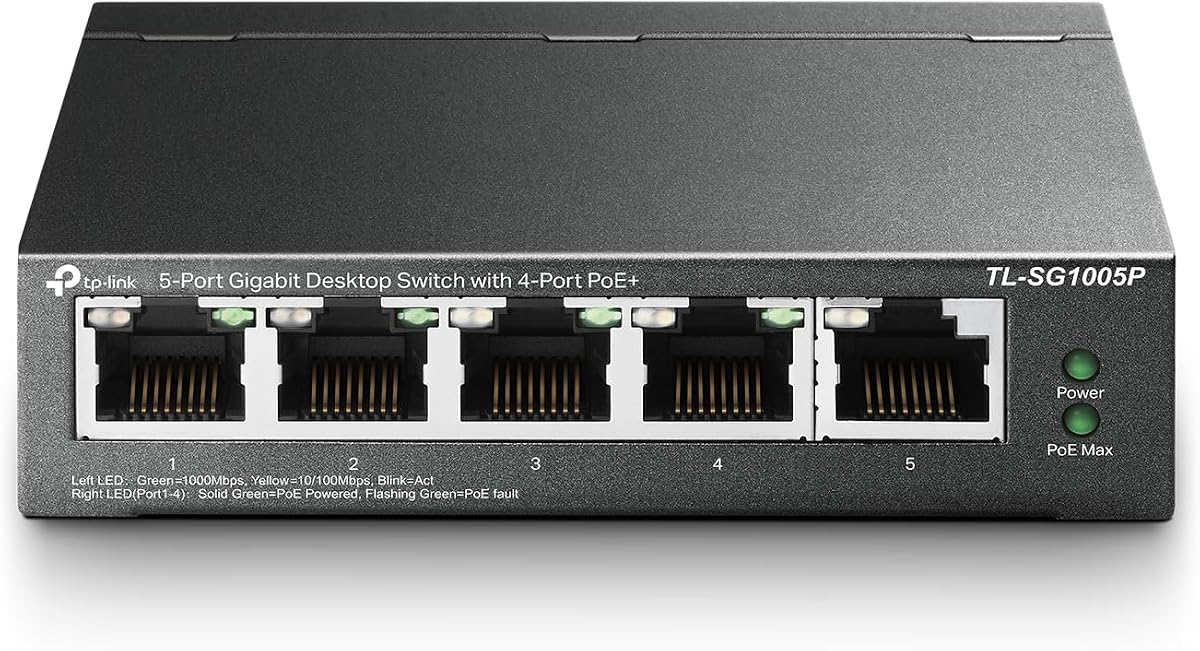
The TP-Link TL-SG1005P is a five-port Gigabit switch with four PoE+ ports, a 65W total PoE budget, and a 4.7 published rating. It is a strong option for an Xfinity home or small office that needs to power access points, IP cameras, VoIP phones, or other compatible PoE devices without placing a power adapter at every endpoint.
We may earn a commission when you buy through this link, at no additional cost to you.
Four ports provide 10/100/1000Mbps connectivity with up to 30W per port, while the fifth port is a non-PoE Gigabit connection. This arrangement works well when one uplink goes to the Xfinity gateway or router and the remaining ports serve powered equipment. Installation is plug-and-play, and port-based 802.1p/DSCP QoS plus IGMP Snooping support traffic management.
The principal limitation is the unmanaged design. Users cannot configure VLANs, monitor individual ports through a management interface, or apply the broader controls found in a managed switch. There are also only four PoE-capable ports, so a growing camera or access-point installation may quickly require a larger model.
Buyers should choose the TL-SG1005P when compact PoE distribution is the central goal. Its metal case, shielded ports, fanless design, and desktop or wall-mounting options make it a tidy solution for a home network cabinet, small office, or surveillance installation connected to an Xfinity service.
Four PoE+ ports can deliver up to 30W each, allowing compatible network hardware to receive both data and power through one cable. That can simplify installations where running local power is inconvenient or visually undesirable.
The fifth Gigabit port does not provide PoE but serves as a normal wired connection to a router, gateway, or computer. It can preserve the PoE budget for devices that genuinely need centralized power.
We may earn a commission when you buy through this link, at no additional cost to you.
The TP-Link TL-SG108S-M2 is an eight-port 2.5G unmanaged switch with a 4.8 published rating, the highest rating among the products in this guide. It is a strong all-around recommendation for an Xfinity-connected home that needs several wired connections and the option to use faster-than-Gigabit local links.
We may earn a commission when you buy through this link, at no additional cost to you.
All eight ports provide Multi-Gig performance, with auto-negotiation across 100Mbps, 1Gbps, and 2.5Gbps. The switch offers up to 40Gbps of switching capacity, giving it enough aggregate headroom for demanding combinations of computers, storage devices, servers, and a 2.5G Wi-Fi 6 access point. It is also suitable for home entertainment, small offices, and workstation transfer tasks.
As an unmanaged model, it focuses on plug-and-play operation rather than VLANs, traffic analytics, or detailed port controls. It also lacks PoE, so cameras and access points requiring Ethernet power need an alternative. Users should distinguish local switching performance from the internet speed delivered by their Xfinity plan, since a faster switch cannot independently raise the available WAN connection.
This switch earns a recommendation for buyers who want more ports than the five-port Multi-Gig model and do not need managed features. Its combination of 2.5G flexibility, quiet operation, and an eight-port layout makes it particularly effective for a modern home with several mixed-speed wired endpoints.
Eight ports provide enough capacity for multiple entertainment devices, office computers, and high-speed network storage. This makes the switch useful for consolidating numerous wired endpoints around one Xfinity gateway or router.
The 40Gbps switching capacity and 2.5G ports support demanding local transfers and mixed high-speed equipment. Auto-negotiation ensures slower devices can connect without requiring a different switch for basic Gigabit traffic.
We may earn a commission when you buy through this link, at no additional cost to you.
The TP-Link TL-SG116 is a 16-port Gigabit unmanaged switch with a 4.7 published rating. It is aimed at larger Xfinity-connected homes, shared offices, or equipment rooms where many ordinary Ethernet connections need to terminate in one compact device. Its generous port count reduces the need for multiple smaller switches.
We may earn a commission when you buy through this link, at no additional cost to you.
Every port supports 10, 100, and 1000Mbps with auto-negotiation and auto MDI/MDIX. Setup is plug-and-play, while IEEE 802.3X flow control, port-based 802.1p/DSCP QoS, and IGMP Snooping help maintain efficient transfers. The fanless metal case is designed for desktop or wall-mounting and has a listed operating range from 32 to 104 degrees Fahrenheit.
The tradeoff is that all connections are limited to Gigabit speed. There is no 2.5G option, PoE support, or managed interface. For a typical household with only a few wired devices, sixteen ports may be unnecessary, but the capacity becomes valuable in a larger building, shared workspace, or a home with extensive cameras and access points requiring separate wired connections.
The TL-SG116 is best for buyers who prioritize port density and simple Gigabit expansion over advanced controls or Multi-Gig performance. It is particularly useful in a central wiring location where one device can provide many downstream links to an Xfinity-connected network.
Sixteen ports allow many devices to share a single network point without daisy-chaining several compact switches. That can simplify cabling and make a larger home or shared office easier to organize.
The fanless enclosure is appropriate for a wiring closet, media area, or office where continuous background noise would be unwelcome. Wall-mounting support also helps keep cables and hardware neatly positioned.
We may earn a commission when you buy through this link, at no additional cost to you.
The Ubiquiti 8-Port PoE Switch is a Layer 2 PoE switch with a 4.6 published rating. It is a specialized option for an Xfinity-connected home or small business that already values Ubiquiti network equipment and wants to connect several PoE devices through a quiet, centralized switch.
We may earn a commission when you buy through this link, at no additional cost to you.
The supplied specifications highlight eight PoE ports, fanless cooling, and an external 60W adapter that provides 52W of total PoE capacity. Layer 2 operation makes the device relevant to users who want basic local switching and are comfortable managing network design themselves. Silent cooling is useful in a home office or living area where a fan would be unwelcome.
The available data does not state individual link speeds, uplink details, VLAN capabilities, or whether the eight ports are all configurable PoE ports. As a result, buyers must verify the complete current specification before assuming it can replace a particular Gigabit or Multi-Gig switch. Its PoE budget is also lower than the stated budgets of two competing eight-port PoE models in this roundup.
This switch is most appropriate for an existing Ubiquiti-oriented setup that can benefit from a compact Layer 2 PoE device. It is less certain as a universal recommendation for a new Xfinity network where full-speed Ethernet, detailed port specifications, and a managed interface are the main requirements.
The switch combines PoE delivery with fanless cooling, which makes it suitable for discreet placement near compatible access points, cameras, or other powered equipment. Centralized cabling can make maintenance easier.
Layer 2 switching is appropriate for local traffic delivery and network segmentation when supported by the broader platform. Buyers should verify current configuration options and device compatibility with the rest of their network.
We may earn a commission when you buy through this link, at no additional cost to you.
The NETGEAR GS308EP is an eight-port Gigabit Easy Smart Managed switch with a 4.8 published rating. It stands out as the most capable managed option in this group, combining eight PoE+ ports with VLANs, QoS, port monitoring, and network-security configuration. It is well suited to an Xfinity-connected small business or a sophisticated home network.
We may earn a commission when you buy through this link, at no additional cost to you.
All eight Ethernet ports provide 1Gbps connectivity and use auto-negotiation with existing Cat5e or Cat6 cabling. The switch supplies a 62W total PoE budget, supports uninterrupted PoE, and includes per-port PoE controls. Its software interface expands on basic plug-and-play switching by allowing VLAN assignment, traffic prioritization, monitoring, and security management.
The main limitation is speed: every port is Gigabit rather than 2.5G. It also cannot match the 65W PoE budget of the TP-Link TL-SG1005P, though the NETGEAR offers substantially broader management. Buyers with 2.5G NAS storage or other Multi-Gig endpoints should prioritize a faster unmanaged or lite-managed alternative instead.
Choose the GS308EP when centralized PoE and basic network segmentation are more important than maximum per-port speed. It is a particularly compelling fit for a home office, small storefront, or other setting where administrators want control over traffic and connected endpoints without moving to a fully enterprise-oriented platform.
VLAN support, QoS, port monitoring, and security tools add value in environments where departments, cameras, guest devices, or office equipment should not all share identical network behavior.
Per-port PoE controls allow power delivery to be adjusted, while uninterrupted PoE is useful for maintaining operation around network power changes. The 62W aggregate budget can support a defined group of compatible devices.
We may earn a commission when you buy through this link, at no additional cost to you.
The D-Link 5-Port 2.5G Switch is a feature-rich unmanaged Multi-Gig model with a 4.7 published rating. It is a strong alternative for an Xfinity home that wants five 2.5G connections and more explicit traffic-handling features than a basic unmanaged switch typically provides.
We may earn a commission when you buy through this link, at no additional cost to you.
The five ports provide 2.5-Gigabit connectivity and up to 25Gbps of switching capacity. Auto-negotiation supports 100Mbps, 1Gbps, and 2.5Gbps devices, making the switch suitable for a mixed installation with a 2.5G Wi-Fi 6 access point, NAS, PCIe adapter, server, gaming computer, or high-resolution display. The listed use cases also include 8K video and IPTV.
QoS can classify traffic into eight priority levels, while flow control is intended to reduce packet loss and IGMP Snooping optimizes multicast streams. These features are particularly relevant to networks carrying video, voice, and other bandwidth-intensive traffic. The switch also uses a fanless metal housing, Energy Efficient Ethernet, per-port status indicators, and supports existing Cat5 and Cat6 cables.
This D-Link is ideal for a media room, gaming setup, or small office that benefits from 2.5G without PoE. Its five-port limit may be restrictive in a growing home, and the lack of a management interface means it cannot provide the same VLAN and monitoring controls as the NETGEAR GS308EP.
Eight QoS levels make it possible to classify important network traffic, which can be useful when streaming or gaming shares a local network with file transfers and other activity. Flow control further supports reliable delivery.
The combination of 2.5G connectivity, 25Gbps switching capacity, and Energy Efficient Ethernet provides a useful balance of performance and efficiency. Backward compatibility allows Cat5 and Cat6 cabling to be reused.
We may earn a commission when you buy through this link, at no additional cost to you.
The QNAP QSW-L3208-2C6T-US is a Multi-Gig 10GbE network switch with a 4.0 published rating. It is the most advanced and specialized selection here, aimed at Xfinity-connected power users, creators, and small organizations that need faster local links and more network control than an unmanaged switch provides.
We may earn a commission when you buy through this link, at no additional cost to you.
Six RJ45 ports support 10G, 5G, 2.5G, 1G, and 100M, while two combo SFP+/RJ45 ports allow fiber or copper connections. The switch provides 160Gbps of switching capacity and 80Gbps of non-blocking throughput. Its 12K jumbo-frame support is useful for large transfers and smooth media streaming on properly configured networks.
Lite-managed features include VLAN, QoS, LACP, IGMP Snooping, and loop detection, giving administrators useful segmentation and traffic controls. The compact metal design uses smart cooling and has a stated power consumption of 36W. The drawback is that this level of hardware can be excessive for a basic home, and its 4.0 rating is the lowest among the listed products.
The QNAP makes the most sense when the local network must handle sustained high-speed storage, workstation collaboration, media production, or multiple advanced endpoints. For typical Xfinity internet use alone, a Gigabit or 2.5G model will usually offer a simpler and more economical path.
Six flexible 10GbE RJ45 ports work with multiple supported link rates, and the two combo SFP+/RJ45 ports expand deployment options. This makes the switch adaptable to existing cabling and future high-bandwidth links.
VLANs, LACP, QoS, IGMP Snooping, and loop detection provide useful controls for a structured home or office network. Jumbo frames can improve efficiency for large local transfers when end-to-end support is present.
We may earn a commission when you buy through this link, at no additional cost to you.
The right network switch depends on how many wired devices you own, which speeds those devices support, whether they need PoE, and how much configuration control your home or office requires.
Begin by listing the computers, televisions, consoles, printers, game systems, storage devices, and access points that need a wired Ethernet link. Count the upstream connection to the Xfinity gateway or router as one required port, then add the downstream connections. A five-port model is appropriate for a compact setup, while eight or sixteen ports offer more room for expansion.
Choose a port count that meets current needs without leaving too many links idle. Also remember that some switches use one port as an uplink and provide PoE on the remaining ports. Leaving a small amount of spare capacity is sensible, but excessive port count adds size and may exceed the requirements of a simple home network.
A Gigabit switch supports links up to 1Gbps and is ideal for most internet access, streaming, and office use. Multi-Gig switches add 2.5G links for compatible Wi-Fi 6 access points, NAS systems, servers, and modern computers. The advanced QNAP selection goes further with 10GbE, a level that is generally most relevant to specialized local workflows.
The local switch speed is separate from the internet speed available through an Xfinity plan. A faster switch can improve transfers among devices on the same network, but it cannot increase the download or upload rate delivered by the service provider. Match the hardware to the fastest endpoint that genuinely needs the bandwidth.
Power over Ethernet delivers electrical power and network data through the same cable. It can simplify deployments involving IP cameras, compatible wireless access points, VoIP phones, and other PoE devices. A switch with four PoE+ ports may cover a small home, while eight PoE ports provide greater flexibility for a larger installation.
Check the standard, per-port power allowance, and total PoE budget before buying. A device that advertises PoE may provide less usable capacity than expected. If every endpoint already has nearby power and the installation is temporary, a non-PoE switch can be simpler. PoE also requires compatible cabling and appropriate power-supply support.
Unmanaged switches operate without meaningful configuration and are well suited to straightforward home expansion. Easy Smart Managed and Lite-Managed models add functions such as VLANs, QoS, port monitoring, link aggregation, or loop detection. These controls can improve separation and reliability, but they also introduce setup and ongoing administration.
A single household with ordinary Ethernet equipment can usually begin with an unmanaged model. A small business, a home with many access points, or a user who wants guest-device isolation and traffic prioritization may benefit from a managed switch. Confirm that the specific features listed for the model are useful rather than choosing management simply because it sounds more advanced.
Every device must support the speed and capabilities being requested. Existing Cat5e or Cat6 cables can support Gigabit connections in many installations, and the Multi-Gig models in this guide state that 2.5G can be used without upgrading to Cat6. The D-Link also supports Cat5 and Cat6 cabling. For 10GbE deployments, the relevant QNAP ports are designed for 10GbE and higher-tier cabling may be appropriate.
Check the Xfinity gateway or connected router as well. A switch cannot make an upstream device or internet plan faster, and some gateway combinations may provide more practical benefit from a wired connection than others. A compatible adapter can be necessary for older computers that lack the desired Ethernet speed.
Most models in this guide use fanless designs, which are attractive for bedrooms, living rooms, offices, and entertainment centers. Metal housings also assist heat dissipation. Even so, switches should be installed in a dry, ventilated location and not enclosed so tightly that heat can accumulate.
Compare physical dimensions and mounting options before purchase. A five-port model may fit behind a television or inside a small network cabinet, while a sixteen-port unit is better placed centrally. Verify the included power adapter and cable arrangement, and avoid placing equipment where ventilation is blocked or where cables create an unnecessary trip hazard.
Energy Efficient Ethernet, automatic link detection, and adjustment based on cable length can reduce unnecessary energy use. The TP-Link TL-SG108, for example, automatically adjusts power consumption according to link status and cable length. These features matter more for a switch that remains powered continuously than its effect on a device used only occasionally.
Reliability features include flow control, shielded ports, durable metal construction, and fanless cooling. Warranty and technical-support terms can also influence confidence in a long-term installation. Review the current listing because support arrangements and product details may change over time.
A switch solves only the Ethernet side of a connection. Each device still needs a properly terminated cable routed to the switch, and the switch needs a clear path to the Xfinity gateway or router. Long cable runs through walls or across rooms may need in-wall rated Ethernet cabling and outlet placement rather than exposed floor cords.
For a home with several rooms, consider a central patch point and switches sized for the eventual number of endpoints. Keep switches away from heat, moisture, and direct sunlight, and label cables at both ends. Organized cabling makes troubleshooting and future expansion considerably easier.
Place the switch near the Xfinity gateway or router if practical, or position it in a central location that keeps Ethernet cable lengths reasonable. Connect the upstream gateway or router to one switch port and attach each wired device to the remaining ports. For a PoE switch, confirm that the endpoint and cable support PoE before using a PoE-capable port.
For an unmanaged model, connect the power adapter and allow the link indicators to stabilize without requiring additional software installation. For a managed or Easy Smart Managed switch, use the manufacturer's interface to configure VLANs, QoS, PoE, or link aggregation as needed. Change one setting at a time when possible and document the intended network layout so the configuration can be reproduced later.
Keep the enclosure dry, ventilated, and free from stacked objects that block heat dissipation. Inspect cables for loose connectors and physical damage, and periodically verify that active devices still show a stable link. When adding equipment, use the supplied auto-negotiation features to confirm that each endpoint negotiates the intended speed, and avoid assuming that a connected link automatically performs at the switch's maximum rate.
A network switch does not increase the internet speed included in an Xfinity plan. It can improve local network performance when a bottleneck occurs on a wired link or when several devices need simultaneous Ethernet connections. The benefit is greatest with compatible 2.5G or 10G endpoints and a suitable upstream router or gateway.
For most homes, an unmanaged switch is sufficient when the primary goal is to add reliable Ethernet ports. It requires little configuration and can connect computers, televisions, printers, and consoles to a router. Managed or Easy Smart Managed switches are more useful when VLANs, QoS, port monitoring, PoE controls, or link aggregation are important.
PoE is useful when you have compatible devices such as IP cameras, wireless access points, or VoIP phones. It delivers power and data over one Ethernet cable, which can simplify placement. If all of your wired devices use nearby wall power, a non-PoE switch can be simpler, while a larger network of powered endpoints benefits from a switch with an adequate PoE budget.
The TP-Link TL-SG105S-M2 and TL-SG108S-M2 state that 2.5G can be used without upgrading to Cat6 wiring, and the D-Link model supports Cat5 and Cat6 cables. In practice, cable length, quality, installation, and termination can affect performance. A structured home network should use properly rated and correctly terminated cabling.
A five-port switch provides five physical connections, but one is normally used to connect the switch to the Xfinity gateway or router. That leaves four ports for endpoint devices unless the upstream connection uses a different arrangement, such as a stacking or uplink feature supported by the model. It is best to reserve one port for the upstream link.
Placing it nearby minimizes the distance of the important uplink cable and makes initial setup easier. However, running long Ethernet cables to a central wiring location can be more organized and may provide easier access for maintenance. The best position balances cable length, heat, ventilation, security, and convenient access to the ports.
Most ordinary home devices use Gigabit Ethernet, so a 10GbE switch is rarely necessary for basic internet access and standard streaming. It becomes more relevant for fast NAS transfers, workstation collaboration, media production, or multiple high-bandwidth devices. A 2.5G switch often provides a more practical middle ground for a modern home.
An unmanaged switch primarily forwards network traffic with little or no configuration, making it simple and suitable for straightforward home use. A managed or Easy Smart Managed switch can add VLANs, QoS, monitoring, security settings, and sometimes PoE or link-aggregation controls. More features provide flexibility but may require additional setup and administration.
The TP-Link TL-SG105 is the most straightforward all-around choice for a small wired network, while the TL-SG105S-M2 adds compact 2.5G flexibility. The NETGEAR GS308EP is the strongest premium option for buyers who need managed controls and eight PoE+ ports in one device.
Prioritize port count, endpoint speed, and PoE requirements before considering more specialized features. Unmanaged models are easiest for ordinary household expansion, Multi-Gig ports help newer high-speed equipment, and managed switches make sense when segmentation or traffic control is genuinely needed. A faster switch will not increase the internet speed delivered by Xfinity.
Finally, confirm the current product specifications, accessories, compatibility, and pricing on the live listing. Network hardware and availability can change, and current pricing may influence which option provides the best overall fit for your home or small office.