
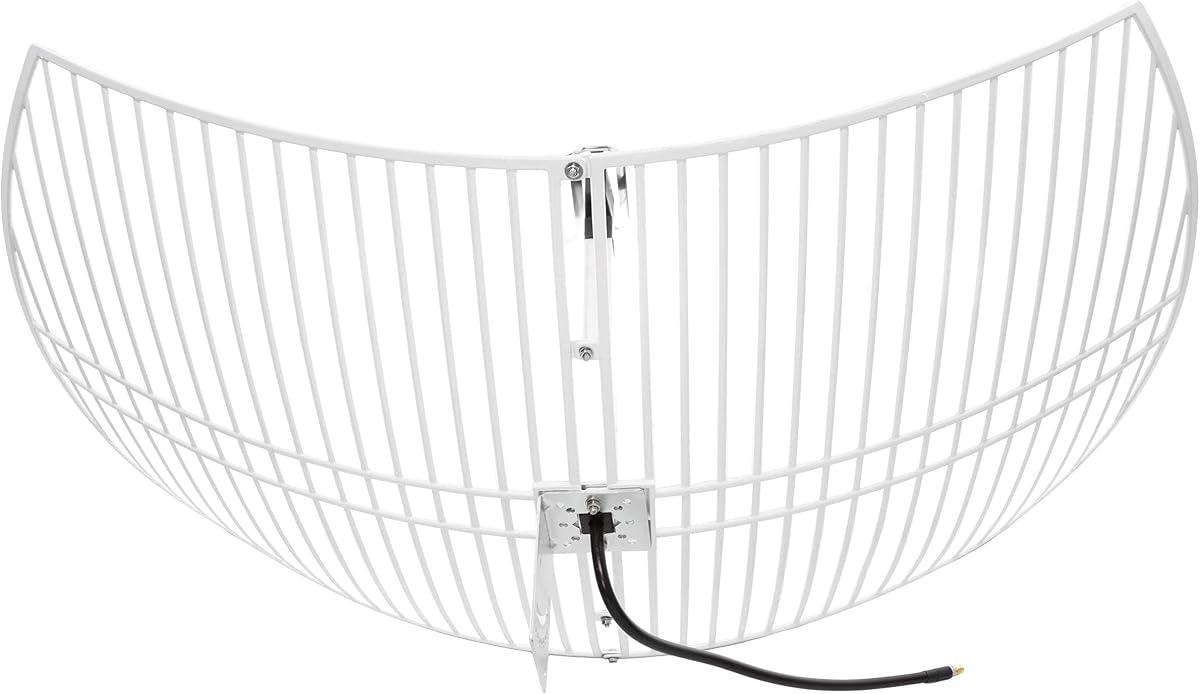
WiFi Parabolic Directional Antenna Set 2.4G Outdoor High Gain External Kit
5.0Editor score
20 dBi directional gain
Complete outdoor mounting kit
Low-loss RF400 cable
Our Parabolic WiFi Antenna guide compares ten outdoor and satellite models across gain, frequency, connectors, MIMO support, weather resistance, and installatio
A parabolic WiFi antenna concentrates radio energy toward a specific access point, tower, or satellite, making it useful for outdoor links, weak rural service, security cameras, and long-range backhaul. The most important considerations are compatible frequency coverage, clear line of sight, connector type, gain, mounting hardware, and whether the device supports multiple antennas for MIMO.
This guide compares ten directional and grid parabolic antennas using the supplied specifications, ratings, included accessories, and intended applications. It covers WiFi-only models, wide-band cellular antennas, and specialized satellite dishes, while separating general WiFi options from equipment designed primarily for weather or satellite reception.
Each review explains who the antenna suits, what makes it stand out, and where its requirements may limit performance. Reader reviews can change over time, product availability and pricing also fluctuate, so confirm the current specifications and accessories before making a final purchase.
5.0Editor score

4.2Editor score

3.0Editor score
The table below compares all ten selections by their core antenna characteristics, including operating band, stated gain, connection method, and most practical application. Because parabolic antennas are highly directional, specifications alone do not determine results; placement, line of sight, and connector compatibility remain essential.




The Griddy antenna-only configuration earns the Editor's Choice as the most adaptable parabolic option in this guide. It covers 600 to 6500 MHz and is listed for 4G LTE, 5G NR, and WiFi applications, allowing it to serve as a shared external antenna for several types of connected equipment. Its supplied rating is 4.2, but the defining feature is the unusually broad operating range rather than rating position alone.
We may earn a commission when you buy through this link, at no additional cost to you.
Stated gain changes by band: 12-17 dBi from 600-960 MHz, 20-23 dBi from 1700-2700 MHz, and 23-26 dBi from 3000-6500 MHz. That makes the antenna useful for cellular modems, hotspots, routers, and access points when the target transmitter falls within one of those ranges. The included 50-ohm N-Type connectors support professional RF installations, and using two or four Griddy units is an option when the receiving device has multiple external antenna ports for MIMO.
The main trade-off is the need for unobstructed line of sight. Trees, walls, and buildings can disperse or reflect the highly directional signal, reducing the antenna's effectiveness. The antenna-only package also means buyers may need the appropriate device-specific adapter, and it is more demanding to position than a lower-gain panel or Yagi. These constraints are inherent to using a high-gain parabolic design rather than shortcomings in the stated coverage.
This is the strongest choice for an installer or technically confident user who needs one antenna to cover cellular and WiFi bands, has a clear view of the tower or access point, and can manage the mounting and cabling. Choose it when flexibility across 600-6500 MHz matters more than a self-contained WiFi-specific kit. It is less suitable for users who need the simplest possible installation in a cluttered environment.
The 600-6500 MHz range distinguishes Griddy from the 2.4 GHz-only grid dishes in this list. It can serve LTE, 5G NR, and WiFi equipment, subject to the gain figure for the exact frequency band and a suitable connector or adapter.
One antenna can improve a single connection, while two or four units can support MIMO devices with multiple external antenna ports. This makes the design more relevant to cellular and modern WiFi systems than a basic single-antenna alternative.
We may earn a commission when you buy through this link, at no additional cost to you.
The Griddy complete kit is the premium version of the same high-gain grid parabolic concept. It has a 4.0 supplied rating and retains the 600-6500 MHz operating range, but the kit format makes it more convenient for buyers whose equipment may use N-Type, TS9, or SMA connections. It is especially useful for cellular modems, LTE routers, 5G systems, and WiFi access points.
We may earn a commission when you buy through this link, at no additional cost to you.
Its band-specific gain reaches 23-26 dBi at 3000-6500 MHz, 20-23 dBi at 1700-2700 MHz, and 12-17 dBi at 600-960 MHz. Those figures make it a credible choice for stable outdoor links where the target tower or access point is visible. The included N-Type connectors, TS9 adapter, and SMA adapter reduce uncertainty when assembling the connection chain, although a careful buyer should still verify the interface on the router, modem, or booster.
Like the antenna-only Griddy, this model concentrates energy into a narrow directional pattern. That focus can reject unwanted signals and improve the usable connection in the right direction, but it also means trees, buildings, terrain, and incorrect aiming can seriously reduce performance. The complete kit does not remove the need for a stable mount, suitable cable routing, and compatible radio equipment. Its 4.0 rating should be considered alongside the installation demands associated with high-gain antennas.
Choose this kit when you want broad cellular and WiFi capability along with the supplied adapters. It is a sensible premium option for rural cellular service, outdoor backhaul, or a remote installation where changing connector standards could otherwise complicate setup. Buyers wanting a more compact and purely WiFi-focused system should consider a single-band grid dish instead.
The package includes N-Type connectors plus TS9 and SMA adapters, covering common interfaces found on cellular and WiFi equipment. This convenience is the main distinction from the antenna-only configuration.
The stated gain reaches its highest level in the upper 3000-6500 MHz range, while lower bands still receive meaningful directional gain. Users should match the antenna to the exact band used by their transmitter.
We may earn a commission when you buy through this link, at no additional cost to you.
The Nooelec GOES mesh antenna is a specialized parabolic dish for receiving detailed, near-real-time images from orbiting weather satellites. Its supplied rating is 4.0, while its 21 dBi gain and 1.7 GHz center frequency position it for GOES, NOAA HRPT, Meteor M2 HRPT, Metop, FengYun, and other systems operating around 1.6-1.8 GHz. It is not intended as a general household WiFi antenna.
We may earn a commission when you buy through this link, at no additional cost to you.
The antenna can be used with linearly or circularly polarized signals, including RHCP and LHCP. The package includes LMR400 feed cable with a male SMA connector, mounting hardware, and a two-year warranty. For a complete receiving system, it is designed to work with an SDR, filter, and low-noise amplifier, and the supplied information identifies SatDump as a recommended decoding option for Windows, Linux, macOS, and Android.
Its limitations come from the nature of satellite reception rather than basic construction. Decoding software and suitable radio hardware are required, and the product does not include a paid XRIT Decoder license. Satellite tracking, station placement, polarization matching, and stable aiming all influence the result. It therefore offers little value to a buyer whose goal is extending a conventional 2.4 or 5 GHz WiFi network.
This is the right selection for satellite hobbyists, remote weather observers, and radio users building a dedicated downlink. It is also a solid reference for anyone comparing higher-gain mesh dishes for fixed satellite reception. For general outdoor WiFi backhaul, choose one of the 2.4 GHz grid models or a dual-band panel antenna instead.
A 1.7 GHz center frequency and more than 200 MHz of bandwidth focus the antenna on the portion of the spectrum used by many weather-satellite downlinks. This targeted design is more meaningful for satellite reception than a general wideband claim.
Support for both linear and circular polarization broadens the antenna's usefulness across different satellite systems. Correct setup still depends on the receiving equipment and the transmission being targeted.
We may earn a commission when you buy through this link, at no additional cost to you.
The 2.4G Outdoor Grid Parabolic kit is the best-budget option for buyers who want a focused WiFi link and a collection of essential installation components. It carries a supplied rating of 5.0 and offers 20 dBi gain across the 2400-2500 MHz range. The grid-dish format, vertical polarization, 50-ohm impedance, and stated VSWR of 1.5 or lower make it a conventional directional antenna for compatible 2.4 GHz equipment.
We may earn a commission when you buy through this link, at no additional cost to you.
The package contains one grid parabolic antenna, a right-angle mounting bracket, a 9.8-foot RF400 cable, an SMA male adapter, and two U-bolt clamps. That is a more complete starting point than an antenna sold without a cable or mounting hardware. It is positioned for long-distance point-to-point links, remote receivers, high-bandwidth backhaul, and compatible WiFi routers or security cameras.
Its central limitation is frequency. The antenna only operates from 2400 to 2500 MHz and will not cover 5 or 5.8 GHz WiFi. The N-Female connector also requires the supplied SMA adapter or another correctly matched connection. As with any high-gain directional antenna, the target access point should have a clear view, and the included maximum input power specification of 100 watts should be respected.
For a single-band outdoor link, this is an easy recommendation because the dish, cable, adapter, bracket, and clamps are all supplied. It is also better suited to a straightforward budget than a premium wideband cellular package. Choose it when your source and receiver both use 2.4 GHz and the goal is maximum directional concentration.
The included RF400 cable, right-angle bracket, U-bolt clamps, and SMA adapter reduce the need to source basic parts separately. It makes the kit particularly approachable for a first directional antenna installation.
With 20 dBi stated gain and a weather-resistant grid dish, the antenna is aimed at reliable reception over open distances or a point-to-point connection. Visibility of the source remains more important than the dish size alone.
We may earn a commission when you buy through this link, at no additional cost to you.
This 2×2 MIMO parabolic antenna is built around a high-gain cellular configuration rather than a conventional single WiFi dish. Its supplied rating is 3.0, but it offers a stated 34 dBi gain across 600-6000 MHz and is intended for 5G, 4G, LTE, and WiFi devices. That makes it a specialized option for users who already understand MIMO antenna ports and need a two-antenna cellular arrangement.
We may earn a commission when you buy through this link, at no additional cost to you.
The package includes one directional parabolic antenna, two 49-foot SMA cables, two TS9 cables, two N male adapters, and pole mount brackets. That generous cable and adapter selection supports different connection arrangements, while the 2×2 design is intended to improve consistency and data performance in compatible 5G or LTE systems. The stated compatibility includes major carrier networks, including Verizon, AT&T, Sprint, and T-Mobile.
The 34 dBi figure is impressive but should be treated as a highly directional specification, not a guarantee of faster speeds in every location. The antenna must point toward the desired tower with minimal obstruction, and both receiver and transmitter hardware must actually support the intended MIMO configuration. Cable losses, connector choices, tower congestion, and the device's own antenna limitations can all influence the final result.
Choose this antenna for an advanced home-internet or cellular installation where the receiving modem or router has two suitable external antenna ports and a clear tower view. It is less attractive for a basic router upgrade because of the 3.0 rating and more demanding configuration. Users who only need one external 2.4 GHz antenna should favor a simpler grid kit.
The 2×2 MIMO layout gives compatible 5G and LTE equipment separate signal paths, which can improve reliability when both antennas are correctly aligned. The receiving system must provide the required ports and support the arrangement.
Two 49-foot low-loss cables allow the antenna to be mounted where visibility is best while the modem remains indoors. Care should be taken to protect the connections and route the cables without sharp bends or damage.
We may earn a commission when you buy through this link, at no additional cost to you.
The Eifagur outdoor panel is not a true dish, but it provides a useful alternative for buyers who want a directional WiFi antenna without a large parabolic reflector. It has a supplied rating of 4.3, 15 dBi gain, and dual-band operation from 2400-2485 MHz and 5150-5850 MHz. That makes it relevant to both 2.4 GHz and 5 or 5.8 GHz wireless equipment.
We may earn a commission when you buy through this link, at no additional cost to you.
Its listed compatibility includes 802.11 b, g, n, and ac networks, along with wireless routers, repeaters, security cameras, surveillance recorders, PCI WiFi adapters, and access points. The package description identifies a directional panel antenna with an RP-SMA male connector and a 10-foot RG58 cable. Unlike a high-gain grid dish, its broad vertical panel shape can be more forgiving when the target is nearby or its exact position is difficult to pinpoint.
The trade-off is reduced concentration compared with the 20-26 dBi options in this guide. A 15 dBi directional panel can still provide a meaningful improvement over a small internal router antenna, but it may not sustain the same long-range results in a heavily obstructed environment. The supplied information does not mention a mounting bracket, so outdoor installation may require separate hardware. Cable losses and connector compatibility also deserve attention.
This panel is best for a security camera, remote access point, or home office where both WiFi bands matter and the source is within a moderate distance. Choose it for simpler dual-band coverage; choose a grid parabolic when maximum gain and a long, unobstructed link are the priorities.
Dual-band coverage avoids the single-band limitation of many outdoor dishes. It can suit mixed networks where 2.4 GHz provides reach while 5 GHz supplies additional capacity in a clear line of sight.
The listed support for security cameras, DVRs, and other surveillance equipment makes this a practical option for outdoor cameras placed away from the main router. The source must be visible and the camera must accept the connection.
We may earn a commission when you buy through this link, at no additional cost to you.
The Nooelec satellite mesh bundle is designed to receive L-band signals used by Inmarsat, Iridium, and Hydrogen Line applications. Its supplied rating of 4.4, 20 dBi gain, 1.4 GHz center frequency, and bandwidth greater than 300 MHz distinguish it as a specialized fixed-satellite antenna. It is most appropriate for users building satellite communication, remote sensing, or weather-tracking stations.
We may earn a commission when you buy through this link, at no additional cost to you.
A sub-reflector supports enhanced performance, while the antenna uses an SMA termination for connection to compatible radio equipment. The supplied LMR400 cable is attached to the arm, and a versatile mounting kit is included for different installation situations. The design is described as lightweight and durable, with high gain and low noise performance for outdoor use.
It is important to recognize that the term WiFi antenna does not make this a general wireless networking dish. The antenna concentrates energy around the L-band portion of the spectrum and needs compatible receivers, decoders, or satellite equipment. The fixed nature of the system means that carefully selected placement and stable mounting are more important than the ability to move the antenna casually around a property.
Choose this bundle for a dedicated L-band receiving station and take advantage of the included arm, cable, and mounting kit. It may be a better fit than a narrower GOES-specific antenna when the target signals sit near 1.4 GHz or the system needs broader L-band coverage. It should not be selected solely for ordinary 2.4 or 5 GHz WiFi range extension.
More than 300 MHz of bandwidth encompasses many popular L-band applications around the 1.4 GHz center frequency. This gives it a broader role than a satellite antenna tuned to one narrow channel.
The included sub-reflector is intended to enhance antenna performance, while the arm-mounted LMR400 cable simplifies connection to existing radio equipment. Stable alignment remains necessary for dependable results.
We may earn a commission when you buy through this link, at no additional cost to you.
The 2.4GHz Yagi is a high-gain directional alternative to a parabolic grid dish. It has a supplied rating of 4.5, a maximum gain of 25 dBi, and an operating range of 2400-2483 MHz. The aluminum-alloy construction and waterproof positioning make it appealing for outdoor 2.4 GHz links involving routers, USB adapters, PCI Express cards, cameras, and industrial equipment.
We may earn a commission when you buy through this link, at no additional cost to you.
The supplied 150-centimeter extension cable makes it easier to place the antenna where the signal source is visible while keeping the connected device away from the mounting point. A gold-plated RP-SMA male connector supports direct use with many compatible WiFi devices, and the package includes a wall-mount bracket. The stated 50-ohm impedance matches common wireless networking equipment.
The central limitation is that this antenna does not cover 5.8 GHz, despite the broader product-description wording. The 25 dBi figure is listed as maximum gain, so actual performance depends on frequency, alignment, and the source. A Yagi also creates a narrow directional pattern and is best aimed directly at the transmitter, making placement less forgiving than a panel antenna.
Choose the Yagi when maximum 2.4 GHz gain and a straightforward antenna swap are priorities. It is a good fit for a fixed security camera, remote router, or point-to-point wireless link where a wall or pole mount is available. If both 2.4 and 5 GHz networks must be served, the Eifagur dual-band panel offers a simpler alternative.
The listed 25 dBi maximum gain is among the strongest figures in the guide, but it is specific to the 2.4 GHz band. The narrow directional pattern makes careful aiming essential.
The 1.5-meter extension cable gives users room to separate the antenna from the router or adapter. That flexibility is useful when the radio equipment must stay indoors or in a protected enclosure.
We may earn a commission when you buy through this link, at no additional cost to you.
The 16 dBi 2.4 GHz Yagi is a compact directional option with a supplied rating of 3.9. It operates from 2400 to 2500 MHz and includes both RP-SMA male and SMA male antenna connectors, giving it unusual connection flexibility. Its listed uses include drone remote controls, USB wireless adapters, routers, cameras, industrial systems, remote monitoring, and wireless video transmission.
We may earn a commission when you buy through this link, at no additional cost to you.
A two-meter extension cable and mounting accessories allow the antenna to be placed away from the connected radio equipment. By concentrating the signal in one direction, the Yagi can provide a stronger intended link and reduce interference arriving from other directions. That makes it useful in industrial settings, shopping centers, schools, vehicle-mounted systems, and other locations where choosing one source is easier than covering an entire area.
The trade-off is that it only supports 2.4 GHz devices and has less stated gain than the 25 dBi Yagi, the 20 dBi grid kit, or the broad Griddy models. Directional performance also depends on polarization, distance, obstructions, and precise alignment. The two connector options improve compatibility, but the correct one still has to match the device and intended transmit or receive role.
Choose this antenna when a moderate-gain directional link, flexible connectors, and a longer extension cable are more important than multi-band support. It is particularly relevant to drone control or remote video arrangements where a stable endpoint can aim toward the receiver. For a basic router that lacks a suitable antenna port, verify compatibility before ordering.
Providing RP-SMA and SMA male connectors helps accommodate different wireless devices without insisting on a single interface. Users should still confirm the required connector and any adapter requirements.
The 16 dBi directional pattern can strengthen a link toward a drone or remote endpoint while limiting reception from other directions. Stable positioning and a clear path are important for reliable control or video.
We may earn a commission when you buy through this link, at no additional cost to you.
The 2.4GHz 17 dBi Grid Parabolic is a straightforward outdoor dish for point-to-point WiFi and long-distance reception. No numeric rating is supplied for this product, so its 17 dBi stated gain, 2400-2500 MHz operating range, and supplied physical characteristics provide the clearest basis for comparison. It uses an N-Type female connector and a 50-ohm impedance.
We may earn a commission when you buy through this link, at no additional cost to you.
The package includes one grid parabolic antenna, a right-angle mounting bracket, and two U-bolt clamps. Its stated VSWR is 1.5 or lower, maximum input power is 100 watts, and the dish uses vertical polarization. The construction is described as weather resistant and corrosion resistant, with a stated ability to withstand wind speeds up to 60 meters per second.
Compared with the similarly styled 2.4G kit, this listing does not mention an included RF cable or SMA adapter. That means users should verify the full connection chain before purchase. Its 17 dBi gain is lower than the 20 dBi figure of that kit, so the absence of cable may be one of several reasons to compare specifications rather than assume one is automatically better.
This antenna suits users who specifically want a grid parabolic format for a 2.4 GHz backhaul link, remote receiver, or weak WiFi source. It includes the basic mounting hardware and has a clear outdoor orientation. The complete 2.4G Outdoor Grid Parabolic kit is the more convenient option when a cable and SMA adapter are important, while a dual-band panel is preferable for mixed 2.4 and 5 GHz needs.
The 17 dBi dish concentrates energy toward a selected source, making it appropriate for a stable point-to-point connection. Trees, walls, and other obstructions can scatter that directional energy and reduce the benefit.
A right-angle bracket and two U-bolt clamps support secure placement on a suitable pole. The listing does not mention a coaxial feed cable, so connection requirements should be confirmed before installation.
We may earn a commission when you buy through this link, at no additional cost to you.
Choosing a parabolic WiFi antenna requires matching the radio band, connection interface, installation environment, and link type. A high-gain figure cannot compensate for incompatible connectors, obstructed paths, or equipment that lacks an external antenna port.
In short, match the supported band first, then consider directional performance.
Choose higher gain for long, stable links and a narrower pattern only when precise placement is realistic.
If a clear view is impossible, an omnidirectional or wider-beam antenna may produce better real-world results.
Never force a connector or assume visually similar interfaces are electrically identical; verify model numbers before buying.
Inventory the package, cables, adapters, brackets, clamps, and weather seals before installation day.
Verify external antenna-port count and MIMO support before purchasing a multi-antenna arrangement.
Use corrosion-resistant hardware, protect every connector, and secure the mast against movement in wind.
Select the antenna category that matches the signal source and receiver, not merely the largest stated gain.
Begin by identifying the exact source, confirming that the antenna's frequency range covers it, and checking the receiving device for a compatible external antenna port. Assemble the required adapter and feed cable before mounting the dish. Connect the system temporarily, place the antenna toward the target, and adjust its position while monitoring the device's signal indicators to find a stable direction.
Mount the antenna on a rigid bracket or pole with the reflector facing the intended source. Use the supplied right-angle bracket, wall bracket, or pole clamps as applicable, and ensure the antenna does not shift after aiming. Route low-loss cable away from sharp bends, power conductors, and moving parts. Protect outdoor connectors with suitable weather sealing, leave service loops near the antenna, and avoid placing excess strain on the connector itself.
For ongoing care, inspect the mounting hardware and cable after high winds or severe weather. Clean accumulated dirt or salt from the reflector and check for corrosion around brackets, clamps, and grounding points. Do not rotate or reposition a high-gain antenna without a plan for retuning it toward the source. If performance declines, first check alignment, physical damage, connector moisture, cable condition, and device compatibility before assuming the antenna has failed.
It can improve the quality and stability of a weak directional link, which may allow the network to operate at higher throughput. It will not automatically increase the available capacity of a congested tower or access point. The largest benefits occur when the antenna receives a clearer signal than the device's internal antennas, the target is in line of sight, and the hardware supports an external antenna.
No. Higher gain concentrates energy into a narrower beam, which can improve a long link but also makes alignment and line of sight more important. A 15 dBi panel may be more practical for a nearby or slightly obstructed source, while a 20-26 dBi dish can be ideal for a distant source with a completely open path.
No. The 2.4 GHz grid dishes and Yagi antennas in this guide do not support 5 GHz networks. Use a dual-band antenna such as the Eifagur panel, or a wideband model whose stated frequency range includes the 5 GHz service. Both the transmitting access point and receiving device must use the matching band.
It depends on the equipment. Many routers and USB adapters use RP-SMA, while N-Type appears on several high-gain outdoor dishes. The Griddy complete kit includes N-Type, TS9, and SMA connection options, and some other products include an adapter. Check the device manual or the existing antenna before buying any additional cable.
Usually not reliably. A high-gain dish depends heavily on a direct path, and trees, walls, and other structures can scatter or reflect the signal. The Griddy descriptions explicitly note that dispersion and reflection reduce effectiveness. For obstructed locations, consider an omnidirectional antenna, a wider-beam panel, or a different mounting position with a clear view.
A device that supports 2×2 MIMO generally needs two compatible antenna paths to use that feature. The 5G LTE parabolic is designed for 2×2 MIMO, and the Griddy can be used in multiples when the connected device has multiple external ports. A single antenna may improve one path, but it cannot provide full MIMO operation on unsupported hardware.
The Nooelec GOES and L-band models are designed for satellite and weather-related signals near 1.7 GHz and 1.4 GHz, not conventional 2.4 or 5 GHz WiFi. They also require compatible receivers and decoding equipment. For regular WiFi, select one of the 2.4 GHz dishes, the dual-band panel, or a wideband cellular model.
Identify the transmitter's approximate position and point the antenna's narrow reception pattern directly toward it. Make small adjustments while watching the router, modem, or camera's signal reading, and then secure the mount firmly. Remember that the apparent direction of a tower may not be perfectly clear at ground level, so test from the intended mounting height if possible.
The Griddy antenna-only model is the most versatile overall selection because it spans cellular and WiFi bands from 600 to 6500 MHz, while the complete kit adds convenient adapter options. The 2.4G Outdoor Grid Parabolic is the best-budget dedicated WiFi choice, and the 2×2 MIMO cellular model is the premium option for compatible high-speed cellular installations.
Prioritize the operating band, connector, line of sight, and application before focusing on gain. A 2.4 GHz dish is the right choice for a compatible WiFi backhaul link, the dual-band panel serves mixed 2.4 and 5 GHz networks, and the Nooelec dishes belong in dedicated satellite installations. Proper mounting, weather protection, and careful alignment can influence the result as much as the stated gain.
Ratings, package contents, and product availability can change over time, and sellers may update listings as new versions appear. Check the current specifications, connector requirements, included accessories, and present price before ordering, then confirm that your source and receiving device operate on a compatible frequency.
