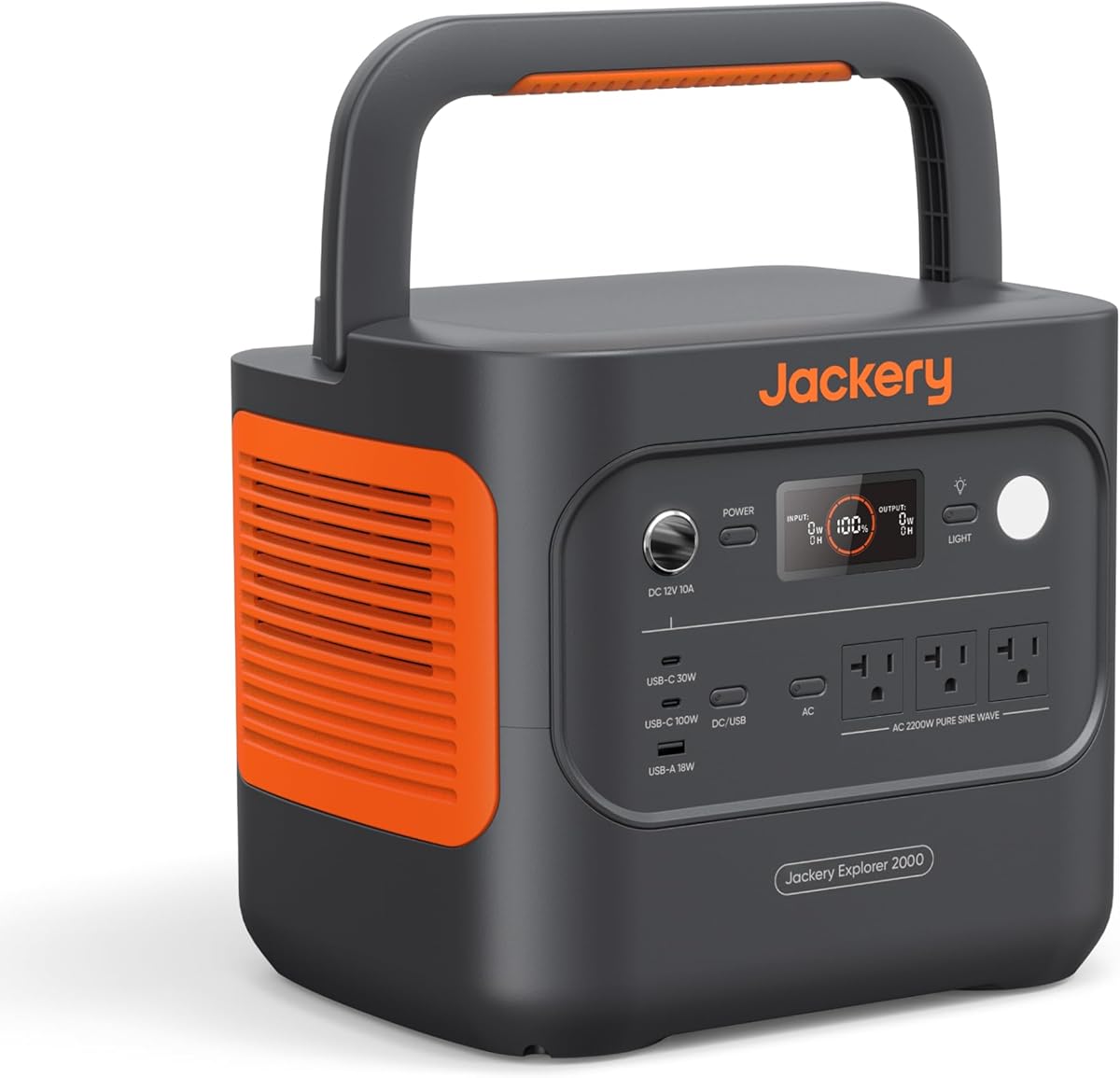
Jackery Explorer 2000 v2
4.4Editor score
2,042Wh battery capacity
2,200W continuous AC output
USB-C PD reaches 100W
Our Power Stations for Vanlife guide compares 10 leading models for capacity, output, charging speed, portability, safety, and dependable off-grid power use.
Power stations for vanlife can transform a vehicle into a comfortable, capable base for road trips, remote work, and time spent beyond electrical hookups. A capable unit keeps phones charged, powers kitchen appliances, runs fans, and supports cameras without the noise, fumes, and constant maintenance associated with fuel generators.
The products in this guide were compared using the information supplied for each model, focusing on battery capacity, continuous and surge output, charging methods, port selection, weight, dimensions, expansion options, safety features, and van-friendly usability. The list covers compact units for lighter builds as well as higher-capacity systems for demanding appliances and extended off-grid stays.
Each review explains where a power station fits and where its trade-offs may matter. Features such as UPS switching, fast charging, car charging, RV outlets, and solar compatibility can be decisive for mobile living, while every shopper should verify current specifications, accessories, and pricing before purchasing. Prices and configurations can change over time.
4.4Editor score

4.6Editor score

4.6Editor score
The comparison below highlights the principal differences in capacity, output, charging flexibility, and physical portability. These specifications help vanlife travelers identify the right balance for mobile electronics, everyday kitchen loads, or higher-energy appliances.


The Jackery HomePower 3600 Plus combines a 3,584Wh LFP battery with 3,600W of continuous AC output, giving it the strongest balance of usable capacity and appliance capability in this guide. Its 4.6 rating reflects a well-rounded system for van travelers who need more than a weekend charge bank, particularly when powering a coffee maker, tools, a refrigerator, or several devices at once.
We may earn a commission when you buy through this link, at no additional cost to you.
One of its most compelling features for mobile use is the potential to combine units for 7,200W of parallel output. It also supports 120V and 240V equipment in parallel configurations, while expansion can raise a single unit's capacity to 21kWh and a multi-unit setup to 43kWh. That scalability makes the platform attractive to travelers planning extended periods away from reliable hookups.
Recharging is unusually flexible for its class. The unit can replenish through hybrid AC and DC in two hours, AC in 2.5 hours, solar in four hours, or a gas generator in 2.5 hours. The luggage-style chassis, built-in wheels, and telescopic handle improve handling, although the overall size and weight still place it closer to a mobile power cabinet than a lightweight camping accessory.
This is the best general recommendation for vanlife because it offers enough energy for substantial daily loads while retaining multiple replenishment routes. It is especially suitable for full-time travelers, couples who work remotely, and van builders who want a system that can grow. Travelers should measure their storage area and assess lifting demands before committing to this larger format.
The 3,584Wh capacity offers meaningful room for a refrigerator, electronics, lighting, networking equipment, and periodic higher-wattage appliances. Expansion options make the investment more adaptable as a vanlife setup evolves, although actual runtime depends on the load and operating conditions.
Hybrid charging, wall charging, solar, and generator input give travelers multiple ways to keep the battery ready. That versatility is particularly helpful during long drives, changing weather, or trips where campsite power is unavailable.
We may earn a commission when you buy through this link, at no additional cost to you.
The Jackery Explorer 2000 v2 delivers 2,042Wh of capacity and 2,200W of continuous AC output in a 39.5-pound package. Its 4.4 rating and broad device support make it a practical middle ground for vanlife travelers who need real appliance power but do not want to carry a 3.6kWh system.
We may earn a commission when you buy through this link, at no additional cost to you.
Three AC outlets, a 100W USB-C PD port, and additional USB and DC connections cover the common devices found in a working van. A 20ms UPS transfer is a useful feature for computers, routers, and other equipment that may be disrupted by a brief outage. The unit is also UL1778 test certified for uninterruptible power systems according to the supplied information.
Its charging options include AC fast charging to 80% in 66 minutes, a 102-minute app-controlled emergency mode, solar charging in as little as six hours with a 400W panel, and a silent charging mode at less than 30dB. The trade-off is that it lacks the broad high-voltage and multi-unit expansion potential of the larger systems in this list.
This is the best value pick for campers and part-time travelers seeking a durable middleweight option. It should suit users who regularly run moderate electronics, small kitchen appliances, lights, and occasional power tools. Those planning to power large heating equipment or an air conditioner should choose a higher-output model instead.
The silent charging mode operates below 30dB, making recharging less disruptive during a campsite stop. Smart fan control also adjusts to internal and environmental temperatures, supporting quieter use when the unit is stationed inside or near sleeping quarters.
A 20ms switchover allows compatible electronics to continue running when utility power fails. This makes the Explorer 2000 v2 useful for remote work, connectivity, and other needs where a brief interruption could be inconvenient.
We may earn a commission when you buy through this link, at no additional cost to you.
The Jackery Explorer 1000 v2 combines a 1,070Wh battery, 1,500W continuous output, and a 3,000W surge peak. At 23.8 pounds, it is the lightest power station in the comparison, while its 4.8 rating is the highest listed among the selected products. These traits make it especially appealing for small vans and travelers focused on mobile electronics.
We may earn a commission when you buy through this link, at no additional cost to you.
The port selection includes two USB-C ports, one USB-A port, one DC car port, three pure sine wave AC outlets, and LED lighting. One USB-C connection supports 100W PD, reducing the need to carry separate adapters for compatible laptops, tablets, and phones. A foldable handle also helps with packing and carrying.
The app provides emergency charging that can take the battery from empty to full in one hour, although the unit defaults to a 1.7-hour mode to optimize battery health. A 30dB quiet mode supports overnight use. The main limitation is capacity: 1,070Wh is well suited to electronics and smaller essentials, but it will not support large appliances for long.
This model is best for minimalist vanlife, weekend trips, or use as a secondary power bank inside a larger electrical system. It is less appropriate for refrigerators, heaters, or high-wattage tools over extended periods. Buyers should also note that the supplied information states that the Explorer 1000 v2 is compatible only with Jackery solar panels for solar charging.
At 23.8 pounds, the Explorer 1000 v2 reduces the lifting and storage burden associated with larger power stations. Its foldable handle and compact output make it easier to deploy from a hatch, side door, or interior cabinet.
Emergency charging can refill the battery in an hour, while the standard mode prioritizes long-term battery health. Users can also select quiet charging and energy-efficiency settings through the Jackery app.
We may earn a commission when you buy through this link, at no additional cost to you.
The EcoFlow DELTA 3 pairs a 1,024Wh LFP battery with 1,800W of output and a 4.7 rating. Its defining advantage is speed: a full charge can be achieved in 56 minutes using upgraded charging, while 80% of capacity is reachable in about 30 minutes. This makes it highly useful when a traveler has limited charging time between destinations.
We may earn a commission when you buy through this link, at no additional cost to you.
The station can power 13 appliances simultaneously and supports expansion to 5kWh through compatible DELTA 3, DELTA Pro 3, and DELTA 2 Max batteries. X-Boost is available for resistive appliances with demands above 2,600W. This combination of rapid turnaround, broad device support, and modular capacity gives it a strong feature set despite the relatively small base capacity.
The LFP cells are specified for 4,000 cycles to 80% capacity and a ten-year lifespan under daily use. The expandable battery system carries IP65 protection against dust, splashes, and oil. The box includes the power station, an AC cable, user manual, and access to EcoFlow's customer service.
This is a good choice for travelers who recharge whenever possible and need a broad port ecosystem rather than maximum base capacity. It may be less suitable for extended appliance use without expansion. Owners should check which expansion batteries are compatible with the exact DELTA 3 configuration and confirm dimensions before installation.
The ability to reach a full charge in 56 minutes reduces downtime during route planning. It can also be replenished using solar, making it practical to top up during a sunny stop if compatible solar input is available.
Expansion to 5kWh allows the compact base unit to grow as energy demands increase. Buyers should consider the extra weight and space required by an expansion battery before planning a van installation around it.
We may earn a commission when you buy through this link, at no additional cost to you.
The Anker SOLIX C2000 Gen 2 provides 2,048Wh of capacity, 2,400W rated output, and 4,000W peak power. Its 4.7 rating reflects a capable, compact design with particular relevance to van travelers who need to operate RV air-conditioning units or several appliances at once.
We may earn a commission when you buy through this link, at no additional cost to you.
Its standout travel feature is 800W UltraFast alternator charging, which can bring the unit to a full charge in three hours while driving. AC and solar charging can also restore the battery in 58 minutes. The low nine-watt standby draw helps preserve stored energy during periods when the unit is connected to a vehicle or RV but not actively supplying loads.
Adding an expansion battery increases capacity to 4kWh and extends the stated refrigerator runtime from as much as 32 to 64 hours. At 41.7 pounds and 18.1 by 9.8 by 10.1 inches, the unit is positioned as lighter and smaller than comparable products. The included package contains the station, AC charging cable, quick start guide, safety manual, and warranty card.
This is an excellent choice for mobile living with substantial cooling or appliance loads, especially when alternator charging is part of the travel plan. It is less appropriate for travelers seeking a very small unit or a model with high-voltage parallel output. Confirm the connection method needed for the van or RV electrical system before buying.
The 800W alternator charging option is well suited to vanlife because it makes use of time spent driving. A full recharge in three hours can reduce the need to find a wall outlet when campsite conditions are poor.
With 2,400W rated and 4,000W peak output, the station can handle many window and RV air-conditioning requirements. Users should still check an appliance's startup surge and sustained draw before connecting it.
We may earn a commission when you buy through this link, at no additional cost to you.
This bundle combines the Jackery HomePower 3600 Plus with two 200W solar panels, making it a more complete starting point for van travelers who want renewable charging from the outset. The power station itself has a 3,584Wh battery, 3,600W continuous output, and a 4.5 rating.
We may earn a commission when you buy through this link, at no additional cost to you.
Its charging options are extensive. The power station can be fully recharged from empty to full in two hours through hybrid AC and DC charging, 2.5 hours through AC, four hours through solar, and 2.5 hours through a gas generator. It can also operate with 120V and 240V equipment in parallel setups, and multiple-unit expansion can reach 43kWh.
The hardware is designed for movement around a home, garage, or campsite, with a luggage-style shell, wheels, and a telescopic handle. However, this is still a large system, and the supplied information notes that the HomePower 3600 Plus and solar panels are shipped separately. The panels also require adequate sunlight and appropriate positioning to deliver useful charging.
This bundle is best for vanlife travelers who already value solar independence and want a coordinated starting bundle. It may offer more than necessary for a minimal build, and buyers should account for the storage consumed by the station, panels, and their wiring. The separate shipment also means a van owner may need to plan delivery access carefully.
Including two 200W panels removes the need to choose a separate solar setup initially. This can simplify planning for long trips where dependable campsite charging is uncertain, provided the panels can be safely deployed and secured.
The high capacity and continuous output can support more than ordinary electronics, including pumps, heaters, and dryers according to the product information. Parallel operation offers additional flexibility for demanding mobile setups.
We may earn a commission when you buy through this link, at no additional cost to you.
The EBL Acc2400 combines a 1,843.2Wh LFP battery with up to 2,400W of output and a 4.4 rating. Its distinguishing strength is device variety: it can charge 12 devices simultaneously through four AC ports, two USB-A ports, two fast USB-C ports, a car port, two DC ports, and a wireless charging panel.
We may earn a commission when you buy through this link, at no additional cost to you.
That port breadth makes the Acc2400 useful in a van shared by multiple travelers. Phones, cameras, laptops, drones, lights, and smaller household devices can be served from one station. The included wireless charging panel is convenient for compatible phones, although the need for so many simultaneous connections should be checked against the unit's overall output limits.
An intelligent emergency power mode switches in 0.1 seconds, which is a noteworthy feature for protecting computers and file devices from interruption. The display shows remaining battery and operating status, while a four-mode LED provides camping and emergency illumination. The battery system is specified for more than 3,500 charge-discharge cycles and a service life exceeding ten years.
This model is best for group travel, mobile creative work, or a van filled with many different charging needs. The principal drawback is its 55-pound weight, making it less attractive to travelers who need to move the station frequently. Its dimensions and dual handles help with transport, but storage and lifting should be evaluated before purchase.
Twelve simultaneous charging positions reduce the need for several wall adapters and extension leads. The varied AC, USB, DC, car, and wireless options also make the station adaptable to changing device requirements.
The 0.1-second emergency mode can keep compatible electronics operating through a blackout. It is particularly relevant to mobile offices where an abrupt shutdown could interrupt work or damage files.
We may earn a commission when you buy through this link, at no additional cost to you.
The Jackery HomePower 3000 offers 3,072Wh of capacity and 3,600W of continuous AC output. Its 4.5 rating and built-in TT-30 RV port make it especially relevant to travelers who want a portable station that interfaces directly with an RV-style electrical setup.
We may earn a commission when you buy through this link, at no additional cost to you.
The UPS function switches in 20 milliseconds or less and is UL certified, supporting continuity for security cameras, medical refrigerators, communications, remote work, and pet feeders. Two 100W PD ports provide dedicated fast charging for phones, tablets, and drones, while AC, USB-A, USB-C, and DC connections cover other equipment.
The station recharges fully in 1.7 hours through hybrid AC and DC charging or 2.2 hours through AC. It can also use a 12V car charger, a gas generator, or compatible SolarSaga 200W panels, which can reach 80% in nine hours when two are paired. LiFePO4 batteries are rated for 4,000 cycles while retaining 70% capacity.
This is a strong recommendation for vanlife travelers who want RV connectivity, UPS protection, and substantial power in one package. CTB technology helps keep the enclosure relatively compact for a 3kWh unit, although the battery is still a significant item to secure inside a vehicle. The TT-30 connection should be checked for compatibility with the van's wiring.
The 30A TT-30 port removes the need for a separate adapter when working with compatible RV equipment. That makes setup and load management more straightforward for travelers already familiar with this connection standard.
A UPS transfer of 20 milliseconds or less helps maintain operation during outages. The feature is most useful for electronics that cannot tolerate abrupt shutdowns and require uninterrupted connectivity.
We may earn a commission when you buy through this link, at no additional cost to you.
The BLUETTI AC200PL pairs a 2,304Wh LFP battery with 2,400W of output and a 4.5 rating. It stands out for flexible expansion, with support for two B300 batteries, two B210P batteries, or one B230, allowing configurations up to 8,448Wh. That makes it a strong platform for a van electrical system designed to grow over time.
We may earn a commission when you buy through this link, at no additional cost to you.
Its 48V RV port is designed for charging an RV battery, offering a convenient way to combine portable storage with a vehicle's electrical system. Four 2,400W AC outlets, a 30A TT-30 port, a 48V 8A DC port, a car port, two 100W PD ports, and two 15W USB-A ports create an extensive total of 11 connections.
Maximum AC input of 2,400W allows a recharge from zero to 80% in 60 minutes. Solar input up to 1,200W can fully charge the unit in a stated 1.9 to 3.8 hours. LiFePO4 chemistry, more than 3,000 cycles, and an advanced battery management system provide the stated durability and protection against overcharging and short circuits.
This model is best for experienced van builders or travelers planning substantial mobile power infrastructure. Expansion is the central advantage, but extra batteries add weight and installation complexity. The RV port is for charging a battery, so it should not be confused with an output connection for directly powering RV equipment.
Several compatible expansion-battery options allow the installation to scale from a compact two-person setup to a larger energy system. The correct battery mix should reflect expected loads, storage, and lifting constraints.
A 60-minute charge to 80% is useful between travel days, while high solar input can support faster replenishment in suitable conditions. Actual recharge time changes with available input, temperature, and system settings.
We may earn a commission when you buy through this link, at no additional cost to you.
The EcoFlow DELTA Pro is a high-capacity 3,600Wh LFP system with 3,600W AC output and a 4.6 rating. It offers 15 output methods, including five AC outlets, USB-A and USB-C connections, DC outlets, a car power socket, and an Anderson port. For a van carrying extensive electronics or substantial household loads, that breadth is valuable.
We may earn a commission when you buy through this link, at no additional cost to you.
Its standout specification is expansion to 25kWh using DELTA Pro Extra Batteries or Smart Generators. Two DELTA Pro units can be paired to achieve 7,200W, while X-Boost can increase the output of a single unit to 4,500W. These figures make the platform relevant to full-time vanlife, mobile workshops, and demanding professional equipment.
Charging is highly flexible. The battery can recharge in 1.8 hours from a 240V outlet, 2.7 hours from a 1,800W wall outlet, or 2.8 hours using four 400W solar panels. EV station, solar, wall, smart generator, and car outlet inputs are all supported. Wi-Fi and Bluetooth app controls provide remote monitoring of charge, temperature, inputs, outputs, and customized settings.
This is the premium pick for buyers who want extensive expansion, app-based control, and the ability to operate high-draw equipment. It is excessive for a minimal weekend setup, where a smaller station would be easier to store and carry. Before installing it in a van, check floor load, ventilation, securing methods, and the weight implications of future expansion.
Expansion to 25kWh offers far more headroom than most portable systems. It is a major advantage for travelers whose battery needs change over time or who need multiple days of energy between charging opportunities.
Wi-Fi and Bluetooth monitoring lets users review status and adjust behavior without standing beside the unit. Customized battery, input, and output settings can also help match operation to a travel routine.
We may earn a commission when you buy through this link, at no additional cost to you.
A useful vanlife power station is determined less by headline capacity than by the balance between stored energy, available output, charging options, weight, safety, and the electrical demands of your van. The following factors help narrow that balance before you buy.
Capacity is the total energy the battery can store and is measured in watt-hours. Electronics, lighting, fans, and communications equipment need relatively little energy, while refrigerators, induction cooking, power tools, and heating can consume much more. Estimate your essential loads and the hours each should operate away from a connection, then compare that total with a unit's rated capacity. A larger margin is useful for poor weather and reduced solar performance, but excess capacity also adds weight, charging time, and cost.
Choose enough capacity for your essential loads, then leave some margin for contingencies and battery aging.
Continuous output is the power an AC outlet can deliver steadily, while surge output covers the brief startup spike many motors and compressors require. A power station may advertise an impressive peak figure but lack the sustained output needed for an appliance to run for hours. Check both values against the nameplate requirements of every device, especially refrigerators, air conditioners, pumps, heaters, and tools.
Match both continuous output and surge capability to the largest appliances you intend to run.
Vanlife creates opportunities to charge from wall outlets, vehicle alternators, solar panels, and sometimes other generators. Fast AC charging is convenient at campgrounds and businesses, while alternator or 12V charging can replenish energy while driving. Solar input supports remote stays but varies with sunlight, panel orientation, temperature, and cable losses. A model that supports several methods is more resilient than one that depends on a single source.
Prioritize units that support the charging methods available along your normal route.
A power station still has to be lifted, secured, and stored without obstructing the van's living area. Capacity generally increases weight, and higher-output models may use larger housings and heat-management components. Measure the installation area, check door and hatch clearance, and consider whether the unit will remain mounted or need regular movement. Dual handles, wheels, or a folding handle can make a heavy system more manageable.
Select the largest unit you can comfortably store, secure, and lift without compromising space.
AC outlets handle standard household plugs, while USB-C PD can charge compatible phones, tablets, and laptops rapidly. USB-A, 12V car sockets, DC barrel connections, and RV ports add flexibility for specialist equipment. Count the number of devices used together and check whether the station can support their combined draw. A generous port count is useful, but a single overloaded port or the station's total output ceiling still applies.
Match every port type and quantity to your actual devices rather than relying on headline counts.
UPS or emergency modes transfer power rapidly when mains electricity fails, helping prevent computers, networking equipment, security systems, and refrigeration controls from shutting down abruptly. Transfer speed is the key specification, with 20 milliseconds or less proving useful for many sensitive loads. Not every outlet or appliance will behave identically, so confirm which functions remain active during a transfer before relying on the feature.
For remote work and essential electronics, verify the transfer time and supported connections.
Expansion batteries can extend runtime without replacing the main inverter, but they add weight, wiring, and storage requirements. Confirm whether compatibility is proprietary, how the batteries connect, and whether a parallel system needs a separate kit. App controls can provide useful information about charge level, temperature, charging time, and output status, yet they should supplement rather than replace safe installation and sound operating practices.
Choose expansion only when your present and future energy needs justify the extra space and weight.
LFP chemistry is specified across this guide and is associated with thermal stability and a long cycle life. Look for battery management systems that address overcharging, over-discharging, short circuits, and temperature. The products also describe cycle counts, retention percentages, and operating-temperature claims, so compare those figures only on the same basis. In a vehicle, ventilation, secure mounting, protected cables, and adherence to the manufacturer's instructions remain essential.
Prioritize robust battery protection, stable chemistry, and clear manufacturer safety guidance.
Before installation, read the manual and identify the unit's supported inputs, outputs, ventilation requirements, and operating temperature limits. Secure the power station in a dry, stable location where it will not block airflow or become a projectile during sudden vehicle movement. Keep cables organized, leave connector access clear, and use the correct port and cable for every device.
Build a power plan rather than treating the battery as an unlimited outlet. Charge essential electronics first, avoid leaving high-draw appliances running continuously, and monitor remaining capacity through the display or official app. For sensitive electronics, test the UPS function before relying on it during travel. Use solar and vehicle charging when practical, but follow the stated input limits for all cables and panels.
Keep the battery away from extreme heat, direct cold, moisture, and combustible materials, and do not use damaged cables or visibly impaired connectors. Follow the specified charging mode when longevity is the priority, and use emergency fast charging only when the extra speed is genuinely needed. Periodically inspect mounting hardware, ventilation, and cable connections, and consult the manufacturer for battery-health or safe-disposal guidance.
The right size depends on the appliances you use and how long they must run without hookups. A compact unit around 1,000Wh suits phones, cameras, laptops, lights, and smaller electronics, while a 2,000Wh system supports more varied daily use. Van travelers running refrigerators, tools, cooking equipment, or heating generally need more capacity and a strong continuous output.
Many can, provided the fridge's running draw stays within the station's continuous output and its startup surge remains within the supported peak range. Energy needs vary with compressor behavior and ambient temperature, so calculate from the appliance's label and expected runtime. A larger battery or expansion unit will generally provide more resilience during travel and poor-weather periods.
Safety depends on correct placement, secure mounting, ventilation, and adherence to the manufacturer's temperature and charging instructions. Avoid wet areas, combustible materials, blocked vents, and damaged cables, and do not leave charging unattended where the manual prohibits it. High heat inside a parked vehicle is a particular concern because battery performance and safety depend on temperature.
Charge time varies with capacity, input wattage, battery temperature, and the charging method. Several products in this guide advertise full or partial recharge times around an hour or two using fast AC input, while solar and vehicle charging can take longer. Faster modes may be less desirable for routine use because some manufacturers default to gentler charging to preserve battery health.
Solar panels are not essential if you regularly recharge from a wall outlet, campsite electricity, or your vehicle's electrical system. They become valuable for longer stays in remote locations and for maintaining power without frequent hookups. Actual solar performance depends on panel wattage, sunlight, mounting angle, temperature, shading, and the power station's maximum solar input.
Some models support charging from a vehicle's 12V socket or a dedicated alternator connection, and the Anker SOLIX C2000 Gen 2 specifically supports 800W alternator charging. The electrical method, cable rating, and the power station's input limits must all be compatible. Installation should be handled safely so wiring does not interfere with driving or vehicle systems.
UPS mode is intended to transfer power to connected equipment when mains input fails, ideally with little interruption. Normal output simply supplies power from the battery and does not provide the same outage-handling function. Users should test UPS behavior with their specific devices and confirm which outlets remain powered during a transfer.
Expansion is worthwhile when expected energy use exceeds what the base unit can store between charging opportunities. It is less useful if the system already meets your needs through wall, vehicle, and solar charging. Extra batteries increase weight, storage requirements, and installation complexity, so consider the full energy budget rather than maximizing capacity by default.
The Jackery HomePower 3600 Plus is the strongest all-around choice because it combines 3,584Wh of capacity, 3,600W continuous output, several charging methods, and meaningful expansion potential. The Jackery Explorer 2000 v2 provides a more manageable middleweight option, while the EcoFlow DELTA Pro offers the most extensive premium scaling and connection features.
For a smaller van or lighter travel setup, prioritize the Jackery Explorer 1000 v2 or EcoFlow DELTA 3 and accept less runtime for greater portability. Travelers with substantial cooling, tool, or appliance needs should examine the Anker SOLIX C2000 Gen 2, Jackery HomePower 3000, BLUETTI AC200PL, or EBL Acc2400. The best choice is the one whose capacity, continuous output, charging methods, and physical size fit your actual routine.
Before purchasing, confirm the latest specifications, port details, expansion compatibility, included accessories, and current price with the seller. Product configurations and promotions can change, and a van's available space and electrical system may narrow the practical choice even when several models appear technically capable.