
1080P Strong Magnetic Wireless Backup Camera
4.5Editor score
One-minute magnetic installation
1080P infrared night vision
170-degree wide viewing angle
An RV backup camera adds a valuable layer of awareness when traffic, campground posts, trees, hooks, or other obstacles fall outside your mirrors. The right system should provide a clear rear view, work reliably at night, suit your rig’s wiring, and remain easy to use while maneuvering.
We compared ten wireless RV backup camera systems across installation methods, display size, image resolution, night vision, transmission range, waterproofing, recording, multi-camera support, and parking aids. The list covers magnetic, pre-wired, hardwired, rear-only, and multi-camera configurations for different travel styles.
Each review explains the product’s strongest qualities, practical limitations, and ideal buyer, so you can narrow the field before checking current availability. Product details and customer ratings can change over time, and prices fluctuate, so verify the latest listing information before purchasing.
4.5Editor score

4.4Editor score
4.4Editor score
As an Amazon Associate we earn from qualifying purchases.
This side-by-side comparison highlights the important differences among ten wireless RV backup camera systems, including installation style, camera coverage, signal range, night vision, recording support, display size, and waterproofing.



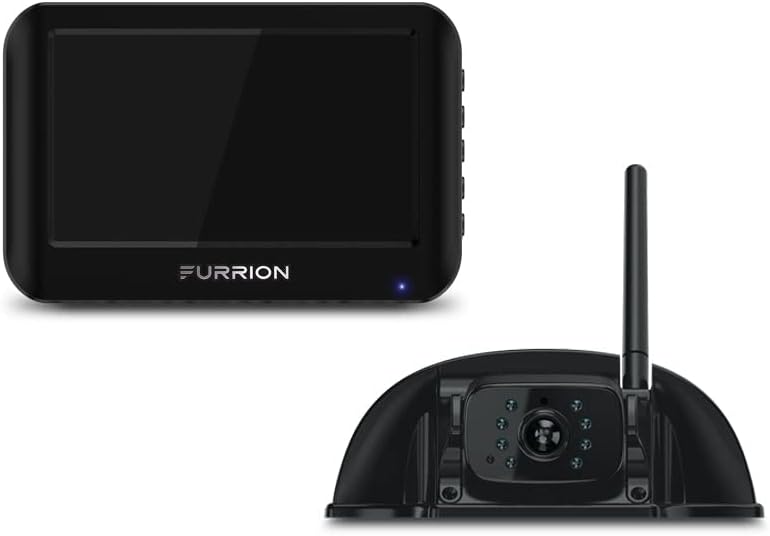
The Furrion Vision S 4.3 Inch Monitor is a compact wireless rear-camera package built around a 4.3-inch display and one rear sharkfin camera. It carries a 4.4 customer rating, and its appeal comes from straightforward parking guidance, automatic motion activation, infrared night vision, and a body designed for RV use.
We may earn a commission when you buy through this link, at no additional cost to you.
Its most useful feature is the motion-sensing behavior. Instead of demanding constant attention, the display can wake when the system detects activity, while the built-in microphone transmits audio for parking guidance or added security. This gives the product a broader role than a simple reversing aid, particularly when an RV is parked and the occupants want awareness of the area behind it.
The trade-off is its focused design. The smaller 4.3-inch screen takes up less dashboard space than the 7-inch and 7.2-inch displays offered by several competitors, and the included camera focuses on the rear rather than providing a multi-angle side-view arrangement. It also has fewer documented recording and expansion features than the more elaborate multi-camera systems in this guide.
This is a compelling option for RV owners who value compactness, automatic activation, and security-oriented functionality without needing a large display or several camera channels. It works especially well as a streamlined rear observation and parking aid, provided the smaller screen and rear-only coverage align with your needs.
Motion sensors can wake the display when activity occurs, reducing the need to check it constantly. The built-in microphone also adds another layer of awareness around a parked RV.
The compact monitor takes up relatively little dashboard space, while the rear camera combines a wide viewing angle, waterproof construction, and infrared imaging for low-light parking.
We may earn a commission when you buy through this link, at no additional cost to you.
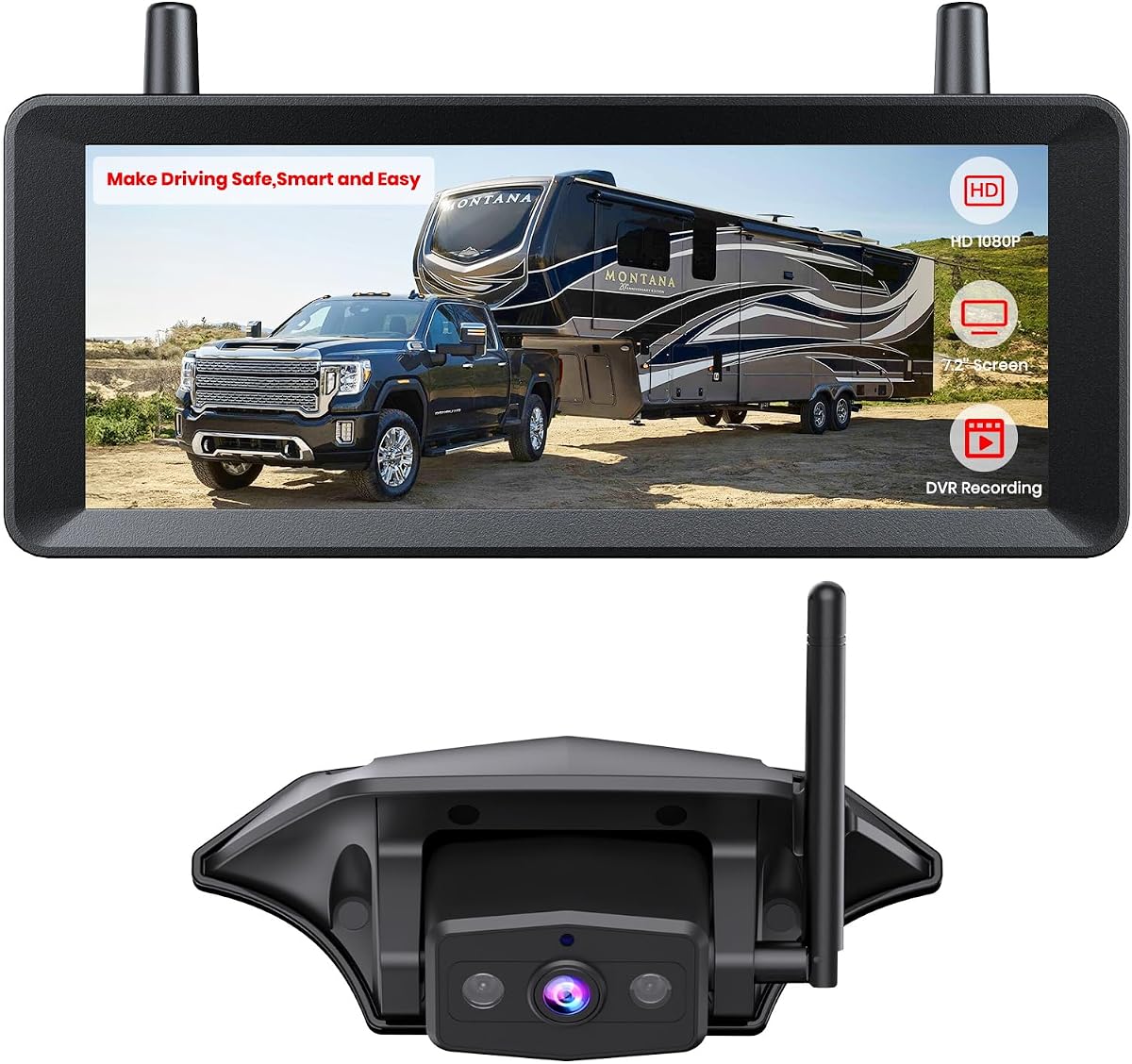
The AUTO-VOX Wireless RV Backup Camera System with Dual Lens Rear and Side Coverage is one of the most adaptable systems in this roundup. It combines a 7.2-inch HD screen, a rear camera with two viewing modes, and side cameras, earning a 4.4 rating among the strongest choices here.
We may earn a commission when you buy through this link, at no additional cost to you.
The dual-lens rear camera is the system’s defining advantage. One view looks farther down the road behind the RV, while the lower bumper view helps with hookup alignment, hitch-area checks, and close obstacle avoidance. Side cameras add coverage around the rear corners, which is valuable in narrow RV parks, tight campsites, and locations where mirrors cannot show enough of the surroundings.
Dual antennas on both the rear camera and monitor help the wireless link remain responsive across longer setups. The stated open-area test distance is up to 500 feet, with coverage intended for rigs longer than 60 feet. A 1080P image, infrared night vision, flexible monitor power, and built-in DVR round out a feature-rich package, though recording requires a separately sold microSD card.
Choose this system if maneuvering confidence matters more than the simplest possible installation. It is particularly attractive for owners who want multiple perspectives without abandoning a large HD display. The extra hardware and camera placement planning are justified for large RVs, frequent campsite navigation, and drivers who want both close and extended rear views.
A long road-facing lens is useful while towing, while a close lower view helps judge hookups, posts, and the hitch area. Having both perspectives available reduces guesswork during different stages of reversing.
Side cameras make the system useful beyond basic rear alignment. They help users inspect rear corners, parked vehicles, campsite posts, and other areas that may remain hidden in side mirrors.
We may earn a commission when you buy through this link, at no additional cost to you.
The AUTO-VOX Wireless RV Backup Camera with 30-Minute Plug and Play Setup combines a 7.2-inch widescreen display with an easy installation path for factory pre-wired RVs. Its 4.3 rating reflects a practical balance of rear visibility, expandable camera support, night vision, and recording.
We may earn a commission when you buy through this link, at no additional cost to you.
For an RV with existing compatible pre-wiring, installation typically takes 20 to 30 minutes and may avoid extra drilling. Non-prewired rigs can use included adapters connected to taillight power. The system’s wide-angle lens is designed to clarify curbs, posts, trees, license plates, and road signs when squeezing between trailers or entering storage spaces.
This product also considers travel rather than only parking. Dual antennas are intended to maintain a stable connection on trailers and fifth wheels up to 60 feet. It can expand to three cameras with a three-way split screen, and the included 32GB card provides a visual log of trips or incidents. Automatic brightness adjustment and long-range infrared illumination support late-night arrivals.
This is a strong recommendation for owners of a compatible pre-wired RV who want room to add side cameras later. It may be less convenient for a completely unprepared vehicle because connecting to taillight power and adapting the mounting location requires more work than the headline installation time suggests.
The camera fits compatible factory pre-wired housings, reducing drilling and cable routing. For other rigs, the included taillight-power adapters provide an alternative installation route.
Support for up to three cameras allows owners to add rear and side blind-spot coverage. A three-way split screen keeps multiple perspectives visible during parking and slow maneuvering.
We may earn a commission when you buy through this link, at no additional cost to you.
The Fookoo HD 1080P 7-Inch Wireless Backup Camera System is designed for RV owners who want a responsive display and broad camera support. It carries a 4.4 rating and pairs a 7-inch IPS screen with a 1080P camera, automatic dimming, touch controls, and support for as many as four cameras.
We may earn a commission when you buy through this link, at no additional cost to you.
Its physical installation can be straightforward for many Furrion pre-wired RVs because the camera fits most compatible Furrion mounting locations. However, the product description explicitly notes that it is not compatible with Furrion’s system because the underlying technologies differ. Owners with other pre-wired arrangements can still install the camera by securing it and connecting it to vehicle power.
The camera carries an IP69 waterproof rating, a 120-degree viewing angle, and six infrared lights that activate in low ambient light. Dual antennas and 2.4GHz technology support a stated open-area reception range of up to 200 feet. Loop recording, optional windshield or table mounting, and adjustable parking lines add convenience, but compatibility with certain GMC, Chevrolet, and Ford PWM circuits may require an appropriate power adapter or filter.
The Fookoo system is a good match for an RV with a compatible pre-wired mount and a preference for a touchscreen-style interface. It offers more expansion potential than most single-camera sets, although buyers should confirm their exact mounting and power arrangements before ordering.
The 7-inch IPS panel offers crisp visuals, touch buttons, and automatic brightness changes. It is large enough for detailed parking work without requiring the compact footprint of smaller monitors.
Some newer Chevrolet, GMC, and Ford circuits use PWM signals that can cause flickering or failure. A compatible power adapter or filter may therefore be necessary for reliable operation.
We may earn a commission when you buy through this link, at no additional cost to you.
The 1080P Strong Magnetic Wireless Backup Camera is the quickest installation concept in this guide. Its magnetic base attaches directly to a metal surface without screws or wiring, and the system has a 4.5 rating, the highest among the ten products listed.
We may earn a commission when you buy through this link, at no additional cost to you.
Installation is designed to take about a minute, making this camera attractive for owners who move between an RV, truck, boat, fifth wheel, horse trailer, or camper. The magnetic base is described as stronger than the camera itself, with vibration testing and a scratch-resistant rubber layer intended to protect the mounting surface.
Image features include 1080P resolution, infrared low-light assistance, and a 170-degree lens. A built-in solar panel charges the battery daily, while USB-C provides an alternative for cloudy periods. The stated stable link extends to 56 feet and is described as supporting use on 40-foot trailers at highway speeds, although that range is shorter than several hardwired multi-camera alternatives.
This is the choice for renters, travelers, and RV owners who prioritize portability over comprehensive blind-spot coverage. It avoids permanent modifications and can move between vehicles, but it provides a single wide rear view rather than separate side perspectives. A metal mounting surface and careful placement are essential to maintain a secure view.
The reusable magnetic base changes the usual installation process. It can be placed where the rear view is most useful, removed in seconds, and transferred to another compatible metal-bodied vehicle.
The integrated solar panel handles routine charging, while USB-C offers a backup method when sunlight is limited. This battery-powered approach avoids a permanent connection to the RV’s electrical system.
We may earn a commission when you buy through this link, at no additional cost to you.
The AUTO-VOX Wireless RV Backup Camera System with Rear and Side Coverage is designed for drivers who want a consolidated view of the area around a long RV. It has a 4.2 rating, a 7.2-inch HD display, rear and side coverage, and an included 32GB card for automatic recording.
We may earn a commission when you buy through this link, at no additional cost to you.
Viewing options are a major strength. The screen can show a full view while driving and switch to split views during backing, tight turns, and campsite alignment. Rear and both side angles help users monitor traffic, neighboring vehicles, campsite posts, and the corners of their rig in situations where mirrors alone are insufficient.
Dual antennas help the system maintain a responsive connection, and the stated open-area test range reaches 500 feet for setups including rigs longer than 60 feet. The 1080P image, automatic infrared night vision, and flexible USB or 12V monitor power support both travel and late-day parking. The DVR begins when the system is powered and overwrites older clips as needed.
This system is a strong fit for large RVs and fifth wheels that benefit from broad situational awareness. Its main disadvantage is the greater installation work required to place multiple cameras correctly. The monitor also requires a power connection, so wireless video does not mean completely wire-free operation.
Rear and both side perspectives can be monitored together, while full-screen mode provides a larger view of the most important angle. This makes the display useful for both highway awareness and precise parking.
The built-in DVR records automatically and saves footage to the included 32GB card. Loop-style overwriting keeps continuous documentation without requiring the driver to start each recording manually.
We may earn a commission when you buy through this link, at no additional cost to you.
The RV Backup Camera Wireless Recording Dual Cameras system pairs a 7-inch 1080P HD monitor with two cameras and the ability to expand to four channels. Its 4.4 rating and broad feature set make it a practical choice for RVs, trucks, trailers, campers, fifth wheels, and heavy-duty vehicles.
We may earn a commission when you buy through this link, at no additional cost to you.
Single, dual, and quad split views provide flexible coverage. The included custom metal adapter can fit many factory pre-mounted RV bases, reducing drilling and speeding installation. A 150-degree camera lens reduces blind spots, and dual antennas support a stated 300-foot open-area signal distance with stable HD video.
The cameras have an IP69K waterproof rating, and the housing is specified for temperatures from -23°F to 179°F. Reversing guidelines can be moved and resized or turned off, helping less experienced drivers align a towable RV. DVR loop recording supports a microSD card up to 256GB, although that card is not included.
This system stands out for owners who want four-channel potential without buying the largest display in the roundup. The important caveat is that the video link is wireless, while both the cameras and monitor need wired 12V power. Buyers should therefore treat it as a wire-reduced rather than entirely wire-free installation.
Two cameras are included, and the monitor can support as many as four. Users can select single, dual, or quad layouts according to whether the priority is a detailed view or full surrounding coverage.
The reversing guides can be moved up, down, left, and right, with adjustable width. Turning them off entirely provides flexibility for drivers who prefer an unobstructed image.
We may earn a commission when you buy through this link, at no additional cost to you.
The AUTO-VOX Wireless RV Backup Camera System with Rear and Side Cameras combines a 7.2-inch monitor, 1080P infrared imaging, and a three-way split screen. It holds a 4.3 rating and is aimed at RV owners who want more than a single rear image without moving to a much larger display.
We may earn a commission when you buy through this link, at no additional cost to you.
For compatible pre-wired RVs, the included adapter bracket and pigtail harness simplify installation. Otherwise, the camera can connect to a 12V source. The rear and side views are useful when changing lanes with a long trailer, checking traffic behind the rig, and navigating narrow campground roads where parked RVs and scenery sit close to the vehicle.
Dual antennas support a stated transmission distance of up to 500 feet. The camera’s IP69K construction is designed to withstand rain, road spray, and dust, while built-in infrared LEDs improve visibility after sunset. DVR recording is available with a compatible microSD card, which is sold separately, allowing footage to be reviewed following a traffic incident.
This product is a balanced multi-camera option for travel trailers and RVs that want flexible viewing and incident documentation. Buyers should verify the included camera arrangement, obtain a suitable storage card if recording is important, and confirm that their rig’s wiring and mounting points are compatible.
The rear and side perspectives make it easier to check traffic and nearby objects before moving a long rig across lanes. The same coverage assists when slowly navigating tight campground roads.
With a compatible microSD card installed, the DVR can preserve footage for later review. That makes the system useful when documenting unexpected traffic events or campsite maneuvering.
We may earn a commission when you buy through this link, at no additional cost to you.
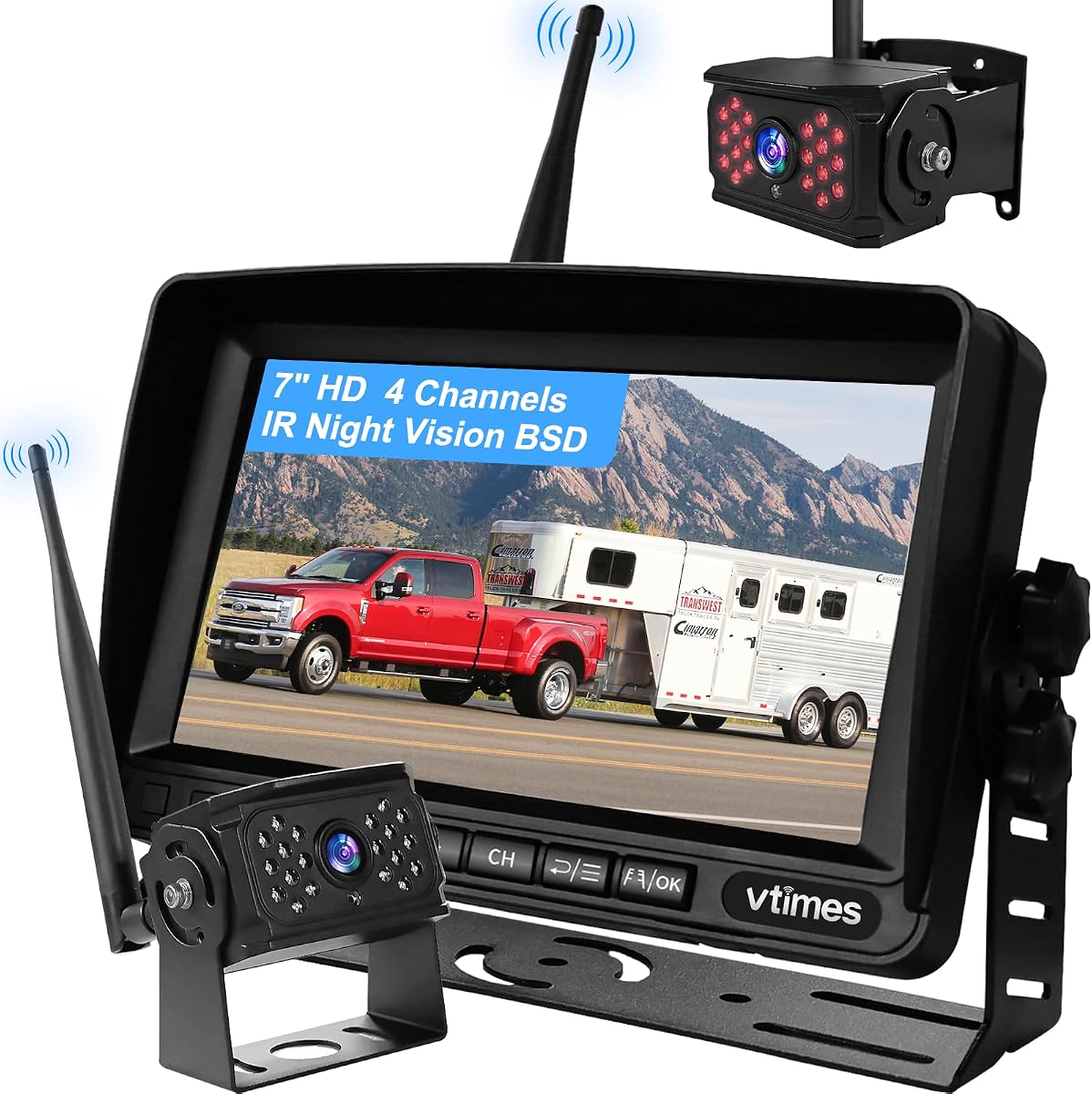
The VTimes Wireless Backup Camera for Trucks and RVs combines a 7-inch display with a long-range wireless link, blind-spot detection, and four-channel recording. It has a 4.2 rating and differentiates itself through audible alerts designed to call attention to people or objects in monitored blind spots.
We may earn a commission when you buy through this link, at no additional cost to you.
The built-in BSD function can be switched on or off. When active, it highlights detected objects or people on the monitor and provides an audible warning, adding a layer of information beyond the image itself. The 2.4GHz encrypted transfer system has a stated open-area range of up to 984 feet, or 300 meters, although real results will depend on surroundings and installation.
Installation uses a cigarette-lighter connection for the monitor and wiring to a tail, reversing, or running light for the camera. An included bracket and pigtail support Furrion pre-installed systems, while the all-metal camera carries an IP69K rating for outdoor use. Automatic night vision uses 20 infrared lights, and customizable parking lines help frame the reversing area.
Continuous recording and playback can cover four video channels at once, but a microSD card between 8GB and 128GB must be supplied separately. This system is a good fit for owners who value warnings and long-range transmission as much as the visual display, particularly when using the camera for both parking and travel awareness.
Blind-spot detection highlights a person or object and adds an audible warning. This can help draw attention quickly when a hazard is not immediately obvious in the video.
The stated transmission distance of up to 984 feet in open areas provides ample room for many trailer configurations. Real-world performance will still depend on obstacles, interference, and camera placement.
We may earn a commission when you buy through this link, at no additional cost to you.
The AUTO-VOX RV Backup Camera Wireless Plug and Play Compatible with Most RV is a straightforward three-channel system for travel trailers, fifth wheels, trucks, and other large vehicles. Its 4.1 rating is the lowest in the group, but the product offers a large display, flexible installation, and expandable camera coverage.
We may earn a commission when you buy through this link, at no additional cost to you.
Compatible pre-wired systems can use the supplied mounting bracket adapter and pigtail wire, and non-prewired vehicles can draw power from taillights, running lights, or marker lights. The 7.2-inch widescreen monitor provides a substantial rear image, while a super-wide lens is intended to help with trees, campsite obstacles, and tight alignment.
Dual antennas support a stated 500-foot test range. The camera uses a 1080P color chip and infrared night vision, giving users a clearer view at night and while securing a campsite. Up to three cameras can be added, allowing rear and side views or additional coverage at doors and windows. DVR recording is supported with an SD card.
This system makes the most sense for owners who want a versatile setup without the highest possible feature level. Confirm your RV’s pre-wiring arrangement, identify a suitable constant power source, and add compatible storage before relying on the recording function. Its broad compatibility and three-channel potential remain meaningful advantages.
The included bracket adapter and pigtail simplify use with compatible factory wiring. Rigs without pre-wiring can still use the camera with suitable tail, running, or marker-light connections.
Three-channel support allows additional cameras to cover both sides or other areas around the RV. That flexibility can help with campsite monitoring and blind spots during slow travel.
We may earn a commission when you buy through this link, at no additional cost to you.
Choosing an RV backup camera involves balancing installation demands, image quality, wireless reliability, coverage, and recording needs. The right choice depends on your rig’s wiring, typical parking conditions, and whether a portable rear view or comprehensive multi-camera monitoring is the priority.
Choose a pre-wired-compatible model for the simplest installation, or a wired system when reliability and placement flexibility matter most. Confirm connector type, mounting dimensions, and available 12V power before ordering.
For long rigs, favor dual antennas and a stated range comfortably above your setup length. For short travel trailers, a shorter range may still provide ample room if the camera and monitor are unobstructed.
Choose one camera for straightforward rear alignment or multiple cameras for campsite maneuvering and highway awareness. Match the channel count to how many sides of your RV regularly remain hidden from your mirrors.
Prioritize automatic night vision for frequent nighttime travel. Position the camera so infrared illumination covers the ground area you need to judge rather than shining directly into reflective surfaces.
Choose a larger display for multiple camera views and detailed parking. Choose a smaller screen when dashboard space, simple controls, and automatic activation are more important.
Select a system with included storage if documentation matters from day one. If you will add your own card, verify capacity, format requirements, and the need for continuous loop recording.
Prioritize a well-sealed camera for exposed outdoor mounting. Regardless of rating, mount the unit securely and inspect the housing, lens, and cable connections periodically.
Choose a magnetic system for portability and rapid setup. Choose a wired multi-camera system when permanent coverage, flexible channel layouts, and maximum integration with your RV are the priority.
Begin by identifying the correct camera and monitor power sources, then pair the display before mounting the camera permanently. For pre-wired RVs, use the supplied adapter bracket or pigtail only after confirming compatibility. For a hardwired installation, connect the camera to an appropriate 12V source and route the cable away from hinges, suspension components, exhaust heat, and sharp edges. A magnetic system can be attached to a clean metal surface after its battery has been charged.
Use the display at a glance rather than staring continuously while driving. Review the selected camera view before reversing, switch between long-range and close views when available, and adjust the guide lines so they correspond to your trailer or RV. At night, allow the camera to activate its infrared mode automatically. When parking, move slowly and still use mirrors and direct observation because a wireless image can be affected by interference or mounting alignment.
Clean the camera lens with a soft cloth, keep the seal and housing free of mud and road salt, and check that the mount remains tight. Inspect wiring for chafing, moisture, or loose connectors, and avoid pressure washing directly against seals. Keep the monitor’s vents unobstructed, format and manage recording storage as directed, and update or replace the battery on a magnetic system according to its charging guidance.
Usually not. Wireless refers to the video transmission between the camera and monitor, while most systems still require a 12V power connection for the camera and monitor. Magnetic battery-powered models can operate without permanent wiring, although their field of view, range, and recording options may differ from hardwired multi-camera systems.
It depends on the model. The systems reviewed support between one and four camera channels. Some include a rear camera, while others include multiple cameras or allow owners to add rear, side, door, or window views using compatible units and the manufacturer’s supported setup.
A camera may fit a common pre-wired mounting position without being electronically compatible with the original system. Check connector type, power requirements, bracket dimensions, and manufacturer guidance before ordering. Some vehicles may also require a PWM filter or specialized power adapter for reliable operation.
The range should comfortably exceed the distance between the camera and monitor, especially for long fifth wheels and travel trailers. Stated maximums generally describe open-area performance, so dual antennas and an unobstructed placement remain important. Walls, trees, metal structures, and other interference sources can reduce the effective range.
Many systems support DVR loop recording, which can save footage while the system is powered and overwrite older files. Some packages include a microSD card, while others require one to be purchased separately. Check the card capacity, recording behavior, and whether the monitor can record several channels simultaneously.
Night vision is highly useful for late campground arrivals, dark storage lots, and roadside parking. It helps reveal posts, animals, branches, and other low obstacles beyond what the taillights illuminate. The included products use infrared-assisted imaging, though camera placement and environmental conditions will affect the final picture.
A magnetic camera is best for quick installation, portability, and moving between vehicles. A permanent system is better for broader camera coverage, stable positioning, and integrated RV power. Consider your rig’s wiring, available mounting surfaces, desired number of views, and willingness to route or connect power.
No. A backup camera adds a rear or multi-angle perspective, but drivers should continue using mirrors and direct observation whenever possible. Cameras can be obstructed, affected by signal conditions, or limited by their mounting angle, so they are an aid to safer maneuvering rather than a replacement for good visibility practices.
The 1080P Strong Magnetic Wireless Backup Camera is the most convenient pick for quick, tool-free setup, while the AUTO-VOX Dual Lens Rear and Side Coverage system stands out for flexible viewpoints and large-RV maneuvering. The Furrion Vision S offers a compact, security-minded alternative with automatic activation and a smaller footprint.
For a pre-wired RV, prioritize confirmed mounting and power compatibility. For a non-prewired rig, plan the power connection carefully. Long trailers should look for dual antennas and sufficient open-area range, while drivers who often navigate tight campsites may receive more benefit from side cameras, split-screen views, a close bumper perspective, and infrared night vision than from a larger single-camera display.
Ratings, product configurations, availability, and prices can change, so check the current Amazon listing and included components before ordering. Also verify whether a storage card, power adapter, mounting bracket, or other accessory must be purchased separately to achieve the setup and recording features you want.