
Gorilla Super Glue Gel XL
4.6Editor score
Controlled no-run gel formula
Impact-resistant bonding technology
Metal-pin anti-clog cap
Crystal-clear cured finish
Discover the best super glue for 3D prints, with ten expert-reviewed options compared for material fit, precision, setting speed, strength, and ease of use.
Super glue can transform a loose, damaged, or unfinished 3D print into a functional assembly, but the wrong formula may run, fog, embrittle, or bond poorly to the chosen filament. A useful product for 3D printing must combine reliable adhesion with enough viscosity and applicator control for small joints, layered surfaces, and detailed miniatures.
This guide compares ten cyanoacrylate and plastic-model adhesives based on the supplied product information, including compatible materials, viscosity, applicator design, setting time, cure behavior, transparency, and intended repairs. It covers options for PLA, PETG, ABS, PVC, resin, and mixed-material projects, from fine-tip liquids to thicker gels and dual applicators.
Each review explains where a glue stands out, identifies practical trade-offs, and clarifies the types of prints it suits best. Ratings reflect the listed customer feedback rather than a personal laboratory test, and product availability may change. Check the current listing and material-compatibility information before making a final purchase.
4.6Editor score

4.7Editor score

4.7Editor score
The comparison below highlights applicator style, material compatibility, setting behavior, and the repair situations best suited to each adhesive. Together, these details show why a general-purpose gel, thin CA liquid, model glue, or dual-formula kit may be appropriate for different 3D-printing projects.




This purpose-built 3D-printing adhesive has a 4.7 rating and stands out for its direct focus on printed parts. Its cyanoacrylate formula is described as bonding PLA, ABS, PETG, resin, and other common 3D-printing materials, giving it broader appeal than a glue formulated primarily for household plastics. It is intended for functional parts, prototypes, models, miniatures, repairs, assembly, and reinforcement rather than only quick household fixes.
We may earn a commission when you buy through this link, at no additional cost to you.
The 40g squeeze bottle with a precision tip is perhaps its most practical feature for additive-manufacturing work. Layered prints and miniature components often have tiny landing areas, where a free-flowing liquid can spread beyond the intended joint. A targeted nozzle gives the user more opportunity to control the amount and location of adhesive, which is especially useful when joining separate printed sections or reinforcing a stressed area.
Its fast-setting industrial-strength cyanoacrylate approach also makes it convenient for iterative assembly. Cyanoacrylate bonds quickly, but the exact result depends on joint design, surface cleanliness, fit, and the materials involved. The product information does not specify a detailed set-time range or full cure time, so users should allow the joint to sit undisturbed rather than assuming the initial grip represents the final strength.
This is the strongest all-around recommendation for someone who wants one adhesive for multiple 3D-printing tasks. It combines an explicitly broad material claim with a precision application format and a stated role in both assembly and repair. The main caveat is normal cyanoacrylate handling: work on a protected surface, avoid contact with skin and eyes, and provide ventilation while the bond cures.
The pointed applicator is valuable for miniatures, articulated figures, and printed mechanisms with small contact surfaces. It helps place adhesive only where needed, reducing the likelihood of visible overflow around detailed parts.
Explicit compatibility with PLA, PETG, ABS, and resin makes this a practical option for mixed print collections. Users can still conduct a small test because additives, surface texture, and joint geometry can affect adhesion.
We may earn a commission when you buy through this link, at no additional cost to you.
Gorilla Super Glue Gel XL earns a 4.6 rating and is a strong choice when control matters more than maximum flow. Its no-run gel formula is thicker than ordinary liquid super glue, which can be a major advantage on vertical 3D-print assemblies, detailed miniatures, and joints where adhesive would otherwise migrate. The tube is also compatible with plastics, wood, metal, ceramic, rubber, leather, paper, and glass.
We may earn a commission when you buy through this link, at no additional cost to you.
This adhesive combines rapid handling strength with a stated full cure of 24 hours. The listed setting range of 10 to 45 seconds means it can be positioned and held without extensive clamping, while the complete bond continues developing afterward. That distinction matters for load-bearing prints, articulated pieces, and repairs where the joint should not be flexed during the first minutes of curing.
Gorilla's Impact Tough technology is another important feature. The product is designed to increase impact resistance and strength, making it more suitable than a basic brittle adhesive for parts that will experience handling, vibration, or everyday stress. It dries clear without the foaming associated with some gap-filling products, which helps preserve the appearance of a repaired print.
The bottle's metal-pin anti-clog cap is valuable in a hobby workshop where glue may sit between projects. A stable, controlled gel is particularly helpful for models, fixtures, prototypes, and vertical repairs, although a thin liquid may work better when adhesive must penetrate a close-fitting joint. This is the premium option for users who value a clean finish, controlled placement, and impact-resistant performance.
The thicker gel stays closer to the application point and is well suited to vertical or intricate assemblies. It offers a cleaner workflow when a watery liquid would spread across visible surfaces or collect in recesses.
A 10-to-45-second set provides enough time to align the parts, but the advertised 24-hour cure means the joint should remain undisturbed. Avoid flex testing immediately after assembly.
We may earn a commission when you buy through this link, at no additional cost to you.
This 30g plastic model glue has a 4.4 rating and is positioned for lightweight assembly work involving miniatures, toy cars, interlocking model pieces, ABS, and PVC. The thin consistency can flow into close-fitting joints, which is useful when two printed parts must be joined without adding a thick adhesive layer. It offers a quick route to repairing small household and hobby models.
We may earn a commission when you buy through this link, at no additional cost to you.
Its stated setting time of 10 to 30 seconds supports rapid work on individual pieces. The manufacturer also advertises a 30% strength increase compared with super glue, although that comparison should not be treated as a universal performance measure for every joint and material combination. The more useful practical distinction is that this is a plastic-focused model adhesive rather than a general-purpose household gel.
The transparent formula is appealing for colored prints, toys, and miniatures because the adhesive can remain visually unobtrusive. An anti-clogging cap is also included, helping preserve the remaining glue and reducing waste during frequent model work. Once fully cured for 24 hours, the product is described as waterproof, so it can be considered for parts exposed to moisture after assembly.
This glue is best for small model builds, inexpensive repair projects, and users who want fast placement rather than a long positioning window. Its specific ABS and PVC emphasis means it should not automatically be assumed to perform equally well on PETG, PLA, or resin. Test on scrap material before committing an important print, and use the stated glove recommendation when handling it.
A thinner adhesive can reach small contact areas without creating a bulky glue layer. This makes the product practical for miniature assemblies and closely aligned printed components.
The transparent formula is suited to painted or colored models where an opaque or cloudy joint would be visible. Cure the assembly fully before exposing it to moisture.
We may earn a commission when you buy through this link, at no additional cost to you.
This heavy-duty plastic super glue has a 4.5 rating and targets toys, models, miniatures, interlocking construction pieces, and 3D-printed parts. It explicitly lists PLA, ABS, and PVC, making its intended applications more apparent than those of a generic household adhesive. The product is positioned as a quick-setting solution for immediate repairs and compact assemblies.
We may earn a commission when you buy through this link, at no additional cost to you.
A fine-tip nozzle is the key feature for detailed work. It allows the user to place a small quantity at a specific joint, helping reduce overflow on visible surfaces and avoiding the wasteful application often seen with a liquid stream. The cap is designed to help prevent the nozzle from drying out, which supports repeated use over the life of the bottle.
The adhesive is advertised as crystal clear and colorless, which helps a repair remain visually discreet after the model has been painted or assembled. Its high-strength formula is also described as capable of withstanding daily use and stress, although actual performance will depend on the geometry of the joint and whether the printed surfaces have been cleaned.
This product is a good match for miniature modelers and makers who repair rather than load-bearing functional parts. Rapid bonding is convenient, but it also means users should confirm alignment before the adhesive grabs. Because the listing does not provide a full cure time, allow additional settling time before handling the model aggressively. A test on a scrap print remains the safest way to confirm compatibility.
The narrow nozzle helps keep adhesive confined to small landing areas. This is particularly useful when repairing a detailed figurine or reinforcing a joint that remains in view.
Support for PLA, ABS, and PVC makes this a practical choice for mixed plastic models. Confirm compatibility with the specific resin or filament and any surface coating before use.
We may earn a commission when you buy through this link, at no additional cost to you.
This CAMALEAO adhesive set has a 4.7 rating and pairs a 1oz bottle of medium-viscosity super glue with an additional 3g aluminum tube of gel. The two textures are useful in a 3D-printing workflow: the liquid can handle more precise, close-fitting work, while the gel offers greater control on uneven surfaces or during vertical assembly.
We may earn a commission when you buy through this link, at no additional cost to you.
The liquid is described as providing high-strength bonding in 15 to 20 seconds, while the gel reaches a stated higher strength and sets in 10 to 45 seconds. Its 750 CPS viscosity and 0.008-inch permeability are intended to balance flow with control. These details are particularly relevant to precision bonding of hobby models, aquascapes, and PLA, ABS, or PETG prints.
The package design includes an easy-to-squeeze bottle and an anti-clogging cap with a built-in steel pin. The aluminum gel tube is portable and convenient for carrying a smaller amount to a club, classroom, or away-from-home repair session. Compatibility extends to plastics, metals, leather, wood, ceramics, and pottery, which makes the set useful beyond the print itself.
This combination offers excellent value for a maker who wants both liquid and gel without managing several unrelated adhesives. The main limitation is that the set is less focused on a single filament than the dedicated 3D-print glue, so testing remains important. Store the product dry, away from light, and within the stated temperature range to preserve its advertised 24-month shelf life.
The thinner liquid is useful for fine model details and close fits, while the gel is better suited to vertical positioning and less precise surfaces. Having both can prevent repeated compromises in assembly technique.
The compact gel tube is easy to carry and useful for a small repair away from the main workbench. Keep the cap secure and store the tube away from heat and moisture.
We may earn a commission when you buy through this link, at no additional cost to you.
This transparent plastic repair gel carries a 4.5 rating and is intended for PLA and ABS prints, PVC parts, acrylic models, toys, car components, and general crafts. It uses a precision applicator tip for controlled placement and a low-stringiness formulation, which can make repeated small repairs easier than working with a freely flowing adhesive.
We may earn a commission when you buy through this link, at no additional cost to you.
Its handling sequence is particularly attractive for quick work. The parts are held together for 5 to 10 seconds for an initial fix, the glue sets within 60 seconds, and it fully hardens in 5 to 10 minutes. This provides a short alignment window without requiring the long restraint associated with some slower-curing plastics. Users should still avoid stressing the joint until the stated full-hardening period has passed.
Unlike a rigid, brittle glue film, the product is described as forming a tough and highly elastic bond. That characteristic is useful for repaired joints that may encounter vibration, impact, or minor flexing. It can also bridge uneven, rough, and vertical surfaces, making it more forgiving than a thin liquid on a poorly supported print.
The gel can bond plastic with fabric, wood, and metal, which is valuable when a printed part is only one component of a larger assembly. Its low-odor, transparent formula is helpful for discrete repairs, but safety still depends on good ventilation, protective gloves, and keeping the adhesive away from eyes and skin. It is a strong choice for mixed-material and repair-heavy 3D-printing work.
The elastic cured film is intended to tolerate some movement better than a brittle adhesive. It can suit repaired toys, mechanisms, and model components that experience regular handling.
Gap-filling gel is more forgiving on rough and vertical surfaces than a very thin liquid. It can also bridge plastic to metal or other non-metallic components.
We may earn a commission when you buy through this link, at no additional cost to you.
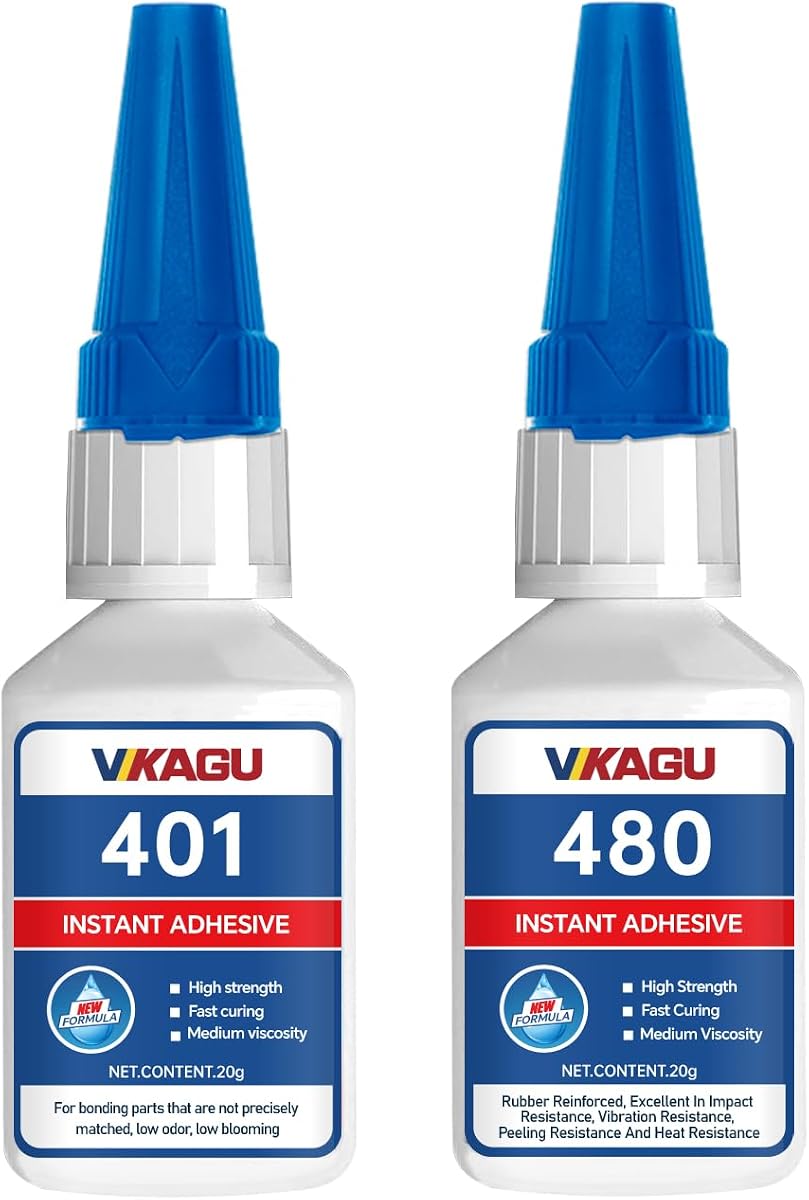
This two-pack has a 4.6 rating and distinguishes itself by offering two complementary formulas rather than a single general adhesive. The 401 clear medium-viscosity product is designed for fast, rigid bonding, while the 480 black formula is rubber toughened for high-stress and impact-sensitive applications. The bundle therefore covers rigid printed parts and components that need more flexibility.
We may earn a commission when you buy through this link, at no additional cost to you.
The 401 formula is listed as suitable for ceramics, stiff plastics, PLA, PETG prints, wood, and O-ring splicing. It is described as penetrating tight spaces and curing in seconds, with the product data specifying a 3-to-10-second set. This makes it a candidate for assembling rigid prototypes where fit is close and repositioning must be quick.
The 480 formula has a longer 10-to-30-second set to provide positioning time. It is intended for high-stress parts, vibration, peeling, and thermal cycling, with applications including rubber components, weather stripping, and speaker repairs. Its black finish makes it less suitable for a concealed joint on a finished model, but it may be valuable where appearance is secondary to resilience.
This set is a strong option for users who want a workshop with more than one performance profile. Precision tips and stainless-steel-pin anti-clog caps help control dispensing and preserve the formulas. The safety warning is serious: both products can bond skin and eyes in seconds, so wear gloves and eye protection, work with ventilation, and never treat the clear or black adhesive as harmless.
Use the clear 401 for a fast rigid joint and the black 480 when shock, vibration, or flexing is the greater concern. Matching the formula to the joint can be more useful than settling for one compromise adhesive.
The 480 adhesive cures somewhat more slowly but offers useful positioning time and rubber-enhanced toughness. Its black appearance is a consideration for finished models with visible seams.
We may earn a commission when you buy through this link, at no additional cost to you.
This 1500 CPS super glue gel has a 4.4 rating and stands out with two dispensing methods. A fine brush offers steady, controlled application on tiny or delicate components, while the nozzle provides more adhesive for larger surfaces. That versatility is helpful in 3D printing because a single project may involve both a miniature-scale detail and a broader reinforcing joint.
We may earn a commission when you buy through this link, at no additional cost to you.
The applicators are intended to reduce mess and keep the adhesive focused. The brush can spread a controlled film along a seam, and the nozzle can deliver a small bead when a model has a larger flat contact area. The product is advertised as suitable for plastics, rubber, wood, metal, glass, ceramics, jewelry, leather, and toys, giving it broader repair utility than a narrowly specialized model adhesive.
The gel grips in 15 to 45 seconds and fully cures within 24 hours, according to the supplied listing. It is also described as resistant to moisture, heat, and wear after curing. As with all cyanoacrylate products, the apparent quick bond should not be mistaken for immediate full-strength performance.
This product is a good pick for detail-oriented hobbyists who want more than a standard pointed nozzle. It can be especially helpful for reinforcing irregular seams where a brush distributes adhesive more evenly. Keep the applicators clean, close the cap securely, and avoid allowing the brush to harden against the bottle neck. Safe handling remains essential because the adhesive bonds skin and eyes rapidly.
The fine brush gives the user more visual control over a thin adhesive layer. It is useful for delicate miniatures, small decorative parts, and seams where a narrow bead would be difficult to place.
The precision nozzle is the faster option when a joint needs a small bead or a larger amount of adhesive. Clean either applicator after use to prevent curing and clogging.
We may earn a commission when you buy through this link, at no additional cost to you.
This two-pack of clear Gorilla Super Glue has a 4.5 rating and combines two 12g bottles with brush and precision-tip applicators. The two dispensing options are a meaningful benefit for 3D-print repairs: the brush is suited to controlled, spread-out application, while the narrow tip is better for placing a small bead on a joint.
We may earn a commission when you buy through this link, at no additional cost to you.
The adhesive is described as all-purpose and compatible with glass, plastic, wood, metal, ceramic, rubber, leather, and paper. Its fast-setting formula dries in 10 to 45 seconds and does not require clamping. This fast initial grip is useful for model assembly, though users should allow the bond to reach its full cure before applying significant stress.
Impact-resistant design is another advantage for printed parts that will be handled repeatedly. The clear finish can conceal repairs on transparent or lightly colored components. The special anti-clog cap is intended to keep the bottle usable between sessions, which matters more with fine nozzles that can otherwise trap hardened adhesive.
The main tradeoff is redundancy: two bottles of a broadly similar product may be less useful to a user than one bottle plus a different viscosity. Nevertheless, the set is convenient for separating workshop and portable kits or for keeping one bottle dedicated to fine detail. It is a dependable choice for hobby repairs, general assembly, and 3D-printed plastic parts where quick placement and discreet results matter.
The brush supports smoother coverage on a seam, while the precision tip reduces waste on small joints. Select the applicator according to the scale and geometry of the repair.
The two-pack makes it easier to keep separate supplies for different projects or locations. Seal each bottle after use to reduce nozzle clogging and premature drying.
We may earn a commission when you buy through this link, at no additional cost to you.
Loctite 454 Surface Adhesive Gel is a compact 3gm tube with a 4.6 rating. It is designed to create strong bonds between surfaces such as rubber, leather, plastic, and metal, making it relevant when a 3D-printed component is being attached to a non-printed part or repaired at a specific contact surface.
We may earn a commission when you buy through this link, at no additional cost to you.
The transparent gel is useful for discreet repairs on finished models, prototypes, and household components. Unlike a highly fluid cyanoacrylate, a gel can be easier to control on uneven or vertical surfaces. Because the tube contains only 3 grams, it is best suited to targeted repairs rather than extensive assembly or high-volume model production.
The listed full cure time is 24 hours, and the product data does not provide a specific initial set time. Users should therefore avoid assuming immediate handling strength. The surface-focused formulation suggests that clean, dry, appropriately prepared contact areas may be especially important for achieving a dependable result.
This adhesive is a good option for compact kits and occasional repairs where a small amount of clear gel is enough. It can bond a printed plastic piece to rubber or metal, while its multi-material support makes it useful for hobby work beyond the printer. Users should store the tube tightly closed, protect it from moisture, and allow the joint to cure undisturbed.
The 3gm tube occupies little space and is practical for a portable repair kit. It is best for small joints rather than repeated assembly of large printed models.
The clear gel is useful when joining a printed component with rubber, leather, plastic, or metal. Clean the surfaces carefully and allow the stated cure time before loading the connection.
We may earn a commission when you buy through this link, at no additional cost to you.
The right adhesive depends on the printed material, joint geometry, required appearance, and amount of stress the repaired part will endure. The following factors help narrow the field before making a purchase.
Start by confirming that the adhesive explicitly supports the filament or resin in your project. PLA, PETG, ABS, PVC, acrylic, and resin are not interchangeable simply because they are all plastics; additives, surface finishes, and chemical composition can change adhesion. Some products in this guide name several common materials, while others focus on ABS, PVC, rigid plastics, or general household surfaces. A broad compatibility claim is convenient, but it is not a substitute for a small test on the same type of print you intend to repair.
Choose an adhesive that names your primary material whenever possible, and test it on an offcut or hidden area first.
Thin liquids can penetrate close-fitting joints and create a low-profile bond, while gels remain more localized and are easier to control on vertical or uneven surfaces. A thick gel may not fully reach the center of a tight mechanical fit, and an extremely thin liquid can spread beyond the intended connection. Medium-viscosity formulas offer a middle ground and are often easier for beginners to place than water-like glue. Think about whether the joint needs penetration, gap filling, surface coverage, or simply localized bonding.
Match the glue thickness to the joint: thin for tight fits, gel for vertical or uneven surfaces.
Fine tips, precision nozzles, and brushes are especially valuable for miniatures, articulated models, and repaired areas that remain visible. A brush can distribute a thin layer along a seam, a pointed nozzle can target a small landing surface, and a gel can reduce running. The packaging should also prevent the opening from collecting dried adhesive, because even a high-quality gel can become difficult to dispense after storage or repeated use.
Choose a fine or dual applicator for detailed models and keep it clean after every use.
A fast set reduces the time required to hold parts together, but it also shortens the window for correcting alignment. Products setting in roughly 3 to 10 seconds demand immediate positioning, while formulas with a 10-to-45-second range provide more adjustment time. A longer setting period is not necessarily inferior; it can help with complex assemblies. Always distinguish the initial grip from the full cure, because a joint can feel secure well before it reaches maximum strength.
Use a fast set for simple, well-aligned joints and allow extra positioning time for intricate assemblies.
A strong bond in a static model may not survive repeated flexing, vibration, impact, or thermal cycling. Rigid, fast-curing formulas suit stiff prototypes and tightly fitted parts, while rubber-toughened or elastic gels are more appropriate where the joint may move. Gap-filling and elastic properties can also help with uneven printed surfaces, but they do not replace correct joint design. Reinforcing a thin or poorly supported printed area is often more effective than simply using a stronger adhesive.
Choose elastic or impact-resistant formulas for active parts and rigid formulas for stable assemblies.
Clear and colorless adhesives help preserve the appearance of a finished print, especially when the joint remains visible. Black glue can be useful for functional components but may stand out on decorative models. Some formulas dry without residue or foaming, which is beneficial when the print has a smooth surface. If appearance matters, consider the color of the filament, paint, filler, and primer, and test the adhesive in an inconspicuous location before committing.
For visible models, favor a clear formula and verify that the cured finish matches the surrounding surface.
Several products reach an initial hold within seconds but advertise a full cure of 24 hours. This matters for load-bearing prints, hinged figures, and parts under continuous pressure. Moving a joint during the cure can weaken the bond even if the initial alignment appears correct. Plan the assembly so each section can be held in a stable position without continuously squeezing it, and avoid testing strength by flexing the freshly repaired area.
Treat the initial grip as temporary and leave the joint undisturbed until it has fully cured.
Cyanoacrylate adhesives cure by reacting with moisture, so their containers and caps directly affect usability. Anti-clog caps, metal pins, sealed packaging, and precise tips can all help preserve the product. Choose a package size that matches how often you will use the glue, since very small tubes can dry before frequent use and larger bottles demand careful storage. Work on a protected surface with ventilation, wear gloves and eye protection, and keep all adhesives away from children and pets.
Select durable anti-clog packaging, store glue as directed, and treat skin contact as an emergency.
Prepare the printed parts by removing dust, oils, loose powder, and any flexible residue from the bonding area. Wipe compatible surfaces with a clean cloth, allow them to dry completely, and make sure the pieces fit before applying adhesive. For best alignment, test-fit the parts or mark their intended positions. Work on a protected, well-ventilated surface and keep gloves, protective eyewear, and a clear disposal plan nearby because cyanoacrylate can bond skin and eyes in seconds.
Apply the smallest practical amount of glue directly to one bonding surface, using the fine tip, brush, or gel consistency appropriate to the joint. Bring the parts together immediately, align them carefully, and hold the assembly still without creating unnecessary stress. Gel formulas generally stay more localized, while thin liquids can flow into a close fit. Allow the joint to cure without movement for the period stated by the manufacturer, recognizing that an initial set is not the same as full cure.
After the joint has cured, inspect it gently and test the repair under realistic conditions rather than applying an abrupt destructive force. Store the bottle upright, tightly capped, dry, and away from direct heat or light. Clean the applicator immediately if excess glue is present, and do not attempt to reopen a hardened nozzle with a sharp tool that could damage the container. Dispose of unused adhesive and contaminated materials according to local disposal guidance.
Yes, several products in this guide explicitly list PLA compatibility, including the dedicated 3D-printing adhesive, the plastic model glue, the medium CA set, and the transparent repair gel. Adhesion can still vary with fillers, pigments, printing settings, and surface contamination, so test on a small scrap first. Clean and dry the bonding area before applying a small amount of glue.
Several formulations state compatibility with PETG, ABS, PVC, or multiple common plastics. Cyanoacrylate can form a strong bond on these rigid printed materials, but printed surfaces may contain residues that interfere with adhesion. Test on an offcut and allow the full cure before applying load. Do not assume a general household adhesive will bond every filament equally well.
Liquid glue is usually better for very close-fitting joints because it can flow into gaps and create a low-profile connection. Gel is better for vertical assemblies, uneven surfaces, and visible joints because it is easier to control. The 401 and 480 set and the medium CA liquid-and-gel set are examples of options that cover both application styles.
Many products provide an initial grip within seconds but list a full cure of 24 hours. Handle the piece gently during that period and avoid flexing, twisting, or loading the repaired joint. Even products advertising faster full hardening should be treated according to their specific instructions, since adhesive strength continues to develop after the parts can first be moved.
The dedicated 3D-printing glue explicitly lists resin among compatible materials, so it is a relevant option for resin repairs. Resin surfaces can retain uncured material, silicone residue, or release-agent contamination, all of which may weaken adhesion. Clean the part as recommended for the resin, test a hidden area, and use the glue in a ventilated space.
Use a fine-tip applicator, brush, or controlled gel and apply only a small amount to one contact surface. Confirm the fit before gluing, then align the parts immediately and leave them undisturbed during the cure. A brush can offer smooth coverage on an irregular seam, while a precision nozzle is convenient for a tiny landing area.
Cyanoacrylate can harden inside the opening when it is exposed to moisture, left uncapped, or repeatedly contacted with the applicator. An anti-clog cap with a built-in pin can reduce this problem, but the tip should still be wiped clean and closed immediately after use. Do not squeeze a hardened bottle or use a blade to open it, as damaged packaging can cause an uncontrolled release.
A strong adhesive can improve the bond, but it cannot fully compensate for a joint that has almost no contact area, is continuously flexed, or places excessive leverage on a thin printed feature. Add mating surfaces, pins, a support, or a reinforcement before gluing. Adhesive works best when it reinforces a sound joint rather than replacing missing geometry.
The strongest overall choice is the dedicated 3D Printing Glue CA-Based Adhesive because it combines explicit support for common filaments with a precision-tip bottle and a broad role in assembly, repair, and reinforcement. Gorilla Super Glue Gel XL is the premium alternative for controlled placement, impact resistance, and a clear finish, while the Medium Super CA Glue Set offers excellent value by including both liquid and gel formats.
Prioritize material compatibility, applicator control, and the mechanical demands of the repair rather than choosing only by setting speed. A thin liquid suits close-fitting rigid joints, a gel is easier to control on vertical or uneven areas, and an elastic or impact-resistant formula is better for parts exposed to flexing or vibration. Test on a scrap print, apply sparingly, and respect the stated full cure time.
Ratings, packaging, and product availability can change, so review the current listing before buying. Check the filament compatibility, applicator type, set time, cure time, safety instructions, and customer feedback to confirm that the adhesive still matches your particular repair. Current pricing and promotions should also be compared separately, since they can change without notice.
