Car Remote Battery Terminal
4.8Editor score
250A 12V rating
Brass terminal construction
Two-post installation package
Protective insulating caps
Remote battery terminals extend a vehicle’s battery connection to a more accessible location, making routine charging and emergency jump starting far easier. A worthwhile installation should balance sturdy electrical construction, secure panel mounting, clear polarity identification, dependable wire connections, and protection from moisture, dust, and accidental contact.
This guide compares ten remote battery terminal products using the supplied specifications, package details, compatibility claims, and customer ratings. It covers complete relocation kits as well as individual posts and connector studs for trucks, cars, marine vessels, RVs, ATVs, UTVs, and other battery-powered equipment.
Each review explains the product’s strongest features, limitations, and ideal installation. The list highlights the top three choices for different priorities, while noting that two listings provide no descriptive specifications and should be evaluated only after confirming the current product details. Prices and availability can change.
4.8Editor score

4.7Editor score

4.5Editor score
As an Amazon Associate we earn from qualifying purchases.
The comparison below organizes all ten listings by practical installation details, including electrical rating, terminal size, mounting provisions, wire inclusion, and covered or protected contact designs. Two entries lack supplied product information, so their placeholders should be treated as items requiring further verification rather than fully documented options.


The Joinfworld Remote Battery Terminals kit earns a 4.7 rating and stands out as the most complete documented installation in the group. It combines two battery posts, a heavy-duty steel mounting bracket, 4-gauge wiring, mounting hardware, insulated protector boots, and black heat-shrink tubing. That bundled approach reduces the number of separate parts a vehicle owner must source for a remote charging or jump-start connection.
We may earn a commission when you buy through this link, at no additional cost to you.
The 3/8-inch studs are designed to accommodate substantial cable sizes, while the included cables measure about 53 inches and are rated to accept up to 150A. The bracket is intended to simplify and speed installation, while the red and black covers help identify polarity and reduce exposure to dust, accidental contact, and debris when the connection is not being used.
There is an important distinction between the terminal’s stated 250A rating and the 150A capacity attributed to the included wires. That difference is reasonable in a complete kit, but it means the cable set—not necessarily the brass contact area—sets the practical limit for supported charging equipment and jump-starting current.
This is a strong recommendation for owners of cars, trucks, boats, UTVs, and ATVs who want an accessible battery connection without assembling every component individually. It is particularly useful for Can-Am Maverick X3 applications, provided the installer confirms panel space, cable routing, electrical requirements, and local safety practices.
Unlike a simple single-post purchase, this package includes the terminals, bracket, cable set, hardware, protective boots, and heat-shrink tubing. That combination makes it easier to plan a clean relocation installation and reduces overlooked accessories.
Extending the battery connection to a reachable panel or compartment location can make routine charging and emergency jump starts much less convenient. The positive and negative protector covers also add a visible safety cue during everyday use.
We may earn a commission when you buy through this link, at no additional cost to you.
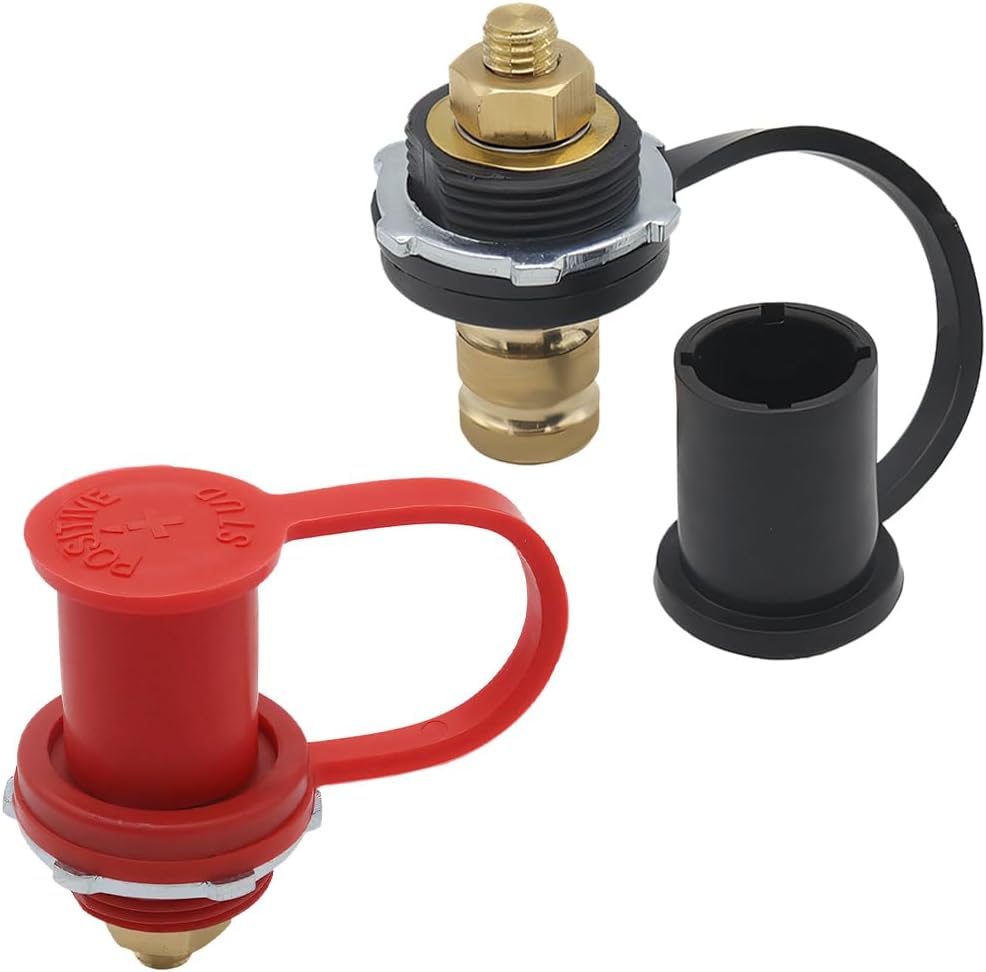
The Car Remote Battery Terminal holds a 4.8 rating, making it one of the strongest customer-rated products in this guide. Its two-post configuration provides both positive and negative remote access, while the brass terminal material, nylon exterior, brass studs, and insulating caps are intended to provide durable, low-leakage connections.
We may earn a commission when you buy through this link, at no additional cost to you.
The terminals carry a stated 250A rating at 12V and measure 2.68 by 3.39 by 1.73 inches. Each can be installed through a 1.25-inch hole in a panel as thick as 0.3 inches. Their detachable-looking exterior construction and accessible covers support straightforward installation and repeated use without complicated tools.
The package contains two remote terminals, allowing one to be installed as a working post and the other retained as a backup or used in a second connection location. The downside is that the product description does not mention included battery cables, so buyers with an existing suitable cable may have an advantage.
This is a compelling choice for sedan, truck, ATV, and RV owners who need accessible charging or jump-start posts but do not want a full relocation kit. Confirm the panel thickness, stud size, cable diameter, and charging-equipment requirements before purchase, and use appropriately rated cables for the intended current.
A matched pair can support a complete positive-and-negative installation or provide a replacement when a post becomes worn or damaged. This makes the package more versatile than a listing that includes only one isolated terminal.
Brass contact components support efficient current transfer, while the nylon body and PVC insulating caps help protect exposed contacts. The covered design is also suited to installations where dust, moisture, or accidental contact could otherwise create problems.
We may earn a commission when you buy through this link, at no additional cost to you.
This Joinfworld Remote Battery Terminals kit has a 4.7 rating and focuses on a durable, protected post for battery relocation. Its brass construction and stated 250A, 12V rating make it suitable for demanding charging and jump-start connections when paired with appropriately rated wiring.
We may earn a commission when you buy through this link, at no additional cost to you.
The 3/8-inch stud accepts relatively large cable sizes, which can be advantageous for high-current work. Installation requires a 1.25-inch hole in a panel no more than 0.3 inches thick, and the terminal is designed to pass through the panel before being secured.
A protective cover shelters the exposed contact from dust and water while also reducing the likelihood of accidental contact. Although the listing focuses on a protected battery post, it does not clearly list the package contents as comprehensively as the other Joinfworld kit in this guide.
The product is well suited to automotive, truck, marine, boat, ATV, and Can-Am applications where the installer wants a single accessible post with a robust contact. Buyers should verify the supplied hardware, cable configuration, and polarity markings against the current package before installation.
A 3/8-inch stud gives installers a larger attachment point than smaller studs common on general-purpose hardware. That makes the post easier to use with cable sizes intended for substantial current transfer.
The cover is valuable in a vehicle compartment where cables and tools may move around. It helps isolate the contact from dust, water, and accidental touching between charging sessions.
We may earn a commission when you buy through this link, at no additional cost to you.
The Jiozermi 1/4-inch Copper Battery Terminal Studs earn a 4.8 rating and offer a compact alternative to larger, fully packaged jump-post kits. The set contains one red and one black stud connector, providing basic polarity identification for batteries, generators, trucks, welding machines, ships, vehicles, and solar applications.
We may earn a commission when you buy through this link, at no additional cost to you.
Each connector is described as pure copper with bakelite insulating material. The copper construction is intended to provide good conductivity and resistance to rust and corrosion, while the insulating material helps keep the electrical contact separated from surrounding components.
The dimensions are clearly defined: each stud connector is 1.69 inches, or 43 millimeters, long, with a 1/4-inch, or 6-millimeter, screw diameter and a 0.39-inch, or 10-millimeter, threaded hole. These dimensions are useful for checking compatibility before modifying a panel or battery enclosure.
This option suits builders comfortable creating a custom remote connection from separate components. It lacks a stated amperage rating, dedicated protective cover, panel mounting hardware, and wire set in the supplied description, so it is less convenient for a straightforward installation. Verify every mechanical and electrical requirement before purchasing.
The compact dimensions give fabricators room to create a tailored remote terminal arrangement. It can be incorporated into a larger junction system where standard bracket kits do not suit the available space.
Pure copper is a conductive contact material commonly chosen for battery-related hardware. The bakelite insulation provides separation around the terminal body, although the installer must still provide strain relief and environmental protection.
We may earn a commission when you buy through this link, at no additional cost to you.
The Joinfworld Heavy-Duty Battery Relocation Kit has a 4.5 rating and is framed as a substantial upgrade for vehicles where the original battery is difficult to access. The package extends the battery connection so charging and jump starting can be performed from a more convenient location.
We may earn a commission when you buy through this link, at no additional cost to you.
A heavy-duty mounting bracket is included to simplify installation, and the set comes with 4-gauge cables approximately 53 inches long. Those cables are stated to accept up to 150A, providing ample capacity for many jump-starting and charging tasks while leaving the terminal and bracket to handle the mechanical demands.
Red and black protector covers identify the two sides and help shield the exposed contacts from dust, debris, and accidental contact. The listed applications include the Can-Am Maverick X3, cars, UTVs, ATVs, and boats, making the package appealing to owners of recreational or utility vehicles with constrained battery access.
This is a strong premium-style choice for a complete installation rather than a single component. Its 4.5 rating is slightly lower than those of several alternatives, but the included bracket, long cables, and relocation focus compensate for that distinction. Confirm the physical layout, grounding, fusing, and charge-sender compatibility before installation.
The included bracket and 4-gauge leads make this more installation-ready than a bare post. It is a practical starting point for a new remote battery access point rather than an improvised add-on.
The explicit Can-Am X3, UTV, and ATV references reflect the product’s powersports orientation. Those vehicles often benefit from convenient jump-start access when their batteries are tucked beneath cargo areas or body panels.
We may earn a commission when you buy through this link, at no additional cost to you.
The GUMRA Battery Jump Post Kit has a 4.6 rating and is designed primarily around compact installation and cable protection. It includes two pure-copper terminals, two 1.2-meter connecting cables, mounting screws, a black PVC insulating bracket, and terminal insulating rubber caps.
We may earn a commission when you buy through this link, at no additional cost to you.
The cable is described as IP67 waterproof and able to withstand voltages up to 450V, while 7 AWG construction supports efficient power transmission. Red-and-black cable identification helps prevent crossed connections, and the reduced bracket size is intended to avoid consuming excessive installation space.
An insulating cap is fitted beneath the bracket to keep metal fittings from being exposed, improving safety around the installation. The product is also compatible with a broad range of vehicles and equipment, including UTVs, ATVs, trucks, race cars, travel trailers, RVs, tractors, lawn mowers, diesel vehicles, and boats.
This kit is a compelling choice for powersports users who value a compact bracket and protected cable routing. However, the supplied information does not state a current rating, and the voltage claim should not be treated as evidence that the posts are suitable for every high-voltage system. It is primarily described for 12V vehicle battery access.
The revised smaller bracket is useful in UTVs, ATVs, and other vehicles where every piece of available panel space matters. An accessible post can still be positioned close to the starting battery without dominating the compartment.
The IP67 cable specification and insulating bracket work together to improve protection in demanding environments. They are particularly relevant to off-road vehicles, marine installations, and areas exposed to water or debris.
We may earn a commission when you buy through this link, at no additional cost to you.
The MARSTEK eight-piece junction post kit has a 4.5 rating and provides four red and four black 1/4-inch M6 studs. Its eight-terminal format distinguishes it from the two-post products designed specifically for a single positive-and-negative vehicle battery relocation.
We may earn a commission when you buy through this link, at no additional cost to you.
The screws are made from brass and paired with flame-retardant insulation intended to withstand high temperatures and resist corrosion. The detachable design allows the components to be tightened securely and adjusted to suit different power-distribution arrangements.
The manufacturer lists welding machines, charging generators, ships, RVs, trucks, automobiles, and solar cells among potential applications. That makes the set especially useful for a builder creating several connection points or maintaining a custom distribution panel rather than installing a single vehicle jump point.
The kit is not a complete remote-terminal system because no cable, panel bracket, or enclosure is listed. It also lacks an explicit current rating. Buyers should treat it as hardware for a custom installation and confirm that 1/4-inch M6 studs match the intended cables and terminals.
Eight color-coded posts provide more connection options than a standard battery relocation pair. This is useful for workshop projects, auxiliary circuits, or equipment that needs several accessible distribution points.
The removable terminal construction gives fabricators freedom to assemble connections in a sequence that fits the available space. Secure tightening and cable strain relief remain necessary to preserve reliable performance.
We may earn a commission when you buy through this link, at no additional cost to you.
The Ampper M10 Remote Battery Terminals carry a 4.6 rating and provide a focused single-set solution for remote battery connections. The brass posts are rated for 250A at 12V and are intended to join multiple connectors or wires during a battery relocation.
We may earn a commission when you buy through this link, at no additional cost to you.
Two sets of nuts make the terminals relatively flexible to extend, tighten, and assemble. They can be mounted in a battery box or on a panel, with wires routed to the inside and outside, which offers flexibility for different engine-bay and enclosure layouts.
Compatibility includes cars, vehicles, RVs, boats, electrical equipment, and solar cells. That broad range is useful for installers who need a compact, high-current connection point rather than a full vehicle-specific relocation kit.
The product recommendation is for professional installation, and the supplied description does not mention a protective cap, cable set, or bracket. Those omissions make this a better fit for a knowledgeable installer than a plug-and-play buyer. Confirm grounding, fusing, cable sizing, and physical clearance during the installation.
The M10 brass post offers a straightforward way to create a remote positive or negative connection. It can be fitted to a battery box or panel where a larger enclosed jump-post assembly would be unnecessary.
Wiring can be routed inside and outside the mounting surface, giving the installer freedom around tight battery compartments. The double-nut arrangement helps create a stable mechanical connection when properly torqued.
We may earn a commission when you buy through this link, at no additional cost to you.
The product identified by ASIN B0CNYNYLP9 has no supplied title, description, rating, image, or technical specifications. Consequently, there is not enough documented information to assess its material, current capacity, mounting method, included accessories, or vehicle compatibility.
We may earn a commission when you buy through this link, at no additional cost to you.
Because the information is missing, this listing should not be treated as a direct recommendation over the eight documented alternatives. A prospective buyer would need to open the product page and confirm the terminal size, current rating, mounting hole dimensions, wire capacity, protective features, and package contents before making a decision.
The available link still allows direct investigation of the listing, and the product may ultimately prove suitable if its specifications align with the installation. However, a complete product page, manufacturer instructions, and verified buyer feedback are essential when electrical equipment and high-current connections are involved.
This entry is best treated as a research placeholder. It is only worth considering if the current page confirms the same qualities emphasized throughout this guide: a conductive contact material, secure panel mounting, suitable stud or thread size, strain relief, corrosion protection, and a method of covering the exposed connection.
Electrical and mechanical specifications should be confirmed before purchase. Pay particular attention to current capacity, mounting dimensions, included hardware, and cable compatibility.
Even a well-built terminal requires compatible cables, proper insulation, and secure mounting. Establish those requirements first so the final purchase fits the intended electrical system.
We may earn a commission when you buy through this link, at no additional cost to you.
The listing associated with ASIN B0FJ1VHDLR likewise has no supplied product title, description, rating, image, or specifications. The available data therefore does not support conclusions about current handling, contact materials, mounting dimensions, or environmental protection.
We may earn a commission when you buy through this link, at no additional cost to you.
This makes the listing appropriate for further checking rather than blind ordering. Before buying, examine the live product page for the number of posts, stud or thread dimensions, maximum current, operating voltage, mounting-hole size, panel thickness, and whether cables, nuts, caps, or a bracket are included.
Buyers should also determine whether the product is a standalone binding post, a pair of automotive jump posts, or a broader junction kit. That distinction affects cable routing, panel preparation, and the amount of additional hardware required for a complete installation.
If the current listing supplies adequate documentation, customer feedback, and clear safety information, it could still become a viable option. On the information available here, however, the documented products offer a more transparent basis for comparison and should be considered first.
Review the manufacturer information and package contents on the current page. Those details determine whether the item is genuinely complete and suitable for the intended battery connection.
Confirm operating voltage, current capacity, and stud size against the battery, cable, and charger involved. A mechanical match alone is not enough for safe, efficient power transfer.
We may earn a commission when you buy through this link, at no additional cost to you.
The right remote battery terminal depends on electrical capacity, mounting conditions, cable size, environmental exposure, and the level of installation work you want to undertake. Comparing complete kits with individual posts prevents a low-cost hardware purchase from becoming an incomplete project.
Current capacity is one of the most important considerations because a terminal must tolerate the combined demands of the battery, charger, and jumper cables without creating an unsafe connection. Several listings specify 250A at 12V, while others provide no current rating at all. A missing rating is not proof of low capacity, but it gives an installer less confidence and should prompt closer review of manufacturer documentation. The capacity of the attached cable also matters: the most complete Joinfworld kit lists a 250A terminal rating but only 150A capacity for its 4-gauge cables.
Choose a terminal and cable system whose lowest rated component determines the realistic operating limit. Also confirm that the intended charger or jumper method is appropriate for the battery type and vehicle electrical system. Higher current ratings do not automatically make a post better, but they provide more margin when properly matched with suitable wiring.
In short, match the weakest component and verify every current specification.
The attachment size determines whether the terminal can accept the cable lugs used in the installation. Popular options in this guide include 3/8-inch studs, 1/4-inch M6 studs, and M10 binding-post hardware. A large stud may suit thick battery cable, while a smaller threaded post can work well in custom or space-conscious assemblies. The dimensions should be compared with both the cable lug and the available mounting surface.
Cable entry is only one part of a secure connection. The installer must also provide adequate rotational strength, prevent the cable from pulling against the terminal, and ensure that the lug surface makes reliable electrical contact. Flexible wire strands should be fully seated, and the connection should not rely on the cable being bent immediately after installation.
In short, match stud size to the cable and secure the connection against movement.
Remote terminals are frequently installed through a panel or battery-box wall, so the required hole diameter and maximum panel thickness must be known before drilling. Some listings specify a 1.25-inch hole through material up to 0.3 inches thick. Others include a separate heavy-duty bracket or an insulating bracket, making their mechanical requirements somewhat different. A bracket can add rigidity and simplify final positioning, but it can also require additional clearance.
Account for the wires behind the panel, the depth of the post, nearby bodywork, and access to the battery. The remote location should be convenient for routine use without exposing the connection to excessive heat, sharp edges, moving parts, or standing water. Confirm that any insulating cap or bracket sits between the terminal hardware and the conductive mounting surface.
In short, measure the panel and leave room for secure, serviceable wire routing.
The distance between the battery and the desired access point determines the cable length required. Two complete relocation kits include approximately 53-inch, 4-gauge cables, while the GUMRA kit includes two 1.2-meter, 7 AWG cables. A bare post leaves the entire cable-selection decision to the installer, which can be beneficial for custom routing but inconvenient for first-time users.
A complete kit may also include mounting hardware, nuts, insulating boots, caps, and heat-shrink tubing. These parts help the installer create a coherent system rather than discovering missing pieces after the panel has been modified. Even with a complete kit, the vehicle’s existing cables, fuse links, and connection hardware may still need inspection.
In short, calculate cable length first and inventory every included component.
Brass and copper are common conductive materials in battery hardware because they offer good electrical performance and resistance to corrosion. The Jiozermi set uses pure copper terminal blocks with bakelite insulation, the MARSTEK kit uses brass screws with flame-retardant insulation, and several automotive-focused listings use brass studs with nylon bodies. The material is only one element; contact cleanliness, tightening torque, and corrosion prevention are equally important.
A durable installation should prevent copper or brass from contacting an unintended conductive surface. Insulating washers, bushings, caps, or brackets can interrupt those paths. If the terminal is mounted to metal, the product instructions should explain how current is isolated from the panel. Moisture can increase leakage and corrosion, making covers and sealed cable routing valuable in exposed locations.
In short, prioritize conductive contacts, proper isolation, and corrosion control.
A cover over the exposed contact is useful whenever tools, clothing, moisture, or debris could accidentally touch the terminal. The covered Joinfworld products and the two-post automotive set include red and black protector caps or boots, making polarity easier to identify while the connection is idle. The GUMRA package adds an insulating bracket beneath the mount and includes rubber terminal caps.
Marine, powersports, and off-road installations should pay particular attention to water, mud, salt, and vibration. The GUMRA cable is described as IP67, and one Joinfworld cover is said to protect against dust and water. These features improve protection but do not eliminate the need for proper seals, cable strain relief, and regular inspection.
In short, choose protective caps and suitable routing for the environment.
A terminal advertised for cars and trucks may also fit an RV, boat, ATV, or UTV, but compatibility depends on panel space, cable size, battery layout, and operating voltage. The Can-Am Maverick X3 and Polaris RZR are specifically mentioned by some products, while the GUMRA listing also names travel trailers, tractors, lawn mowers, and diesel vehicles. These references help define the intended market but do not replace measuring the actual vehicle.
For a relocated starting-battery connection, consider whether the vehicle uses a separate charging lead, a battery-sender circuit, or other monitored wiring that must be extended. A connection added for a portable charger can have different requirements from one intended for frequent jump starting. The installation should preserve the original electrical architecture wherever possible.
In short, verify dimensions and wiring architecture rather than relying on broad fit claims.
Some products are positioned as easy panel-mounting posts, while the complete relocation kits include brackets and extensive hardware. The Ampper listing explicitly recommends professional installation, and any high-current connection benefits from correct cable sizing, secure fasteners, strain relief, and careful electrical isolation. DIY experience does not eliminate those steps, even when the hardware can be installed with basic tools.
Look for clear instructions, identifiable positive and negative parts, and enough hardware to complete the planned route. If the listing does not state the package contents, confirm them before ordering. Buyers who are uncertain about the vehicle’s electrical layout should consult a qualified automotive or marine electrician rather than relying on appearance alone.
In short, choose the level of assembly you can complete safely and correctly.
Begin by disconnecting the battery according to the vehicle manufacturer’s instructions, remove the negative connection first when applicable, and identify the remote post’s positive and negative sides. Mark the wiring before relocation and use cable with a current rating suitable for the charger, jump starter, and vehicle. Use lugs that match the post’s stud or thread size, make clean metal-to-metal contact, and tighten fasteners to the manufacturer’s specified level.
Route the cables away from sharp edges, hot exhaust components, moving suspension parts, and sources of chafing. Secure them with appropriate clips or loom, leaving enough slack for movement without pulling on the terminals. If the post passes through a metal panel, use the supplied insulating components and verify that the exposed hardware cannot contact the body. Test the entire installation for correct polarity before reconnecting the battery.
For routine use, open only the cover needed for the active connection and never leave a charging lead attached to the wrong terminal. Disconnect charging equipment before restoring vehicle power. Periodically inspect for loose fasteners, cable movement, corrosion, damaged insulation, water ingress, and worn lugs. Clean the exterior with appropriate methods, keep the contact surfaces free of dirt, and replace damaged covers or hardware rather than relying on exposed posts.
Remote battery terminals extend a battery connection to a more accessible location. They are commonly used for jump starting, portable battery charging, auxiliary power connections, and battery maintenance when the original battery is hidden or difficult to reach. They are also used on trucks, boats, RVs, ATVs, UTVs, and recreational vehicles.
They can be safe when the posts, cables, charger, and battery are correctly rated and the polarity is right. A post with a stated 250A rating does not mean every attached cable or jump starter is safe at 250A. Use cables appropriate for the available current and follow the instructions supplied with both the terminal and the charging equipment.
Yes, but the terminal must be isolated from the panel so the metal surface does not become an unintended electrical path. Use the product’s insulating washers, bushings, caps, or bracket as applicable. The panel also needs a correctly sized hole and enough thickness for a secure mount. A marine or off-road installation may require additional sealing against moisture.
The cable should match the stud size, available installation current, charging-device output, and battery type. The included 4-gauge cables on two Joinfworld kits are stated to accept up to 150A, even though their terminals are rated at 250A. For other systems, follow the cable manufacturer’s ampacity guidance and account for length, heat, and routing conditions.
Most portable charging and jump-starting setups need access to both battery polarities, so a matched pair is generally the practical choice. Some vehicles or equipment may use a different grounding arrangement, and a negative-only extension can create additional resistance or safety concerns. Confirm the vehicle’s grounding architecture before choosing a single-terminal arrangement.
Several listings explicitly identify boats, marine applications, RVs, and travel trailers as suitable uses. The most important factors are the system voltage, current demands, corrosion protection, mounting strength, and applicable wiring rules. Marine environments are particularly demanding, so sealed connections, corrosion-resistant hardware, and secure cable routing deserve extra attention.
No. These designations refer to different mounting or attachment dimensions and should not be assumed to fit the same panel, nut, or cable lug. Check the product’s stated hole diameter, thread size, and stud dimensions against the installation. The Jiozermi set uses 1/4-inch studs, the MARSTEK kit uses 1/4-inch M6 studs, and the Ampper product uses an M10 configuration.
Start with clean contact surfaces, secure the terminals properly, and use covers or seals appropriate for the location. Keep standing water away from the connection, inspect periodically, and address green or white corrosion before it compromises contact resistance. In salt-air marine environments, compatible corrosion-protection measures and regular maintenance are especially important.
The Car Remote Battery Terminal is a strong value pick because it includes two 250A, 12V posts, protected contacts, and a straightforward panel-mounting design. The Joinfworld Bracket and Wire Kit is the editor’s choice because its bracket, long 4-gauge cables, covers, and hardware create the most complete documented relocation package, while the Heavy-Duty Relocation Kit offers a similar full-kit approach for powersports vehicles.
Prioritize the weakest part of the installation rather than focusing on the largest headline rating. Confirm stud size, panel dimensions, current capacity, cable length, polarity protection, and environmental requirements. A complete kit may save setup time, whereas a standalone post can be better for a custom junction or unusually tight installation.
Finally, check the current listing, manufacturer instructions, customer feedback, and price at the time of purchase. Product details and availability can change, and a remote battery terminal should never be selected without confirming that it fits the battery, cables, charger, and vehicle wiring system.
