
ROVSUN 9000 BTU Mini Split AC/Heating System
4.4Editor score
115V single-phase power
400-square-foot cooling capacity
Four-way airflow swing
Our Mini Split for Tiny Houses guide compares ten ductless heat pumps by room coverage, efficiency, controls, heating range, noise, and installation needs.
A mini split can bring efficient, zoned temperature control to a tiny house where extending a central duct system may be impractical. The right system must fit the available wall space, match the room’s heat gain, and operate quietly without overwhelming the home’s electrical or structural limits.
We compared ten heat pump systems using capacity, room coverage, SEER2 efficiency, electrical requirements, operating modes, smart controls, low-temperature performance, sound levels, installation provisions, and maintenance features. The list includes compact 9,000- and 9,100-BTU models alongside larger 12,000- and 24,000-BTU options.
Each pick reveals which type of tiny-house resident it best serves, from space-conscious buyers seeking 115-volt convenience to occupants wanting premium smart-home integration or stronger cold-weather heating. Ratings, product details, availability, and pricing can change, so confirm current specifications and costs before purchasing.
4.4Editor score

4.4Editor score

4.2Editor score
The table below compares all ten systems by practical tiny-house considerations. Pay particular attention to electrical requirements, stated room coverage, low-temperature heating performance, and the included line-set length because these factors determine whether a mini split will fit both the living space and the installation plan.


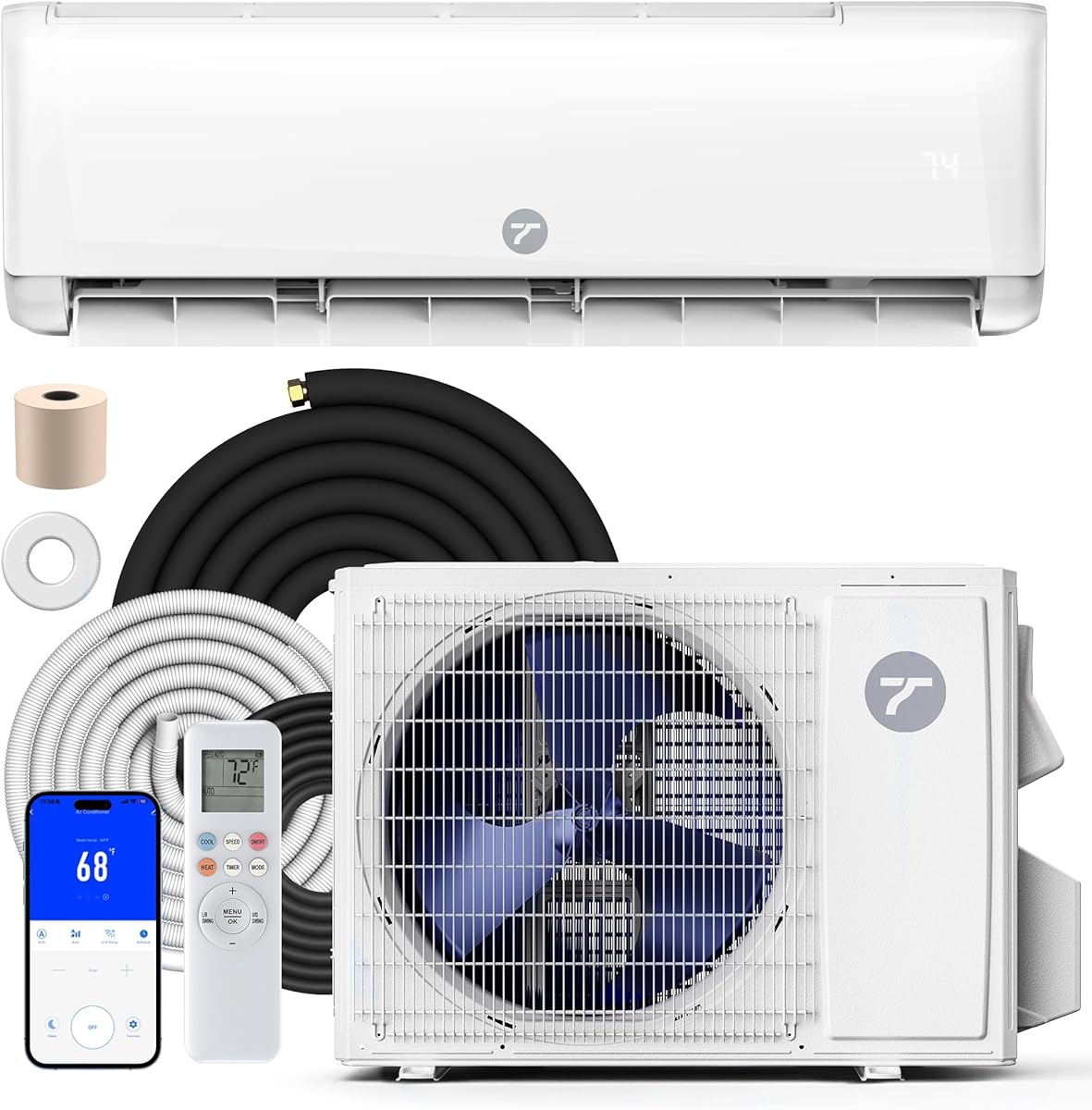


The ROVSUN 9000 BTU is a compact inverter heat pump aimed at small bedrooms, home offices, and other modest spaces in a tiny house. It carries a 4.4 rating and stands out for 115-volt operation, 20 SEER2 efficiency, and a stated cooling capacity of 400 square feet.
We may earn a commission when you buy through this link, at no additional cost to you.
Its indoor unit combines cooling and heating with remote-controlled fan speed, sleep, 24-hour timer, ECO, turbo, and mute settings. Four-way swing distributes conditioned air more evenly around the room, while the listed 28–42 dBa operating range is relevant where equipment noise must remain unobtrusive.
The trade-offs are that professional installation is explicitly required, and 9,000 BTU may be insufficient for a poorly insulated tiny house experiencing high summer heat gain. The 400-square-foot figure is a useful planning maximum, not a guarantee, because windows, solar exposure, ceiling height, and internal heat sources all affect performance.
This is a strong selection for a small, well-insulated space served by a 115-volt circuit. It combines a useful inverter compressor, pre-charged condenser, heat-pump capability, and a generous control feature set without requiring the user to manage a complicated installation.
Running on 115 volts can simplify electrical planning in a tiny house compared with many 230-volt mini splits. A qualified electrician should still confirm circuit capacity, grounding, disconnect requirements, and local code before installation.
The 9,000-BTU format is most appropriate for a bedroom, den, or studio where the space is reasonably insulated. Oversizing a compact home can create short-cycling, while undersizing may leave the room uncomfortable during peak heat.
We may earn a commission when you buy through this link, at no additional cost to you.
The Tehanld 12000 BTU provides substantially more stated capacity than the ROVSUN while retaining a 115-volt electrical requirement. Its 4.4 rating, 17 SEER2 rating, and claimed coverage of up to 750 square feet make it a flexible option for a larger tiny-house living area or addition.
We may earn a commission when you buy through this link, at no additional cost to you.
The heat pump operates in cool, heat, auto, fan, and dry modes, with four fan speeds. Sleep, quiet, turbo, and ECO settings add further control, while intelligent defrost and operation down to -4°F support year-round use in cold climates.
Its main disadvantage is efficiency relative to the higher-SEER2 choices in this list. The 17 SEER2 specification also means shoppers with modest cooling loads should compare annual energy costs and operating patterns. Two packages may arrive at different times, requiring patience and careful inventory checking.
Buy this model if 115-volt power and 12,000 BTU of capacity are priorities in a room with significant heat gain. It is less compelling for a very small space or for owners whose main goal is maximum operating efficiency.
A 12,000-BTU system can suit the main living area of a well-designed tiny house, but the listed 750-square-foot maximum should be treated cautiously. Solar exposure and poor insulation can make actual cooling demands greater than the floor area suggests.
Low-temperature operation makes this unit more relevant in four-season regions. Installation location, building envelope, and actual winter load remain decisive, so the stated threshold should not substitute for an HVAC load assessment.
We may earn a commission when you buy through this link, at no additional cost to you.
The DELLA Vario Series stands out as the most balanced option in the group, pairing a 12,000-BTU heat pump with a 23 SEER2 efficiency rating and a 4.4 customer rating. Its stated 550-square-foot capacity is a more realistic starting point for many compact homes than the maximum figures on some competitors.
We may earn a commission when you buy through this link, at no additional cost to you.
Smart functions include remote temperature sensing, automatic defrost, self-diagnosis and cleaning, I Feel mode, dehumidification, a 24-hour timer, sleep, ECO, multiple fan speeds, and compressor preheating. The system also works with Alexa, adding voice control without replacing the included remote.
This system requires 208–230V electrical service and professional installation. The included line set is 16.4 feet, but altering its length requires adjusting refrigerant levels, making careful layout planning essential. Line-set vacuuming is also part of a proper installation.
It is the strongest general recommendation for a tiny-house owner who can accommodate standard 230-volt service. The combination of capacity, efficiency, quiet operation, cold-weather capability, and thoughtfully integrated controls makes it more versatile than a basic fixed-speed unit.
The 23 SEER2 rating gives the Vario an efficiency advantage while its stated 550-square-foot limit feels better aligned with compact-home planning. Both values remain important because a highly efficient but oversized system is not necessarily the right economic match.
The remote acts as a temperature sensor, allowing the indoor unit to adjust airflow and temperature based on conditions near the user. This can be especially helpful in a tiny house where the living zone occupies only part of the total interior.
We may earn a commission when you buy through this link, at no additional cost to you.
The Garvee 12000 BTU earns the highest customer rating among the compared systems at 4.5. It offers 12,000 BTU of cooling, 18.5 SEER2 efficiency, heat-pump functionality, and 208–230V operation in a package aimed at spaces up to 750 square feet.
We may earn a commission when you buy through this link, at no additional cost to you.
Its defining feature is connected control through the built-in WiFi module, mobile app, Alexa compatibility, and physical remote. Custom sleep mode supports nighttime comfort, while automatic self-cleaning is designed to reduce dust accumulation and lessen routine filter maintenance.
As with most mini splits in this category, the 750-square-foot statement is a maximum coverage claim rather than a guarantee. Owners in hot climates should obtain a load calculation, particularly if the room has broad glazing, west-facing exposure, a wood stove, or substantial appliance heat.
This is a compelling choice for a tiny-house resident who values app control and voice operation enough to accept standard 230-volt electrical requirements. It balances capacity, efficiency, low sound, and maintenance convenience without relying on the most expensive premium system.
The app and voice controls can be valuable when the tiny house is used as a full-time residence or temporary retreat. Scheduling the system before arrival may improve comfort without leaving conditioned space running for long periods.
Automatic cleaning and a reusable washable filter simplify upkeep, although neither removes the need for periodic filter checks. The filter should still be cleaned as needed based on dust, pets, construction dust, and local conditions.
We may earn a commission when you buy through this link, at no additional cost to you.
This 12,000-BTU inverter system combines a 4.4 rating with 22 SEER2 efficiency while retaining 115-volt operation. It is one of the most attractive specifications combinations for a tiny house because it offers substantial capacity without requiring the same electrical service as many 230-volt systems.
We may earn a commission when you buy through this link, at no additional cost to you.
Its feature set includes seven operating modes, seven fan speeds, 4D auto swing, turbo, Follow-Me or I Feel control, a backlit remote, an app, and Alexa or Google Assistant support. A claimed 23 dB minimum is particularly relevant for bedrooms, and the listed 5°F heating threshold supports cold-season use.
The 750-square-foot coverage statement is notably ambitious for a 12,000-BTU system. Tiny houses may have high summer heat loads, so the figure should not be interpreted as permission to condition an equally sized room regardless of insulation or exposure. The product also appears to ship in two separate boxes.
Choose this model for a relatively large, well-insulated tiny-house living area with 115-volt electrical access and a preference for extensive digital controls. It may be especially attractive to owners who want efficiency, heat-pump versatility, and low nighttime sound in one system.
The 22 SEER2 rating gives this model a strong efficiency profile for a single-phase system. Inverter modulation can maintain steadier temperatures than conventional on-and-off operation, particularly in a well-insulated structure with moderate loads.
A listed 23 dB minimum makes the system attractive for sleeping spaces, but published minimum figures generally represent the most favorable setting. Actual noise varies with fan speed, airflow direction, wall construction, and the system’s operating demand.
We may earn a commission when you buy through this link, at no additional cost to you.
The upgraded Tehanld 12000 BTU combines a 4.5 rating with 19 SEER2 efficiency and 115-volt electrical service. It is a straightforward 12,000-BTU heat pump intended for tiny-house living spaces that need both cooling and heating without app-based controls.
We may earn a commission when you buy through this link, at no additional cost to you.
Cool, heat, auto, fan, and dry modes cover the primary climate needs. Four fan speeds, a programmable 24-hour timer, sleep, ECO, and rapid cooling or heating functions provide useful control through the remote. The use of R32 refrigerant also reflects attention to a lower global-warming-potential option.
Compared with app-equipped alternatives, the system has a simpler control proposition. That can be an advantage for owners who want predictable operation and fewer account or network dependencies. The two-package shipping arrangement should be expected, and professional installation remains necessary.
This Tehanld is a compelling middle ground for a 115-volt tiny house with moderate-to-high cooling demand. It provides strong efficiency, familiar features, and a higher customer rating without taking on the electrical requirements of a conventional 230-volt installation.
The mode and fan-speed layout is easy to understand for everyday use. Owners who prioritize a physical remote and timer over voice assistants may find this more than sufficient for a compact residence.
A 19 SEER2 rating positions the system between the more efficient premium models and lower-SEER2 alternatives. The correct capacity still depends on climate and construction, so efficiency should be evaluated alongside realistic heating and cooling loads.
We may earn a commission when you buy through this link, at no additional cost to you.
The DELLA Serena Series is the premium compact pick in this roundup, pairing a 9,000-BTU inverter heat pump with 22 SEER2 efficiency and extensive connected controls. Its 4.2 rating is lower than the rest of the group, but its feature set is aimed at buyers who prioritize refined integration.
We may earn a commission when you buy through this link, at no additional cost to you.
The DELLA app, WiFi, Alexa, and Google Home support make this a natural fit for a tiny house used as a smart residence or workaway. A geolocation feature adjusts operation based on the user’s location, while 4D airflow, I Feel mode, sleep, ECO, turbo, and dry functions cover everyday comfort needs.
A 24 dBa mute specification, Energy Star certification, PureClean technology, and an outdoor heating element for winter defrosting reinforce its premium positioning. The trade-offs are a 230-volt requirement and the fact that its 4.2 rating trails the group average.
This model is best for a small bedroom or studio where excellent efficiency, quiet operation, and seamless connected control matter more than a lower-cost physical remote. Its 400-square-foot capacity fits the compact end of the tiny-house market.
The app, voice assistants, geolocation, and full remote support give owners several ways to manage the system. In a compact house where space and time are limited, automation can reduce everyday operating effort.
A bottom heating element in the outdoor unit is designed to reduce ice buildup during low-temperature operation. This feature supports heating performance but does not eliminate the need for sheltered placement and routine seasonal inspection.
We may earn a commission when you buy through this link, at no additional cost to you.
The 24,000-BTU system is the capacity leader in this comparison and carries a 4.4 rating with a 19 SEER2 efficiency rating. It is intended for much larger spaces, making it more relevant to a tiny house with an unusually open floor plan, extensive additions, or a separate studio.
We may earn a commission when you buy through this link, at no additional cost to you.
The system uses inverter modulation, R32 refrigerant, WiFi, a mobile app, Alexa or Google Assistant, and a backlit remote. Seven modes, seven fan speeds, 4D swing, turbo, Follow-Me control, sleep, ECO, and a self-cleaning function provide broad operation options.
Its 1,500-square-foot coverage makes it clearly oversized for a conventional tiny house. Installing a 2-ton-class system in a small, well-insulated space can lead to poor humidity control and cycling, while the outdoor unit also requires an appropriate location and adequate electrical support.
Choose this model only when a load calculation shows that the entire conditioned area genuinely requires this capacity. For most tiny houses, a 9,000- or 12,000-BTU system is the more responsible starting point.
A large tiny house with a loft, attached studio, or open living arrangement may approach the load this system is designed to support. Floor area alone is insufficient; insulation, glazing, orientation, and internal heat sources must be included in the assessment.
Undersized equipment struggles during peak demand, but excessive capacity can also create uncomfortable cycling. Matching the system to the actual design load is especially important in compact homes with modest thermal mass.
We may earn a commission when you buy through this link, at no additional cost to you.
This 12,000-BTU system is a 115-volt heat pump for owners who prioritize heating performance and straightforward remote operation. It has a 4.3 rating, 17 SEER2 efficiency, and a stated 450-square-foot cooling range, making it a more conservative capacity match than many 750-square-foot claims.
We may earn a commission when you buy through this link, at no additional cost to you.
Its notable strengths include quick heating, 26 dB minimum operation, sleep and mute modes, a high-temperature self-cleaning function, a washable filter, and automatic outdoor defrost. These features support both year-round comfort and ongoing maintenance in a compact home.
The 17 SEER2 rating is the least efficient figure among the 12,000-BTU heat pumps reviewed. A cheaper operating profile may still result from inverter modulation and lower cooling loads, but annual energy use will depend heavily on climate, insulation, setpoints, and runtime.
This is a good fit for a tiny house with a dependable 115-volt circuit and meaningful winter heating demand. Owners primarily seeking maximum efficiency or app-based automation may find better-matched alternatives in the same capacity class.
Inverter control adjusts compressor output rather than relying only on full-on operation. That can maintain steadier temperatures and reduce abrupt cycling, particularly useful in a small space with relatively consistent heating demand.
High-temperature indoor cleaning is designed to dry the coil and inhibit mold, while automatic outdoor defrost protects cold-weather heating operation. These features reduce maintenance demands, but the air filter and accessible components still require routine care.
We may earn a commission when you buy through this link, at no additional cost to you.
The DELLA Umbra 9100 BTU is a compact 230-volt inverter heat pump with a 4.3 rating, 19 SEER2 efficiency, and coverage for a room of up to 400 square feet. It is particularly relevant to tiny-house owners who want smart control without moving to a larger 12,000-BTU system.
We may earn a commission when you buy through this link, at no additional cost to you.
Alexa and WiFi compatibility sit alongside a remote, 4D airflow, I Feel mode, a 24-hour timer, sleep, ECO, turbo, multiple fan speeds, heating, cooling, and dry modes. The listed 25 dBa operation and remote temperature sensing make it appealing for a bedroom or quiet studio.
The trade-offs are its lower customer rating relative to the leaders and its requirement for 230-volt electrical service. The outdoor unit also includes a bottom heating element for cold-weather operation, with heating stated down to 5°F.
The Umbra is best for a compact, well-insulated tiny house with standard 230-volt service and a strong preference for voice control. It delivers the convenience of a connected system while keeping physical size and rated capacity relatively modest.
The Umbra offers useful connected functions without moving into a larger equipment class. This makes it a practical middle ground when a 12,000-BTU system would be excessive but a basic nonconnected mini split feels too limited.
R32 refrigerant and a heated outdoor base help support environmentally conscious and cold-weather operation. Proper handling, installation, and refrigerant service should be performed by appropriately qualified professionals.
We may earn a commission when you buy through this link, at no additional cost to you.
Choosing a mini split for a tiny house requires balancing capacity, efficiency, electrical service, noise, winter conditions, and installation constraints. The most attractive specification on a listing is not necessarily the best match for the building, so start with the design and operating environment rather than the largest capacity claim.
Start with the space that actually needs conditioning and then estimate its heat gain. Floor area is only a starting point because window area, glazing orientation, insulation quality, ceiling height, sunlight, appliances, wood stoves, and occupancy can change the required capacity dramatically. A 9,000-BTU system may suit a compact bedroom, while a 12,000-BTU unit may be needed for a sunlit studio. The 24,000-BTU option is generally excessive unless the tiny house includes a large addition or studio.
Choose capacity from a load calculation rather than the largest room-coverage number. Oversizing can produce short cycling, uneven comfort, and weak dehumidification, while undersizing may leave the space unable to reach setpoints during peak weather.
Tiny-house electrical systems vary widely, and the distinction between 115V and 208-230V models may affect the installation plan. Several systems in this comparison run on 115 volts, which can be convenient when a standard household-style circuit is available. The DELLA Vario, Garvee, DELLA Serena, DELLA Umbra, and 24,000-BTU system use 208-230V service and require a more substantial electrical evaluation.
Have a licensed electrician verify capacity, circuit size, grounding, disconnect requirements, and code compliance. Never assume the indoor unit’s power requirement determines the full installation needs of the outdoor equipment.
A heat pump can provide both cooling and heating, but performance at low outdoor temperatures varies. Models in this roundup specify operating thresholds ranging from 5°F down to -4°F, and some include auto-defrost or an outdoor heating element. Those features improve cold-weather operation, yet a stated minimum temperature does not guarantee a particular heat output.
Compare the lowest expected winter temperature in your location, insulation level, and heat-pump capacity. Supplemental heat may still be necessary during severe cold, especially in a very small building with weak thermal envelope performance.
SEER2 is an efficiency measure, but it is only one part of operating cost. Inverter compressors, equipment sizing, climate, thermostat setpoints, solar exposure, and maintenance all influence real energy use. The 23 SEER2 DELLA Vario and the 22 SEER2 systems are attractive from a specification standpoint, while 17 SEER2 models may be more appropriate when electrical or budget constraints matter.
Use the efficiency rating to compare otherwise similar equipment. Then consider the capacity match and your local climate. An efficiently operating system that is badly sized is not necessarily the least expensive option.
Every listed system includes a physical remote, but app, WiFi, Alexa, and Google Assistant support varies. Smart controls can improve scheduling, remote monitoring, and accessibility, particularly when a tiny house serves as a full-time residence or occasional retreat. Physical controls remain useful during network outages and for guests.
Choose remote-only operation for simplicity or connected control for automation. Check app compatibility, account requirements, voice-assistant support, and whether the system includes useful scheduling and geolocation features before making a final decision.
Published sound figures in this list range from low-20s dBa minimum values to a stated 28–42 dBa operating range. These are useful comparisons, but they may represent different fan settings or measurement methods. Actual noise also depends on wall construction, vibration isolation, duct or piping configuration, and the selected speed.
For bedrooms and studios, favor low minimum sound levels and a sleep or mute mode. Ask the installer about isolation practices and avoid placing the indoor unit where airflow or mechanical noise interferes with sleeping and conversation.
All of these are ductless systems, and professional installation is required or strongly indicated. Several packages include a 9.8-foot or 16.4-foot copper line set, but a tiny house’s geometry may not allow a straight indoor-to-outdoor run. Altering line-set length can require refrigerant adjustment, and proper vacuuming is part of a standard installation.
Measure the installation route before ordering, identify where the outdoor unit can sit, and confirm condensate drainage. Treat the included line length as a convenience rather than a guarantee that every layout will work without modification.
Washable filters, self-cleaning cycles, automatic defrost, and self-diagnosis can simplify upkeep, but none eliminates periodic care. Tiny houses can experience concentrated dust from construction, pets, cooking, and compact living. Filters should be inspected regularly, and the indoor and outdoor units should be kept clear of debris and obstructions.
Prioritize a removable washable filter and accessible self-cleaning features if maintenance time is limited. Follow the manufacturer’s cleaning guidance and have the system serviced by a qualified technician when deeper maintenance is required.
Begin by setting a sensible temperature and mode rather than immediately using turbo or the highest fan speed. In summer, select cool, auto, or dry operation as appropriate for humidity and comfort. In winter, choose heat and allow the room to stabilize before making repeated adjustments. The 24-hour timer, sleep mode, and app schedules can reduce unnecessary runtime when occupancy follows a predictable pattern.
Keep the indoor unit’s airflow unobstructed and clean the washable filter on a schedule based on dust and use. Outdoor equipment also needs clearance from leaves, vines, debris, and structures that could restrict airflow. Do not remove fixed panels or open sealed refrigerant and electrical compartments; those tasks belong to qualified service personnel.
For long absences, use scheduling rather than leaving the system at maximum output around the clock. Review filter condition, drain flow, unusual noises, odors, icing, and uneven cooling. Because heat pumps and refrigerant systems involve high-pressure circuits and regulated work, installations, line-set changes, refrigerant adjustments, and repairs should be handled by qualified professionals.
Most tiny-house bedrooms are best served by a 9,000-BTU system, while an open studio or more heavily loaded living area may need 12,000 BTU. The correct answer depends on insulation, window area, orientation, ceiling height, and internal heat sources rather than floor area alone. A professional load calculation is the safest way to prevent both undersizing and short cycling.
A 115-volt mini split may simplify electrical planning when the tiny house already has suitable household-style service. A 208-230V system may offer greater capacity and higher efficiency options, but it requires proper high-voltage circuits, grounding, and code-compliant installation. Choose based on a complete electrical assessment rather than voltage alone.
Yes, if the system is correctly sized and its low-temperature range matches local conditions. The systems listed here include heat-pump heating, with some specifying operation down to 5°F and others to -4°F. Extreme weather, weak insulation, and unusually high indoor heat loss can still require supplemental heating.
Ductless mini splits are well suited to small buildings because they provide zoned temperature control without extensive ductwork. However, a mini split does not introduce outside air and does not replace ventilation. Tiny houses still need a properly designed mechanical or natural ventilation strategy, and windows should remain available for fresh air when practical.
The listed systems advertise minimum sound levels ranging from 23 to 28 dBa, with one unit described as operating from 28 to 42 dBa. Actual noise depends on the mode, fan speed, indoor-unit mounting, wall structure, and operating demand. Sleeping and mute modes are the most useful options for bedrooms and quiet workspaces.
These products are intended for professional installation, and the listings explicitly state or strongly indicate that requirement. Installation involves refrigerant charging or verification, line-set vacuuming, electrical work, drainage, torque, and potentially refrigerant adjustment if line-set length changes. Hiring a licensed HVAC contractor and qualified electrician protects safety, performance, and warranty coverage.
No. A standard ductless mini split recirculates indoor air and does not automatically bring in outdoor ventilation air. A tiny house needs a separate fresh-air solution, such as a properly designed ventilation fan, heat-recovery system, or other code-appropriate approach, especially because tightly insulated small buildings can accumulate moisture and indoor contaminants.
Choose 9,000 BTU for a smaller, well-insulated room with modest heat gain and choose 12,000 BTU for a larger studio, open plan, sun-exposed space, or location with significant summer cooling demand. Neither capacity should be selected solely from the seller’s maximum coverage claim. A load calculation provides a much more dependable recommendation.
The ROVSUN 9000 BTU is the most budget-conscious selection because it combines 115-volt service, inverter operation, 20 SEER2 efficiency, and a room-appropriate 9,000-BTU capacity. The DELLA Vario 12000 BTU is the strongest overall choice, pairing excellent efficiency with balanced capacity, quiet operation, cold-weather heating, and thoughtful controls.
For buyers wanting a particularly polished compact system, the DELLA Serena Series adds high efficiency, app and voice integration, 24 dBa mute operation, and a pre-charged installation kit. Choose 115V models for electrical simplicity, 12,000 BTU for a larger conditioned zone, and avoid oversizing unless a load calculation demonstrates the need.
Before ordering, confirm room coverage against local climate and building design, have the electrical service assessed, and plan the line-set route and condensate drainage. Product specifications, ratings, availability, and pricing can change, so check the current listing and obtain an installation quote before making a final purchase.