
Table Vise or Bench Vise 3.2 Inch
4.4Editor score
3.2-inch jaw width
2.79-inch maximum opening
360-degree swivel base
Supports bench thicknesses up to 4 inches
Hardened, textured jaws
A clamp-on bench vise brings a dependable workholding platform to a table, portable bench, or temporary workstation without requiring permanent installation. The best models combine secure clamping, useful jaw capacity, smooth rotation, durable construction, and enough clearance to handle common woodworking, metalworking, and repair tasks.
This guide compares ten clamp-on bench vise options using their stated specifications, construction, mounting methods, jaw designs, swivel ranges, portability, and customer ratings. It covers traditional clamp-only vises as well as versatile models that can also be bolted down, allowing shoppers to compare both convenience and long-term versatility.
Each review highlights the most useful strengths, credible limitations, and ideal buyer for every product. The top selections represent the strongest all-around options, while the full list covers different budgets, sizes, and installation needs. Product prices and availability can change, so confirm current listings and fit before buying.
4.4Editor score
4.8Editor score

4.3Editor score
As an Amazon Associate we earn from qualifying purchases.
The comparison below organizes all ten vises by mounting flexibility, jaw geometry, swivel range, construction, and practical capacity, making it easier to identify the right model for a permanent bench, portable workspace, or mixed project schedule.



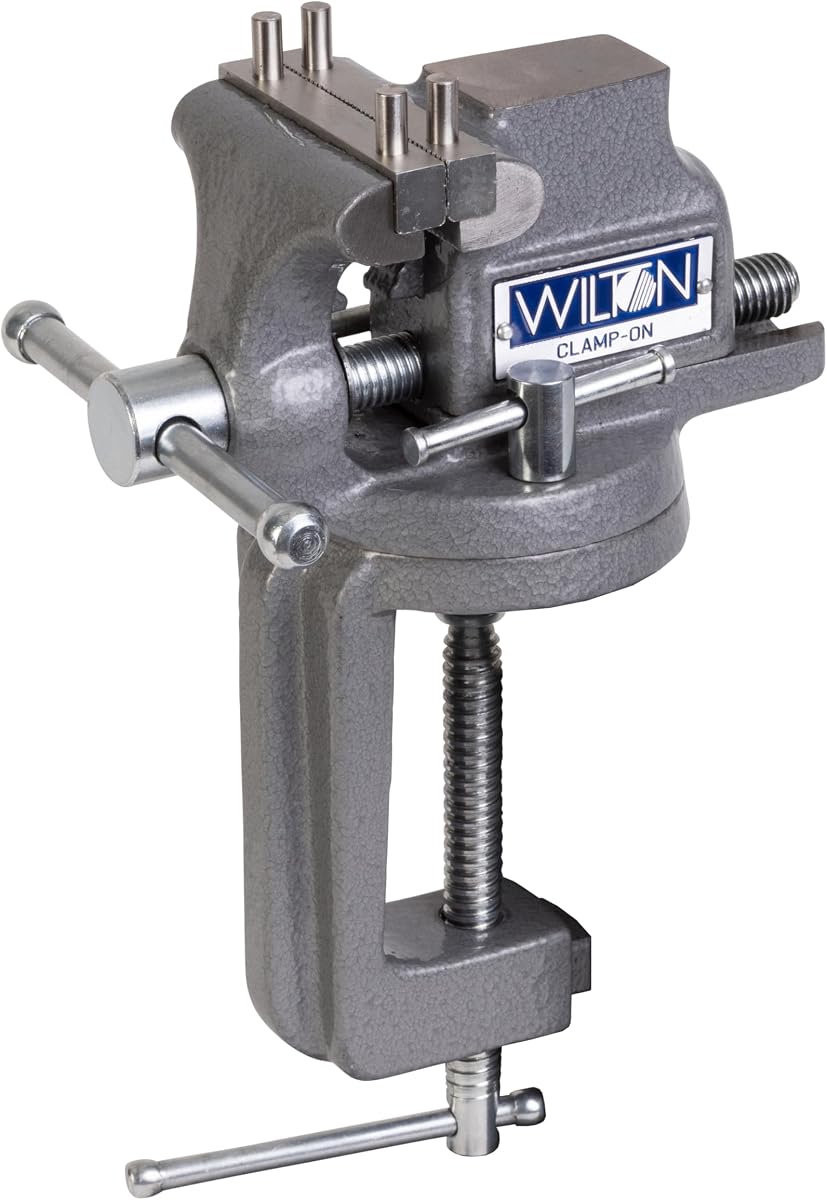
The Wilton 3" Clamp-On Apprentice Vise combines a 4.8 customer rating with an unusually strong set of workholding specifications. Its most impressive feature is the stated 1,800-pound clamping force, supported by a quick-release mounting clamp that can attach to work surfaces up to three inches thick.
We may earn a commission when you buy through this link, at no additional cost to you.
The dual-lockdown swivel base offers 45 degrees of positioning and is designed to keep the vise stable after installation. A two-inch throat depth and capacity for pipe between one-half and one inch give it useful versatility for assembly, fitting, cutting, and light-to-medium fabrication work.
Its main limitation is the 45-degree swivel range, which is less flexible than the 270- or 360-degree bases found elsewhere in this list. The mounting limit is also more restrictive than several competitors. Even so, the combination of clamping force, fast mounting, and positive locking is excellent for portable shops.
This is the strongest recommendation for buyers who need more holding power than a lightweight hobby vise without moving to a large permanent installation. It suits students, homeowners, repair technicians, and traveling tradespeople who will use a temporary workstation but still require consistent control over the workpiece.
The stated 1,800-pound force separates this model from many compact clamp-on vises. That capacity gives users confidence when gripping pipe, small assemblies, and irregular stock without treating the vise as a permanent bench-mounted workhorse.
A quick-release clamp and dual lockdowns make setup and repositioning convenient. The system is particularly useful for jobs that move between a kitchen table, garage bench, or temporary project surface.
We may earn a commission when you buy through this link, at no additional cost to you.
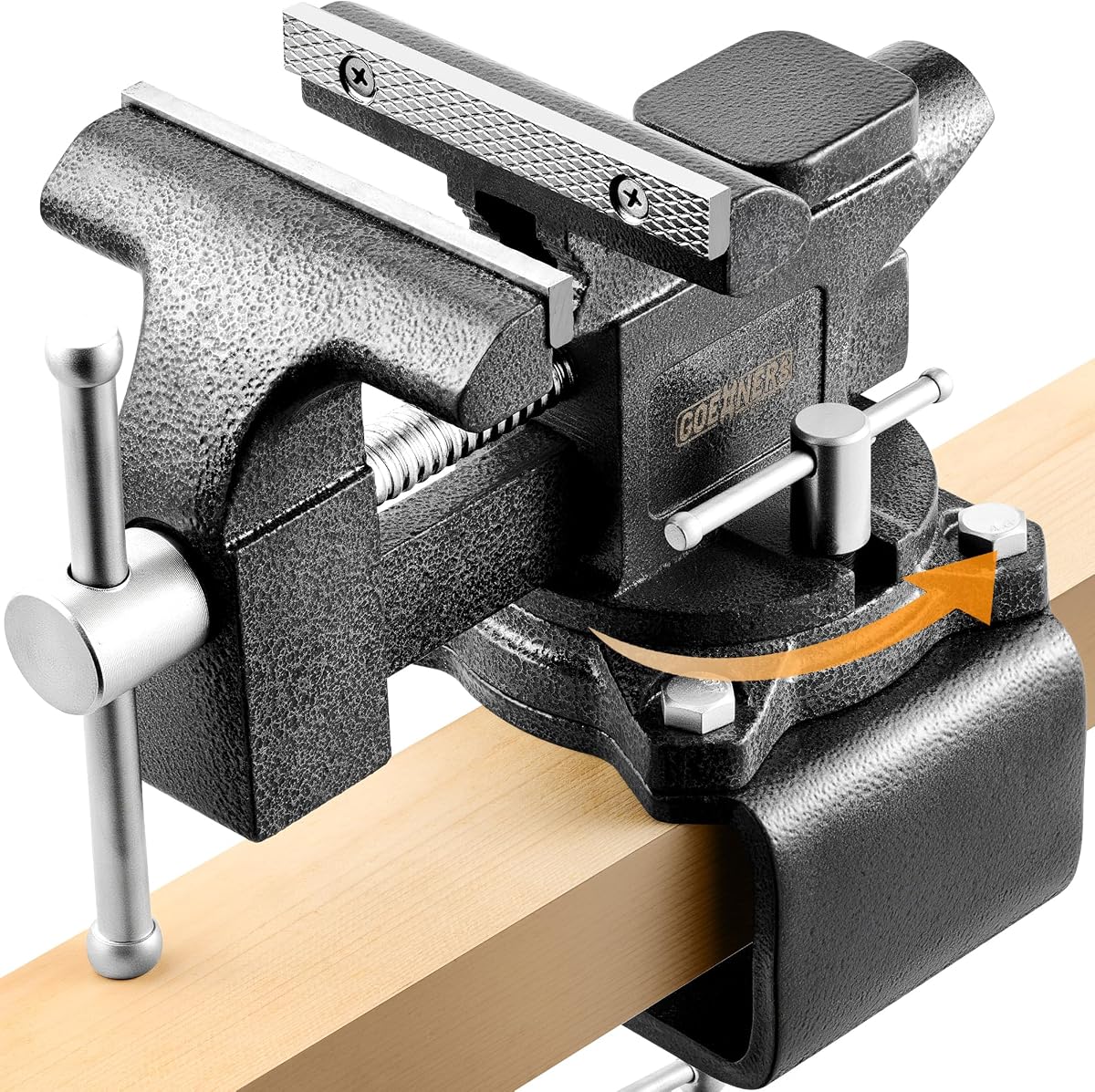
This 3.2-inch clamp-on table vise earns a 4.4 rating and delivers a broad set of features at an approachable tier. It can grip workpieces up to 2.79 inches, while its clamp accommodates benches up to four inches thick, giving it more mounting reach than many similarly compact competitors.
We may earn a commission when you buy through this link, at no additional cost to you.
The full 360-degree swivel is a major convenience for woodworking, drilling, gluing, sanding, sawing, and metalworking. Cast steel construction, hardened jaws, and a textured gripping surface support dependable everyday use. The large anvil also expands its usefulness for light shaping, flattening, or supporting small components.
The product information does not state a numerical clamping-force capacity, so buyers should not assume it equals the 1,800-pound figure of the Wilton Apprentice Vise. Its light-duty and general-purpose positioning also makes it less appropriate for sustained industrial work. Even so, the combination of rotation, jaw size, and mounting capacity is excellent for the budget category.
Choose this vise when you want a versatile clamp-on setup without spending heavily. It is well suited to home workshops, occasional repairs, craft work, and portable projects. The broad four-inch mounting range and 360-degree head make it particularly attractive for users working across different tables and temporary benches.
A 360-degree swivel lets the operator bring the jaws around a workpiece instead of repeatedly loosening and repositioning the entire vise. This is especially helpful for drilling, sanding, and assembly.
The balance between a 3.2-inch jaw width, nearly three-inch opening, and four-inch mounting limit gives the vise useful flexibility without the footprint of a full-size bench vise.
We may earn a commission when you buy through this link, at no additional cost to you.
The WORKPRO Dual Jaws Table Vise stands out with two distinct jaw widths: 2.5-inch serrated jaws and 1.5-inch smooth jaws. That pairing lets users choose aggressive teeth for pipes and tubes or a gentler surface for woodworking and precision DIY tasks. Its customer rating is 4.5.
We may earn a commission when you buy through this link, at no additional cost to you.
The head and base rotate through 360 degrees, while the mounting system can be used as a clamp or as a bolt-down installation. Four-quarter-inch 20 bolts are not included, so permanent users need to supply appropriate hardware. Its 7.7-pound weight and listed dimensions make it easy to carry between jobs.
Ductile iron construction, jaws hardened to 52–58 HRC, and a galvanized handle support a stated 660-pound clamping force. That is below the Wilton Apprentice Vise, but the dual-jaw design offers more surface-shape choice. The compact profile may also feel restrictive for large stock or major fabrication.
This is a strong choice for hobbyists and mobile repair professionals who need different gripping surfaces in one tool. Choose it when working with pipe, tube, timber, and small precision parts in a compact space. It is less compelling for heavy shop production or large woodworking pieces.
Serrated jaws improve control on cylindrical and irregular stock, while smooth jaws reduce marking on finer workpieces. Having both widths available makes the vise adaptable without changing tools.
At 7.7 pounds and with compact listed dimensions, the WORKPRO is easier to transport than many cast-iron competitors. It remains usable on workbenches, tables, and mobile workstations with limited room.
We may earn a commission when you buy through this link, at no additional cost to you.
The Wilton Super-Junior is the premium traditional choice in this group, with a 4-inch jaw width, 2.25-inch opening, and 2-inch throat. It carries a 4.3 rating and emphasizes long-term workmanship, including an enclosed design intended to keep contaminants out while retaining lubrication.
We may earn a commission when you buy through this link, at no additional cost to you.
Replaceable grooved top jaws are a particularly valuable feature for buyers who use the vise regularly. Worn jaw components can be serviced rather than forcing replacement of the entire vise. Double lockdowns secure the base, while the head rotates 45 degrees left or right for common angled tasks.
Its principal disadvantages are cost and capacity. The 2.25-inch opening is smaller than several less expensive models, and the 45-degree swivel does not offer the near-total rotation of 270- or 360-degree competitors. It also lacks the very high stated force rating of the newer Wilton Apprentice Vise.
Despite those limitations, the Super-Junior is ideal for buyers who prioritize replaceable parts, enclosed maintenance, and a lifetime manufacturing-defect warranty. It works well for general-purpose shop tasks, light trades, and owners who prefer a proven traditional bench-vise design over maximum swivel movement.
Replaceable grooved jaws extend the useful life of a frequently used vise. The enclosed mechanism also supports smoother operation by reducing the entry of chips, dust, and other workshop debris.
Double lockdowns help prevent the base from shifting, and 45-degree rotation covers many angled operations without adding the complexity of a full spherical or 360-degree head.
We may earn a commission when you buy through this link, at no additional cost to you.
This 4.5-inch bench vise offers a useful balance of clamping capacity and installation flexibility. Its 2-in-1 design can be attached to a table with supplied screws or held by the included base, while the product data describes a 13-pound weight, 3.3-inch maximum jaw opening, and 4.5-inch jaw width.
We may earn a commission when you buy through this link, at no additional cost to you.
The 270-degree swivel base improves access around workpieces and supports woodworking, model making, crafts, electronics, and welding applications. Forged steel construction gives the vise a substantial feel, and the coated surface is intended to resist rust. Multifunctional soft jaws add a gentler gripping option for materials that could be marked.
The base clamps a workbench up to 2.3 inches thick, which is narrower than several competitors. At 13 pounds, the vise is also less convenient for frequent transport. Buyers needing a shallow anvil or very wide jaw opening should examine the listed dimensions closely.
This model makes sense for users who may eventually convert a temporary clamp-on setup into a permanent bench installation. It is a good general workshop choice for those who value jaw width, soft-jaw utility, and 270-degree positioning more than minimal weight or a larger mounting range.
The two included attachment methods offer an uncommon degree of flexibility. Users can begin with clamp-on operation and later use screws for a more permanent workstation setup.
Soft jaw accessories can reduce marking and improve control over finished surfaces, tubes, and irregular pieces. They are especially useful when the standard jaws would be too aggressive.
We may earn a commission when you buy through this link, at no additional cost to you.
The 4.5-Inch Drill-Free Bench Vise combines a 4.8 rating with a mounting system designed to avoid permanent holes. It can clamp directly to a workbench or be secured with four screws when a permanent installation is preferable, making it adaptable to both rented and owned workspaces.
We may earn a commission when you buy through this link, at no additional cost to you.
Its pipe-and-flat jaw design accommodates round tubes, pipes, irregular pieces, and flatter materials. A set of soft jaws is included to help protect workpieces. The polished anvil supports light shaping and flattening tasks, while hardened jaws and cast iron construction support regular workshop use.
The base has a stated 14.4-pound weight, which makes it more of a stationary bench tool than a highly portable vise. Its 2.3-inch mounting range is also modest, and the stated opening of 3.5 inches is below the widest products in the list. These limits matter for oversized workpieces or thin portable tables.
This is an excellent recommendation for homeowners and renters who do not want to drill into a valued workbench. It is also practical for mixed-use shops, where the ability to move the vise or bolt it down later adds long-term flexibility.
The clamp base grips the bench without requiring permanent holes, reducing damage to tabletops and simplifying relocation. Four screws remain available for users who eventually want a fixed installation.
V-grooves support round stock while flat sections handle broad, flat materials. Included soft jaws add another controlled option for delicate or finished pieces.
We may earn a commission when you buy through this link, at no additional cost to you.
The MAXMAN Clamp Bench Vise distinguishes itself with a 360-degree spherical design and a side tilt of up to 45 degrees. That unusual geometry provides more ways to orient a workpiece than a conventional rotating base, which can improve access during detailed DIY, woodworking, or metal-part processing.
We may earn a commission when you buy through this link, at no additional cost to you.
The vise has an approximately three-inch jaw width and a 3.2-inch maximum opening. Its installation kit includes four support posts, protective rubber covers, and non-slip gaskets. Rubber pieces at the jaws help prevent scratches and slipping, while bench pads reduce wear where the base applies pressure.
The 12.5-inch maximum height makes this more of a floor or stand-mounted configuration than a low-profile tabletop attachment. The included system may also feel more elaborate than needed for simple bench work. Buyers should verify that the listed height and accessory arrangement suit their workstation.
This vise is ideal for users who regularly need unusual workpiece angles or want added control over round and delicate items. It is less attractive for those who require a low-profile portable clamp or a straightforward traditional bench-vise setup.
The spherical head rotates through 360 degrees and tilts to 45 degrees, allowing the operator to approach a workpiece from several directions. This is useful for drilling, shaping, and finishing.
Rubber jaw gaskets and bench pads help reduce scratches and slipping. The included protective covers also make the multi-post installation system easier to use without marring the work surface.
We may earn a commission when you buy through this link, at no additional cost to you.
This 3.3-inch table vise combines a 4.5 rating with a compact 2-in-1 mounting design. It can be screwed to a workbench or clamped directly to a table, and the base supports surfaces up to four inches thick. That makes it suitable for both a home bench and a smaller workshop.
We may earn a commission when you buy through this link, at no additional cost to you.
A one-button mechanism brings the jaws together for initial positioning, reducing the need to repeatedly align the workpiece with a traditional screw clamp. The 360-degree swivel improves access, while the smooth rails are designed to make tightening and operation more consistent.
Its 2.5-inch maximum opening is the main constraint, especially for larger pipe, round stock, or broad boards. The product information also does not provide a numerical clamping-force rating, making direct force comparisons difficult. Buyers should treat it as a general-purpose vise rather than assume industrial capacity.
This model is a good fit for frequent repositioning, assembly work, and projects where switching between several temporary work surfaces is common. It provides useful features without a large mounting footprint, making it appealing to DIY users and compact-shop operators.
The jaw-opening button helps the operator close in on a workpiece quickly. Once positioned, the normal handle mechanism supplies the final holding pressure.
Full swivel rotation improves access while the vise remains small enough for tables and portable benches. That balance is valuable when workspace is limited.
We may earn a commission when you buy through this link, at no additional cost to you.
The Updated 4.5-Inch Bench Vise combines broad dimensions with a high stated clamping capacity. Its 4.5-inch jaw width, approximately 4.33-inch maximum opening, and 5,500-pound clamping force position it as a workhorse for demanding woodworking, industrial, and DIY applications.
We may earn a commission when you buy through this link, at no additional cost to you.
The pipe-and-flat jaw arrangement supports circular tubes as well as flat materials. Hardened, engraved jaws improve grip, and the surface coating is intended to improve corrosion resistance. A 270-degree swivel gives users substantial directional flexibility, while the polished anvil adds a secondary work surface.
The two installation methods offer both clamp-on convenience and permanent attachment with screws. Conversely, the high-force, large-jaw design is likely heavier than more compact alternatives, although the listing does not provide a numerical product weight. Buyers should ensure their bench and mounting surface can support it comfortably.
This is a compelling option for users who work on large boards, pipe, and demanding assemblies and want strong stated force. It is less suitable for a lightweight mobile toolkit or a small temporary table, where a more compact vise would be easier to manage.
The stated 5,500-pound clamping force is the most notable specification in this group. Combined with wide jaws and an opening above four inches, it is aimed at larger and more demanding jobs.
Pipe grooves accommodate round stock, while flat jaw sections suit boards and other broad pieces. This avoids needing a separate holder for many common workshop tasks.
We may earn a commission when you buy through this link, at no additional cost to you.
The IRWIN Tools Clamp-On Vise is a compact, general-purpose option rated 4.5 by customers. Its defining advantage is straightforward portability: it attaches to tables up to two inches thick, allowing a workholding solution to move with the task rather than requiring a permanent bench installation.
We may earn a commission when you buy through this link, at no additional cost to you.
Integrated pipe jaws help keep cylindrical workpieces steady, while the incorporated shaping-horn anvil provides a hardened area for light shaping and forming tasks. These features make the vise more than a basic jaw clamp and broaden its usefulness for repair and hobby work.
Its two-inch jaw capacity is the smallest opening in this comparison, and its two-inch table limit rules out many thicker benches. There is no stated numerical clamping force, swivel range, or detailed material composition in the supplied information. It should therefore be judged as a portable general-purpose tool rather than a heavy fabrication vise.
This is a sensible recommendation for repair kits, mobile maintenance, students, and light-duty home projects where portability matters more than maximum capacity. It is best for small parts, pipes, and assemblies that fit comfortably within its two-inch jaw opening.
The simple clamp-on format lets users bring a familiar grip to a temporary table without permanent modifications. It is particularly practical for mobile repair work and compact hobby spaces.
Integrated pipe jaws help prevent round stock from turning, and the shaping horn creates a convenient contact point for controlled light-duty forming tasks.
We may earn a commission when you buy through this link, at no additional cost to you.
Choosing a clamp-on bench vise means balancing jaw capacity, mounting range, rotation, force, portability, and the kinds of materials you expect to hold. Comparing those factors against your actual bench and projects prevents an attractive but poorly matched purchase.
Jaw opening determines the largest workpiece that can fit between the jaws, while jaw width influences contact area, stability, and the ability to hold broad boards. General DIY users often benefit from roughly two to three inches of opening, whereas pipe, round stock, and larger woodworking projects may need more than four inches. Consider both measurements because a wide jaw does not necessarily mean a wide gap.
Match the maximum opening to the largest material you expect to use, and choose jaw width according to the workpiece surface. A broad jaw improves control on flat stock, while a narrower jaw can be easier to access when working inside confined spaces.
The maximum workbench thickness supported by the clamp is critical because a vise cannot be installed securely if the base cannot wrap around the available edge. Products in this guide range from two inches to four inches of stated reach. Buyers should measure both the bench thickness and the available underside clearance before choosing a model.
Select a clamping range that comfortably fits the bench and allows the mechanism to engage fully. Do not force a narrow vise onto a thicker bench, and avoid assuming that a clamp can compensate for an unstable or unusually shaped table.
Rotation determines how easily the user can work around the sides and underside of a clamped object. A 45-degree swivel suits common angled tasks, 270-degree bases provide broad directional access, and 360-degree heads or spherical systems make it possible to approach work from nearly any angle. More rotation is useful for drilling, assembly, and finishing.
Choose the range that matches your most common workflow rather than paying for complexity you will not use. Check that the rotating head does not interfere with nearby tools, bench edges, or overhead clearance.
Clamping force indicates how strongly the vise resists the force applied by a handle, though actual holding can also depend on jaw geometry and workpiece condition. The products here list figures from 660 pounds to 5,500 pounds, while some omit a number. For light hobby work, a modest vise may be sufficient; fabrication, assembly, and stubborn materials benefit from higher rated force.
Treat published force figures as comparisons rather than guarantees, and always use the supplied handle. Excessive leverage can damage the vise or the workpiece, so choose a capacity that comfortably covers your workload without forcing the mechanism.
Serrated or textured jaws improve friction on pipes, tubes, and rough wood, while smooth jaws reduce marking on finished surfaces and delicate components. Some models combine flat sections, V-grooves, pipe jaws, and removable soft jaws. Having several surfaces makes one vise useful across a broader mix of materials.
Consider the most delicate and most demanding materials you handle. Use soft jaws or protective jaw pads when finish matters, and confirm that the jaw shape matches parts such as tubes, irregular pieces, and flat boards.
A clamp-on vise is convenient for temporary use and movable workstations, while a bolt-down vise is more rigid during prolonged or heavy work. Several models support both approaches, allowing users to clamp during quick jobs and later fasten the vise permanently. This is especially attractive in shared shops, rented spaces, or multi-purpose workbenches.
If your bench is suitable for permanent modification, bolts can improve consistency. If not, prioritize a strong clamp mechanism, adequate bench thickness, and a base that protects the table surface from damage.
Compact vises are easier to carry between jobs, store in small workshops, and position near the material being worked. Larger cast-iron designs offer greater jaw dimensions and force but can be tiring to move. The listed weight is most useful when deciding whether the vise will remain mounted or travel with a mobile tool kit.
Balance portability against the capacity you need. A smaller vise is easier to use consistently if it is comfortable to position, while a heavier model may be worthwhile when it stays installed and handles demanding work.
Cast iron, forged steel, ductile iron, and hardened jaw components affect durability, but construction alone does not determine long-term performance. Look for corrosion-resistant finishes, replaceable jaw plates, enclosed mechanisms, and accessible screw components. These features make cleaning and eventual repair easier after exposure to sawdust, metal chips, and moisture.
Choose a model with serviceable parts and a surface that can be wiped or lightly oiled. Avoid using a vise as a permanent storage surface, because accumulated debris can interfere with the screw and swivel mechanism.
Begin by placing the vise on a level, rigid surface with enough clearance around the jaws. Confirm that the clamp can fully engage the bench edge and that the bench is heavy enough to resist movement. Attach the base evenly, tighten the mounting hardware gradually, and test the installation with gentle pressure before handling a valuable workpiece.
Place the workpiece so that force travels through the jaws and base rather than against a narrow unsupported section. Use the appropriate flat, serrated, pipe, or soft-jaw surface, then close the jaws firmly enough for control without crushing the material. Keep fingers clear of the jaw area and support large workpieces so their weight does not pull against the vise.
After use, release the jaws completely and remove chips from the screw, guides, swivel, and base. Use a brush or soft cloth, apply a suitable light lubricant where appropriate, and inspect the mounting points and jaw surfaces for wear. Store the vise securely, particularly if it uses removable posts, and avoid excessive handle leverage or side loading that could damage the base.
A clamp-on vise grips the edge of a table or bench, making it portable and avoiding permanent drilling. A bolt-down vise is fastened directly to the surface, usually offering greater rigidity for sustained heavy work. Some models support both methods, providing flexibility as workshop needs change.
The bench must fit within the vise's stated clamping range, which varies among these products. Measure the bench at its thickest point and confirm that the mechanism has enough room to engage securely. A bench at the maximum listed thickness may require careful positioning of the clamp and supporting hardware.
No. A larger opening accepts bigger workpieces, but overall size, weight, throat depth, and jaw shape also affect usability. A very large vise can be harder to position and may be unnecessary for small projects. Choose the smallest model that comfortably fits the materials you expect to clamp.
Yes, when the construction, jaw design, and clamping force match the task. Models with V-grooves, pipe jaws, hardened surfaces, and higher stated force are better suited to metal components. For severe hammering or fabrication, confirm the workload rating and use appropriate protective jaw covers.
Soft jaws are useful when standard serrated teeth could scratch, dent, or mar a workpiece. They are particularly helpful for finished wood, painted parts, tubes, and delicate surfaces. Remove them when maximum tooth engagement is needed for rough material.
A 360-degree swivel allows the head or base to rotate through a complete circle, making it easier to reach different sides of a clamped workpiece. It reduces the need to loosen the bench clamp and reposition the vise. Check whether the model rotates at the base, head, or both, as the practical result differs.
Use protective pads or non-slip gaskets where the clamp contacts the surface, and tighten evenly without applying excessive leverage. Check the table underside for hardness and confirm that the clamp fits correctly before applying full holding force. A stable, undamaged base helps prevent both scratches and sudden movement.
Only models that include bolt holes or support an optional bolt-down installation should be converted. The product data identifies several 2-in-1 designs with this capability, but hardware requirements can vary and some bolts are not included. Confirm compatibility with the vise and the bench material before drilling.
The Wilton 3" Clamp-On Apprentice Vise is the strongest overall choice because it combines a 4.8 rating, high stated clamping force, quick-release mounting, and secure dual lockdowns. The Table Vise or Bench Vise 3.2 Inch offers the most approachable entry, while the Wilton Super-Junior stands out for serviceable jaws and traditional premium construction.
For buyers with different priorities, the WORKPRO is compact and offers both smooth and serrated jaws, while the Updated 4.5-Inch Bench Vise targets demanding work with a wide opening and very high stated force. The 4.5-Inch Drill-Free model is ideal for protecting an unperforated bench, and the IRWIN prioritizes portable, compact general work.
Before buying, measure the bench thickness, identify the largest workpiece, and decide whether portability, rotation, pipe support, soft jaws, or permanent mounting matters most. Check current product listings, included accessories, dimensions, and availability, since prices and configurations can change after publication.