
4K Bidirectional EDID Emulator
3.9Editor score
Bidirectional passthrough
No external power
1080p to 4K
Our HDMI Edid Emulator Passthroughs guide compares 10 models for reliable handshakes, display stability, headless use, resolution support, and easy setup
HDMI EDID emulator passthroughs help computers, media players, KVM switches, and video gear maintain consistent display identities when screens are switched, powered down, or disconnected. A capable unit can preserve layouts, simplify headless installations, and reduce frustrating renegotiation errors, while still passing HDMI audio and video to the intended display.
We compared the ten products using the supplied specifications, including resolution support, EDID controls, passthrough behavior, compatibility, installation requirements, and intended applications. The list covers fixed-emulation adapters, bidirectional units, programmable models, HDMI 2.0 and 2.1 devices, and a compact ATEN option for straightforward EDID learning.
Each review identifies the setup that best suits the product and explains any limitations that matter before installation. The top picks demonstrate why the budget choice, the most versatile editor's choice, and the feature-rich premium option stand out, although prices and availability can change at any time.
3.9Editor score

4.2Editor score

4.3Editor score
The comparison below places all ten adapters side by side, emphasizing resolution ceiling, EDID programmability, passthrough direction, power requirements, and the scenarios each model is designed to address.




The EVanlak 3rd Generation Aluminum is the most balanced choice in this guide, earning a 4.2 rating for its straightforward combination of EDID emulation, HDMI passthrough, and broad device compatibility. It is designed to keep a display identity available so connected systems can retain their desktop arrangement when a monitor, receiver, switch, or splitter changes state.
We may earn a commission when you buy through this link, at no additional cost to you.
Its strongest qualities are practical rather than elaborate. The adapter supports resolutions from 1080p through 3840 by 2160 at 60Hz, works with Mac Thunderbolt sources, AV receivers, switches, extenders, and splitters, and requires neither drivers nor external power. The premium aluminum housing also gives it a more durable appearance than a basic plastic dummy plug.
This is a fixed-emulation solution rather than a programmable EDID manager. That means it suits users who need a stable 4K60 target without selecting detailed color formats or copying a particular display's data. It is particularly attractive for headless computers, frequently switched displays, and installations where an entire system should not restart its screen layout after a hot-plug event.
Overall, this is the most broadly useful pick for typical home-office, media-center, and AV installations. Buyers who need exact EDID copying, many presets, HDMI 2.1 features, or surround-audio profiles should move up to a more specialized model. For the core job of keeping a predictable display identity while passing HDMI signals, however, the EVanlak is difficult to overcomplicate.
The adapter continually presents an emulated monitor identity, reducing the chance that Windows will rearrange the desktop when the real display is switched off or disconnected. This makes it useful for remote-access stations and setups with frequently changing receivers.
Because the device works without software, drivers, or an external supply, installation is largely a matter of placing it inline between the source and display. Its 4K60 target covers common high-resolution uses without requiring advanced menu configuration.
We may earn a commission when you buy through this link, at no additional cost to you.
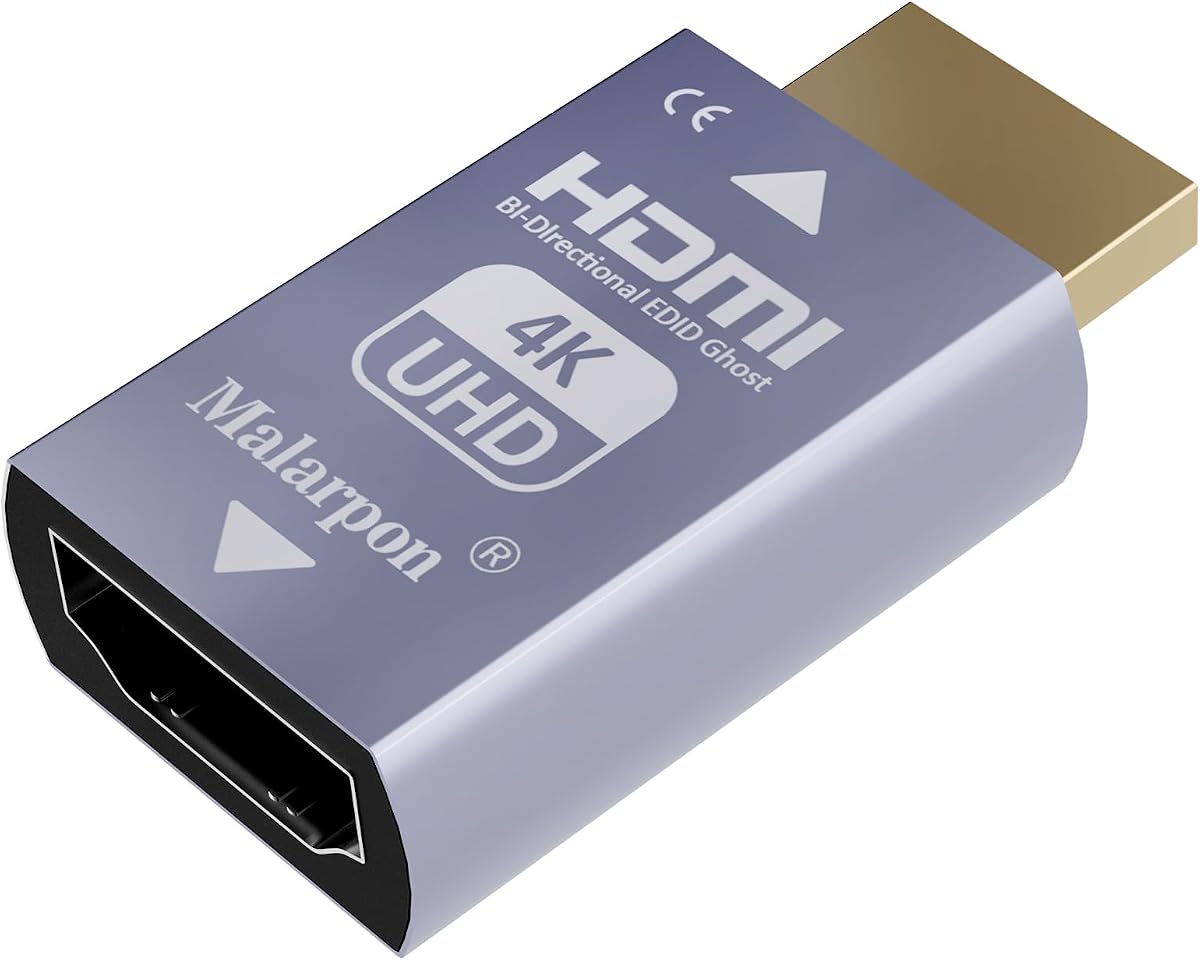
This 4K HDMI EDID Emulator Passthrough Adapter delivers a capable low-cost solution for users whose main problem is display rediscovery or desktop rearrangement. Its 3.9 rating reflects a useful set of essentials: fixed EDID emulation, bidirectional signal handling, support for resolutions up to 4K60, and a plug-and-play design.
We may earn a commission when you buy through this link, at no additional cost to you.
The adapter accepts either a male or female source connection, reducing the need to worry about signal direction. It can sit inline with a KVM setup and helps prevent Windows from resetting its display arrangement when sources change. Hot swapping, low power consumption, and operation without drivers make it particularly convenient for frequently changing installations.
The most important limitation is explicit: HDCP is not supported. Protected content may therefore be unavailable, blank, or restricted, and the product is less suitable for modern streaming devices, discs, or game consoles that depend on HDCP handshakes. It also emulates a fixed display profile rather than copying a specific monitor's EDID.
This is the budget recommendation for IT administrators, remote-access users, and computer builders who need stable display identity at a basic resolution. Choose it for KVM control, headless Mac mini or NUC operation, or a multi-screen arrangement prone to rearrangement. Avoid it when protected-content playback is essential or when exact audio and color capabilities must be reproduced.
Bidirectional passthrough means either connector orientation can serve as the input, which is useful behind racks and in compact installations. The product is particularly suited to inline KVM use, where preserving the existing desktop is more important than advanced EDID selection.
By keeping the emulated display active, the adapter lets computers such as Mac minis, Raspberry Pi systems, NUCs, and Jetson Nano boards remain recognizable during remote access. Its fixed target can span 800 by 600 at 60Hz through 3840 by 2160 at 60Hz.
We may earn a commission when you buy through this link, at no additional cost to you.
The HDMI EDID Emulator Passthrough with HDR support has a 3.5 rating, but its specification sheet covers several useful requirements for modern display networks. It supports 4K 2K at 60Hz, 1080p at 120Hz, and a maximum of 4096 by 2160 at 60Hz while providing male-to-female bidirectional passthrough.
We may earn a commission when you buy through this link, at no additional cost to you.
This adapter is aimed at installations where signals must remain stable through hot swaps, source changes, and repeated renegotiation. It requires no drivers or external power, and the supplied description says it works with Mac mini, Raspberry Pi, NUC, DisplayPort, Thunderbolt, and Type-C-to-HDMI adapters. It can also be connected in series with KVM switches.
The main drawback is that it offers fixed EDID emulation rather than exact copying or a menu of selectable profiles. Its 3.5 rating is the lowest among the reviewed products, so buyers should consider the complete specification and compatibility requirements carefully. The advertised HDR capability also does not replace the need for a source, display, and signal path that support the desired format.
This model is worth considering for office wiring, KVM arrangements, and headless computers that benefit from a stable hardware identity. It is less compelling when programmable EDID data, exact surround-audio matching, or advanced HDMI 2.1 negotiation is required. For those needs, the HD-EWB or 4K PRO offers more explicit control.
The pure-hardware design avoids operating-system drivers and configuration utilities. That makes the emulator suitable for a headless machine that must boot, establish a virtual display, and remain available through remote administration.
Keeping the EDID active through power cycles and display changes is intended to reduce repeated handshakes. The result is a more consistent operating environment for frequently switched sources and display equipment.
We may earn a commission when you buy through this link, at no additional cost to you.
The HDMI EDID Emulator with a stated 8K30Hz to 4K120Hz range is the highest-rated product in this roundup, carrying a 5.0 rating. It is designed as a general-purpose signal stabilizer for sources, displays, receivers, switches, extenders, and splitters where a consistent emulated identity can prevent output errors or connection failures.
We may earn a commission when you buy through this link, at no additional cost to you.
Its advertised resolution range is notably ambitious, and the supplied information says the adapter simulates resolution, refresh rate, color depth, and audio settings. Installation requires no drivers or software: the user places the emulator between the source and display, and it operates automatically. Applications include home theaters, conference rooms, control rooms, commercial displays, and digital signage.
There is an important distinction between a broad advertised format range and the capabilities of every attached source, sink, switch, or cable. The product uses a default, fixed EDID rather than providing a documented control panel for copying a specific display's data. Buyers should therefore verify the resolution and audio formats needed by their complete signal chain.
This adapter is a strong candidate for users who want a high-rated, broadly described dummy plug across mixed AV equipment. It is especially suitable for permanent installations where display discovery or signal loss becomes disruptive. Those needing exact EDID cloning, selectable presets, or HDMI 2.1-specific SCDC controls should instead examine one of the programmable models.
The listed compatibility with AV receivers and video splitters makes the emulator useful in layered entertainment systems. It can help maintain consistent source behavior when several display-management devices sit between the computer or player and the screen.
Commercial displays and control rooms often need a source to remain available even while a panel is off. The emulated identity supports that headless-style use and can reduce screen errors caused by mismatched EDID information.
We may earn a commission when you buy through this link, at no additional cost to you.
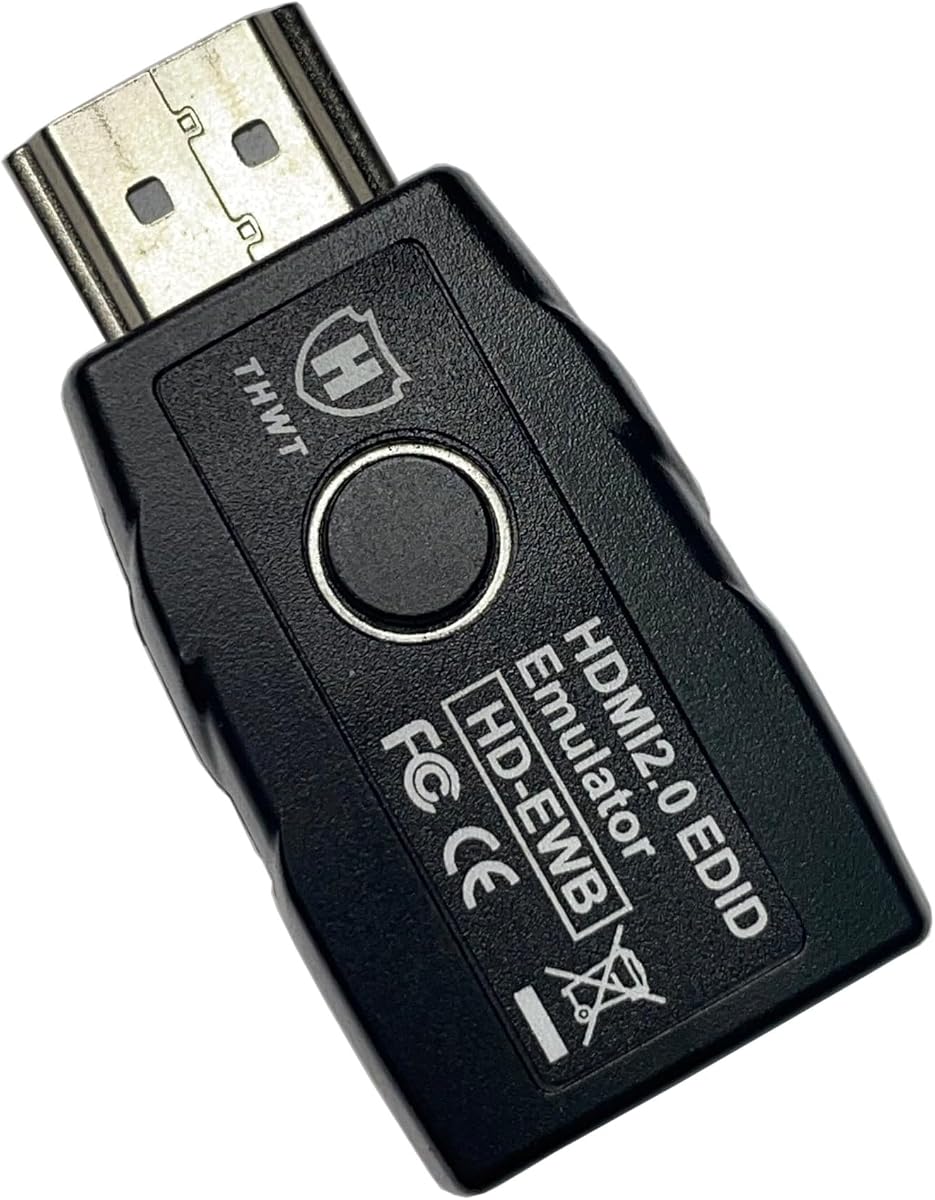
The HD-EWB is an HDMI 2.0 EDID emulator built for users who need more control than a fixed dummy plug provides. Its 3.6 rating accompanies two significant features: exact EDID copying from an external monitor and a button that switches between stored external data and an internal preset.
We may earn a commission when you buy through this link, at no additional cost to you.
The internal profiles offer 1080p at 60Hz with 4:4:4 and 4K at 60Hz with 4:2:0, both using 2.1-channel audio. Holding the button for three seconds enters copy mode and saves the latest connected monitor's EDID for later emulation. This is useful when a source, switcher, or extender repeatedly loses display information.
Its limitations are technical and should be considered before purchase. It does not fully support HDMI 2.1 devices or SCDC behavior, so some modern 4K arrangements may interrupt the signal or fail to replug reliably. The internal preset supports only 2.1-channel audio; obtaining surround sound requires copying an EDID from a display that advertises the desired 5.1- or 7.1-channel capability.
This is a compelling choice for an HDMI 2.0 system that needs exact monitor emulation and HDCP pass-through. It is less appropriate for cutting-edge 4K120 or HDMI 2.1 chains, where the dedicated 4K PRO is better suited. For conventional 4K60 AV infrastructure, though, the combination of copy mode, preset profiles, and automatic signal-direction detection is unusually flexible.
The three-second copy action stores an external monitor's EDID inside the emulator and replays it when needed. That makes the adapter useful for matching a complex display, receiver, or extender rather than relying only on a generic profile.
The bi-directional design lets the unit be placed on either side of the connection. Automatic source and sink detection simplifies deployment around splitters, switchers, and extenders where fixed cable orientation could otherwise complicate setup.
We may earn a commission when you buy through this link, at no additional cost to you.
The 4K 60Hz HDMI EDID Emulator with HDCP Passthrough combines a 4.4 rating with a specification set centered on reliable 4K operation. It supports resolutions up to 4K at 60Hz and 1080p at 120Hz, while its male-to-female bidirectional passthrough removes concerns about fixed connection direction.
We may earn a commission when you buy through this link, at no additional cost to you.
Its operational advantages are centered on stability. The adapter requires no external power, software, or drivers, supports hot swapping, and can be connected in series with a KVM switch. According to the supplied information, it keeps display parameters stable through source changes, power cycles, and renegotiation, making it well suited to frequently changing signal paths.
The product uses fixed EDID emulation and does not advertise a way to copy a specific display or choose among multiple internal profiles. That simplicity is an advantage for users who want consistent behavior without configuration, but it is a drawback when color depth, exact audio formats, or a particular monitor's capabilities must be reproduced.
This adapter fits offices, remote-access systems, and AV installations using standard 4K60 displays. Its 4.4 rating makes it one of the strongest-rated options here, though the rating should not be confused with independent laboratory testing. Buyers should check whether their source and display need anything beyond the stated resolution and passthrough capabilities before ordering.
Keeping the emulated display identity active reduces the chance that source switching will reset desktop arrangement. Audio and video continue passing during device power cycles and renegotiation, according to the supplied description.
Compatibility is listed for Mac mini, Raspberry Pi, NUC, DisplayPort, Thunderbolt, and Type-C-to-HDMI adapters. This makes the unit practical for mixed computer systems where an inline HDMI stabilizer is needed.
We may earn a commission when you buy through this link, at no additional cost to you.
The 3rd Generation Aluminum EDID emulator carries a 4.1 rating and focuses on a narrow but common need: keeping a monitor identity active after the real display is switched off, disconnected, or routed through an intermediate device. Its stated target is 3840 by 2160 at 59Hz.
We may earn a commission when you buy through this link, at no additional cost to you.
The adapter is bidirectional, so either the male or female end may connect to the source. It tells the operating system that a specified monitor remains present while passing video and audio to the real screen. This can prevent Windows from rearranging the desktop and allows the unit to act as a removable dummy plug after the desired identity is established.
The product is described as working with DP-to-HDMI adapters and with Mac mini, Raspberry Pi, NUC, and Jetson Nano devices accessed remotely. Its aluminum body and simple inline format make it practical for a permanent installation. It is not a programmable EDID manager, however, and the 59Hz ceiling may be restrictive for demanding 4K displays.
This is a sensible choice for a computer that needs a stable headless identity, particularly when the surrounding system uses switches or extenders. Choose a newer 60Hz model if exact 4K60 behavior is important, and choose a copying or preset-based adapter when audio formats or color characteristics must be matched precisely.
The emulated monitor remains visible to the source even when the physical display is unavailable. That continuity is valuable for remote-access workflows in which disconnecting a local monitor should not cause a full desktop rearrangement.
Users can connect a suitable monitor once and then remove it, leaving the emulator in place. This makes the adapter a straightforward alternative to a conventional headless display dummy plug when the desired identity is already appropriate.
We may earn a commission when you buy through this link, at no additional cost to you.
The HDMI 2.1 4K EDID Emulator PRO, model 4K-EW2, is the most technically advanced option in this guide. Its 4.3 rating reflects a combination of HDMI 2.1 compatibility, SCDC support, exact EDID copying, HDCP pass-through, and fourteen built-in EDID profiles selected with a control knob.
We may earn a commission when you buy through this link, at no additional cost to you.
Its resolution ceiling reaches 4K at 120Hz in 4:2:0, while 1080p at 240Hz in 4:4:4 is also listed. SCDC frequency controls for 10x and 40x modes add value in modern high-bandwidth installations, and hot-plugging is supported. The unit can store an external monitor's video and audio information, then accurately emulate that environment when the display is unavailable.
There is one major format boundary: the model does not support 8K resolution because it lacks FRL handshaking. It also does not support 8K in any other advertised configuration. For users working with conventional 4K120 or high-refresh 1080p equipment, this is an excellent feature set, but it should not be mistaken for a full 8K solution.
This premium adapter is best suited to serious AV builders, advanced KVM setups, and high-end displays where SCDC behavior and selectable EDID profiles matter. It is also appropriate when copying the exact EDID of a display is more valuable than a lower-cost fixed profile. The investment is justified by control and compatibility rather than by basic passthrough alone.
Fourteen internal EDID settings give installers more choices than fixed-emulation adapters provide. A knob makes it possible to select the desired target and then use external EDID copying when an exact match is preferable.
SCDC control and HDMI 2.1 compatibility address handshaking demands that can disrupt 4K120 links. Automatic source and sink detection also allows flexible placement around switches, splitters, extenders, and display-side equipment.
We may earn a commission when you buy through this link, at no additional cost to you.
The 4K Prophecy 8 Extended Display EDID Manager earns a 5.0 rating and distinguishes itself through a combination of EDID management and HDMI signal conditioning. It can copy and save an end display's EDID, offers eight preset EDID types, and functions as a repeater and retimer for installations that need more than identity emulation.
We may earn a commission when you buy through this link, at no additional cost to you.
The HDMI 2.0b-based design supports 4K at 60Hz over an 18G bandwidth system. Its repeater function amplifies and equalizes HDMI signals, making multiple cascaded levels possible. CEC pass-through is included, allowing the unit to coexist with an AV system's existing control functions rather than blocking them.
Installation remains hardware-oriented: the adapter uses plug-and-play operation without software or drivers, consumes little power, and is described as capable of continuous 7-by-24-hour operation. That makes it relevant to commercial displays, control rooms, digital signage, and other always-on installations where signal reliability matters more than a small feature set.
This is a strong option for integrators who need EDID management plus active signal conditioning. It is less suitable for an HDMI 2.1 or 4K120 project requiring SCDC controls, because those capabilities are not documented for this model. For standard 4K60 systems with cascaded hardware and CEC needs, it offers a notably well-rounded feature set.
Most basic emulators only present an identity. This model also amplifies and equalizes the signal, which can help preserve transmission through layered HDMI equipment and support multiple cascade levels.
Low-power, driver-free operation and a stated 7-by-24-hour working design suit commercial and institutional installations. The eight presets and copied display data provide enough flexibility for mixed control-room and signage networks.
We may earn a commission when you buy through this link, at no additional cost to you.
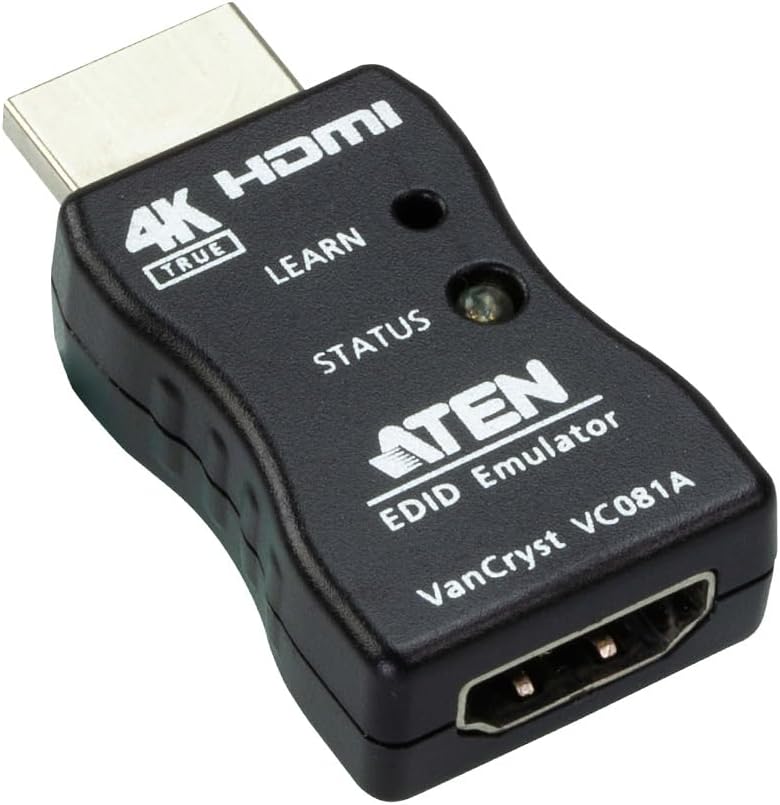
The ATEN VC081A is a compact True 4K EDID emulator with a 2.7 rating, the lowest in this guide, though its core functions are clearly defined. It manages EDID communication between connected devices, learns an attached display's information through a single pushbutton, and relays that information back to the video source.
We may earn a commission when you buy through this link, at no additional cost to you.
The adapter supports resolutions up to 3840 by 2160 at 60Hz with 4:4:4 chroma sampling. It is compatible with HDMI 3D, Deep Color, True 4K, HDCP 2.2, and Consumer Electronic Control, providing a familiar feature set for established AV installations that do not need 4K120 or HDMI 2.1-specific controls.
Its main limitations relate to depth of control and modern high-bandwidth formats. Only one-button learning is described, with no catalog of preset profiles or frequency controls comparable with the HD-EWB or 4K PRO. The unit's 2.7 rating indicates that some buyers have been less satisfied, so prospective users should review current customer feedback and confirm that its single learned profile fits their system.
ATEN's established, compact design may appeal to users who want a straightforward learned-display solution without a larger programmable manager. It is best for standard 4K60 chains, KVM arrangements, or installations that already rely on ATEN equipment. Advanced users should select a model with external power, explicit preset selection, and stronger feedback about EDID data.
Connect the intended display, press the single control, and the VC081A can save and relay its EDID. This straightforward workflow is useful when the desired display profile is known and frequent adjustments are unnecessary.
Support for 4K60 4:4:4, Deep Color, HDCP 2.2, and CEC keeps the adapter compatible with common professional display systems. Its compact, lightweight enclosure is useful where rack space or cable routing is constrained.
We may earn a commission when you buy through this link, at no additional cost to you.
The right HDMI EDID emulator passthrough depends on your display path, protected-content requirements, resolution target, and need for configuration. These factors separate simple fixed emulators from advanced copying and signal-management devices.
A fixed EDID emulator presents a built-in display identity and is usually the simplest option. It can stabilize a system that loses its display whenever a monitor or receiver powers down, but it cannot necessarily reproduce a specific monitor's complete color and audio characteristics. Exact-copying models learn data from a connected display and replay it later, offering more control when a complex receiver, extender, or commercial panel must be matched.
Choose fixed emulation for a predictable standard target, and choose copying when the entire signal chain depends on one specific display.
Resolution claims should be evaluated beyond the headline 4K label. Check the maximum pixel dimensions, refresh rate, chroma format, and whether the HDMI version and SCDC behavior are supported. A device listed for 4K60 may not negotiate a 4K120 link, while a fixed 59Hz profile can be unsuitable for displays expecting a 60Hz signal. High-bandwidth HDMI 2.1 equipment requires careful compatibility checks.
Match the emulator's supported mode to the weakest device in the chain, including cables, switches, receivers, and displays.
HDCP support matters when the source produces protected video, including many streaming services, discs, and console applications. Pass-through means the emulator allows the source to read the display's HDCP key during a properly established connection; it does not mean protected content is bypassed or removed. A product without HDCP support may still work for ordinary desktop signals while leaving protected playback unusable.
For media centers and gaming setups, verify explicit HDCP support and test the complete chain before installation.
Bidirectional passthrough removes a common source of installation uncertainty because either connector orientation may be used. It is particularly useful with KVM switches, extenders, splitters, and rack arrangements where a fixed source-to-display direction can be inconvenient. Automatic direction detection goes further by allowing the emulator to be placed closer to either the source or the display.
Select a bidirectional model when flexibility in placement matters, and a clearly directional unit only when the wiring path is fixed.
Many EDID emulators draw power from the connected HDMI source and require no external supply, which keeps installation simple. Hot-swapping support allows a unit to remain in the chain while equipment is powered, switched, or renegotiated. This is valuable for KVM and control-room systems where frequent changes are routine. More advanced managers may add signal amplification or retiming functions that also improve reliability over longer or more complex chains.
Prioritize source-powered, hot-swappable models for flexible everyday use and consider powered conditioning for long or layered installations.
A larger preset library allows an installer to choose among common display identities without repeatedly learning from hardware. Audio capabilities also matter: an internal profile may advertise only stereo or 2.1-channel support, while a copied EDID may preserve 5.1- or 7.1-channel support if the source display advertises it. Color depth and chroma information can be equally important in professional video work.
Choose more presets and copy controls when display matching, surround audio, or precise color formats are central to the installation.
The emulator must fit between the devices in the actual signal chain. Common source types include PCs, Mac minis, Raspberry Pi systems, NUCs, laptops, Blu-ray players, game consoles, and AV receivers. The display side may include computer monitors, televisions, projectors, splitters, extenders, receivers, or commercial signage panels. Some products also work with DisplayPort, Thunderbolt, or USB-C-to-HDMI adapters.
Confirm connector orientation, device support, and any HDCP or HDMI-version restrictions before making a final selection.
The simplest emulators need no configuration, which can be an advantage in a small home setup. Advanced managers add knobs, buttons, stored profiles, exact copying, SCDC frequency controls, CEC passthrough, repeater functions, and retiming. These features are most valuable to integrators and users with changing displays, while unnecessary complexity can make a basic installation harder to maintain.
Match control depth to operational complexity: favor simplicity for one screen and programmability for changing rooms or extensive equipment chains.
Begin by identifying the source, the display or AV processor, and every switch, splitter, extender, receiver, or adapter between them. Note the required resolution, refresh rate, color format, audio configuration, and whether protected content must pass through. For a copying model, connect a suitable monitor during the learning step; for a fixed model, confirm that its advertised profile matches the target equipment.
Install the emulator inline using the orientation supported by the product. Source-powered units generally begin operating once the HDMI chain is connected, while models with controls may require a button press or knob adjustment. With a copy-capable adapter, learn the intended EDID, select the internal or external mode as required, and allow the complete chain to renegotiate. Verify that the computer sees the expected display, resolution, and audio output.
For care, keep the connector housings dry and avoid applying force to the attached HDMI cables, because strain at the adapter can interrupt a handshake. Do not repeatedly unplug the emulator while the source is active unless the manufacturer explicitly supports hot-unplugging. When an issue appears, test with a short known-good cable, power-cycle the source and display, confirm the selected EDID mode, and check that every intermediate device supports the intended resolution.
It tells the connected source that a display is still available, even when the physical screen is off, disconnected, or managed by another device. This can prevent the source from rearranging its desktop or repeatedly renegotiating the connection. Most models also pass the active HDMI audio and video signals through to the display side.
Usually not. A direct connection already allows the computer to read the monitor's own EDID. An emulator becomes valuable when the display is switched, powered down, disconnected remotely, hidden behind an AV processor, or used with a headless computer that needs a persistent virtual display identity.
Many models are specifically designed for inline KVM use, and the products in this guide advertise compatibility with KVM switches and hot swapping. Position can matter, however, particularly when the switch performs its own EDID handling. Follow the manufacturer's placement guidance and verify that the system retains its display configuration after every source change.
That depends on HDCP support. The B0B7R5NYPV explicitly does not support HDCP, while the HD-EWB and 4K PRO advertise HDCP pass-through. Protected content still requires a properly negotiated source, display, cable, switch, and emulator chain, so compatibility with every component should be confirmed.
A fixed profile is simpler and works well when a standard 4K identity is all the installation needs. Exact copying is better for complex receivers, unusual commercial displays, specific audio formats, or setups that must reproduce a known monitor's characteristics. Programmable devices are preferable when the required identity may change over time.
Not necessarily. The HDMI 2.1 4K PRO supports HDMI 2.1 and SCDC behavior but explicitly lacks the FRL handshaking required for 8K. The separate product advertised as 8K30Hz is another model with different fixed-emulation characteristics. Buyers should check the actual connection standard and bandwidth requirements rather than relying on the HDMI version label alone.
The emulator may be placed incorrectly, selected in a different EDID mode, or connected to a switch that does not pass the relevant handshake. Another possibility is a compatibility issue involving HDMI version, SCDC, HDCP, cable quality, or an intermediate device. Confirm that the source detects the emulated display and test the chain with fewer components to isolate the failure point.
Most products in this guide are described as driver-free, software-free, and powered by the HDMI source. The HD-EWB and 4K PRO also state that no external power is required. Even so, cable quality and source power delivery can affect performance, so the manufacturer's connection and compatibility guidance should take priority.
The EVanlak 3rd Generation Aluminum stands out as the best overall option for straightforward 4K60 EDID stabilization, while the 4K Bidirectional EDID Emulator offers the most budget-conscious route to headless and KVM use. The HDMI 2.1 4K PRO earns the premium recommendation for buyers who need exact copying, fourteen presets, SCDC control, and high-refresh 4K support.
Prioritize the complete signal chain rather than resolution alone. Confirm HDMI version, SCDC behavior, HDCP requirements, audio capabilities, connector direction, and power conditions. Fixed emulation is usually enough for a stable single display, but copying and programmable controls become increasingly valuable in multi-device rooms, professional AV installations, and changing commercial environments.
Finally, check the current listing, customer feedback, compatibility notes, and price at the time of purchase, because pricing and availability can change. A carefully matched adapter can eliminate repeated display discovery, preserve remote-access workflows, and make an otherwise troublesome HDMI installation substantially more dependable.