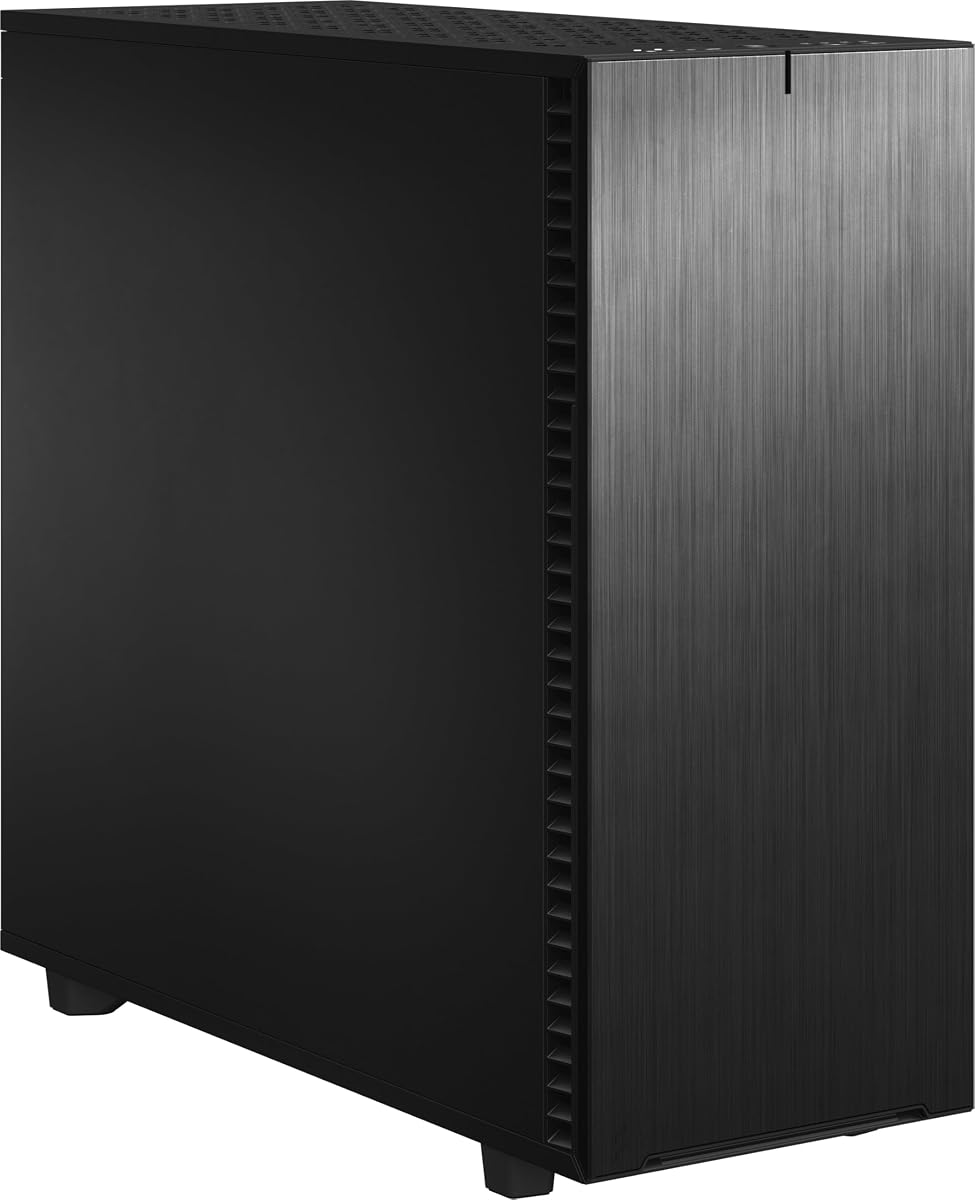
Fractal Design Define 7 XL
4.6Editor score
Supports E-ATX and SSI-EEB
Stores eighteen hard drives
Accommodates 480mm radiators
Our Industrial PC Case guide compares 10 options for rackmount and desktop builds, comparing expansion, cooling, storage, compatibility, airflow, and usability.
An industrial PC case must provide more than a place to mount a motherboard. It needs dependable airflow, serviceable storage, flexible expansion, and compatibility with the hardware used in demanding professional systems. The right enclosure also depends on whether the computer belongs in a server rack, an office, a workshop, or a conventional desktop environment.
This guide compares 10 cases spanning rackmount server chassis and full, mid, and compact towers. The evaluation focuses on motherboard support, drive capacity, expansion slots, cooling provisions, front connectivity, cable-management options, and physical security, using the supplied product specifications and customer ratings to distinguish each model.
The selections show that there is no single universal industrial enclosure. Rack-focused builders need compact dimensions and high-density drive support, while desktop users may prioritize quiet operation, large radiators, cable management, and a more refined appearance. Product specifications and availability can change, so readers should verify current details and prices before ordering.
The following comparison brings together the ten included products, with each row emphasizing the factors that most clearly distinguish its format, capacity, and intended use.
4.6Editor score
4.0Editor score

4.7Editor score
This side-by-side overview covers rackmount and desktop industrial PC cases, highlighting their form factors, motherboard support, storage provisions, cooling options, and defining features.


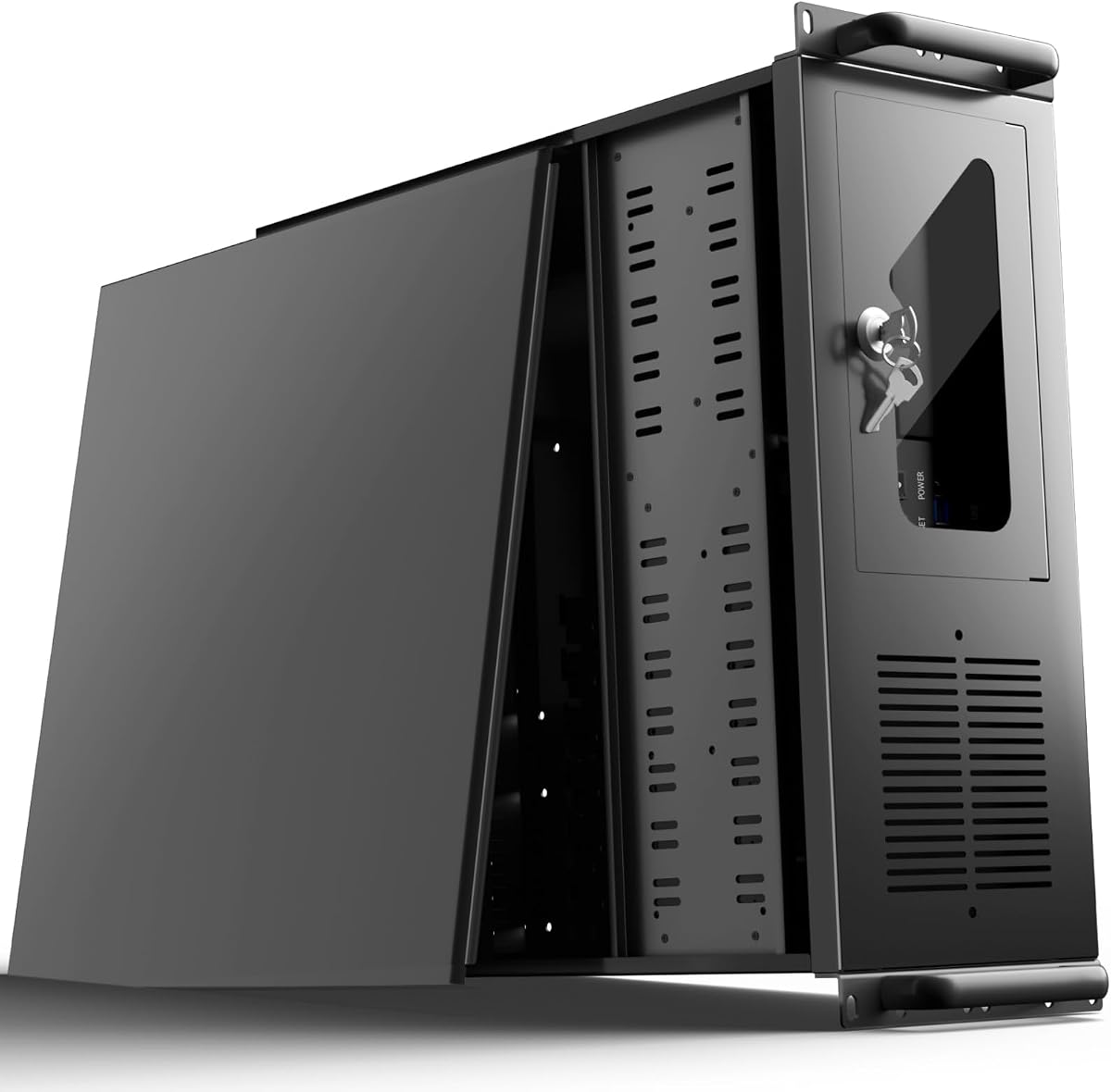
The UTLGAMENG 4U Rackmount Server Case is built around a clear industrial-server requirement: fitting numerous drives and expansion cards into a standardized rack space. It carries a 4.0 customer rating and stands out for 12 dedicated hard-drive bays, seven PCI slots, and compatibility with ATX, Micro-ATX, and Mini-ITX motherboards. Those are meaningful advantages when assembling storage servers, virtualization hosts, or systems that need several add-in cards.
We may earn a commission when you buy through this link, at no additional cost to you.
Storage is the headline feature. Twelve dedicated bays make it possible to organize a substantial collection of hard drives without relying on improvised mounting positions. Seven rear expansion slots allow graphics cards, network adapters, RAID controllers, and other add-in hardware to be installed according to the project’s requirements. Two front USB 3.0 ports provide a practical route for connecting a drive directly during setup or routine maintenance, while front LEDs offer at-a-glance system-status cues.
Physical security and dust management are also thoughtful additions for an industrial enclosure. A robust key-lock mechanism helps protect internal components in shared or less-controlled spaces, and a dedicated side-panel air filter is designed to reduce dust entering the chassis. Component compatibility is broad: the case accepts standard ATX power supplies, CPU coolers up to 125mm, or 153mm with the bracket removed, and graphics cards up to 230mm, extending to 330mm when the drive bays are removed.
This is the strongest choice for a builder whose workload genuinely benefits from high-density storage and multiple PCI devices. It will not suit someone who wants a quiet living-room PC or convenient desk installation, because the 4U format is designed for a rack rather than ordinary furniture. Within that specialized category, however, its storage capacity, expansion options, security features, and broad hardware support make it the most industrial-focused selection in the guide.
Because the enclosure is a server case, prospective buyers should confirm the exact rack depth, rails, accessories, and component clearances against their planned equipment. The supplied specifications indicate strong core compatibility, but a successful build also depends on matching the chassis to the rack and all selected hardware.
Twelve dedicated drive bays make this chassis well suited to storage-heavy systems that need orderly media mounting, serviceable connections, and room to grow. Removing the bays also creates additional clearance for long graphics cards when a particular workload requires it.
Seven PCI slots give server and workstation builders more room for network interfaces, controllers, and graphics hardware. Front USB 3.0 connections, status LEDs, a key lock, and a removable dust filter all support practical operation and routine servicing.
We may earn a commission when you buy through this link, at no additional cost to you.
The Fractal Design Define 7 XL combines an expansive internal layout with a quiet, refined exterior, giving it a 4.6 customer rating and a place as the guide’s premium desktop option. It supports motherboards up to E-ATX and SSI-EEB, making it well suited to professional workstations, elaborate gaming systems, and compact server-like builds that remain outside a rack.
We may earn a commission when you buy through this link, at no additional cost to you.
Its storage configuration is particularly impressive. The default layout can hold 18 hard drives and five SSDs, which is enough for substantial media libraries, local backups, and projects involving multiple high-capacity drives. Switching to the Open Layout removes some restrictions and creates additional room for a custom water loop, including a large reservoir and radiators up to 480mm. The multi-bracket system can also repurpose otherwise unused fan positions for HDD, SSD, or pump mounting.
The enclosure is not merely about raw capacity. Its brushed-aluminum front surrounds a refined door with reversible dual-handed hinges and magnetic latching, allowing the front panel to suit either orientation. That flexibility can matter in professional workspaces where cabinet doors, viewing angles, and desk arrangements vary. The combination of modular mounting, extensive storage, and a restrained exterior makes it especially appealing for a polished workstation rather than a purely utilitarian office tower.
The main trade-off is physical scale. A full tower of this class demands more room than a compact mid-tower and may not suit a confined desk or small equipment cabinet. Buyers may also need to plan the liquid-cooling loop and power-supply arrangement carefully, particularly in a heavily populated storage configuration. Even so, those demands are reasonable for a premium system designed around long-term expandability and tidy presentation.
Choose the Define 7 XL when workstation-class hardware, extensive storage, and a polished appearance matter more than minimizing desk footprint. It is less compelling for a basic office system, yet for a high-end build that may expand over time, the combination of motherboard support, drive capacity, cooling headroom, and modular organization is exceptionally strong.
Support for E-ATX and SSI-EEB boards opens the case to demanding motherboards that many ordinary towers cannot accept. The roomy interior and configurable layout also reduce the likelihood that future upgrades will be constrained by the enclosure.
The brushed-aluminum and steel enclosure, reversible front door, and magnetic latch give the chassis a professional finish. Multi-brackets add functional flexibility by turning unused fan locations into storage or pump mounts.
We may earn a commission when you buy through this link, at no additional cost to you.
The Zalman T6 is a straightforward ATX mid-tower aimed at home workstations, office systems, and practical gaming builds. Its 4.3 rating reflects a balanced approach: the chassis accepts ATX, Micro-ATX, and Mini-ITX motherboards while remaining more compact than the oversized full towers in this guide. A preinstalled 120mm rear fan provides a useful starting point for airflow.
We may earn a commission when you buy through this link, at no additional cost to you.
Cooling is supported by a hairline mesh design on the front and side, allowing air to move through the enclosure rather than relying on a mostly solid panel. The case can hold four fans in total, including a side-panel position, giving builders room to tune intake and exhaust. Its high-strength steel construction and corrosion-resistant black powder coating make it appropriate for regular desktop use, where visual refinement is less important than straightforward utility.
Storage and external-device support remain adequate rather than expansive. There are two dedicated 2.5-inch positions and two 3.5-inch or 2.5-inch positions, plus an external 5.25-inch drive bay. The front I/O includes one USB 3.0 port, two USB 2.0 ports, and separate audio input and output connections. This arrangement covers common accessories without turning the small chassis into a crowded connector hub.
There is one important compatibility caveat: the T6 will not fit an ATX motherboard whose SATA ports face sideways. That limitation is uncommon but can be decisive for a specific component, so buyers should inspect their chosen board before buying the case. The drive count and compact proportions also make this less suitable for a large storage server, but for a conventional single-system build, the trade-offs are sensible.
The Zalman T6 is a good fit for a budget-conscious builder who wants a small but properly sized ATX case with basic cooling and no complicated modular system. Check the motherboard’s SATA orientation and available cable space first. If both align with the planned build, it provides a durable, uncomplicated enclosure without requiring a full-tower footprint.
Mesh front and side panels encourage airflow through the compact chassis, while one rear 120mm fan is included. Three additional fan positions give users room to improve cooling as their components become more demanding.
The major limitation is the exclusion of ATX motherboards with side-facing SATA ports. Confirming connector placement before purchase avoids the most likely compatibility problem in an otherwise versatile build.
We may earn a commission when you buy through this link, at no additional cost to you.
The Cooler Master HAF II 500 leads the included products with a 4.8 customer rating, supported by an unusually ambitious cooling package. It comes with two 220 by 40mm front intake fans and one 180 by 40mm rear exhaust fan. These large-diameter fans move substantial air while creating the low airflow resistance that matters in a high-heat desktop or workstation environment.
We may earn a commission when you buy through this link, at no additional cost to you.
Large ventilation openings complement the oversized fans, making the case particularly compelling for power-hungry processors and graphics hardware. The MasterRail mounting system accepts multiple fan and radiator sizes at the front and top, so the included cooling is a starting point rather than a fixed configuration. Split-level cable management preserves space behind the motherboard tray and allows room for the rear fan without forcing cables into the airflow path.
The dual-mode GPU holder is another distinguishing feature. In single-GPU mode it clamps and stabilizes one graphics card, while in dual-GPU mode it can support two cards up to 3.6 slots, or 72mm, thick each. A flexible storage cage accepts 3.5-inch and 2.5-inch drives in orientations based on available PSU length. This adaptability is valuable when a workstation must accommodate multiple accelerators and unevenly sized storage devices.
The trade-offs are size and component clearance. A case configured around 220mm front and 180mm rear fans is necessarily large, and every major component must be checked against the relevant dimensions. A powerful graphics card also needs adequate room from the front fans and GPU holder. For users willing to plan the layout, those physical demands are part of the reason the cooling performance can be so strong.
This is a compelling choice for a high-airflow gaming rig, rendering workstation, or compute-oriented desktop that uses substantial processing and graphics hardware. It is less attractive for a small office system where simplicity, compactness, and low acoustic priority outweigh maximum airflow. For a large, performance-focused build, the HAF II 500 offers one of the most complete cooling packages in the comparison.
The two 220mm front intake fans and 180mm rear exhaust fan are designed to move more air than a collection of conventional 120mm units. Their size also reduces reliance on very high fan speeds when large volumes of cooling are required.
The dual-mode GPU holder supports either one stable graphics card or two cards up to 3.6 slots thick. This makes the enclosure relevant to specialized workstations as well as ambitious multi-GPU desktop systems.
We may earn a commission when you buy through this link, at no additional cost to you.
The Antec VSK4000E-U3_US is a conventional ATX mid-tower with a 4.1 customer rating and a focus on useful capacity rather than elaborate features. Its SGCC steel shell provides a durable structure for office, home, and general-purpose desktop systems. The recognizable mid-tower format should also be more approachable for builders than a rack chassis or one of the very large full towers.
We may earn a commission when you buy through this link, at no additional cost to you.
Its most notable feature is the generous number of traditional drive bays. There are three external 5.25-inch bays and five internal 3.5-inch bays. While modern computing often favors compact SSDs, this capacity is useful for a system that needs multiple hard drives, removable media, or a mix of legacy and current storage devices. It also makes the case easier to repurpose for a storage-oriented workstation than a minimalist enclosure with very few drive positions.
Front connectivity includes two USB 2.0 ports, one USB 3.0 port, and audio input and output. The arrangement is uncomplicated, and the steel construction should be more than adequate for standard desktop hardware. There are no stated advanced features such as extensive radiator support, bundled fans, or a modular mounting system, so buyers should treat the enclosure as a platform whose cooling and layout depend on the components they install.
The main limitation is that the product data provides less information about modern airflow and cooling than some competing listings. A user planning a high-power processor or large graphics card should verify the available fan mounts, radiator clearance, and overall component dimensions against the manufacturer’s specifications. The case may not be the natural choice for a compact, quiet, or visually elaborate build.
The Antec VSK4000E-U3_US is most attractive to someone who values a familiar steel chassis, several conventional drive bays, and straightforward ATX building. It works especially well as a practical office, media, or home workstation enclosure where expansion storage is more important than premium styling or a large included cooling package.
Five internal 3.5-inch bays and three external 5.25-inch positions provide more conventional drive flexibility than most modern compact cases. That makes the chassis useful for legacy media, bulk storage, and systems that retain optical or removable-device requirements.
The SGCC steel shell prioritizes durability and familiar desktop construction. It is a sensible foundation for a work-oriented system where long-term serviceability matters more than decorative features.
We may earn a commission when you buy through this link, at no additional cost to you.
The Fractal Design North XL combines workstation-scale capacity with a distinctive exterior built around wood and alloy details. Its 4.7 customer rating reflects a successful mix of function and appearance. It supports E-ATX, ATX, Micro-ATX, and Mini-ITX motherboards, giving it broad flexibility for advanced desktop systems while also serving as a visually appealing gaming enclosure.
We may earn a commission when you buy through this link, at no additional cost to you.
Cooling starts in a strong position because three 140mm Aspect PWM fans are included. The case also accepts a front radiator up to 420mm and a top radiator up to 360mm. This is useful for modern processors and powerful graphics cards, especially in a full tower with room to route cables and position fans intelligently. The combination of preinstalled fans and large-radiator options lets builders start with solid airflow and add liquid cooling when the workload justifies it.
Graphics-card clearance is another major strength. Cards up to 413mm can be installed, while the stated limit becomes 380mm with a 420mm front radiator. The relatively long allowance supports many modern cards, although builders using both very long graphics hardware and the largest front radiator must follow the more restrictive figure. Broad motherboard support also makes the North XL useful for professional platforms that would be too large for ordinary mid-towers.
Its obvious trade-off is the combination of full-tower size and decorative styling. The enclosure is substantial, and the wood accents may not suit an office, server room, or minimalist environment. Some buyers may also prefer a case focused entirely on functional modularity. Those considerations are matters of preference rather than shortcomings for users who want a full-size system with a more distinctive look.
The North XL is a strong match for a premium gaming station, creative workstation, or showpiece system where both component clearance and visual design are important. It is less compelling for a rack deployment or a space-constrained desk, but for a large desktop environment it combines strong specifications, included cooling, and a mature, attractive industrial design.
Three 140mm Aspect PWM fans provide immediate airflow, while support for 420mm front and 360mm top radiators allows a future liquid-cooling upgrade. The case is designed to handle powerful desktop components without relying on a compact layout.
Wood and alloy details give the enclosure a recognizable character, while motherboard support and long graphics-card clearance suit professional and enthusiast systems. A 380mm graphics limit applies when the largest front radiator is installed.
We may earn a commission when you buy through this link, at no additional cost to you.
The SilverStone FLP02W stands apart with a retro-inspired tower design and a performance-oriented feature set. Its 4.7 customer rating reflects a chassis that combines an unusual appearance with current conveniences. A distinctive Turbo button provides an immediate route to full-speed cooling, which can be useful when a workstation is handling a sudden intensive workload and the user wants maximum fan response.
We may earn a commission when you buy through this link, at no additional cost to you.
Expansion is broad for a desktop tower. Three front 5.25-inch bays support conventional devices, and they are compatible with a hot-swap adapter cage, although that cage is a separate accessory. Graphics cards up to 386mm in length can be accommodated, giving users plenty of room for many modern cards. The case also supports a 360mm liquid-cooling radiator, allowing a substantial thermal solution when the internal layout permits.
The top I/O panel is notably modern despite the heritage-inspired exterior. It includes one USB Type-C port, two USB 3.0 ports, and one combination audio jack. This is a useful selection for contemporary accessories, external storage, headsets, and mobile devices. It gives the case more day-to-day flexibility than a purely decorative design might otherwise provide.
Potential drawbacks are mostly related to preference and accessory planning. The retro styling will not be equally welcome in every office or industrial environment, and users interested in hot-swap operation must obtain a compatible cage. As with any large chassis, component dimensions and clearances should be checked together, especially when combining a 360mm radiator with a long graphics card or expansive drive setup.
Choose the FLP02W for a creator, enthusiast, or specialist workstation where distinctive presentation, a direct cooling control, and generous expansion are priorities. It offers an unusual balance of nostalgic appearance and modern connectivity, making it a memorable option without sacrificing the core capabilities expected from a contemporary tower.
The dedicated Turbo button changes the cooling mode instantly, giving users a direct way to increase fan activity during demanding tasks. It is a distinctive operational feature that complements the case’s performance emphasis.
USB Type-C, two USB 3.0 connections, and a combo audio jack provide a practical top panel. The interface mix suits current accessories while the chassis retains three front 5.25-inch expansion bays.
We may earn a commission when you buy through this link, at no additional cost to you.
The Rosewill RSV-L4620 is a 4U rackmount server chassis designed for modern compute-intensive systems, and it holds a 4.3 customer rating. Its support for E-ATX and SSI-EEB motherboards gives it access to larger, more capable platforms than standard ATX rack cases. That makes it relevant to rendering systems, AI training platforms, virtualization servers, and other multi-GPU-oriented installations.
We may earn a commission when you buy through this link, at no additional cost to you.
Cooling is one of its strongest features. A 360mm AIO radiator can be installed directly, and three 120mm PWM fans are preinstalled to work alongside it. This combination supports a high-heat processor and dense accelerator configurations more effectively than a basic server case with only basic airflow. The preinstalled fans also reduce the number of separate cooling purchases required for a straightforward installation.
Front connectivity is designed for demanding workflows. The USB 3.2 Gen Type-C port supports transfer rates up to 10Gbps, which is useful when moving large project files between the server and portable storage. Storage is handled through a flexible arrangement of up to two 3.5-inch hard drives and four 2.5-inch SSDs. That mix is well suited to a system using SSDs for operating systems and active data, with hard drives supplying bulk capacity.
The main limitation relative to the first rack-focused pick is its lower number of dedicated hard-drive positions. Users whose priority is maximum disk density may find the 12-bay alternative more suitable. The Rosewill is optimized instead for a balanced compute platform with modern boards, high-speed external storage, and active cooling. As a rack product, it also requires appropriate rack rails, depth, and mounting provisions.
The RSV-L4620 is a compelling choice for a builder creating a dedicated compute or virtualization server in a 4U rack. It balances motherboard flexibility, modern data transfer, mixed storage, and ready-made liquid-cooling support. Confirm the server’s overall depth, GPU arrangement, and rack environment before purchasing to ensure every component aligns with the enclosure.
E-ATX and SSI-EEB compatibility allows the chassis to accept larger server and workstation boards. This creates a stronger foundation for rendering, virtualization, AI development, and multi-GPU configurations than a compact ATX enclosure.
The front USB 3.2 Gen Type-C connection offers transfer rates up to 10Gbps. It is a practical way to move large datasets quickly between portable storage and a rack-based system.
We may earn a commission when you buy through this link, at no additional cost to you.
The CORSAIR 4000D RS ARGB combines a 4.7 customer rating with a strong set of features for a mid-tower gaming system. It includes three CORSAIR RS ARGB PWM fans in the front, each using daisy-chainable four-pin PWM connections and eight LEDs controllable through a motherboard’s 5V ARGB header. Zero RPM support allows the fans to stop at low loads, which helps preserve a quiet experience when appropriate.
We may earn a commission when you buy through this link, at no additional cost to you.
Its defining system is the FRAME modular architecture. Builders can replace the motherboard tray with a billet-aluminum alternative or change the front I/O panel to suit different connectivity needs. Combined with the InfiniRail steel mounting system, this creates a case that can adapt as requirements change. Rails in the front and roof can slide to accommodate fans up to 200mm in front and 140mm in the roof, allowing airflow to be aimed toward particular components.
Cooling is supported from more than one direction. The steel front panel uses a perforated three-dimensional Y-pattern that reduces obstruction while filtering incoming air. On the internal side, the panel next to the motherboard tray can remain as a cable cover or be removed to mount additional fans and increase cooling potential. That dual-purpose design is particularly useful when a system begins with modest hardware and later gains a more powerful processor or graphics card.
Cable management is handled through wide channels, hooks, and straps, helping keep wiring away from fans and airflow paths. The main compromise is that the ARGB presentation and modular options may be more elaborate than necessary for a purely functional industrial workstation. Users should also ensure their motherboard and lighting controller support the appropriate 5V ARGB connection.
The 4000D RS ARGB is an excellent value-oriented choice for a gaming or mixed-use desktop that needs good airflow, tidy wiring, and a polished illuminated appearance. It offers more flexibility than a basic mid-tower without moving into the footprint of a full-tower workstation case. It is the strongest balance of features and accessibility among the desktop models in this guide.
The FRAME system allows the motherboard tray and front I/O arrangement to be changed as needs evolve. That modular approach makes the case easier to tailor for both functional and visual priorities.
InfiniRail mounting points slide to support different fan sizes and positions at the front and roof. The removable side cable cover can also become an extra fan location for components that require concentrated cooling.
We may earn a commission when you buy through this link, at no additional cost to you.
The NZXT H5 Flow is a compact ATX mid-tower with a 4.6 customer rating, offering a clean layout, straightforward operation, and useful cooling options. Two 120mm Quiet Airflow fans are preinstalled, one at the front for intake and one at the rear for exhaust. This provides a functional baseline without requiring every fan to be purchased separately at the start of a build.
We may earn a commission when you buy through this link, at no additional cost to you.
Its airflow design extends beyond the included fans. Ultra-fine mesh across the top, front, and side panels promotes movement of air while filtering dust. The power-supply shroud is perforated on both its side and bottom, allowing two 120mm fans to draw air from either direction. This is particularly helpful in a compact chassis where components are packed closely and the shroud would otherwise become an isolated region of trapped air.
Liquid-cooling support is unusually generous for the format. A radiator up to 360mm can be mounted at the front, and one up to 240mm can be installed at the top. These options make the H5 Flow suitable for a compact system that still wants strong CPU cooling, even though its overall dimensions remain smaller than the full towers in the guide.
Cable management is handled with wide channels, hooks, and straps intended to conceal wiring neatly. The trade-offs include a more limited storage layout than several other models and the need for additional fans if the user wants to populate the perforated shroud positions. Buyers building around multiple hard drives should confirm the exact internal mounting options before committing.
The H5 Flow is a good choice for a compact gaming system, quiet workstation, or space-conscious office build that still supports ATX motherboards. It combines a tidy appearance, effective airflow, two included fans, and meaningful liquid-cooling capability. For users who prioritize a small footprint and clean installation over extensive drive expansion, it delivers a particularly balanced package.
Two included 120mm fans establish front-to-back airflow, while perforated shroud surfaces add another route for air. Support for 360mm front and 240mm top radiators makes strong liquid cooling possible despite the compact dimensions.
Wide routing channels, hooks, and straps help keep power and data cables organized. This supports easier servicing and prevents wiring from obstructing the case’s usable airflow paths.
We may earn a commission when you buy through this link, at no additional cost to you.
The right industrial PC case depends on the deployment environment, hardware density, cooling demands, and service requirements. Compare rack and desktop formats, expansion capacity, motherboard clearance, storage options, and accessibility before making a final choice.
A rackmount case is the correct starting point when the system must integrate with server-room or data-center infrastructure. The two 4U options are designed for standard rack deployment and emphasize drive density, serviceability, and professional connectivity. Desktop towers offer more freedom in placement and often better aesthetics, but they still need to fit the available cabinet, bench, or workstation area. Check the chassis dimensions and required rack depth before planning the rest of the build.
Choose rackmount for centralized infrastructure and desktop for a local workstation, production system, or gaming-class computer.
Motherboard support should be checked before any other specification. Available choices range from Mini-ITX and Micro-ATX support to E-ATX and the very large SSI-EEB standard. Also verify CPU-cooler height, graphics-card length, power-supply dimensions, and expansion-card clearance. The Zalman T6 has a specific warning about ATX boards with side-facing SATA ports, illustrating why exact board compatibility matters even within a standard case size.
Select the case only after matching every critical component to its stated dimensions and connector orientation.
Storage needs vary more dramatically than most buyers initially expect. The UTLGAMENG 4U case offers 12 dedicated drive bays, the Define 7 XL accommodates 18 hard drives and five SSDs in its default layout, and the Rosewill balances two 3.5-inch drives with four 2.5-inch SSDs. Desktop mid-towers may provide fewer positions, so users should count current and planned drives rather than relying on a generic storage claim.
Prioritize the number, type, and accessibility of drive bays that your workload actually requires.
Cooling requirements depend on processor power, graphics-card output, rack density, ambient temperature, and noise sensitivity. Included fans are a useful starting point: the HAF II 500 supplies three oversized fans, the Rosewill provides three 120mm PWM fans, and the H5 Flow includes two 120mm fans. Large radiator support adds long-term flexibility, especially for sustained compute workloads. A perforated front panel and low-resistance vents are also important if the system will run continuously.
Match fan and radiator provisions to expected heat output, while leaving enough clearance for unobstructed airflow.
Industrial systems often need more than a single graphics card. Check rear expansion-slot count, GPU thickness, riser-cable requirements, and the stability of any card holder. The UTLGAMENG provides seven PCI slots, while the HAF II 500 includes a dual-mode holder that can support two GPUs up to 3.6 slots thick each. Multi-GPU workstation planning also requires confirming the motherboard, power delivery, operating system, and workload support.
Treat expansion slots and GPU support as a complete platform requirement, not merely a case feature.
The front and top I/O panel determines how quickly a technician can connect storage, networking equipment, or diagnostic devices. Current industrial cases may include USB Type-C, as seen on the Rosewill and SilverStone models, while older-style drive-bay designs emphasize USB-A and audio connectivity. Consider the adapters and cables used in the deployment environment, especially when rack access is limited or a server is operated remotely.
Choose connectors that match the actual service workflow and avoid requiring repeated access to rear ports.
A case used in a shared rack, workshop, or unattended office should provide practical protection against accidental access and airborne dust. The UTLGAMENG includes a key-lock mechanism and a dedicated side-panel air filter. These features do not replace careful installation, but they can support a cleaner and more controlled internal environment. Removable filters, accessible drive trays, and modular internal panels also make routine inspection and cleaning easier.
For unattended or dusty installations, prioritize lockable access and filters that can be serviced without a full rebuild.
Case size affects more than floor space. It influences rack depth, desk footprint, room for cable routing, ease of component installation, and the size of compatible cooling hardware. Full towers such as the Define 7 XL, North XL, and HAF II 500 offer expansive interiors, while the Zalman T6 and NZXT H5 Flow prioritize compact desktop use. The most capable chassis is not necessarily the most convenient one for the intended operator.
Choose the smallest format that comfortably holds the required hardware, cooling, storage, and service access.
Begin by inventorying every component before installation, including the motherboard form factor, power supply, CPU cooler, graphics card, storage devices, expansion cards, and radiator. Compare each item with the case’s stated clearances and connector requirements. Install the power supply and storage first, route cables through the designated channels, and confirm that fans can pull air through unobstructed openings.
During operation, keep intake and exhaust areas clear, and inspect dust filters at regular intervals. A workstation exposed to construction dust, workshop debris, or a less-controlled rack environment may need more frequent checks than a clean office system. Remove power before opening the enclosure, and use the documented lock, latch, or panel-removal method rather than forcing components.
For a rack system, verify that the chassis is fully seated, all required screws and rails are installed, and cables do not block neighboring equipment. For a desktop build, check that the front intake and rear exhaust remain unobstructed. Schedule periodic inspections of fans, connections, storage activity, and temperatures, and clean filters using methods compatible with the case materials.
An industrial PC case is generally designed around a specific professional environment rather than appearance alone. Rack-oriented models emphasize rack integration, high-density storage, serviceability, and physical protection, while industrial desktop towers may focus on durability, cooling, legacy expansion, and straightforward access. The best choice depends more on the hardware and operating environment than on the industrial label itself.
Choose a 4U rackmount when the system must be installed in an equipment rack or managed rack enclosure. A full tower is usually more appropriate for a desk, studio, workshop, or standalone workstation area. Rack cases offer dense integration, but they require sufficient rack depth, rails, and a controlled environment, while towers usually provide easier physical access.
Capacity varies dramatically among the cases reviewed, ranging from a small number of mixed drive positions to 12 dedicated hard-drive bays and a full-tower layout capable of holding 18 hard drives plus five SSDs. Count the drives required now and any likely expansion, then check whether they must be hot-swappable, isolated from vibration, or accessible without removing the entire side panel.
Not necessarily. The correct cooling method depends on processor output, graphics or accelerator load, ambient temperature, noise limits, and whether the enclosure is densely populated. Several cases include capable air fans, while others directly support large radiators for systems that will sustain heavy workloads. A large-radiator option is useful for future flexibility, but it should never be chosen without checking clearance.
Only if the case explicitly supports that motherboard standard. E-ATX and SSI-EEB boards need an enclosure with sufficient area and mounting support, while ATX, Micro-ATX, and Mini-ITX boards offer progressively smaller options. Even when the board fits, graphics length, CPU-cooler height, storage position, power supply, and expansion cards must also be checked.
Rack depth, mounting rails, drive-bay density, cooling, front data connectors, and physical security are the most important considerations. A 4U chassis must also integrate with the surrounding rack and neighboring equipment without blocking airflow or service access. Confirm server-grade features such as hot-swap cages only when the required adapter or cage is included or planned.
A key lock can be valuable where equipment is shared, unattended, or located in a less-controlled area. It helps deter casual access to internal components, but it is not a substitute for rack security, operating-system controls, or physical control of the room. It is more useful in a secured deployment than in a private desktop setting.
Compare the usable interior rather than exterior dimensions alone. Check radiator length, graphics-card clearance, drive positions, power-supply space, cable routes, fan mounts, and the width of any support hardware. A compact mid-tower is easier to place and can be sufficient for a single workstation, while a full tower offers more room for multiple accelerators, extensive storage, and elaborate cooling.
The UTLGAMENG 4U Rackmount is the strongest choice for storage-heavy server work because of its 12 dedicated bays, seven PCI slots, security features, and broad motherboard compatibility. The Fractal Design Define 7 XL is the premium desktop alternative, offering exceptional storage capacity and custom-loop flexibility, while the CORSAIR 4000D RS ARGB delivers the best balanced value for a modern gaming or mixed-use build.
Before choosing, prioritize the deployment format first, then verify motherboard size, graphics length, CPU-cooler height, storage requirements, expansion needs, cooling provisions, and front connectivity. A rack enclosure serves centralized infrastructure, whereas a full tower supports expansive workstation builds and a compact mid-tower suits space-conscious desktop users. Exact component clearances remain more important than a general case rating.
Specifications, accessory bundles, availability, and prices can change, so confirm the current manufacturer or seller information before purchasing. This guide provides a practical shortlist based on the supplied features and ratings, but checking the latest details helps ensure that the selected industrial PC case integrates cleanly with the rest of the system.
